Time: the Soul of Music

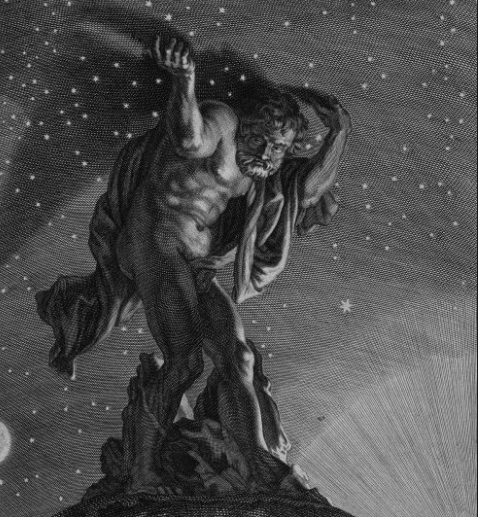
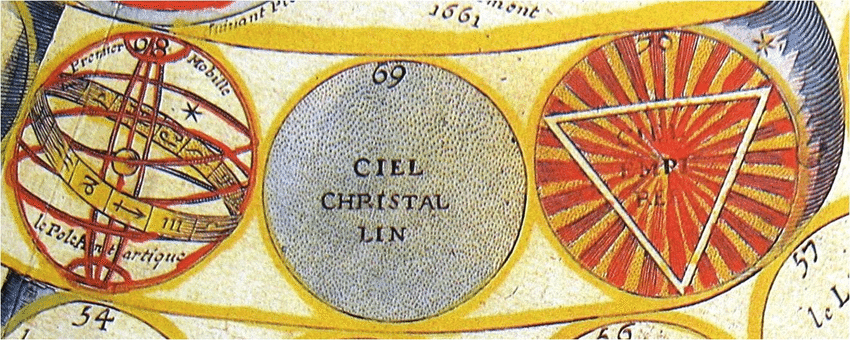
The Primum Mobile (aka Ciel Christallin) in the 1661 Game of the Spheres.


Time is what gives being to Music

Il tempo dunque è quello che da esser alla Musica. Zacconi Prattica di Musica (1596) Chapter 30.

Rhythm is life.

Paderewski Tempo Rubato (1909)

Many musicians and listeners might agree that rhythm is the life and soul of Music, whilst holding quite different opinions as to what kind of musical time is so essential.

  1. “Just give that rhythm everything you’ve got”
  2. “It’s got a back beat, you can’t lose it”
  3. “Emotion excludes regularity. Tempo Rubato then becomes an indispensible assistant”
  4. “Above all things, keep the Equality of Measure”
  5. “Time, like an ever-rolling stream…”
  6. “Time is a number of motion, in respect of before and after”
  7. “Time is the space demonstrated by the revolution of the Primum Mobile”
  8. “Absolute, true and mathematical time, of itself, and from its own nature flows equably without regard to anything external”


… li cieli, li quali continuamente si girano … sono nove, come di sopra è stato ditto; cioè VII cerchi di sette pianeti e l’ottavo de le stelle fisse dov’è lo zodiaco, e lo nono che è lo primo mobile. E queste revoluzioni sono quelle che dimostrano lo tempo: imperò che tempo non è altro che lo spazio, nel quale queste revoluzioni si fanno; e questo spazio produce Iddio dal suo essere eterno. Buti Commentary on Purgatorio 24: The heavens, which revolve continuously… are nine, as has been said above; that is 7 circles of seven planets and the 8th of the fixed stars, where the Zodiac is, and the 9th is the Primum Mobile. And these revolutions are what show time; therefore time is nothing other than the space/interval within which these revolutions are made; and this space is produced by God from his eternal being. 

Texts from classical Antiquity and the Middle Ages – Dante, Aristotle and Buti – still provide the primary definitions of Tempo in successive editions of the Vocabulario of the Accademia della Crusca from 1612 to 1748.
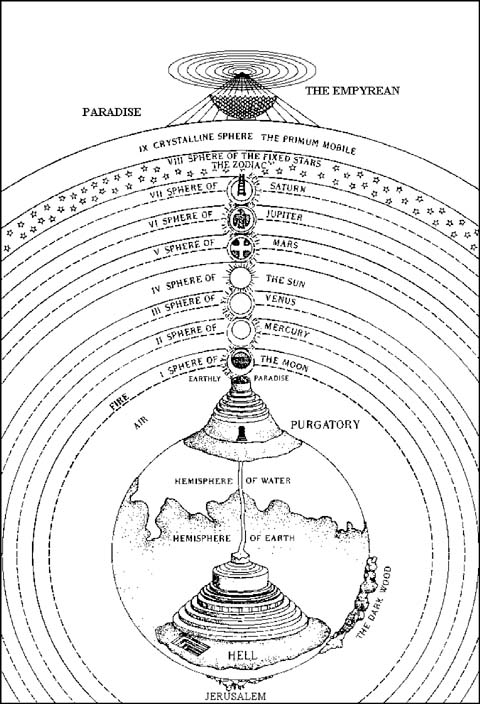
 

Dante’s Cosmography


  1. Irving Berlin It don’t mean a thing, if it ain’t got that swing (1931)
  2. Chuck Berry It’s gotta be Rock ‘n’ Roll music (1957)
  3. Ignacy Jan Paderewski Tempo Rubato (1909)
  4. John Dowland Micrologus (1609) 
  5. Isaac Watts Oh God, our help in ages past (1708)
  6. Aristotle Physics (4th cent. BC)
  7. Francesco di Bartoli da Buti Commento sopra la Divina Commedia di Dante (end of 14th cent.)
  8. Isaac Newton Principia (1687)


Newton’s (1684) MS notebook for De motu corporum in mediis regulariter cedentibus defines Tempus Absolutum three years before the fuller definition in Principia. But the text made famous by the first English translation of Principia by Andrew Motte only appeared much later, in 1729. 

So when we read from many Baroque writers [heartfelt thanks to Domen Marincic and others who sent me numerous citations of this concept] that 

Time is the Soul of Music

 – from Zacconi writing in 1592 (published in 1596 as Prattica Book 2, Chapter XV, folio 95v):  il Tempo….essendo egli nella Musica quasi l’anima [Time… being in Music like the soul] and (Book 2, Chapter III) Il tatto non è altro che il Tempo in esser presente [Tactus is none other than Time in actual presence] to the Biblioteca Universale sacro-profana antico-moderna (1704): la Battuta è la misura, e quasi l’anima della Musica [the Beat is measure, and like the soul of Music] –

we must be on our guard that all three terms lead us into complex semantic fields (Time: tempo, misura, battuta, tatto; Soulanima, animo, mente, cuore; Musicmondanahumana, instrumentalis, arithmetica) where technical definitions and everyday understandings have shifted over the centuries. Aristotle’s motion-driven Time (which was still the common understanding in mid-18th-century Italy) is not the same as Newton’s Absolute, Mathematical Time, any more than our own intuitive sense of everyday Time corresponds to Einstein’s Relativity or Hawking’s Imaginary Time.


Tactus is the Soul of Music


Nevertheless, two writers from different countries and periods give strikingly similar descriptions of Tactus, showing a strong continuity from the 16th to the 18th centuries, and a noticeable differences from modern practice. 

Venice 1592

Sotto il tatto si pone questa figura & quella, & per questo si dice che l’harmonia nasce dalla consideratione di diverse figure sotto una determinata quantita di Tempo constituite (Zacconi Prattica Book 1 Chapter 29 Del Tempo Musicale & delle sue divisioni): Under the Tactus you put this note and that, and by this we say that harmony is born from the consideration of various notes organised within a certain amount of Time.

Halle 1789

Der Takt… ist eine Anzahl von Noten in einen gewissen Zeitraum eingetheilt (Türk Klavierschule Chapter IV Vom Takte):  The Tactus … is a number of notes organised into a certain amount of Time.

Semantic Fields

For both writers, the term they are trying to define has a wide and rich semantic field. Time ~ mensuration Sign; Tactus; Measure of duration; Rhythm, i.e. the division of time into note-values, written and performed; a specific note-value; the act of beating time and the Beat itself; speed; Metre.

Venice 1592

Tempo: il quale si forma con un segno che ne da inditio… dal tatto che è la misura (Chapter 28) Time [mensuration sign of Tempus]: which is formed by a Sign that indicates the Tactus and the Measure.

Il tatto e quando dal Tempo in atto le vengan misurate, & che si cantano… il Tatto occupase tutto un Tempo… il Tempo essendo atto a diverdersi (Chapter 30 Del origine del Tempo) The Tactus is when [the note-values] are measured in real Time and are sung. The Tactus occupies a complete [unit of] time… Time [Rhythm] is action of dividing [the note-values] 

Se per vigor di segno vanno due Semibreve al tatto, over due Minime (Chapter 33 Del division del tatto & sua sumministratione) [A specific note-value] Whether according to the Sign two semibreves go to the Tactus, or two minims. [ALK: In the late 16th century, identification of equal Tactus with the breve, i.e. down for one semibreve, up for the second semibreve, was being replaced by identification with the semibreve, i.e. down for one minim, up for the second minim, with triple metre proportions replacing tempus perfectum. The difficulty of reconciling older theory and notation with new practices accounts for much of the confusion about proportional notation in the early baroque period.] 

Onde si come il tatto si divide, nel equale & nel inequale; cosi essi segni contenuti sotto questo nome di Tempo si dividano nel perfetto, & nel imperfetto. (Chapter 29)  So just as the Tactus is divided into equal (duple metre) and unequal (triple metre); so these Signs included under this term Tempus are divided into perfect (triple) and imperfect (duple).

Piu tatti possano essere quali piu presti, & quali piu tardi, secondo il loco, il tempo, & l’occasione (Chapter 33) [Speed] Different [ways of beating] Tactus can be faster or slower, according to the place, the time and the occasion.

Le misure alla fine non son altro che quantità di tempo (Chapter 30) Measures finally are nothing else than amounts of Time [duration]

Quelli intervalli Musicali che sotto il Tempo si misurano… in dua modi… Il modo occulto Modo occulto è quello con cui componendole il compositore le misura & fa che gl’intervalli di tutte la parti correspondino in uno… Il modo manifesto puoi è quello quando le si cantano. (Chapter 29) Those musical durations which are measured by Time in two ways: the hidden [notated] way is whilst composing them, the composer measures them and makes the durations of all the parts correspond in unity; the revealed [performed] way then is when they are sung.

L’attione o l’atto che si fa… alle volte si chiama tempo, alle volte misura, alle volte battuta et alle volte tatto (Chapter 32 Che cosa sia misura, tatto, & battuta) The action [beating Time] which is actually done… is sometimes called Time, sometimes Measure, sometimes Beat and sometimes Tactus.

Halle 1789

Takt… die Noten, welchen in einem einzigen, zu Anfange des Tonstückes bestimmten Zeitraume enthalten, und zwischen zwey Stricken eingeschlossen sind. [Mensuration Sign & notation of rhythm]: the notes contained in a single amount of time [duration], specified at the beginning of the piece [sign], and enclosed by two lines [bar-lines].

Unter Takt, in sofern von der Ausübung die Rede ist, versteht man daher gemeiniglich, die richtige Eintheilung einer gewissen Anzahl Noten &c, welche in einer bestimmten Zeit gespielt werden sollen. Tactus, when we talk about performance, is commonly understood to be the correct organisation of a specific number of Notes etc, which should be played in a certain time [duration].

Takt… die ganze Taktnote [A specific note-value] … the whole-note [semibreve]

Takt … Taktart, z.B. dieses Tonstück steht in geraden Takte. [Metre]: Type of Tactus, e.g. this piece is in equal [duple] time. 

Takt … Bewegung, z.B. dieser Satz hat sehr geschwinden Takt  [Speed]: Movement, e.g. this composition has a very fast Tactus

Takt… von der äusern Abtheilung durch die Bewegung mit der Hand, z.B. den Takt schlagen.  About the showing of division [i.e. beats within a bar] by moving the hand, e.g. beating time.  

Der Takt ist das Maß der Bewegung eines musikalischen Satzes Tactus is the Measure of the movement of a musical composition.

Takt… ist das Zeitmaß der Musik, die Abmessung der Zeit und der Noten Tactus is the Measure of Time [duration] in music, the measuring of Time and of the notes. 


Differences between 1592, 1789 & 2020


Barlines

As we still do today, Türk associates Takt with notated bar-lines, which are not part of Zaconni’s practice. In the ‘new music’ of early seicento Italy, barlines are either absent, or irregular, and there is no association of bars with a fixed duration in notation or in real-time, and certainly no principle of ‘bar = bar’ for navigating proportional changes.

Accent

As we still do today, Türk associates Takt – in the sense of Metre – with accent. And so his first definition would have shocked Zacconi:  Wenn man, bey einer Folge mehrerer äuserlich gleich langen Töne, einigen derselben, in einer gewissen anhaltenden Ordnung, (Einförmigkeit), mehr Nachdruck giebt, als den andern: so entsteht schon durch diese Accente das Gefühl, welches wir Takt nennen. When, in a succession of many apparently equally-long notes, you give some of them more emphasis in a certain consistent pattern (uniformity): then these Accents produce the feeling that we call Metre.
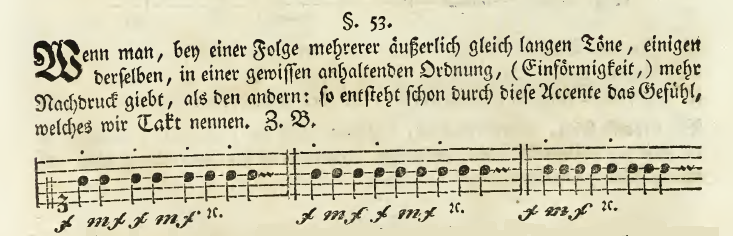


In sharp contrast, Zacconi discusses Tactus, Time, Measure, Beating Time, Beats and even Metre without any reference at all to accents. In old-fashioned polyphony and in the new music of the 1600s, although the accented syllable of a word often falls on the Tactus-beat, quite frequently it does not. Even if there are bar-lines, they too do not imply accentuation. Tactus is a feature of the measurement of Time, whereas accents are determined by words. Metre – as notated and shown by Tactus-beating – does not necessarily match the poetic scansion of the words, or the dance-rhythms suggested by harmonic changes.


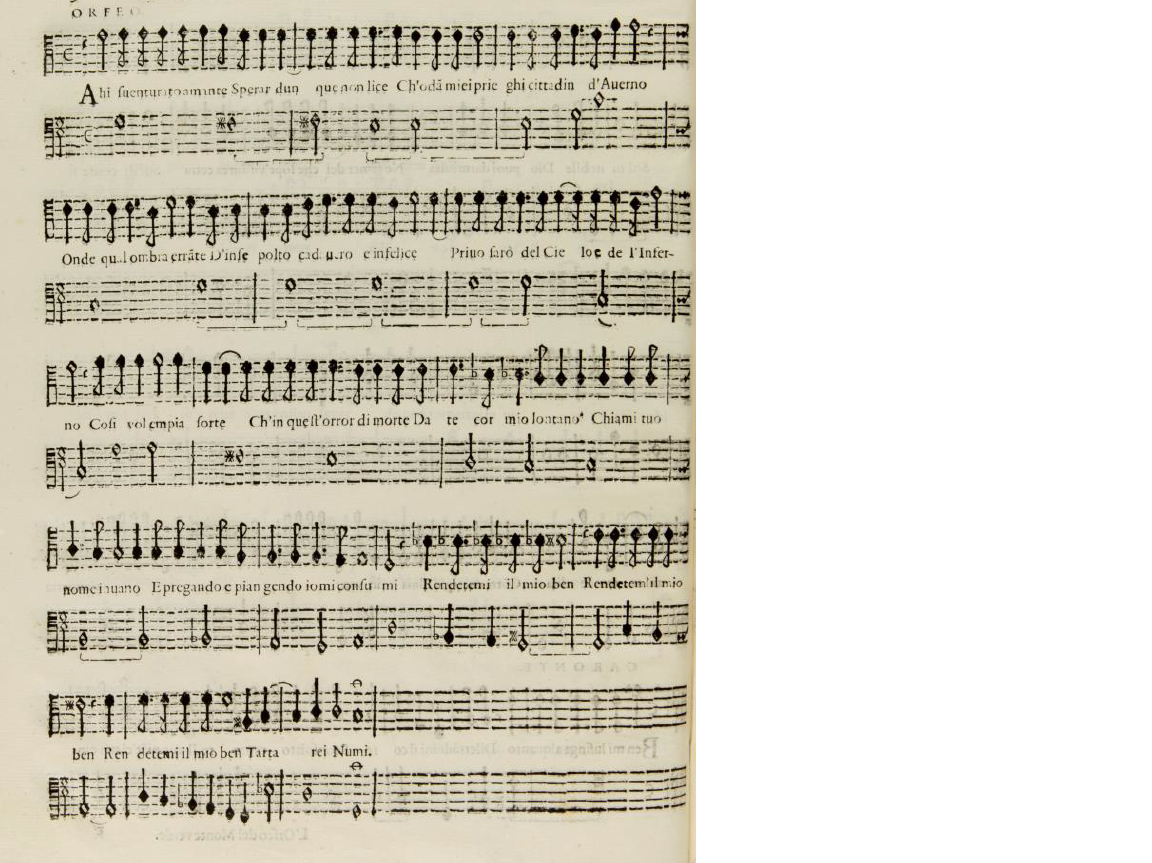
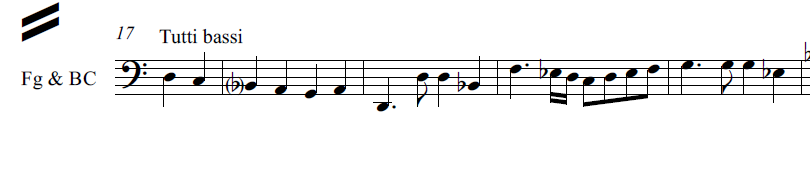
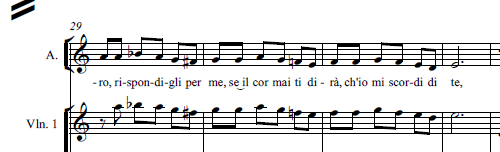
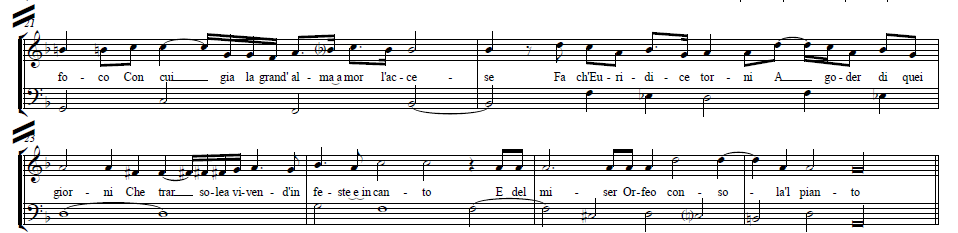
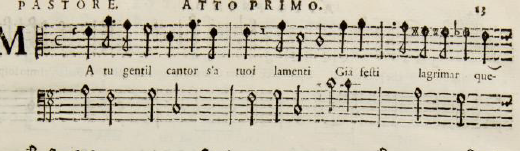
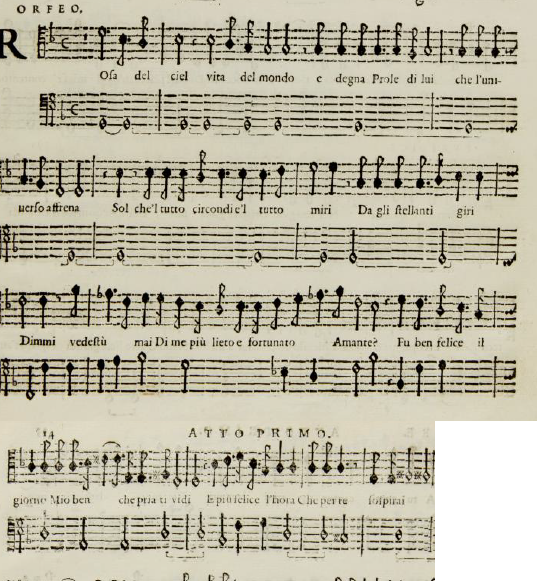
In this oft-cited excerpt from Monteverdi Orfeo, published in 1609, the mensuration mark of C indicates an equal (i.e. duple, down-up) Tactus beat on minims, something around minim = 60, and the barlines are every four minims. But the harmonic metre is clearly in groups of three minims [as shown by the red brackets] and the word-accents fall mostly (but not exclusively) on the first and third minims of these groups. Thus the notation of musical Time is not matched to the metrical structure of harmony and accents. This allows Monteverdi to notate a steady speed, with three minims corresponding to three one-second Tactus-beats to the metrical unit. Contrariwise, if he had used the triple-metre notation of his time, e.g. a tripla Proportion, this notation would direct the singer to fit the whole metrical unit into one Tactus-beat, three minims in one second of actual time: the music would be heard three times as fast. 

Unfortunately, many modern editions rebar this song under a 3/2 time signature, which performers then interpret as if it were Monteverdi’s tripla porportion  – we often hear this music much too fast! 

And failure to understand the subtle relationship between Tactus and word-accent (sometimes coinciding, but not always) has led many singers to disregard Monteverdi’s precisely notated rhythms in so-called Recitative.  See It’s Recitative, but not as we know it.

Re-discovering 17th-century, non-accentual, Time is a considerable challenge for modern-day performers. Well-intentioned 20th-century attempts to ‘escape the tyranny of the bar-line’ have led us to rhythmic Hell: the rejection of the stable self-government of Tactus, even to the anarchy of free rhythm. There is still much work to be done, in learning (not only in theory and practice, but as an instilled habit) how to manage stable, but non-accentual, Tactus-time, and how to weave complex patterns of word-accents (imitated also in instrumental music) around that Tactus. This learning cannot take place in an ensemble directed with modern conducting.

Speed

For both Zacconi and Türk, there is a closer and more specific relationship than for modern musicians between Tactus as sign, notation, duration in real time, a way of beating time, a specific note-value and sub-division of that note-value into various rhythms. Although both writers allow the possibility that the speed of Tactus-beating can vary somewhat, this variation (I would argue) was small: gross changes in the speed of the music (as heard) were acheived by changing the notation whilst the beat remained (more-or-less) constant. 

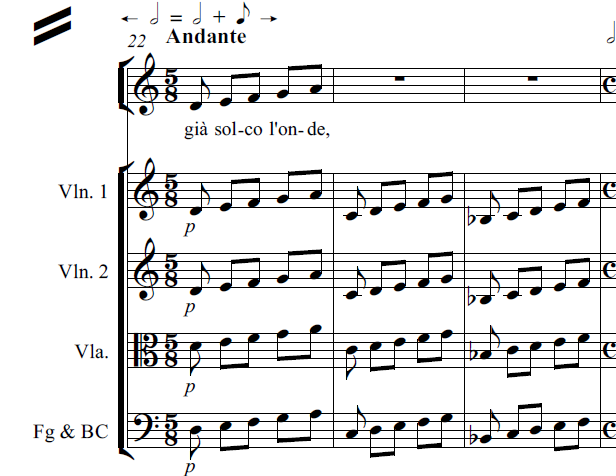
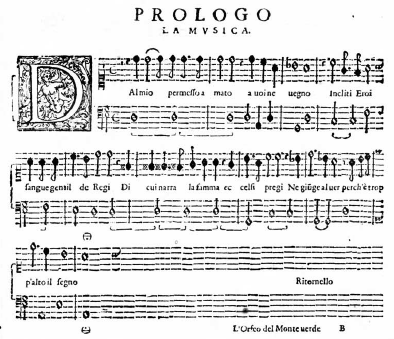
After the slow song cited above, Monteverdi continues with the same Tactus and the same relationship between notated Time, indicated Tactus, and note-values as performed. But the sound changes noticeably, as singers, violins and continuo-bass suddenly move in bursts of quavers rather than semibreves & minims. It feels faster.


In the following Ritornello, the Tactus again continues unchanged. But the relationship between that Tactus and notated Time is altered by the sign of Proportion. The black minims now come three to the Tactus – the effect heard is that the music feels three times faster than the first song. 


There is academic debate about the details of precisely how Proportions should be interpreted. But there is general agreement on the essential principle that the Tactus is maintained (or varied only subtly) whilst a proportionally greater amount of music happens within the real-time duration of that Tactus. See Tempus Putationis: getting back to Monteverdi’s Time. Proportions feel faster.

One of the challenges when studying the subjective feeling of Speed in baroque music is that Zacconi and his contemporaries did not share our concept of Newtonian Absolute Time. Within their Aristotelian understanding of Time as dependent on motion, the Tactus did more than indicate a musical beat, it created Time itself. That real-world time was related to notated durations by the signs of tempus and Proportions. We encounter not only differences in period nomenclature, but conceptual gaps in historic language, when we try to unpick ‘the feeling that we call Speed’ for baroque repertoire, just as Türk encountered a similar gap amongst established authorities when trying to define the emerging concept that ‘Accents produce the feeling that we call Metre’.   

Addition or Division?

Türk’s statements on Takt seem to be ordered with the most up-to-date ideas first, established views next, and citations of older authorities (some which might even derive from Zacconi) in a footnote. Following his description of Takt as accentual metre, his next remark would have struck musicians of previous generations as fundamentally incomplete.

Jeder längern oder kürzern Note, Pause &c ihre bestimmte Dauer geben… so spiele man nach dem Takt. Giving longer or shorter notes, rests etc their proper duration… this is playing in Time. 

Here is an early indication of what was to become the most significance difference in the management of time in practical music-making of the Baroque period from modern-day practices. From the first teaching-book (Milán’s 1536 El maestro, discussed here) and even in Türk’s following remarks, it is not sufficient that performers add up the durations of each individual note and rest… they must also ensure that the total duration of the note-values that add-up to a unit of notated time corresponds to the duration of real-world time, as shown by the Tactus.

Saber quantas de las sobredichas cifras entran en un compas (Milán, 1536) Know how many of the above-mentioned notes come in a Tactus [in notation, and in performance]. 

The essential control of period rhythm was not by adding-up small note-values, but by maintaining the relationship of notated Time to real-world Time through (and at the level of) the Tactus. As Roger Mathew Grant aptly expresses it in Beating Time and Measuring Music (2014), notation is “calibrated” to real-world Time by the Tactus. Smaller note-values were found by dividing the Tactus – a universal principle underlying the specific practice of ornamental ‘diminutions’ or ‘divisions’.

This is the concept of Tactus as the Measure of Time. In actual music-making, it’s the practice of using Tactus to measure Time. And it’s what most musicians do not do, nowadays.

Tactus as Measure


In theory, and purely mathematically, it should make no difference whether one adds or divides – the rhythmic total is the same either way. But in practice, and with human performers, there are considerable differences in the resulting delivery and even greater differences in the subjective ‘feel’ of the music. I’ll try to illustrate this visually, by means of the Cuisenaire Rods used for learning mathematics from the mid-20th century onwards.
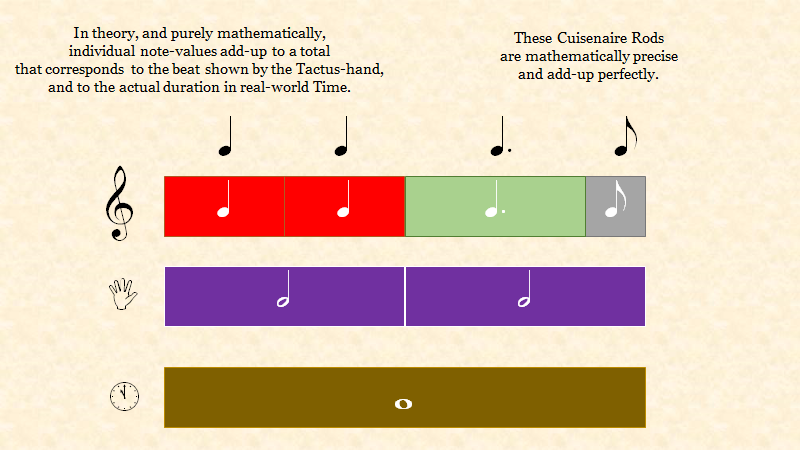


In theory, a performer (or conductor) counting with a short beat (e.g. 4 crotchets to the bar) and adding-up the various note-values should arrive at the same total duration as one counting with the long beat of Tactus (one minim down, one minim up).


In practice, small errors and/or deliberate choices accumulate so that modern counting/conducting and historical Tactus sound – and, even more importantly, feel – noticeably different.


Ironically, amongst today’s Early Music perfomers, stylised articulations and ideas of ‘musical gesture’ etc often result in even greater disconnect from Tactus-Time. Many of those articulations are based on historical evidence and period principles: good/bad notes here , silences of articulation, over-dotting, etc. Caccini gives examples of how to sing typical phrases more gracefully: the common feature of all his examples is exaggerated contrast in note-values – long notes are lengthened, short notes are shortened.


There is no denying the historicity of ‘non-mathematical’ rhythm  – varied lengths for notes written as equal, extra contrast for dissimilar note-values, varied articulations between notes etc –  but all these subtle adjustments should happen within the Tactus. The note-values affected are shorter than the Tactus, and the cumulative result is determined by lining-up with the next Tactus beat. 

This is the essential difference between modern playing and Tactus-playing: whether or not musical Time is measured by Tactus. And the only way to do Tactus-playing is – to adopt Zacconi’s form of words – by actually doing the action! Unless you study initially and then practice regularly with actual physical Tactus (the down-up motion of hand or foot) then you are not using Tactus to measure your music-making. Unless you rehearse Proportional changes with a Tactus hand-beat, you are not managing Proportions according to Tactus. 

In the hope that you would like to try it for yourself, here is the first part of my free online course on The Practice of Tactus.


Frescobaldi explains here that (physical) Tactus facilitates even those difficult (and carefully delimited) moments where the Tactus itself should change. And Monteverdi notates what may well have been a common feature of performance, that soloists may choose to sing elegantly off the beat, whilst the continuo accompaniment remains in Tactus, like a jazz-singer syncopating against the steady groove of the rhythm section. See Monteverdi, Caccini & Jazz.

The Tactus-beat is human, rather than metronomic. The down-up movement has the almost imperceptible ebb and flow of arsis thesis (look very carefully at the Tactus-Cuisenaire rods in my last example). And the Speed of the movement, which in principle is always the same, changes subtly in practice according to performance venue, ensemble forces, emotional state etc. It does not have to be precisely the same, from one occasion to another [for all this, see Zacconi, above], but you should keep it steady, as much as humanly possible.

Ideally, we do not force the Tactus to be faster, in order to mimick emotional agitation; rather we feel the emotional effect of the words, and even though we think we are keeping the same Tactus, actually we are going faster. Tai Chi master Sifu Phu expresses this idea – what actors call ‘working from the inside outwards’: Feel the Force, don’t force the feel! See also the discussion of the psychology and physiology of the Four Humours in Joseph Roach’s (1985) survey of the historical Science of Acting: The Player’s Passion

It should feel as if the Tactus is always the same, but since we are human, it will not actually be the same, if we were to measure it objectively with modern equipment. Nevertheless, this subjective feeling of, and striving for perfect steadiness and consistent speed is utterly different from the arbitrary choices and changes of modern conducting. In this sense, Zacconi’s description (Chapter 33) of how the Tactus feels is both what performers should strive for, and what we hope our audiences will perceive.


Tactus is regular, solid, stable, firm… clear, sure, fearless, and without any perturbation.

Il Tatto… deve essere si equale, saldo, stabile e fermo… chiaro, sicuro, senza paura & senza veruna titubatione, pigliando l’essempio dell’attione del polso o dal moto che fa il tempo dell’Orologgio… following the example of the pulse [heart-beat] or clockwork.


When we have come to appreciate the effect of measuring our music-making with Tactus, and remembering Zacconi’s identification of tatto [Tactus] with tempo [real-world time, and the notation of tempus], the full force of his comment that Tempo is ‘soul of music’ becomes apparent. The element that ‘gives life to music’ is not just rhythm in general, but the interconnected working of notation, physical time-beating, real-world time and musical performance, all co-ordinated at the heart-beat level of approximately a minim per second, and (like a heart-beat) rocking to-and-fro in what we feel to be subtly uneven pairs.

This is not only the sound of Baroque music, it is the shape of Baroque Time. 

(ALK, 2020)

Senza misura

There are fascinating repertoires in baroque music that are written with specific note-values, but carry performance instructions for senza misura. Caccini specifies this (once only!) in his example song in Le Nuove Musiche (1601), here.  But there are many pieces from the mid-17th century by Froberger that are marked to be played with discrétion, and some of these have the additional instruction in some sources sans observer aucune mesure [without observing any Measure]. See Schulenberg on Discretion here, and on Froberger sources here.


Froberger Lamentation “sans observer aucune mesure”


There is plenty of academic discussion of the challenge that Froberger and his copyists faced in trying to notate his highly idiosyncratic performance style. But for today’s performers, rather than taking discrétion as an invitation to introduce 20th-century tempo rubato, a possible approach based on period evidence could be to apply all that we know about articulation, rhythmic adjustments (following Caccini and Monteverdi), good/bad notes, dissonance/resolution etc etc, but without any obligation to make all this add up to the Measure of Tactus.

One might almost suggest that since the standard practice of much of present-day Early Music is to play without observing Tactus, that Caccini’s senza misura and Froberger’s discrétion are heard in almost every performance of every baroque repertoire, robbing [sic] audiences of the emotional impact of what should be a special effect, by soul-destroying [sic] over-exposure.

Conclusion

Zacconi’s concept of Time as the Soul of Music is much more than a trite platitude to remind us that rhythm matters. Rather, he expresses a fundamental element of Baroque practice, that music (and even the ‘affections of the Soul’ i.e. affetti, emotions) are created by a life-giving three-in-one of notated tempus, physical Tactus-beating, and real-world Time, operating (in early-seicento Italy) at the level of a semibreve ~ down/up ~ approximately two seconds.

Today’s Early Music performers mostly fail even to try this: instead we argue about pitch, temperament and vibrato. “Doh! (Dan Castellaneta as Homer Simpson, 1988 – but I use the Oxford English Dictionary spelling from 2001) See Music expresses Emotions?

I give the last word to Türk, who proclaims his continuity with centuries of music-making measured by Tactus, by his translation (explicit) and updating (implicit, since his Takt – however similar – is no longer exactly the same as Zacconi’s tempo and tatto) of that period mantra, as his own last word on the subject. Der Takt ist … die Seele der Musik.

Tactus is the Soul of Music 


Recitative for Idiots (but don’t use that word): three types of Dramatic Monody

Giovanni Battista Doni (1593-1647), grand theoretician of Baroque Opera, loves Idiots – or so he says. And with a little digging, we can find out which particular Idiots he was referring to, and which Opera. So no-one need be offended by the title of this post.  But do be warned: the word Doni says we should not misuse is R*c*t*t*v*.

Recitative – NOT!

The word Recitative is problematic for today’s performers of early 17th-century music-drama, the ‘first operas’. Historically, it was not the preferred term. Nowadays, it evokes all kinds of unexamined assumptions, in particular the 20th-century imposition of free rhythm, instead of period Tactus.  See Frescobaldi for subtle details of the application of Tactus to ‘modern madrigals’ and other genres of ‘difficult’ music.

The period meaning of recitare is ‘to act’, and the anonymous author of Il Corago – The Opera Director – (c1630) discusses three genres of theatrical shows – rappresentationi: spoken plays, music-drama and silent pantomime, which in seicento practice all consist of ‘acting’ recitare. More on Il Corago here. The approach of Il Corago is highly pragmatic: he describes the meaning of the word in common parlance, and links that meaning to three categories of drama in current theatrical usage. Silent pantomime is rather out of fashion in Italian theatre, but dumbshows are a significant feature of English Elizabethan drama, e.g. the play within the play of Shakespeare’s Hamlet.

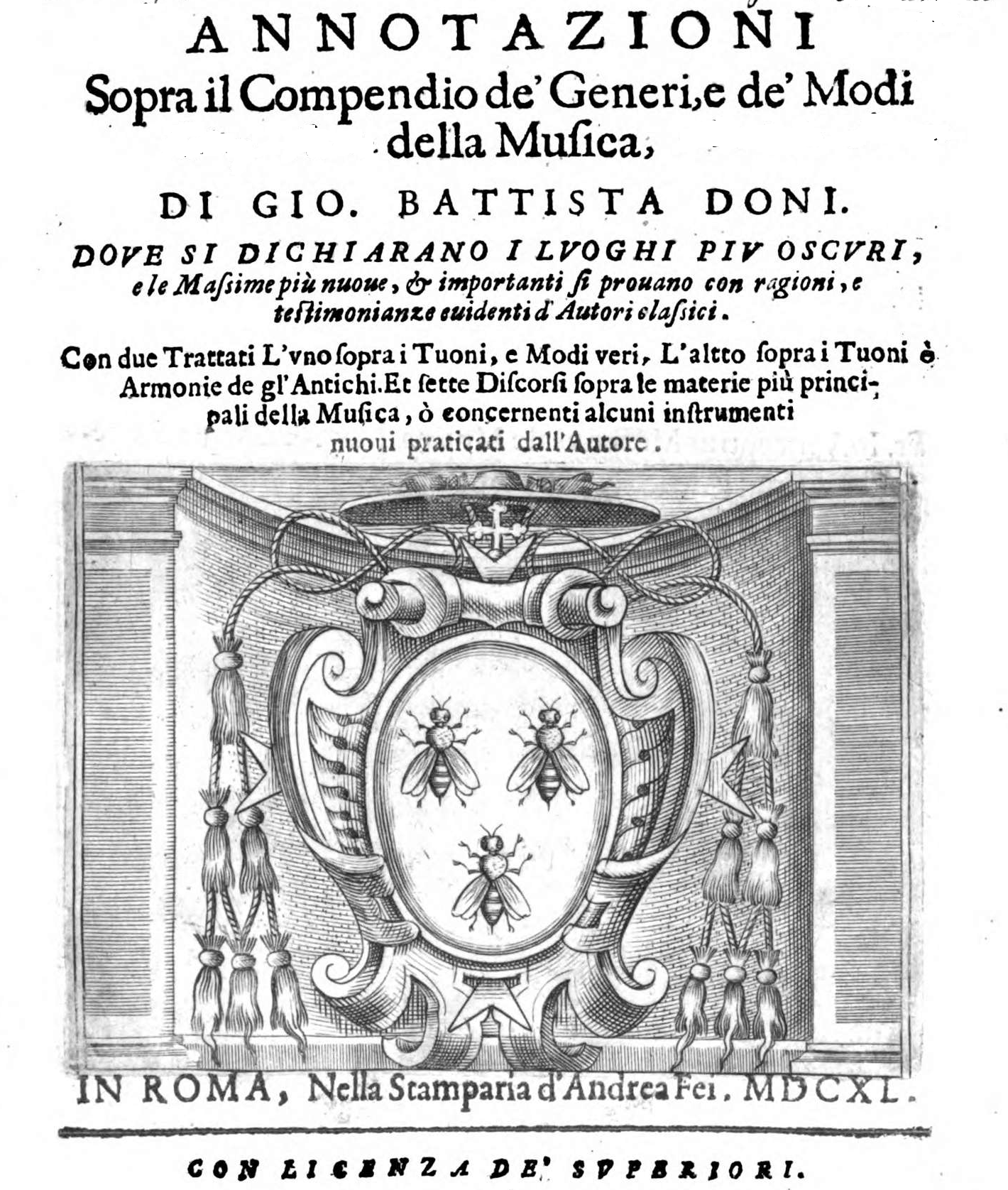
In Doni’s Annotationi (1640) here, ‘Annotations’ to his Compendio del Trattato de’ generi e de’ modi della Musica (1635) here, there is a highly significant discussion [page 60-62] of different types of dramatic monody, sub-categories of what we nowadays call Recitative.

Doni addresses here ‘the musical style called recitativo‘, i,e. dramatic monody.  He too recognises that in normal usage the word recitare means ‘to act’, to ‘present a theatrical show’ rappresentare , even though – as a theorist – he would have liked to restrict the word to declamation of the text, as opposed to physical acting and embodiment of the role. Doni’s approach is that of a critical theorist and utopian: he rails against common parlance. tries to impose a ‘better’ terminology on current usage, and attempts to reassign the offending word to an idealised musical genre that is more-or-less a figment of his imagination.

At this point, the attentive reader might accuse me of being as impractical as Doni himself, as I rail in vain against modern misuse of the word Recitative. That would be a fair point, touché! But my practical purpose is not to stop today’s musicians using the word, since it is the obvious cognate of the seicento term recitativo. Rather, I hope to raise awareness that a 20th-century understanding of the English word ‘Recitative’ does not map onto the 17th-century understanding of the Italian word recitativo, and that this term was already problematic in Monteverdi’s time. Just as we need to add what Americans call “scare-quotes” around the word “Opera” in this period – Cavalieri’s Rappresentatione and Monteverdi’s favola in musica were not designated ‘opera’ and do not correspond to a later understanding of that term – so also for the word “Recitative”.

The take-home message is that the word “Recitative” is highly problematic, and should not be applied thoughtlessly. It’s Recitative, but not as we know it!


Doni & the first “operas”

Doni’s examples look back to the earliest surviving secular ‘opera’, Euridice. Ottavio Rinuccini’s verse-drama was staged – rappresentata – in 1600 in a musical setting by Jacopo Peri, with a few numbers contributed by his arch-rival Giulio Caccini. Caccini hastily set the rest of the libretto and rushed his composition into print in 1601, a few weeks before the publication of Peri’s version (now updated with his own settings replacing Caccini’s work). However, Caccini’s music-drama was not performed until 1602, and is usually considered to have been overshadowed by the prior success of Peri’s composition. More on Peri here.

Meanwhile, Cavalieri’s religious music-drama, Rappresentatione di Anima e di Corpo (1600) was performed and published even earlier, more on Cavalieri here.

In this post, I consider Doni’s remarks in the light of both settings of Euridice, and I add some comments of my own, related to Monteverdi’s Orfeo (1610), see The Orfeo Page.

In what follows, the translation of Doni’s remarks is in black, with my commentary in blue.


Songs for a single voice

ALK: On page 100 of the Compendio, Doni ends his criticism of Diminutione ne’ Contrapunti – singing divisions (improvised, ornamental passage-work) in polyphonic compositions – by blaming wayward singers of Church Music, since (in his opinion) the practice came later to Madrigals and other vernacular poetry.

GBD: In all this, I like to call it the Madrigalian style; because it is especially significant in Madrigals: under this name is included similarly musical settings of Sonnets, Canzonas, Masquerades etc; and perhaps also Villanelle [rustic Peasant Songs] even though they are closer to the simplicity of what are properly called Arias or Canzonets, and to the Ballate [Ballads] and Canzoni a ballo [Dance-Songs] that the Ancients called Hyporchemata

Then, very different and almost contrary to this is the Song for a single voice accompanied by the sound of some instrument; brought back, one might say, from death to life in this century especially by the work of Giulio Caccini, nicknamed Il Romano; but with the guidance and direction of those virtuosi  (noble amateurs) Florentine Academicians; as I have discussed at greater length in the Trattato della Musica Scenica [Treatise on Stage Music here] and he himself admits.

And although there has always been a practice of some kind of Melody for a single Voice with the accompaniment of instruments; there should not be included in this category those vulgar Tunes – Cantilene – which almost without any art or grace were formerly sung by simple persons and idiots, and by blind men, and even today are heard cheaply in every country.

The improvement that Music has made in this sort of Melody is most notable; because apart from the refinement of Composition (in which by the example of Caccini it has acheived more than ever before), there have been musical settings – modulate – of Dramatic Actions and unstaged Dialogues; which give great delight in the style called Dramatic [Recitativo]

ALK:  Doni’s remarks in the Annotationi are a commentary on this ‘style called Dramatic’, and I translate them below. But first here is the conclusion of the principal text from the Compendio.

GBD:  … and the quality of expression – a very important part of Musica operativa [practical music-making, or music with a practical function; this is too early for any reference to ‘opera’ as a musical genre] – has been greatly refined and the Decorum [a Rhetorical term – how the music fits with the text] increased by the drying-up of many of those [ornamented] Repeats; and the ornamentations of this Singing, which are accenti, passaggi, trilli, gorgheggiamenti etc, have been perfected, first by the effort of the same Caccini and then by the experience and good dispositione [technique, especially in singing fast ornamentation] of other singers, especially of this city [Rome] and in particular Giuseppe Cenci, nicknamed Giuseppino.

ALK: ‘Little Joe’ Cenci was a composer of artistic monodies and scandalous popular songs admitted into the Papal choir as a tenor in 1598 and praised alongside Caccini also by aristocratic art-collector and intellectual, Vincenzo Giustiani, for his contributions to ‘Recitative’.

Doni list combines two different classes of ornamentation associated with two distinct styles of solo singing. Accenti & trilli are so-called vocal Effects – Effetti – added especially at cadences to express and induce emotions – Affetti – and associated with expressive, dramatic monody (what we might today call “Recitative”). Passaggi & gorgheggiamenti are fast passage-work, divisions within the main body of the phrase, intended to charm the ear and associated with song-like melodies (what we might call “Arias”). Part of Doni’s purpose in the Annotation that follows is to distinguish more precisely between these different types of solo singing, within the broad category of Dramatic Music. See also Ornamenting Monteverdi: Add, alter or Divide?  


In the style called Dramatic…

[Annotationi pages 60-62]

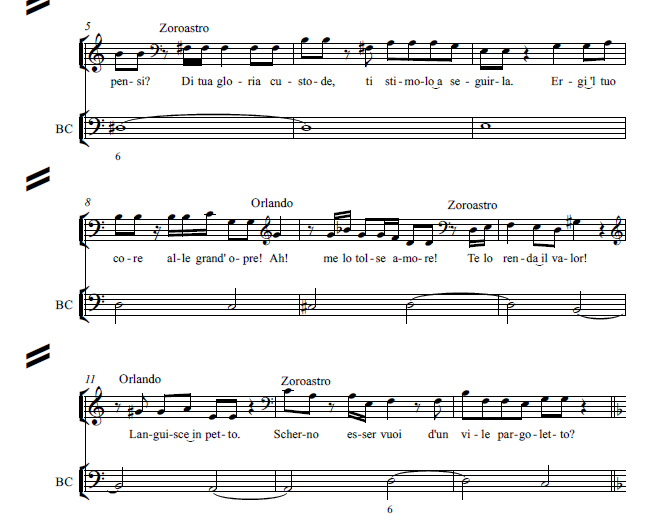
GBD: There is a great diversity of Melodies, which I’ve discussed elsewhere [in the Compendio]However, out of love for the idiots here I want to declare in more detail what the Dramatic style really is.

ALK: Doni’s “idiots” are those ‘simple persons’ mentioned in the Compendio, singers of cheap, vulgar tunes.  This affectionate joke points out the contrast: here, Doni is making subtle intellectual distinctions within the high-art genre of Dramatic music for a single voice. His first categorisation, made explicit below, is to exclude song-like – canzonesco – styles. So he is not discussing diegetic songs (when a character sings a song ‘realistically’ within the staged story), nor what we might nowadays call ‘Arias’. And one attribute of modern Opera can perhaps be traced all the way back to the first fully-sung dramas in the early seicento: from the outset this genre was regarded as the highest form of music-theatre, satisfying not only the eye and ear with its sights and sounds, but also the mind and soul by its intellectual profundity and emotional power. In this, the first ‘operas’ sought to acheive all three aims of Rhetoric – docere, delectare, movere – to teach, to delight, and to move the passions. 

GBD: It’s commonly believed that any music is in this style, if it is composed for a single voice. But in truth it’s not like this, because  – leaving aside the inflections of ecclesiastical plain-chant, which is sung by a solo voice and nevertheless is not categorised as Dramatic – even more artistically complex music, including theatrical music, is of various types.

ALK: Nevertheless, some listeners to Peri’s (1600) Euridice compared the sound of the new style of dramatic monody to the chanting of the Passion-story in church during Holy Week. That comment is usually taken as negative, but it shows an attempt to place a genuinely new practice within a familiar context of existing sound-worlds and emotional experiences. It also suggests that the accompanying instruments might have been quieter, in relation to the voice, than we are accustomed to today.

GBD: Some people assign two types:  the Narrative style narrativo,  which others call Story-Telling raccontativo, and the Expressive style espressivo, which others call Theatrical rappresentativo. But I add as a third type, that which is more strictly called Dramatic recitativo, declaring that there are three styles of Monody in use onstage today (from which I exclude Choral and Song styles).

Narrative

First, the Narrative mentioned above, which is named thus for being used in Narrations and long re-telling of messages and suchlike. This is easily distinguished from the others by its restricting itself to a single note (the Greeks call it monotone), and almost always that of the fundamental tone, with fast pacing tempi veloci [short note values] similar to the pacing of speech. For example where in Euridice the death of Euridice is told.


Dafne’s Narration of the Death of Euridice, set by Peri


ALK: Doni gives only the text, no music, for this example. And as an enthusiastic admiror of Peri’s compositions, at first I blithely assumed that Doni was referring to this setting. But in the linked passage from the Compendio (above), Doni singles out Giulio Caccini for special praise as composer, singer and reformer of ornamentation, whereas Peri is not mentioned at all. So I also checked each example in Caccini’s setting. In this case, Peri’s version corresponds to Doni’s description of the Narrative style on a monotone, but Caccini’s does not.


Dafne’s Narration of the Death of Euridice, set by Caccini

Dramatic

GBD: The second style is the specially Dramatic recitativo, called this because it is particularly suitable for someone who acts/declaims recita [the common meaning is ‘acts’, even though Doni would prefer it to mean ‘declaims a text’] with music, as the Rhapsodes did in ancient times.  For presenting a show onstage rappresentare in scena people incorrectly say ‘acting’ recitare, [but] this [representing] is rather an imitation or embodiment atteggiare, which in Latin is called agere [acting].

ALK: The fifth Canon of Rhetoric, which we would nowadays call Performance, combines Pronuntatio (Delivery of the text) with Actio (Action, i.e. gestures, facial expressions, changes of posture etc). In addition, early 17th-century theatre was concerned with a new approach to Personation (the Embodiment of a character-role). These three elements – delivery of the text, physical action, portrayal of a role – are all contained within our modern concept of ‘acting’ and also within early 17th-century usage of the word recitare (as Il Corago confirms). However, Doni – grumpy theorist that he was – finds this ‘incorrect’, and he tries to draw a theoretical distinction between recitare as rhapsodic delivery of the text in the style of the ancient Greeks, and rappresentare as stage-acting.  Here we see clearly the contrast in approach between Doni and Il Corago, commented on by Fabbri & Pompilio (editors of Il Corago in 1983):  Doni theorises and speculates about the ancient Greeks, Il Corago tells it like it is in seicento Italy.  But, in support of Doni’s academic precision, 17th-century title pages show that recitativo is rarely mentioned in the context of the ‘first operas’, rappresentatione is the preferred term. See Sternfeld A note on ‘stile recitativo’ here [paywall, unless you have institutional access]

In the Trattato della musica scenica Doni himself uses the word recitare in its usual meaning of ‘to act’ or to ‘declaim in speech’ (so not in the idealised way he calls for in the Annotationi, which would be ‘to act/declaim poetry as chamber-music’). At the end of Chapter IV, discussing Seneca’s Medea: “che si recitassero senza canto’ [that they acted/declaimed, without singing]. At the end of Chapter V, he argues that long narrations of messengers, descriptions of places etc were all spoken in Classical Antiquity: “it would not been elegant if some of these speeches were sung – si cantassero – whilst others were declaimed in speech – si recitassero. In Chapter VI, he again opposes recitata and cantata, writing that perfection can be found in Rappresentationi spirituale (dramas on sacred subjects: Cavalieri’s pioneering Anima & Corpo would be an example, and Doni’s own example is Landi’s Il Sant’ Alessio) in two ways: ‘if they are recitata (acted/declaimed) by the most experienced Actors, full of elegance and lightness in their gestures and carriage of the body… or when they are canata (sung) with sweet and appropriate melody’. Note in this last example that ‘gestures and carriage of the body’ are what ‘experienced Actors’ bring to recitare – declamation is only one part of acting, and the word recitare also includes those elements of embodiment. 


In short, recitare means ‘to act’, with hand-gestures and body-movement. This may include declamation of a text (spoken or sung). Recitare can be used to mean ‘spoken acting’, as opposed to cantare (singing). Doni would like to re-define it to mean ‘singing Rhapsodic poetry as chamber-music’, but this meaning is not employed in the real world, not even by Doni himself! All of this is very far from the modern English word Recitative. So we must not translate (even mentally) recitaremusica recitativa etc as ‘singing Recitative, or Recitative music’ etc , in the familiar way. We can better appreciate the period meaning of these terms from Doni’s alternative phrase (beginning of Chapter V of Musica Scenica):

canto scenico –  ‘stage singing’. 


All this matters, because we assume that we know how to do Recitative. But the music of Cavalieri, Peri, Caccini and Monteverdi is not Recitative, not as we know it…


GBD: The quality of its melody is midway between the Narrative and the Expressive, because it is more tuneful arioso [aria in this period also suggests rhythmic patterning, dance-metres etc] than the other two, and and has less pathos than the latter. There is very often heard in it certain desinenze [designs, melodic figures] which serve as clichés for composers and generate a certain tedium for listeners, for example:


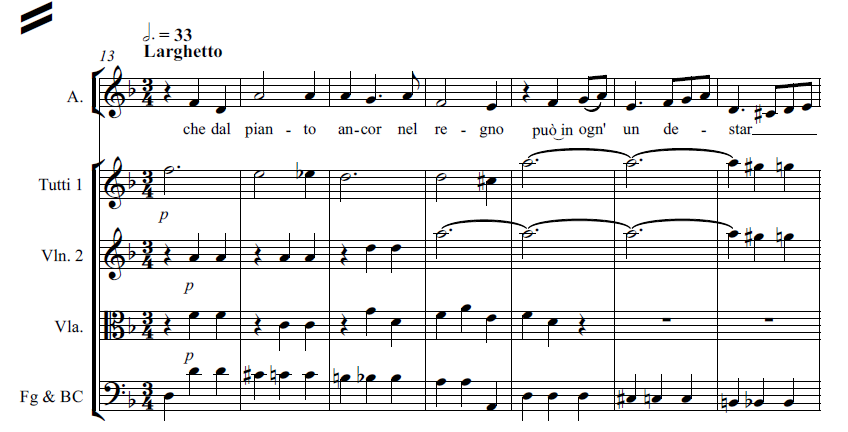
ALK: I searched in vain for this exact melody in Peri’s and Caccini’s settings of Euridice. However, Doni is not wrong, there are many, many figures at the beginning of phrases that sound just like this in Peri. It is indeed a recognisable phrase-opening cliché, in the easy-flowing pastoral dialogues that  Peri contrasts against extended narrations and passionate speeches, fitting very well with Doni’s three categories. In particular, it is a very close match to the first notes of Peri’s Act I, and this might well be what Doni was remembering.


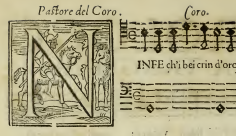
Euridice Act I incipit, in Peri’s setting


I did not find Doni’s cliché so frequently in Caccini’s version. But the incipit of his Act I is strikingly similar to Peri’s (just one more note differing from Doni), although the two settings diverge markedly immediately after this first phrase.


Euridice Act I incipit, in Caccini’s setting


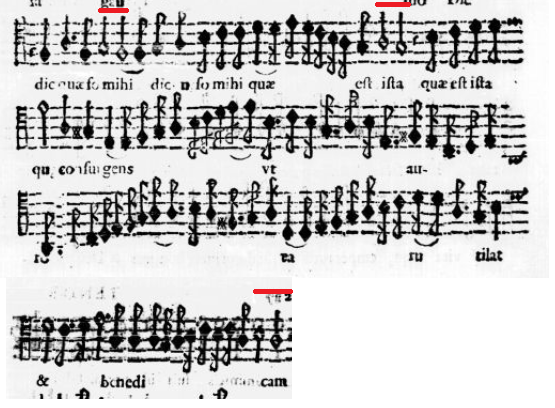
I speculate that Peri’s first phrase might have made so strong an impression that both Caccini and Doni cited it with only minor mis-rememberings. If so, it would seem that both Caccini and Doni were remembering something heard, rather than consulting a score, since the small differences (especially in Doni) do not look like copyist’s or printer’s errors. One could even imagine that Caccini thought the phrase to have been notated as he prints it, since Peri’s unexpected (and beautiful) lower note on the word crin has the character of a singer’s improvised accento – an ornament that creates an emotional accent by descending in order to ascend afterwards (or vice versa). 

For comparison, here is the notated accento in Monteverdi’s La Musica Prologue to Orfeo. At the words dolci accenti (sweet accents) the singer first ascends in order then to descend onto an expressive Bb on the good syllable.


Notated accento ornament on the words dolci accenti in the Prologue to Monteverdi’s Orfeo.


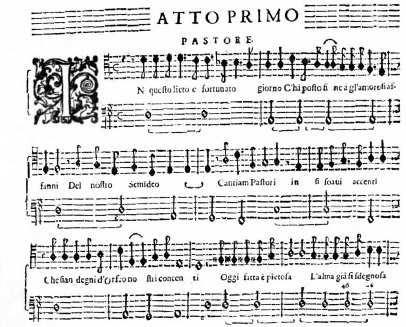
In Orfeo, Monteverdi avoids Doni’s melodic/rhythmic cliché, even though many phrases, including the beginning of the Prologue Del mio permesso amato and the opening of Act I In queto lieto e fortunato giorno, start with three upbeats. The closest he comes to it is in Orfeo’s first song (a diegetic song, but not an aria in 17th-century terms):


and twice in the following phrase, but with only two upbeats:

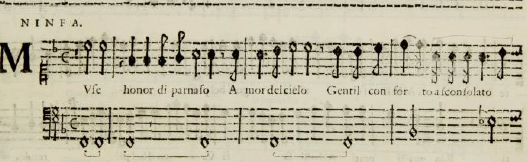
or in the Pastore’s invitation to the Temple Ma s’il nostro gioir del ciel deriva, with three upbeats and altered rhythm:


Catching a glimpse of the 20th-century mind-set

For Doni, the risk of tedium comes from the overuse of similar melodic figures at the beginning of phrases. But modern-day commentators and performers are more anxious about the cadences in long notes at the end of each phrase in this style. I first encountered Doni’s commentary in lecture notes handed out at Yale by eminent musicologist, the late Claude Palisca, Henry L. and Lucy G. Moses Professor Emeritus of Music at Yale University and an internationally recognized authority on early music, especially opera of the Renaissance and Baroque periods. Palisca translates desinenze as ‘endings’, but even a cursory glance at Doni’s example reveals it to be an incipit, not a cadence.
I mean absolutely no disrespect to the memory of this revered musicologist. But the mistranslation would seem to be a Freudian slip, revealing hidden assumptions of which researchers themselves cannot be consciously aware. The notion that cadences are a ‘problem’ is a firmly embedded,  deeply hidden – and hitherto unexamined – assumption in 20th-century musicology, that still influences modern-day performances. But Doni is not at all concerned with cadences: his focus is on incipits. This startling difference reinforces my impression that we have fundamentally misunderstood something in our treatment of cadences. See Ornamenting Monteverdi.  

GBD: The principal use of this style is for Prologues. There it really is more tolerable than elsewhere, even though its true place is in the pulpit and not onstage. But it is optimally suited to Rhapsodies and similar recitations recitationi with song of Heroic Poems, or structured poems of a certain type, such as the Heroics of Antiquity, and modern blank verse verso sciolto [Hendecasyllables], or verses of various types like the Idylls, or set out in stanzas like ottava rima and extended songs. And so it seems to me that we could include in this type also many of the tunes arie for ottava rima that are sung throughout Italy.

ALK: Peri’s Preface to Euridice here also makes the connection between his ‘new manner of singing for music onstage’ [he does not use the word recitativo] which is midway between speech and song, and Hendecasyllables (the Italian equivalent of Shakespeare’s blank verse), which are midway between prose and poetry. The connection between the new mondoy and improvising street-singers, cantastorie, singing ballads of heroes and battles to reciting formulae for ottava rima was extensively discussed in the late 20th-century writings of James Haar and Nino Pirotta. It’s difficult to imagine how this musical style might be used literally from the preacher’s pulpit, but in sacred music we can recognise it in the motets of Monteverdi’s (1610) Vespers – Nigra sum, Audi coelum etc. Doni later describes his ideal of Rhapsodic singing, as chamber-music accompanied by the harp.

These various contexts all address what Peri calls ‘sad or serious matters’, in which the slow-moving bass does not force the singer to ‘dance’. Even the singers of improvised arie and street cantastorie are far from the realm of Doni’s villanelle-singing Idiots. 

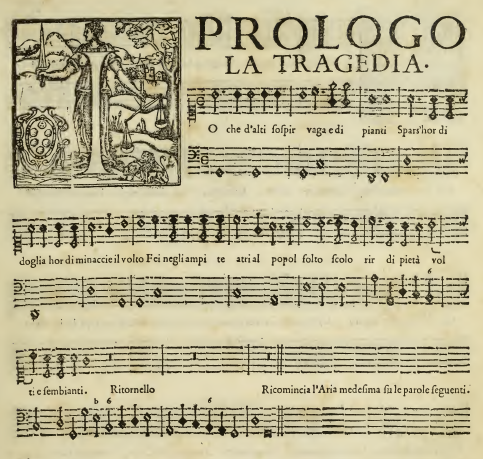
GBD: As an example of this style one could mention the Prologue to Euridice.

The Prologue to Euridice in Peri’s setting.


The Prologue to Euridice in Caccini’s setting


ALK: The two settings are very similar in pitch contours of the voice-part and of the bass-melody for the ritornello. But Peri has the more interesting rhythms and harmonies, and to my ears (though I admit to a pro-Peri bias) Caccini’s version seems to be a pale imitation of Peri’s original. Nevertheless, we should keep in mind that Peri was the champion of sparsely ornamented expressivity, whereas Caccini’s performance would certainly have been heightened by the elaborate ornamentation for which he was renowned.

Monteverdi’s La Musica Prologue is written out with careful attention to the words and emotional contrasts of each strophe, but its basic structure is clearly a strophic aria, variations on a ground bass. We might imagine that Peri’s and Caccini’s Prologues would have been performed with some improvised variation of the melody, possibly also of the bass, from one strophe to another: Monteverdi’s notated variations might even be a model for bold improvisation.

Expressive

GBD: The third type is what we call Expressive, which is the only one truly appropriate and suitable for the stage, for in our opinion [Doni uses the ‘royal we’] the other two types should stay away. The first [Narrative] is too cloying, and should be reduced to simple speech. And the second has too much sing-song cantilena, and would be better suited to poems of a mixed genre. 

So, in the Expressive we proffess to express well the emotions affetti and – in some places – the natural accents of emotional speech parlare patetico.  

ALK: This matches Peri’s analysis, in which the various emotions shape the bass and harmonies, whereas the pitch-contours of the voice-line follow the rise and fall of spoken declamation in the theatre. Il Corago also insists that dramatic monody should imitate the delivery of a fine actor in the spoken theatre.

GBD: Both these elements have very great force upon the human spirits animi humani [animo refers to the mind-body communication of affetti,  i.e. the pyschological and physiological aspects of emotion]. It is evident that when this is combined with lively stage-action vivace attione and a poetic text parlare appropriate proportionato to the subject, it marvellously induces commove laughter, tears, anger etc.

ALK: In spite of Doni’s enthusiasm for Caccini’s contributions to composition, singing and the reform of ornamentation, it seems that his memories of Euridice are of Peri’s setting. Certainly Peri’s version better matches the arguments Doni wishes to advance by his examples. And perhaps Peri’s ideals of dramatic expression, rather than Caccini’s song-like ear-tickling, fits better with Doni’s intellectual concept of baroque opera as carrying forward the theatrical power of Classical Antiquity.

GBD: Here there is the opportunity for all those contrasts of Tone, Genre and Rhythm [mode and hexachord – soft or hard; diatonic/chromatic; syllabic speed, word-accents on/off Tactus etc] which are the the greatest riches and impressive display of music. As an example, one could mention the Lamento d’Arianna, still today admired by everyone, which is the most beautiful composition which has ever been seen amongst dramatic and theatrical music.

ALK: One of the most attractive features of Orfeo is Monteverdi’s rich store of varied melodic and rhythmic figures for the ‘middle ground’ of dramatic monody that Doni identifies as neither Narrative nor passionately Expressive: the Prologue of La Musica, the dialogues of Shepherds, dance-songs in Act II, Speranza’s description of the gateway to Hell, Caronte’s aria, Prosperina’s persuasion, Plutone’s pronouncements, and  Orfeo’s dialogue with Apollo. But many of these examples have at least some moments that could be categorised as Expressive – Monteverdi takes the liberty to move freely between one type and another, setting Striggio’s text ‘verse by verse, even word by word’ [as Monteverdi writes in his letters, and we read also in the Il Corago MS] 

As well as all this delightful monody, there are Orfeo’s set-piece arias – the dance-song Vi ricorda just before the Messaggiera’s entrance with the news of Euridice’s death, Possente Spirto with its elaborate passaggi and Qual honor over a walking bass; the song-like Ecco pur, ch’a voi ritorno [the original notation implies a slow tempo around minim = 60, not a fast Proportion] and the diegetic song Rosa del Ciel in the most artful style of monody; as well as all the charming ensemble-music.

The Messaggiera’s narration perfectly fits Doni’s category of Narrative, and there are of course and many moment of heightened passion and exquisite composition in the style Doni distinguishes as Expressive.

Two of these passionate moments, Dove, ah dove te’n vai and Ahi, sventurato amante are often performed nowadays as fast, free declamation, but are notated in longer note-values, quavers rather than semiquavers for passing syllables (only the first words sventurate amante are fast). Performed in Tactus rather than rattled through freely, these speeches become more song-like in their expressivity, and would seem to satisfy the requirement (remarked on by many modern-day commentators as ‘unfulfilled’) for Orfeo to sing songs of lamenting when he descends to Hell, as we read in the classical myth and hear reported in Proserpina’s speech.


Conclusion (ALK)

If we wish to avoid falling into Doni’s category of Idiots, we must pay careful attention to the genre distinctions he defines so precisely. Within all the rich variety of theatrical solo singing in the “first  Operas” there are songs, arias, song-like moments, and three different types of  dramatic monody. We miss vital contrasts if we simply label all of this ‘Recitative’ and disregard the composers’ detailed notation of Tactus and word-rhythms. We lose contact with text and changing emotions if we sing everything too much. We lose the ebb and flow of contrasting passions if we apply emotionality indiscriminately throughout. We remove a special dimension of theatricality if we try too hard to embody every moment, every character with the full power of Personation: early music-drama was fluid enough to switch seamlessly between action, narration and almost naively-staged music-making (often derided by today’s opera directors as ‘just a concert’).

Doni’s intellectual details might seem to be the dryest of academic nit-picking, but in seicento music-theatre, they can become the key to powerful emotions and dramatic contrasts.


Ornamenting Monteverdi – Add, Alter or Divide?

How far do you and your ensemble go, when ornamenting music by Monteverdi and his contemporaries?


1) Go on, do some ornaments like on the CDs.

2) Not too much ornamention, [insert name here]!

3) Not THAT ornament!

4) Let’s study examples of ornamentation from period ornamentation manuals.

5) Let’s study how to apply those ornaments, by looking at scores and treatises.

I thought I was somewhere between steps 4 and 5, but in researching for this article, I began to realise that the typical approach of today’s Early Music is not just slightly off-target, it’s diametrically opposed to historical evidence. Even for such well-known works as Orfeo (1607) and the (1610) Vespers, our understanding of ornamentation needs a complete reset.


How should we ornament Cadences?

Often, the problem is expressed as a well-intended question:

What to do with all those cadences?


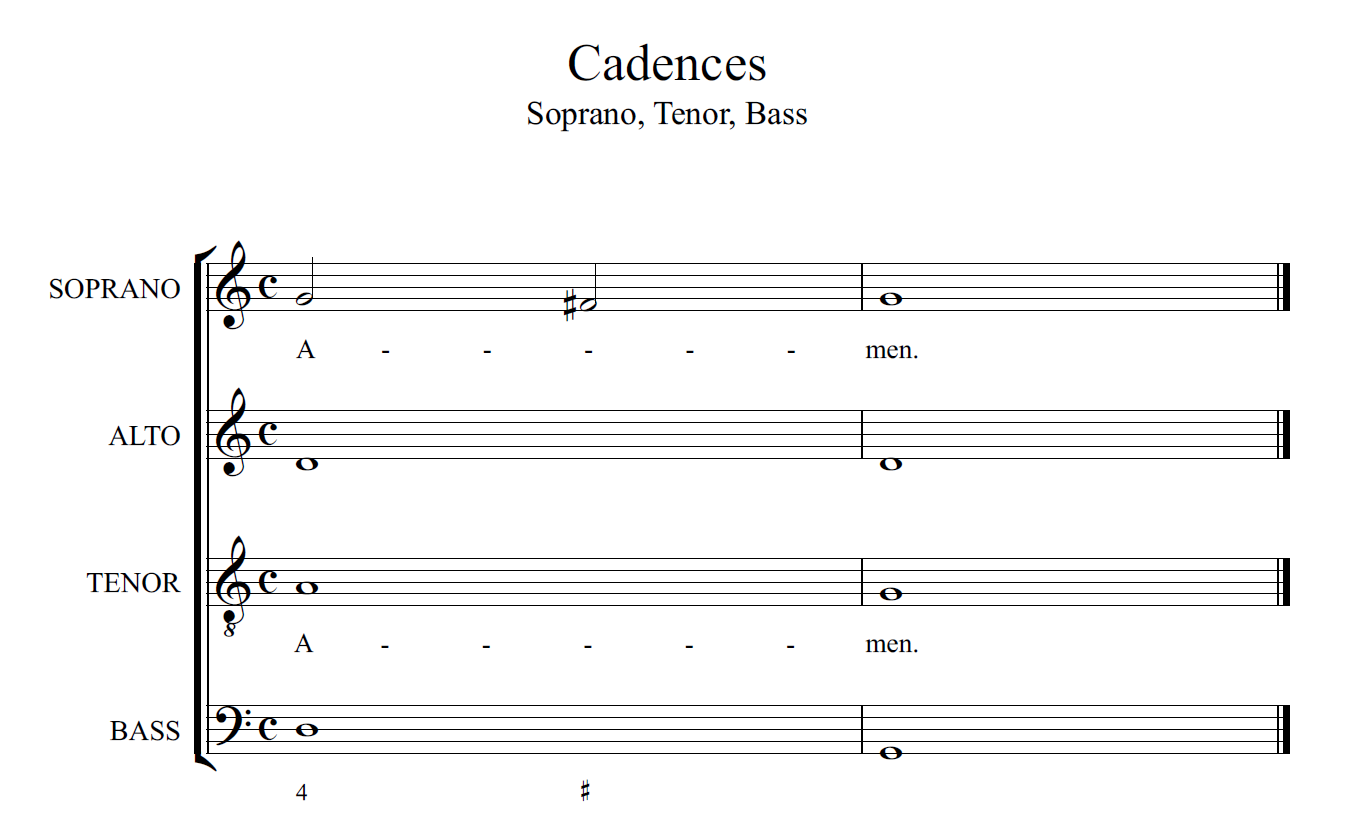
The Bass Cadence usually appears in the lowest voice. Tenor and Soprano cadences can be in any voice. The names Tenor and Soprano are used to identify the melodic shape, not the particular voice.


Cadence in La Musica

“Tenor Cadence” in the soprano voice. “Bass Cadence” in the continuo


In particular, in dramatic, sacred or courtly monody (let’s not muddy the waters by calling it Recitative  more here), how should we ornament what seem to be over-frequent cadences in long notes (minims or semibreves), especially the descending whole tone of the Tenor Cadence?

Diminution Manuals

When we look to the sources, there is an easy answer to this question. There are several historical treatises on the Art of Diminution, showing how any long note can be divided into shorter notes (hence the period English term for this practice, Division), with many examples of passaggi to be taken as models for prepared or spontaneous ornamentating. To ensure that the Diminution flows smoothly to the next note, these examples are categorised by the interval between the two long notes: up or down; unison, second, third, fourth etc. So all we have to do is select a treatise from the early 1600s (or a little earlier, representing the style that Monteverdi’s singers would have learnt from their teachers), and turn to the section on descending a second, and we can see a dozen or more historical solutions.

If a modern-day singer prefers to learn by ear (a reasonable and historical preference), then instead of studying recent CDs, it’s easy to record a selection of historical examples, or to transcribe period dimutions into Sibelius and export a sound-file. There are links at the end of this article for Divisions of the Descending Second by Virgiliano (1600) and Ortiz (1553). And this is a good moment to mention Helen Roberts’ excellent Passaggi app for improvisation and ornamentation, which offers a 21st-century learning approach using period sources. Practice your divisions here www.passaggi.co.uk


Making divisions on a descending second is an attractive and source-based answer for ornamenting Monteverdi’s monody. Unfortunately, it’s the wrong answer! And that’s because we have been asking the wrong question. Instead of asking “how should we ornament cadences?”, we should ask “how should we apply ornamentation?”.

How should we apply ornamentation?

The difference between these two questions becomes clear if we look at Caccini’s Le Nuove Musiche (1601).  [Translation of the Preface and link to the original  print here.] For his ‘noble manner of singing’ Caccini seeks to update the 16th-century practice of diminutions by ‘avoiding the old-fashioned manner of passaggi‘, which is ‘more suitable for wind and string instruments than for the voice’. Nevertheless, his didactic examples and composed songs have plenty of diminutions, fitting into the continuing tradition of Arie Passaggiati [ornamented arias]. So in preparing this article, I thought I would be able to extract from Le Nuove Musiche a useful selection of models for ornamenting cadences, to compare and contrast with Ortiz and Virgiliano.

I was wrong. Firstly, there are few Tenor Cadences in Caccini’s songs: he uses many Imperfect Cadences (7 6, in continuo-speak), and at Perfect Cadences (4 3) he prefers to give the voice the Soprano Cadence. But even more significantly, when he does write a Tenor Cadence, he almost always leaves it plain. There might be plenty of diminutions earlier in the phrase, but at the cadence itself there is a plain long note (in a couple of instances, he adds a simple trillo).


Dolcissimo sospiro (Le Nuove Musiche, 1601) passaggi and plain cadence


Somewhat rattled by this, I turned back to Monteverdi’s most famous examples of written-out diminutions: Orfeo’s magnificent ornamented aria Possente Spirto , the famous Echo piece from the Vespers, Audi Caelum and Monteverdi’s take on the Three Tenors: Duo Seraphim. Here as in Caccini’s teaching examples and chamber-songs, it is clearly seen that the passaggi finish just before each cadence.


Possente Spirto (Orfeo, 1607) passaggi and plain cadence


Audi Coelum (1610 Vespers) passaggi and plain cadences


Duo Seraphim (1610 Vespers) passaggi and plain cadence


Standard modern practice – leaving a phrase plain and then dividing the long note at the cadence – is the opposite of what Caccini and Monteverdi notate.


Prefaces & Treatises

In addition to Diminution Manuals and composed Arie Passeggiati, there are written commentaries on ornamentation practices in several early seicento Prefaces and Treatises.

In the Preface to the earliest surviving baroque music-drama, Rappresentatione di Anima e di Corpo (1600), Cavalieri’s instruction for singers is ‘senza passaggi‘ (and for the continuo, ‘senza diminutioni‘. In sacred music for solo voices and continuo, Cento Concerti Ecclesiastici (1602), Viadana warns singers not to add to the few melismas he writes. Caccini (1601) similarly remarks that he has notated all that is necessary for his chamber-songs.

Peri’s Preface to Euridice (1600) links, translation and commentary here emphasises the speech-like quality of his dramatic monody, in which intermediate syllables are sung so lightly that their pitch is almost indiscernible. He mentions that the famous soprano Vittoria Archilei has added diminutions to some of his previous compositions (‘more to obey the practice of our times, rather than because she thinks that therein lies the beauty and force of our singing’), and hints at ‘those beauties and delicacies which cannot be written, or if written cannot be learnt from notation’. Caccini also warns that the most exquisite touches – squisitezze – are beyond notation, but that they can be learnt from written examples combined with practice.

Effetti

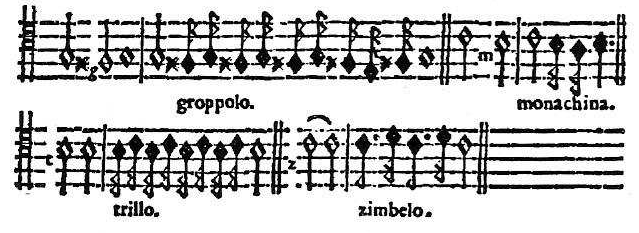
Caccini describes and shows how to apply a new type of ’emotional ornaments’, vocal effetti (effects) that produce affetti (emotions), instead of old-fashioned passaggi. Most frequently mentioned are crescendi/diminuendi on a single note, especially such on exclamatory words as Ahi! Deh!  etc. Phrases can be started with an exclamatione (forte-subito piano -crescendo, all on one note), with piano-crescendo on the first note, or rising from a third below. In the middle of the phrase, rhythms are systematically altered to make long notes longer, short notes shorter. For cadences, Caccini gives two simple ornaments: the one-note trillo (for the Tenor Cadence) and the two-note gruppo (for the Soprano Cadence).


Both examples (contrary to some modern-day recordings and performances) accelerate from slow to fast.

Similar effetti were introduced by Cavalieri (1600) in his Preface, and are indicated in the score itself by the intial letter of each effect. G = groppolo, T = Trillo etc.


Listen to and learn by ear Cavalieri’s & Caccini’s effetti here.

Cavalieri applies these effetti infrequently, perhaps just three or four times for the largest role (Anima), and less often for each supporting role. There are just two indications of gruppo in ensemble music.

This way of ornamenting may not be as ‘new’ as Caccini suggests. Giustiani (1628) describes differing ornamentation practices for sacred polyphony (passaggi) and monody (effetti) amongst performers in Rome as early as 1570. See Timothy McGee’s “How one Learned to Ornament in Late-Sixteenth Century Italy”. 

Rhythmic Alteration


Monteverdi notates rhythmic alterations in which the voice anticipates or lags behind the continuo accompaniment.

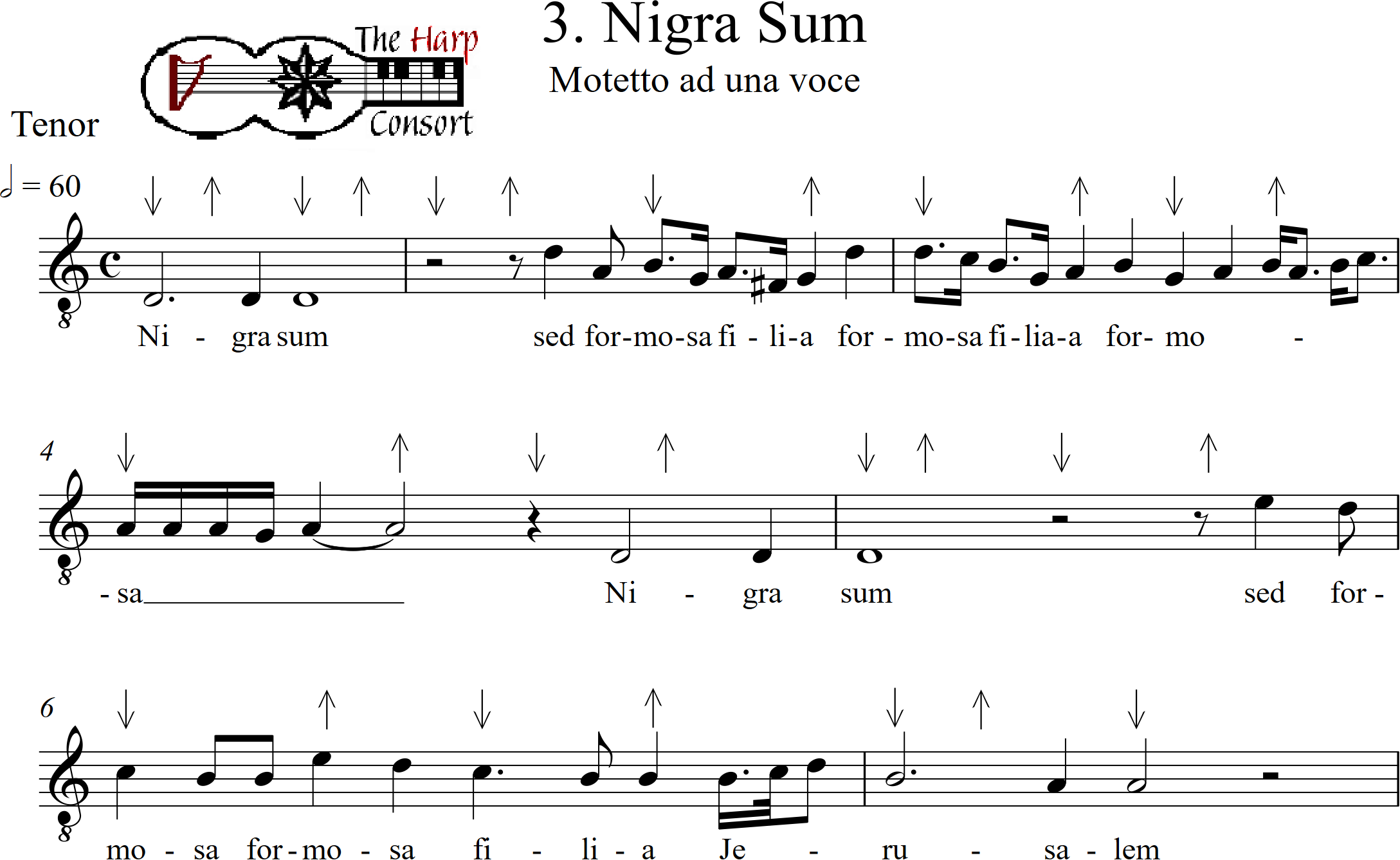
In bar 2, the singer’s “sed” is immediately after the Tactus-beat (just a quaver rest), ahead of the continuo-bass (which comes a crotchet after the beat)

In bar 4, the singer’s “Ni…” again enters  unexpectedly early, anticipating the continuo-bass which is played on the next Tactus-beat

In bar 5, the singer’s “sed” is immediately after the Tactus-beat, and the continuo-bass has a minim, played on the Tactus-beat. Although the singer’s syncopated rhythm is similar to bar 2, the effect here is of a delay, rather than an anticipation, because the structure-defining continuo-bass plays first. 

At the beginning of bar 4, notice also the effetto ornament on the final note of the Imperfect Cadence: Monteverdi uses this effetto also in Orfeo, but only a couple of times in the whole opera.


My esteemed colleague, Xavier Diaz-Latorre, makes the excellent suggestion that one can better understand these jazzy syncopations by first trying the “square” version, with voice and continuo together in the obvious way, in order to appreciate the subtle effect of the altered rhythm. Perhaps singers might introduce this effect spontaneously, even where it is not notated, whilst continuo-players maintain the steady groove of Tactus. Monteverdi, Caccini and Jazz here.

Caccini gives many examples of rhythmic alteration. The common feature is that long notes are extended to become extra long, and short notes are correspondingly adjusted to be even shorter, within the same Tactus-duration.


Rhythmic Alteration


Speech-like or Song-like?

In the Preface to Comboattimento (published in 1638, but first performed in 1624), Monteverdi writes that Testo, the Narrator, should avoid gorghe and trilli, except in the one Aria.

This is supported by the anonymous Il Corago (c1630),  who notes [at the end of Chapter X] that ‘there are only a few cadences appropriate to each voice, and these occur frequently’. Nevertheless, dramatic monody ‘lacks those ornaments and beauties which greatly embellish singing: I mean [a lack] of passaggi, trilli, gorghiggiamenti, because these are too far removed from the normal manner of speaking and work against moving the passions… and for this reason singers are forbidden to use these ornaments and adorments when they act [or perform, declaim] in this style.’ 

In Chapter XI section III, Il Corago explains that ornamentation can be applied to diegetic songs (representing on stage the act of singing). ‘To give the musician an opportunity to use all the artistry of music, such as gorge in passaggi and sweetly drawn-out melodies, the poet can have some of them represent singing… giving an opportunity to both composer and singer to make those passaggi and beauties which are absent from the current style recitativo‘.

For the whole genre of dramatic monody, Doni [Annotationi  pages 60-62] makes a similar broad distinction between speech-like and song-like music, and categorises speech-like monody into three types: Narrative, Expressive and Special. For Doni, (as for McGee and me), the word recitativo is problematic, but what he calls Special Recitative is closer to song (although he does not approve of that!) It is found in many pastoral scenes (Doni’s examples are from the opening scenes of Peri’s Euridice) as well as in Prologues. It is tempting to assume that Special Recitative might therefore allow some passaggi, but the evidence of seicento music-drama scores suggests that although there is plenty of music that Doni would categorise as Special Recitative, hardly any passaggi are notated.

Nevertheless, the Prologue to the 1589 Florentine Intermedi has wonderful passaggi, sung by Vittoria Archilei. These passaggi stop before each cadence.


There is also an Aria Passeggiata by Caccini, in which passaggi in the middle of the phrase lead seamlessly into gruppi at cadences.  The character-role is a Sorceress who will tear down the moon from the skies.


Most probably, the Intermedi reflect earlier practice, as yet less influenced by the northward spread of Neapolitan and Roman influences.

In 1607, Orfeo’s famous aria Possente Spirto shows the seicento application of the old-fashioned aria passeggiata genre , as the protagonist sings a diegetic song at the central moment of the drama. The divisions are spectacular and charm Caronte’s ears, even though they do not move his emotions. The passaggi end before each cadence, though Monteverdi adds effetti at some cadences.


Possente Spirto (Orfeo 1609) passaggi before the cadence, effetti at the cadence


Echoes

Echo scenes were a special case, where the poet cleverly answers his character’s questions with a responding Echo, whilst the composer provides short bursts of passaggi for the Echo to imitate in reply. There is nearly always a moment where the audience are led to expect an answer, but the Echo remains silent. Cavalieri’s Anima sets a musical challenge for the imitating Echo with ornamentation that aptly supports the meaning of each key word, and the poet triumphs at the end of the scene by creating a complete sentence from the Echo’s replies.


In Orfeo, Striggio’s Echo is less witty, but more expressive, and Monteverdi does not notate passaggi for the scene, perhaps because the key words are so emotionally loaded.


Audi Coelum brings the theatrical device of the Echo into the sacred domain, and enlivens the syllabic style of theatrical music with thrilling passaggi.


Genre distinctions – Phrases & Cadences – Passaggi Effetti


Putting all this information together, we can begin to understand in which genres, and at which moments within the phrase,  different types of ornamentation might be applied. We have to distinguish between song-like music and speech-like dramatic monody; between final cadences and the preceding phrase; between dividing long notes into elaborate passaggi and adding restrained effetti. 

Passaggi are associated with the main body of the phrase, with song-like music, and with ear-charming delight. Effetti are associated with cadences, with speech-like music, and with ‘moving the passions’. All kinds of musicial complexity, including passaggi, were considered inappropriate in dramatic monody, because they diminished the speech-like quality of the musical declamation, and therefore worked against emotional communication. But if an actor represents a character singing, then ornamentation becomes ‘realistic’ and appropriate.

Perhaps there was a slight tendency for song-like writing (Doni’s Special Recitative) to encourage small doses of passaggi even in theatrical music, but there is scant evidence for this. The reverse is evident: certainly there was a strong tendency for theatrical restraint (from ear-tickling divisions) and passion (in emotional effects) to be applied to chamber and sacred monody, especially where the text suggested a first-person embodiment of a character-role. In this sense, the soloist of Audi Coelum represents the character-role of a soul crying out to heaven for counsel; the tenor who sings Nigra sum sed formosa speaks the words of the Shulamite “I am a black girl, but beautiful”! 

Where passaggi were employed, they end before the cadence itself. Cadences can have trilli, gruppi etc, but only infrequently.


How to deal with cadences?


This leaves us wondering, what we should do with the cadences, if we don’t ornament them. Doni describes [Annotatione page 362] the standard practice of early seicento theatrical monody (even though as a theorist, he disapproves of it). He is shocked at the contrast between the fully sung penultimate syllable and the almost unpronounced final syllable.

The penultimate note (the accented syllable of the word, and the Principal Accent of the poetic verse) is nearly always a long note (minim or semibreve) and is really sung (in contrast to the speech-like delivery of the rest of the line, clearly described by Caccini and Peri as ‘something less than singing’). The final note (the unaccented final syllable) is short and unaccented, barely pronounced. Il Corago warns that final syllables should not be dropped entirely, but Cavalieri indicates a silence at the end of almost every phrase. Gagliano’s stage directions have the singer starting to move on the penultimate syllable of a strophe, so that they have already turned away from the audience for the final syllable. 

In sharp contrast to today’s standard practice, the period recipe is: almost speak in dramatic styles, or add passaggi to song-like phrases, but don’t ornament the cadence. At the cadence, really sing the penultimate note nice and long, and then the last note is short and unaccented.

Meanwhile, if you actually count the cadences, they are usually no more frequent in monody than in polyphony. Of course, prima prattica polyphony disguises cadences by avoiding simultaneous cadences in all the voices, whereas in monody voice and bass usually make the cadence together. But the percieved ‘problem’ of cadences may be one that modern performers have inflicted on themselves, by inappropriately sustaining last notes and by attempting to ornament in the one place they should not!

Ornaments or emotions?

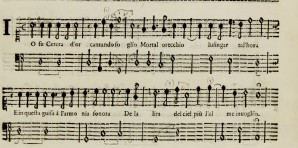
Doni (from his viewpoint as a theorist) and the utterly practical Il Corago both distinguish between song-like music with passaggi that delights the ear, and speech-like music that focusses on the pronunciation and emotions of the text in order to move the listener’s passions. In Orfeo, La Musica can do both:

Io su cetera d’or cantando soglio

Mortal orrechio lusinghar talhora

E in questo guisa a l’armonia sonora

De la lira del ciel, piu l’alme involglio

Singing to the golden lyre as always,

I can beguile mortal ears for a while.

And in this way, with the sonorous harmony

of the lyre of heaven, I can even influence souls.

But significantly, Caronte is not moved by the passaggi of Possente Spirto. And Il Corago explains why [Chapter X]:  ornamentation ‘distracts from the material that is sung about, and transfers your attention to the simple aural delight in masterly singing’. Doni describes this same dichotomy in terms of the rhetorical purposes of music: to delight, or to move the emotions? Caccini similarly contrasts the old-fashioned delight in passaggi with a new focus on moving the passions by means of crescendo/diminuendo, esclamationi and other effetti.

In this context, our modern focus on ornamentation of Monteverdi’s Recitative misses the point entirely. Instead of trying to apply passaggi to the cadences of dramatic monody, we should be focussed on delivering text to and inducing emotional response amongst audience members. And that’s why I’ve utterly lost patience with that ornament: it’s the wrong answer to the wrong question in the wrong situation. 


Finally, as promised, here are links to Diminutions of the Descending Second by Ortiz (1553) transcription and soundfile and Vigiliano (1600) transcription and soundfile. But these files come with a HIP health-warning: the entire argument of this article is that it is not historical to apply these passaggi to the cadences of Monteverdi’s dramatic monody. 

Baroque Opera then and now: 1600 & 1607, 1970-2020

How did Baroque ‘opera’ develop in the first decade of the 1600s?

And how have our modern-day performances of early music-drama advanced in a half-century of Historically Informed Performances?

This post is based on an interview for Radio Orpheus (Moscow)  in which the presenter, Russian poet, novelist and dramaturg, Alexey Parin asked me to compare and contrast two of the earliest surviving baroque operas: Cavalieri’s Anima & Corpo (1600) and Monteverdi’s Orfeo (1607). Both operas can be seen in regular repertoire at Moscow State Theatre ‘Natalya Sats’, in award-winning productions by Georgy Isaakyan, and in collaboration with OPERA OMNIA, the Academy for Early Opera & Dance.. My thanks to Alexey for his profound enthusiasm for opera, for his translation of the libretto of Anima & Corpo, and for his provocative questions in this interview.


With his long experience of opera in Russia, Alexey Parin finds the audience’s experience of the two works very different from one another.  Both productions succeed admirably, but why are they musically so different?


I think the first thing that strikes us, looking at the scores and listening to the music, is the similarity between the two works. Both composers are starting from the text, as if they were setting a spoken play to music.

But Monteverdi’s subject gives him the possibility for a lot more music, arising ‘realistically’ out of the drama. Since the protaganist is Orpheus, the great musician, the famous singer, of course we want to hear him sing and make music. And so he sings a magnificent Aria in Hell, accompanied by all the latest instruments of the early 17th-century Italian baroque. These are actually the same instruments that we hear in Cavalieri – violins, cornetti and the double-harp – but what’s now very different, is that with the excuse of Orpheus, Monteverdi writes virtuosi solos for these instruments. So although we have similar instruments, the sound of Monteverdi’s music begins to change.

Also in the earlier scenes, we are in pastoral Arcadia, and the shepherds of Arcadia all sing. They invite the Muses to descend from Parnassus to play instruments. So once again, Monteverdi has the chance to bring in a lot more ensemble music, proceeding ‘realistically’ from the mythological story.

Comparing the libretti

Another difference between the two works comes also from the text. With Orfeo, we are following one protagonist, we could almost say that the other characters are two-dimensional, only Orfeo is truly ‘there’. So while earlier operas exist on the same story, called Euridice, this drama is really the story of Orpheus. Eurydice has only two lines in the whole opera, but nevertheless what she says is extremely important, and perhaps her lines are the clue for understanding the whole opera. More about Eurydice here.

At the beginning when Orpheus sings beautifully of all his love for Euridice, her reply is that she cannot speak, and we should just ask Love, in order to know her feelings. And so we realise that Orpheus is perhaps speaking too much.

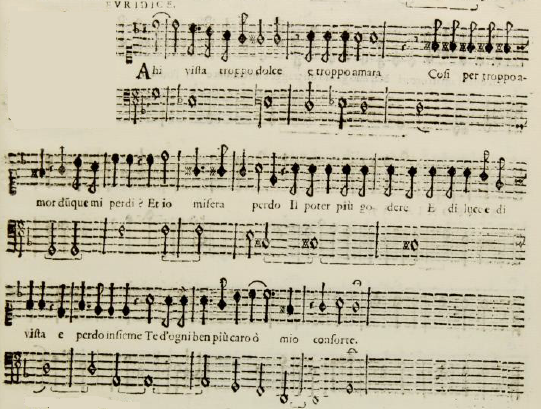
And this suspicion is reinfored with Eurydice’s second speech at the crucial moment in the drama, when Orpheus fatally turns to look at her. She says that the sight of him is too sweet, but also too bitter, and for the sake of too much love, he is going to lose her. And so in this very short speech, the word troppo, too much, comes three times. The poet is making it very clear for us here: this is the message. Orpheus was ‘too much’: too happy, too sad, too much love, too excessive in every way.

And so the message of the opera is then to look for the golden mean, for the perfect balance. But nevertheless, I think that Striggio as librettist and Monteverdi as composer both know that the audience enjoy the excesses. More about the message of Orfeo here.

And this brings us right back to Cavalieri again, because in his Preface, Emilio de’ Cavalieri says that the emotions in this kind of music come from rapid contrasts of opposites. More about Cavalieri’s Preface here.

Comparing the scores

It’s important to realise that a score in the early 17th-century had a very different purpose. It was not there for musicians like me to create a performance four hundred years later. More than anything, it was a souvenir for the public who had been to the performance and wanted to study the work further.

This reminds us how new this style of music-drama was. Cavalieri’s religious music-drama was so different from what had gone before, that he wanted to give his audience a chance to look at it again.

Nowadays, if we go to an opera we like, we might listen to the CD afterwards, as a nice memory of the real theatrical experience. So in Cavalieri’s score there is a lot of detail to help the reader remember the whole experience. He prints the music and the libretto and cross-references one to the other with numbers, number 1 in the music corresponds to number 1 in the libretto.

But, from the performers point of view, other information is missing. Many musical details are not specified in the score, and must be decided by the performers. In particular, the score provides no information about the orchestration of the instrumental parts, which instruments should play where.

In contrast, Monteverdi working at the Ducal court, wants to show off not only the opera, but also the court orchestra. So in his score, which is also a kind of souvenir-edition, he includes not only details of the drama but also a lot of information about the instruments. Especially at very strong dramatic moments…

This focus on moments of high drama shows us the purpose of publication. It’s not a score for musicians to work from. It’s to help audience members remember the show they saw. And so the score makes a kind of ‘close-up shot’ of the orchestra when it comes to the most dramatic moments. This gives us today, as musicians working with this historical material, vital information.

From the score, we know that in the original production of Orfeo, the instrumentalists appeared in different positions around the stage. We know that sometimes the instruments were part of the stage action. In a new piece of research, part of my investigation reveals that in one particular scene, when the Muses appear and the character La Ninfa says “you Muses have come with your instruments, so we’ll sing and you play, and everyone’s happy”, the score describes precisely which instruments play, and there are 10 of them – Apollo and the 9 Muses. So here the instruments are not just the accompaniment, they are part of the stage picture, and essential to the poetic concept.


Combining the information

But these differing levels of information in the two scores make today’s artistic process different for historically informed performers. Often Monteverdi writes details about the instrumentation that we don’t know from Cavalieri. For example, at the beginning of Act III, Monteverdi is extremely clear: the scene changes to Hell, the violins, the theorbos, the harp and the beautiful organs stop playing, and instead we have the cornetti, trombones and the regal. And so we can understand the two worlds, Hell and Arcadia, in Monteverdi’s opera. And this gives us a suggestion for the two worlds of Cavalieri’s opera, again Hell, and (now) Heaven. So from the point of view of a researcher and music director working with the score, it’s good to combine the information from both scores, to help us understand the cultural context of the period.

We don’t know if the Maenad ending was ever composed or not, but for sure it’s now lost. There’s a hint of  how the lost music might have been, in the Moresca that survives as the finale of the happy ending with Apollo. This Moresca starts in the score without time signature – there is no 3/2. This is very strange, and perhaps it’s because this Moresca was the continuation of something else, and that something else, whatever it was,is now lost. A Moresca, which is a danced battle, would also be an appropriate finale after the Bacchic ending with the Maenads. On the other hand, we should remember that often they would put a dance at the end that had no relation to the rest of the drama. After one of Shakespeare’s tragedies, the actors – including characters who had died – would all stand up and dance a jig. Cavalieri says that you can put whatever dance at the end of a show, but then what he actually writes is the perfect dance finale, actually, yes, very connected to the show. More about dancing in Orfeo and Anima & Corpo here.

Personally, I’m fascinated by this question of the end of Orfeo. In another production, in Helsinki, we showed both endings (with my reconstruction of the Maenad scene from the 1607 libretto), and I’m intrigued by the idea of letting the audience vote: should the final triumph be for Apollo, or for Bacchus?

Here in Moscow, in this production, in Georgy Isaakyan’s particular style, it seems to me that he doesn’t tell the audience what happens, he encourages them to ask themselves: does Orpheus live or die?

7 years of Early Opera, half a century of Historically Informed Performance

As we work on Orfeo at OPERA OMNIA, we now have the advantage of 7 years of work together in Theatre Sats on the baroque style of Cavalieri. More about how to study early operatic roles here. No doubt 17th-century musicians also developed their ideas in the 7 years between Anima & Corpo and Orfeo. And I think it’s also fair to say that Monteverdi is musically more difficult than Cavalieri. In our production of Orfeo, we have the opportunity to sing in the Italian language, which makes some things easier for the music, but challenges the actors to make that direct contact with the audience that we have when we sing Anima & Corpo in Russian. More about OPERA OMNIA here,

Perhaps the most unusual thing about the musical approach for the Orfeo production is that we have effectively two musical directors, in the same way that Monteverdi effectively had  two orchestras: the orchestra of the violins and wind instruments who play written parts; and the orchestra of the continuo who improvise their parts. And just as Georgy Isaakyan’s staging is an encounter between Monteverdi’s 17th-century story, and Russia of the 1970s and 1980s; so there is a similar contrast within the musical realisation. Amongst the continuo and soloists, we share the latest ideas of Monteverdi’s baroque style; whilst in the orchestra and chorus the audience are presented with the Russian way to play baroque from the 1970s.


This juxtaposition of fundamentally differing approaches to early opera within one production has led to me reflect on how Historically Performed Performance of Monteverdi has changed in my own lifetime. In the table below, I attempt to identify some key topics and trail-blazing pioneers associated with significant re-discoveries. Any serious early opera production should at least consider these topics. Nevertheless, even decades later, some findings are still considered too “radical”, whilst others are routinely ignored, even by ‘historically informed’ ensembles.


How HIP is your Monteverdi?


  • Chitarrone  1960s Robert Spencer


  • Cornetto  1970s Bruce Dickey
  • Vocal ornamentation    1970s Nigel Rogers
  • Quarter-comma meantone   1970s Mark Lindley
  • Negri/Caroso dance  1970s Julia Sutton
  • Renaissance recorders  1970s Bob Marvin, Martin Skowroneck


  • No conductor  1980s Roger Norrrington
  • Recit without bowed bass  1980s Graham Dixon
  • Baroque harp  1980s Frances Kelly, ALK
  • Led from continuo  1980s Ensemble Tragicomedia
  • Renaissance violin band  1980s David Douglass, Peter Holman
  • Count recit in minims  1980s Ensemble Tragicomedia
  • Metre in Music  1980s George Houle
  • Baroque Gesture  1980s Dene Barnett
  • Il Corago  1980s Fabbris & Pompilio
  • Chiavette  1980s Andrew Parrot
  • Vibrato  1980s Greta Moens-Haenen


  • Proportions  1990s Roger Bowers
  • Pitch  1990s  Bruce Haynes


  • Monteverdi’s Musical Theatre  2002 Tim Carter
  • 1615 print free online  2009 IMSLP


  • Tactus throughout  2010 ALK
  • Historical swordsmanship  2012 Guy Windsor
  • 1609 print free online  2013 IMSLP
  • Beating time & measuring music  2014 Roger Mathew Grant
  • Arianna a la recherche  2017 ALK


  • Violini alla francese  ?
  • 5 trumpets  ?

Of course, this list reflects my own personal experiences and fortunate encounters with individual experts. So I look forward to your comments, corrections and additions. And most importantly, I look forward to new research findings in the 2020s, which will provide new impetus for re-thinking, re-imagining and re-working Monteverdi’s theatrical music.


Orlando Orlando: Drama and dance-rhythms

1st November 2019:
To celebrate Orlando Orlando‘s being nominated for Russia’s highest theatrical award, the Golden Mask, in 6 categories – best production Georgij Isaakyan, best design Hartmut Schörghofer, best musical direction Andrew Lawrence-King, best lighting design Alexey Nikolaev , best female soloist Maria Mashulia, best male soloist Kiril Novakhatko – this article has been updated with additional commentary on Handel’s techniques of Drama & Dance-rhythms.

This article was first posted in connection with the premiere of Handel’s Orlando at the Helikon Theatre in Moscow, 27th March 2019, entitled Orlando, Orlando: Handel’s Orlando (1733) in memory of the victims of the shooting at the Pulse nightclub in Orlando, Florida (2016). Music by George Frideric Handel, Libretto adapted from Carlo Sigismondo Capece L’Orlando (1711) after Ludovico Ariosto Orlando Furioso (1516/1532). Concept & Adaptation by Georgij Isaakyan (Director), Edition by Andrew Lawrence-King (Musical Director), Techno episodes by Gabriel Prokofiev, Design by Hartmut Schörghofer.

Synopsis of Georgy Isaakyan’s version (read online and/or download pdf)

Orlando Orlando libretto (includes English translation: read online and/or download pdf)

This production is not an ‘authentic’ reconstruction of baroque opera, but a new work of music-theatrical creativity in which 18th-century music tells a 21st-century story, bringing together Gabriel Prokofiev’s specially composed electronic music and the most modern understanding of how George Frideric’s score would have sounded at the King’s Theatre, London in 1733.

For Orlando, Handel assembled an unusually large orchestra with a powerful bass-section, and the dance-rhythm of the fashionable Gavotte is heard several times, representing Orlando’s fury.

In his madness, Orlando identifies Angelica as the mythological godess Persephone: “Beautiful eyes, no, do not weep, no”

In his madness, Orlando mistakes Dorinda for the goddess Venus, or an enemy warrior: “Already, I wrestle him; already I embrace him  with the force of my arm”

In the extraordinary mad-scene created for the famous Italian castrato Senesino, bass instruments play alone as the protagonist descends into a hell of jealous rage.

“I am my own spirit, cut off from myself. I am a ghost, and like a ghost I want to make the journey down there to the kingdom of sorrow!”

And the full orchestra lurches into 5/8 metre as Orlando imagines himself rowing Charon’s boat into the underworld.

“There is boat across the river Styx! In spite of Charon, already I’m rowing over the waves”

Handel freely borrowed from other composers’ (and his own) work, and the previous season he re-wrote two earlier dramas, expanding the chamber-opera Acis & Galatea and transforming a one-act staged masque into the first English oratorio, Esther, performed as a three-act concert with the addition of solo harp, trumpets, drums and a chorus. For Orlando, Handel adapted Carlo Sigismondo Capece’s (1711) story of mad jealousy, itself a re-working of episodes from Ariosto’s 16th-century classic, Orlando furioso. Bernard Picart’s (1710) engraving of the giant Atlas, republished in 1733 as Le Temple des Muses, was re-interpreted as the stage set for the opening scene with the magician Zoroastro.

Perhaps this 1731 print inspired the first scene of Handel’s ‘Orlando’

Handel’s audience were thrilled by several spectacular stage transformations, utilising the full resources of period stage machinery and dramatically presented as the result of Zoroastro’s magic, assisted by his demons. In our production, Schörghofer’s design employs modern stage technology to offer the audience surprise and spectacle, whilst clarifying the subtly interwoven stories as characters from medieval romances (Chanson de Roland, 11th cent) are re-drawn by Boiardo (Orlando innamorato, 1495) Capece, Handel and Isaakyan.

“Orlando Orlando” at Helikon Theatre

A German musician producing Italian opera in England, Handel writes a conventional French-style overture, but surprises the audience with up-to-date dance-music, a fast Italian giga.

This Italian giga has characteristically continuous movement in the melody line, with a driving bass.

Listen to how Gabriel Prokofiev transforms Handel’s giga, the height of fashion in 1733, into 21st-century electronic dance-music.


The rhythmic drive of the giga is disrupted with broken phrases to depict Dorinda’s misplaced faith in ‘sweet little lies’.

In spite of trills and rests, this Aria still shows the characteristics of an Italian giga: “Oh dear little words, sweet glances; even if you are lies, how I will believe you!”

The step-and-jump rhythms of a French gigue are heard in Medoro’s second Act aria;

The restrained movement of a French gigue characterises Medoro’s hesitation: “I would like to be able to love you, but…”

the slow swing of an Italian folk-dance, the  siciliano characterises Dorinda’s wistful longing;

More gentle than a giga, the tender siciliano characterises Dorinda’s nostalgia for a love that never was: “If I return to the meadow, I am made to see my Medoro in every flower”

Orlando’s lament in hell is sung to a French passacaille.

In French operas the descending bass of the minor-mode passacaille suggests tragic passions and creates opportunities for expressive dissonances and chromatic variations: “For from tears even in the kingdom of Hell, pity can be aroused in everyone”. The audience come to realise that this text is ironic: in his madness, Orlando shows no pity for Angelica, and changes his Gavotte-refrain to “Yes, eyes, weep, yes, yes!”

The composer’s bold strokes of dramaturgical re-designing and contrasting musical styles were further transformed by unwritten baroque performance practices. Continuo-players spontaneously realised the written bass-line with rich harmonies and strong rhythms; singers added their own variations to the repeated section of a da capo aria; sometimes time would stop whilst singers  or instrumentalists improvised a final cadenza. Handel did not conduct, but directed by playing the harpsichord, alongside the theorbo (bass lute). The expression of the vocal line was not indicated with markings of piano and forte, but follows from the accentuation and emotions of the words.

This Recitative is not just rapid patter, look at all the rhetorical detail: A long note and glorious high notes for “As custodian of your glory…”. Strong dissonance for “I stimulate you to follow it”. Another long note for “Urge.. ” and the highest notes and thrilling contrasts of short notes for “…your heart to great works!”. A long sigh “Ah!” with an intake of breath afterwards, dissonance and Orlando’s voice dropping “love takes it all away from me”. Zoroastro’s voice rises with long notes and an unexpected sharp in the melody-line for “It will be given back to you by valour!”. Orlando’s falling phrase (which would be given the conventional drooping appoggiatura) “It languishes in my breast”. Zoroastro’s strong retort with high notes “Scorned…”, snappily broken phrases “is that what you want to be…” and a suitably horrible melodic tritone “by a vile little boy?”. The “little boy” is Cupid as the flute’s flapping wings show in the following bars.

Instrumentalists similarly have few written phrasing-marks, but imitate the crisp articulation of the Italian language with a great variety of bow-strokes.

What might appear to be just a series of equal quavers acquires subtle rhythmic patterning from the long/short, accented/un-accented syllables of the Italian text, imitated in this English-language metrical paraphrase: “Respond to it for me; your heart might tell you that.. I discard all your love”. Today’s performers might usefully channel a jazz-singer’s approach to text and rhythm, rather than classical training.

For the eerie calm of Orlando’s final aria we added baroque harp, which in Handel’s dramatic works suggests a vision of heavenly peace. Trumpets and drums represent royal authority and military power; horns and oboes a pastoral idyll; the flute an amorous nightingale or Cupid’s fluttering wings. Modern scholarship has revealed the subtle structure of Handel’s recitatives, which imitate the pitch contours and speech rhythms of a great actor in the baroque theatre.

Studying the text as dramatic speech in the grandiose style of baroque spoken theatre reveals how accurately Handel notates [what Il Corago first described c1630 as] ‘the declamation of a fine actor’, in the generation between Thomas Betterton and David Garrick. As shown in my English-language metrical paraphrase: Zoroastro barks out his anger with the urgency of poetic anapests followed by the characteristic contrast of short and long notes “To what risks you’re exposed now, you reckless lovers, by blinded love!”. Angelica’s reply is a languid drawl “We only have to get free from Orlando.” Zoroastro barks again with the upward intonation of an abrupt question “And if he comes here?” – singers can appropriately add an upward appoggiatura. Medoro tries to assert himself, but Handel’s downward inflections betray the character’s weakness “My heart is also valiant!” and Angelica interrupts with powerful rhythm and a strong upward leap “P’haps for my sake, he would not be so cruel” – the conventional appoggiatura makes a harsh dissonance here. Zoroastro mimics her phrase with the slow tempo of bitter sarcasm “And he’ll be nice… to his unfaithful lover?”. With a wonderfully dramatic contrast, he switches back to fast anapests “Hurry up and get running, fly away from his anger…”. The notated rhythms of Handel’s music work perfectly as dramatic speech.

See my previous article on tempo and rhythm for Handel, here.

We added a chorus, whose members (in the manner of Handel’s oratorios or Bach’s Passions) comment on and drive forward the events of which, in the end, they are the victims. Their music is borrowed from Handel’s drama of cultural identity and religious conflict, Israel in Egypt (1739): Handel himself re-worked one of these choruses for Messiah (1741).

In Isaakyan’s reworking of the story, the magician Zoroastro appears in different guises, always as an authority figure: a star news-presenter, a domineering father, a bible-preacher, a populist politician. The choruses I selected show the public’s various reactions: unchallenging acceptance “Great was the company of the preachers”; anxious forboding “The people shall hear and be afraid… they shall be as still as a stone”; belated understanding “There came a thick darkness”; and a fascination with destructive power “He gave them hailstones for rain, fire mingled with the hail”.

“Orlando Orlando” Premiere Left to right: Hartmut Schörghofer, Gabriel Prokofiev, Georgy Isaakyan, Andrew Lawrence-King, Dmitry Bertman

Orlando, Orlando: Nominated  for the Golden Mask in 6 categories (2019)


Understand, enjoy and be moved! Listening to the Rhetoric of Orfeo

This article is based on a pre-performance talk for the production of Monteverdi’s Orfeo at the Vaasa Baroque Festival and in Helsinki, October 2019.

Many audience members seeing performances of Orfeo in 2019 will encounter a more-or-less familiar situation: a baroque opera with Historically Informed Performance of the music, shown in a thoughtful and sympathetic modern production. Nevertheless, a staged production of Monteverdi’s 1607 music-drama is a special event. This beautiful and moving work is justly famous as one of the very first operas, admired by Early Music fans for its varied ensembles and rich instrumental writing. But it is not often staged: Opera Houses tend to favour more the austere scoring and stark psychodrama of Poppea (1643).

What’s different now?

In this particular production, some features that are different from mainstream opera reflect the situation at the first performance in Mantua. The venue is a hall (originally a room within the Ducal Palace) not a purpose-built theatre. The performing space is small, there is no stage machinery. The cast is just 9 singers, some of them doubling roles, and all of them combining to form various vocal ensembles – there is no separate chorus.

Other features of this project reflect the latest research findings in Historical Performance Practice. The instruments are distributed in contrasting ensembles (strings, flutes, continuo, cornetti & sackbuts) across various positions behind and to the sides of the stage. Cello and violone play with the string ensemble, not with the continuo. The default scoring for continuo is organ & theorbo. Singers and continuo alike avoid ornamentation in this stilo rappresentativo – theatrical style.

There is no conductor, not even someone waving their hands whilst using a harpsichord as a very expensive music-stand!  The anonymous writer of a c1630 manuscript for a Baroque Opera Director, Il Corago, rules out even the Tactus-beating that would be usual in madrigals and religious music. Nevertheless, as Frescobaldi describes in 1615, the whole performance is ‘facilitated by Tactus‘, a slow, steady pulse around one beat per second, which changes slightly according to the emotional affetto from one movement to another.

What was different in 1607?

But if the concept of Baroque Opera is familiar to us, then we might question how today’s situation differs from the experience of the audience in 1607. Certainly, they would not have viewed Orfeo as the beginning of a ‘History of Opera’. They could not know the future, but they were well informed about the recent past and excited at the on-going development of new genres of music-drama.

These were not yet called opera. Orfeo is favola in musica, a story in music. That music was only rarely called recitativo: the usual word (as for Orfeo) was rappresentata, a show, a theatre-piece. In the following year, 1608, librettist Ottavio Rinuccini made the bold move to claim for Monteverdi’s lost masterpiece Arianna the grand status of Tragedia (Tragedy) rappresentata in musica.

There was not yet any specific training for opera-singers. The 1607 cast were court and chapel musicians, all male, who brought to the stage their rhetorical skills of presenting poetry, of narrating stories, of expressive gestures and court decorum – how to stand, where to position oneself, how to behave in the presence of a Prince, or (in this case) in the presence of the demi-god Orpheus, or of Pluto, King of the Underworld. This all changed the following year, when professional actresss Virginia Ramponi-Andreini, known as La Florinda, brought her stage-skills to Arianna, performing the famous Lament to great acclaim.

But even though there was no word for it, by 1607 opera was already a ‘thing’. Peri describes in the Preface to Euridice (1600) how to turn theatrical speech into music; Cavalieri gives detailed instructions for opera-composers and performers in the Preface to Anima & Corpo (1600), the earliest surviving such work. In 1601, Caccini proclaims the priorities of the nuove musiche – new music – as Text and Rhythm.

Research into ancient Greek drama and experiments with new genres were supported by renaissance Academies, including the Mantuan  Accademia degli Invaghiti (music-lovers) who promoted Orfeo. The aristocratic and artistic membership of the Academy would have regarded the work as Striggio’s verse-drama set to music by Monteverdi. And much of what we might today analyse as Musical Forms comes from the poetical of the libretto. But Monteverdi sometimes chooses to disregard Striggio’s blue-print, tending to prefer expressive Monody even where the design of the verses suggests Aria.

As Tim Carter writes in his survey of Monteverdi’s Musical Theatre (2002), Academy members’ chief delight was in a show of Rhetoric.  Rhetoric is the use of persuasive speech to explain, to entertain and to stir up the emotions. This focus on words might surprise us, as a way of listening to Monteverdi’s music, but if we think of Shakespeare’s plays (e.g. Anthony and Cleopatra, also in 1607), then we can understand such delight in the powerful use of heightened language.

So in the Prologue to Orfeo, as La Musica tells the story of Orfeo, the sound of instruments tickles your ears, and the supernatural power of Music moves your soul. At the gates of Hell, Orpheus’ song delights Charon’s heart, but does not arouse any emotion of pity in this tough male. Several decades before Descartes, period Medical Science did not consider a mind/body dualism, but more complex models with mind, spirit, soul, heart and lower-body emotions all interacting.

Academicians admired ancient Greek drama for its capacity to move the audience’s passions ‘to tears or laughter’. And Monteverdi’s reputation as ‘the divine Claudio’ was precisely for his ability to compose music that profoundly affected listeners, even if such contemporaries as Artusi complained about technical breaches of the rules of counterpoint.

As music, Monteverdi’s Orfeo was rappresentata – staged, a show. As literature, Striggio’s Favola d’Orfeo was rappresentata in musica. And according to the new concept of Personation – the ‘realistic’ embodiment of a character on stage, for example in Shakespeare’s Hamlet (c1600) – Orpheus himself is ‘represented’ in this drama. We listen to the words, we hear the music, we watch the action, and we are moved also by seeing Orpheus’ reactions.

But the decorum of Greek drama would not allow death to be enacted, and in Classical Theatre the most dramatic events were presented as Narration. This tradition of stage Messengers suited baroque singers’ skills in presenting Rhetorical speech in music: telling a story, delighting in detail, moving the listeners’ passions.

We tend to hear baroque opera as Recitative and Aria, in which Recitative is the ‘boring bit between the nice tunes’. This is problematic, since Monteverdi writes only a few ‘nice tunes’. His audience was – of course – unaware of Mozart, Handel and Vivaldi’s operatic recitative, or the story-telling Evangelist in Bach’s Passions. The words Recitative and Aria were used. but around 1600 they had different meanings. New scholarship on this subject is crucial for a better understanding, not only of how to perform, but also of how the 1607 audience would have heard Orfeo.

Recitare means ‘to act’. According to Doni’s (1640) Annotazioni it is incorrect to apply this word to dramatic Monody.  Il Corago explains that there are three ways to act – recitare: with music, with plain speech, and in silent mime. So musica recitativa simply means ‘music for acting’, everything that is delivered by a soloist. including Aria. Aria in this period is any repeated structure in music, rhythm or words. So in period terms, Shakespeare’s ‘A horse, a horse, my kingdom for a horse!’ [Richard III (c1593)] is an Aria within the Recitative of the whole speech.

In the 20th century, it was assumed that expressive recitative required romantic rubato. But Monteverdi’s rhetorical purpose is not to express the performer’s emotions, but to move the audience’s passions. He does this with subtly composed and carefully notated contrasts of pitch, harmony, rhythm and speed of declamation, controlled by the steady pulse of the Tactus beat.


How to listen?

Concentrate on the words.

Let the poetic imagery create Visions in your imagination, as if the events were happening before your very eyes.

Let the power of your own imaginative Visions be supported and enhanced by what you see on stage and what you hear in the music.

What does it mean?

In Monteverdi’s dramatic Monody – music for acting – contrasts in pitch represent the impassioned speech of a great actor. Speaking on a monotone is code for ‘Let me tell you a story’ – if there is no music, concentrate on the words.

Contrasts of syllabic speed indicate heightened passion. Crescendo on a single note carries the emotion to the listener. Speaking on the Tactus beat suggests stability, whilst being off the beat or syncopated shows agitation.

The continuo bass is structured to convey emotions: a sustained pedal-point signifies seriousness; slow movement of the bass accompanies a serious or sad subject; fast movement creates the lightness of happiness and dancing. Dissonances of many different types show varied emotions.

Typically, there are many changes of emotions, often with rapid contrasts between opposites.

Ensemble music, vocal or instrumental, on stage represents diegetic, ‘real life’ music. The string ensemble symbolises the mythical Lyre, associated with boh Orpheus and Apollo. Strings, flute and harp are played by the nine Muses. A pair of flutes suggest pastoral pan-pipes. The snarling Regal is the organ from Hell. Cornetti and sackbuts evoke the horror of Hell or the power of sacred music.

In a humanist opera, we might well ask, to Whom is music sacred? To Apollo? Apollo and Orpheus were understood as allegorising God and Christ. Or to Bacchus? Whilst the 1609 and 1615 prints of Monteverdi’s music have a happy ending in which Apollo rescues Orpheus from despair, Striggio’s 1607 libretto ends with a glorious triumph for the opposing team, Bacchus and his hard-drinking, hot-loving Maenads. Andrew Lawrence-King has reconstructed music for the original ending, and you will have to wait till the end of the show to find out who triumphs in the end.

So, in the best traditions of Rhetoric, I hope that this Explanation helps the music move your Emotions, and that you Enjoy the show!

Read more at the ORFEO Page by Il Corago

I won’t say too much… the role of Euridice in Monteverdi’s Orfeo

This article is posted in connection with the production of Monteverdi’s Orfeo for Vaasa Baroque Festival in October 2019.

See also The Orfeo Page by Il Corago for further articles and a documentary film.

Whilst Rinuccini’s verse-drama, set by Peri and Caccini in 1600, has the title L’Euridice, Striggio’s 1607 libretto for Monteverdi presents the same mythological ‘fable in music as a theatrical show’ – favola in musica rappresentata – as L’Orfeo, and the focus is almost exclusively on the protagonist. Following the trend towards Personation – increasingly ‘realistic’ embodiment of theatrical roles – seen also in Shakespeare’s Hamlet and other dramas circa 1600, Striggio seeks to move the audience’s passions by encouraging them to watch how each event affects the central character, Orpheus himself.

As Rhetoric,  baroque music-drama persuades by Logos (word), Pathos (emotions) and Ethos (character). Details of poetic imagery in the text use the power of Energeia not only to express, but to induce listeners to share in ever-changing emotions, from the very beginning of the first Act: In questo lieto e fortunato giorno (happy and lucky)… sospirato e pianto (sighing and crying)… lieto e fortunato (happy and lucky again). As the first Pastore delivers those words and sends out waves of Energia (the communicative spirit of passion), he also mentions and gestures towards nostro semideo (our demigod)… Orfeo, directing the spectator’s attention to the protagonist. The audience then sees the present happiness and good fortune as well as the past melancholy and tears, all mirrored in the face and gestures of the principal actor, reflecting and amplifying the emotional Energia. This amplification is all the more effective, because that actor embodies a character renowned for his divine ability to convey emotions in music. Logos, Pathos and Ethos thus unite to convert poetic Enargeia into emotional Energia, with music as the catalyst.

Also, Orpheus is the presiding figure at the pastoral court of Arcadia. Renaissance courtiers were accustomed to watching their Prince, to gauge his reactions to any event. As the audience at a performance, they would divide their attention between the performers and their Lord: their appreciation of the show depended on his approval. So the split-screen effect on stage (simultaneously showing the action, and Orpheus’ reaction to it) takes advantage of the audience’s real-life experience to super-charge the emotional impact.

This is most obvious in the long Messenger scene, where Eurydice’s death (too terrible to be enacted, and too impractical to show on stage effectively) is narrated in every detail, with almost cinematic changes of pace from the girls fussing around her dying body with cold water and powerful charms to the heroine’s languid eyes and last deep sigh. (There are similar contrasts of pace, with slow-motion effects and rich poetic detail, for the death of Clorinda in Monteverdi’s Combattimento.)

As we hear detailed narration, we envisage the scene. And the 1607 audience also saw Orpheus’ reactions: at the bitter news, the unhappy man is like a mute stone, who for too much grief cannot grieve. A l’amara novella rassembla l’infelice un muto sasso, che per troppo dolor non puo dolersi.

Nevertheless, it does seem surprising that Eurydice herself has only two speeches in the entire music-drama. In the original production, the part was played by a male soprano (perhaps the little priest who had so much difficulty memorising words), but this in itself would not have been an obstacle to extending the role. Shakespeare’s plays, even the great love stories of Romeo and Juliet or Anthony and Cleopatra were originally performed by all-male casts, and the Mantuan audience would have been accustomed to this convention.

The result of the concentration of Eurydice’s entire role into just a dozen lines (six in Act I and another six in Act IV) is to invite us to weigh carefully every word she utters, and to listen attentively to Monteverdi’s realisation of her emotions in the most expressive genre of dramatic monody. More about Monteverdi’s monody here.

I won’t say…

Io non diro qual sia
Nel tuo gioir Orfeo la gioa mia,
Che non ho meco il core,
Ma teco stassi in compagnia d’Amore.
Chiedilo dunque a lui, s’intender brami
Quanto lieta gioisca, e quanto t’ami.

I won’t say what might be
In your joy, Orpheus, my own joy,
For I don’t have my heart with me,
But it is with you, in the company of Love.
Ask this therefore of my heart, if you desire to understand
How happily I rejoice, and how much I love you.

Whereas Orpheus’s love song Rosa del ciel is a rhetorical and musical tour de force, opening with the solemn dignity of an invocation of Apollo over a sustained bass on Gamut (the foundation of all music), Eurydice begins plainly. Her first words show the feminine modesty expected at the time, and Monteverdi’s music obediently takes up the D harmonies from the end of Orpheus’ song. And in spite of the structured poetry in rhyming couplets, she does not sing, but speaks (in the convention of expressive Monody).

But what expression Monteverdi introduces! The harmonic shift to the hard hexachord in the continuo-bass C#6 – E major – A minor foreshadows the harmonies of the Messaggiera’s despairing wail Ahi, caso acerbo!, of Orpheus’ tragic wrong turn in Hell ma qual eclissi, ohime, v’oscura? and of his last request to Apollo Ma non vedro piu mai  de l’amata Euridice i dolci rai? (But won’t I ever see again beloved Eurydice’s sweet eyes?)

Euridice does not say much, but with her words “I will not say..”, Monteverdi says all that could be said.

Now the harmonies turn to the natural hexachord, C major, with Orpheus’ joy and hers too. But a strange melodic leap and high dissonance highlight the poetic imagery “I have no heart” – this conventional trope will gain uncanny power in Act III when Orpheus argues that since his heart (Eurydice) is no longer with him, without a heart he cannot be alive, so he must qualify for passage on Caronte’s ferry to the underworld.

In a speech artfully crafted to appear naive, the rhetorical term dunque stands out as an unexpected connector …therefore… Perhaps Striggio is marking connections to other appearances of this word: in the first Pastore’s opening speech (where it underlines a rhetorical repeat of the first lines); in the second Pastore’s reminder that joy comes from heaven; in the Shepherds’ praise of Orpheus and his Lyre in Act II; and in Apollo’s formal invitation to heaven at the end of the whole drama.

In Eurydice’s first speech, by the time we reach the word Amore, we have returned to the soft hexachord and to the harmonies of Orpheus’ song. And her last words are the simplest possible declaration, “I love you”, all on one note. This is a musical code: the absence of melody tells the audience to pay attention to the words. And if we listen carefully, two words are repeated in this short speech, emphasising the emotional tone: love and joy.

But nevertheless there was a hard hexachord hint of trouble ahead when Orpheus’ desire is coloured by B natural, whilst Eurydice’s love has soft hexachord Bb. Bramare (to desire) evokes the Choleric humour associated also with anger, violence and Bacchic excess; whereas amare (to love) is associated with the generosity, joy and hope of the Sanguine humour. With delicate choice of similar but contrasting words and notes, Striggio and Monteverdi drop a subtle hint that Eurydice’s feelings are appropriately warm, but Orpheus’ passions are already too hot.

Too much!

Ahi, vista troppo dolce e tropp’ amara!
Cosi per troppo amor, dunque mi perdi?
Ed io, misera, perdo
Il poter piu godere e di luce
E di vita, e perdo insieme
Te, d’ogni ben piu caro, o mio consorte!

Ah, sight too sweet and too bitter!
Thus through too much love, therefore you lose me?
And I, wretched girl, lose
The power anymore to enjoy light
And life, and I also lose
You, of every good thing the most dear, Oh my husband!

Only one word from Eurydice’s first speech is heard when she speaks again: that word is Amor – love. But two new words dominate this short but emotionally searing lament: troppo – too much, and perdere – to lose, and they are connected by another rhetorical dunque. The message could not be clearer: it is Orpheus’ excessive emotions that have resulted in total loss.

This verdict will be underlined by the commenting chorus at the end of the Act: Degno d’eterna gloria fia sol colui ch’avra di se vittoria. (Worthy of eternal glory is only he who will have victory over himself.)

And at the end of the story, Apollo hammers home the lesson, arriving when Orpheus is ‘in greatest need, driven to a desperate end with extreme grief by anger and love’. Al maggior uopo arrivi, ch’a disperato fine con estremo dolore m’havean condotto gia sdegno ed Amore.

Apollo’s message is stern and clear:

Troppo, troppo gioisti
Di tua lieta ventura,
Hor troppo piangi
Tua sorte acerba e dura.

Too much, too much you rejoiced
In your happy luck,
Now you cry too much
For your bitter and harsh fate.

But with the following dunque (the last one), drawn out and high in the voice, Apollo connects his severe judgement to an invitation to eternal life in heaven, and Orpheus is saved to admire Eurydice’s beautiful face in the sun and the stars.

Euridice’s Act IV music is also loaded with information and emotion. The expressive exclamatione in the soft hexachord, “Oh!”, with a tender dissonance against Eb (compare Grandi’s O quam tu pulchra es here) twists unexpectedly to hard hexachord and the fatal harmony of E major on dolce, an ominously troubled sweetness. Amara returns to soft hexachord Eb again, but with the bitterest dissonance this hexachord allows.

The crucial verse is heralded by the use of narrative style – speaking on a monotone F# warns the audience to pay attention to the words, without being distracted by pretty tunes. And with the genius for expressing emotions that the ‘divine Claudio’ was famous for, this story-telling F# collides heartbreakingly with Orpheus’ love-music of G minor, on the word Amor itself. Monteverdi even manages to convey Eurydice’s disbelief by turning Striggio’s statement into a question, with an upwardly inflected cadence. This musical gesture corresponds to the actor’s upturned hand, indicating a question.

The dissonance on misera (wretched) stabs harsh G# into soft hexachord F, leading inevitably to fatal E major and the Messaggiera’s C# 6. The word caro is given soft hexachord Bb, and another tender exclamatione expresses unhappy Eurydice’s last sigh, before the Infernal Spirit thunders (in E major, of course) Return to the shadow of death! Torna a l’ombra di morte, infelice Euridice!

17th-century poets and poetry-fans would collect beautiful verses in isolation, to admire them, and to insert them into a longer poem when opportunity arose. In the centre of this speech, at the crucial moment in the whole drama, here surely is one such line from Striggio, shining sadly like a dark gemstone in Monteverdi’s artfully bitter-sweet setting:

Cosi per troppo amor dunque mi perdi!


The Minister’s Conditions in Monteverdi’s Orfeo

This article is posted in connection with the production of Monteverdi’s Orfeo for Vaasa Baroque Festival in October 2019.

Read more about Monteverdi’s ‘story in music’ and watch a documentary film here: The Orfeo page by Il Corago


When Pluto, King of the Underworld, declares that Orpheus can recover his beloved Eurydice, two of his infernal Ministers comment. In the musical score, the first speech is marked to be sung a tone higher, perhaps reflecting changes in the distribution of vocal roles during the rehearsal period for the 1607 first production.

O de gli habitator de l’ombre eterne
Possente Re, legge ne fia tuo cenno
Che ricercar altre cagioni interne
Di tuo voler nostri pensier non denno.

O, the inhabitants’ of the eternal shadows
Powerful King, the law will be made from your gesture
For to search out other deeper reasons
For your wishes our thoughts are not worthy.

Striggio’s verses recall Giovanbatisto Strozzi’s lyrics for the Hell scene in the 1589 Florentine Intermedi, set by Giovanni de Bardi Miseri habitator del ciec’ averno (Wretched inhabitants of blind Avernus). The architecture and social structures of Striggio’s Hell would be instantly recognisable to the 1607 audience: within a landscape familiar from Dante’s Inferno, Pluto presides over an infernal court, just as Orpheus presided over the pastoral shepherds in Arcadia. And amidst the Minister’s courtly flattery we are reminded of the importance of the cenno – Gesture – as signifying a binding decision in a court of law, as a manner of royal proclamation to attending courtiers, and as communication to the audience from performers on the baroque stage. See Bonifacio’s 1616 L’Arte de’ Cenni (The Art of Gesture) here.


Monteverdi’s setting uses the coding of dramatic Monody to send listeners two important signals. Long notes in the continuo bass-line, in the Tactus values of semibreves and minims show that this is a serious subject, as explained by Peri in the Preface to his 1600 setting of Euridice. More about the coding of ‘recitative’ here. And the first words are recited on a monotone, categorised in Doni’s 1640 Annotazioni, additional notes to his Compendium of the Genres and Styles of Music (1635) as the Narrative style. This signals that infernal Spirit has a story to tell, that the audience is being addressed directly with significant information about the plot of this ‘fable in music’.

More on Rhetoric, Rhythm and Passions in Monteverdi’s favola in musica here. together with links to the 1607 Libretto, and original scores from 1609 and 1615. 

Striggio presents these two speeches of the two infernal Ministers as a single Chorus (in the Greek sense of commentary on the action of the principal characters), a Choro di Spiriti Infernali in 8 continuous 11-syllable lines of rhyming couplets, contrasting with the blank verse of Plutone and Proserpina’s speeches. And the significant information comes in the second half of this Chorus, allocated by Monteverdi to a second, lower-voiced singer. Striggio’s poetical structures would  usually have cued the composer to write ensemble or song-like music, but Monteverdi declines that invitation, choosing the more serious texture of Monody. Monteverdi’s choice – not to cloak the words in attractive melody but rather to deliver them in stark declamation – is another signal to the audience that this moment is highly significant, not just pretty music!

Trarrà da queste orribili caverne
Sua sposa Orfeo, s’adoprerà suo senno,
Si che no’l vinca giovenil desio,
Ne i gravi imperi tuoi sparga d’oblio.

He will lead out from these horrible caves
His wife, [he] Orfeo, if he uses his wisdom,
If he is not overcome by juvenile desire,
Nor forgets your grave commands.

The conventional rhetorical phrase for ‘forget’ is to ‘scatter into oblivion’. In the libretto, the commands are tuoi = yours, i.e. Pluto’s commands given. But in the scores they are suoi – his, i.e. Orfeo’s commands received. And for ‘wisdom’ the scores have ingegno – ingenuity: here the libretto seems the better choice, suggesting mature wisdom as opposed to juvenile impetuosity. The word senno also appears elsewhere in the drama, and here it makes the better rhyme.


Monteverdi directs the continuo to play their solemn D minor for an extra beat before the singer breathes, another marker of heightened significance. Plutone similarly has two extra beats, and we see notations in other operas for the continuo to repeat opening chords as many times as necessary, if a character is making a grand entrance: Penelope in the first scene of Monteverdi’s Ulisse, Tempo in the first scene of Cavalieri’s Anima & Corpo. More about Anima & Corpo here.

The pitch contours of the opening line step upwards in thirds, imitating the opening line of the first Spirto. This kind of repeating structure is what was called aria in this repertoire, not necessarily a melody, but any kind of repeated structure in words, rhythm or music. This movement in thirds is characteristic of the earliest Spanish recitado, where it represents the speech of divine characters/ Almost certainly Monteverdi intends a similar characterisation here, for the powerful ministers of hell.

The vital message that all these markers point towards is the threefold condition, under which Orpheus’ mission to Hell might succeed. The singer-hero must employ wisdom, not be overcome by passion, and he must remember the command not to turn and look at Eurydice. Of course, the 17th-century audience knows the story already, and so – as very often in early opera – they are ahead of the characters on stage, enjoying an almost god-like capacity to see the future.

This frequent use of dramatic irony is just one more aspect of the period attitude that privileges the audience as high-status courtiers, noble guests for whom the whole spectacle is provided. As La Musica sings in the Prologue, the audience are praised as ‘noble heroes, noble blood of kings’ – more about the Philosophy of La Musica here.

Since the audience are already with, if not even ahead of, the plot. all this emphasis on the Minister’s Conditions highlights what will become the message of the whole drama, the moral of the tale, summarised in the chorus at the end of this Act (after Orpheus’ disastrous turn):

Orfeo vinse l’Inferno e vinto poi
Fu da gl’affetti suoi

Orpheus conquered Hell, and then was conquered
by his own passions.

and reiterated by Apollo in one of the two surviving endings to the show:

Non e consiglio di generoso petto
Servir al proprio afftetto.

It is not wise for a generous heart
To be a slave to its own passions.

Thus in a music-drama that celebrates the power of music to move the passions, the audience is nevertheless guided towards moderation in their emotional response. Or at least, this is the message, if the Apollo ending (from the musical scores) is performed. The alternative Bacchic ending in the libretto concludes the show with a glorious paean to the ‘divine fury’ of inspiration and inebriation, ‘the spice of all human pleasure and the comfort of every troubled heart’.


Cheers!

Rhetoric, Rhythm & Passions: Monteverdi’s Orfeo in 2019

This article is posted in connection with the production of Orfeo in Vaasa and Helsinki, October 2019.

With the golden harp I charm mortal ears,
With the powerful harmony of the cosmos I touch your soul.

La Musica, Prologue to L’Orfeo

More about the Philosophy of La Musica here…

The Theatre of Dreams: La Musica hypnotises the Heroes here…

Monteverdi’s music is Rhetoric that tells a story, delights the senses and stirs your emotions. Although it is one of the earliest music-dramas to be presented in today’s Opera Houses, L’Orfeo was not the ‘first opera’. The designation in Striggio’s (1607)  libretto here… as favella in musica… (a story in music) …rappresentata ( a theatrical show) in Mantua, associates this music-drama with Cavalieri’s (1600) Rappresentatione di Anima e di Corpo in Rome, and with Peri and Caccini’s Euridice,  performed in Florence later that same year.


Monteverdi’s Score was printed in 1609 here…, not to facilitate future performances, but as a souvenir of the original production, with many details of instrumentation and staging not often found in early baroque sources. There were three groups of instruments distributed around the stage: strings and flutes, cornetti and sackbuts, and the Basso Continuo who ‘supported and guided the whole ensemble of voices and instruments’ (Agazzari, 1607). There was no conductor: rhythmic precision was based on the steady pulse of Baroque Tactus more about Monteverdi’s rhythm here…; rehearsals were led by the Corago (opera director) more about Il Corago here… 

For this new genre of music-drama, the performers were not theatre actors but court singers, with star tenor Francesco Rasi in the title-role. And the first performance was not in a purpose-built theatre, but in a small hall inside the Ducal Palace, without the grandiose stage-machinery used in the 1589 Florentine Intermedi. Nevertheless, the show was a great success, and the following year the spirit of this music led to the birth of the Tragedy, Arianna, Monteverdi’s  lost masterpiece (reconstructed by Lawrence-King in 2017 from the surviving Lamento). More about Arianna a la Recherche here…

Libretto and Score offer alternative endings, in which Orpheus either encounters a gang of Bacchus’ followers, or is rescued by Apollo. In the 2019 staging in Finland, you must wait and see who triumphs in the end: Apollo (Monteverdi’s original setting) or Bacchus (in Lawrence-King’s reconstruction for this production)?


Whilst we might today view L ‘Orfeo as a symbolic journey, 17th-century audiences appreciated it as an allegory of music-drama’s power ‘move the passions’. They experienced the emotional impact of hearing the story narrated by La Musica and the Messaggiera, watching the same story dramatised  by actors on stage, whilst both seeing and hearing how Orpheus himself reacts to each new  event. As courtiers, the Mantuan spectators were accustomed to watching their Duke, in order to gauge his reaction to any happening. On stage, Orpheus’ Shepherds represent a pastoral ‘court’ surrounding the semi-divine singer.


A stage court, a dramatised wedding more about the Ballo for Orpheus’ wedding here…, and a mythical singer as protagonist all serve to make music ‘realistic’ within this story. The Muses themselves appear from Parnassus, and baroque audiences were thrilled by the horrors of Hell. Striggio’s inferno is deliberately modelled on Dante. Ordinary speech is represented not by the Recitative more about Recitative here… that we know from Handel and Vivaldi, but by earlier modulatione, Monody, in which Monteverdi’s precisely notated rhythms and pitch-contours imitate the rhetorical delivery of a fine actor in the spoken theatre (Peri, 1600, Il Corago c1630). More about Peri’s monody here…

Tim Carter’s survey of Monteverdi’s Musical Theatre here…


Caccini defines this ‘new music’ (1601) as “words and rhythm, with sound last of all, and not the other way around”.  More about Caccini here…  Monteverdi, Caccini and Jazz here… Cavalieri (1600) alerts us to abrupt contrasts in emotion. More about Cavalieri here… Monteverdi declares (1638) that his purpose was to bring narration, action and music together into ‘a unified representation’. In this Gesamtkunstwerk, centuries before Nietzsche and Wagner, Apollo and Bacchus contend to charm your ears and touch your soul.

The Orfeo page by Il Corago here…


It’s Recitative, but not as we know it

We all know what Baroque Recitative is, don’t we?

the boring bit between the nice tunes!

And we all know how to perform it –

free rhythm,

conversational style,

get through the text quickly,

ornament the cadences [Monteverdi],

eliminate all those silly rests in the middle of sentences [Handel]

NOT!


All these 20th-century assumptions are roundly contradicted by period evidence.  [See also Fake news & Early Opera.] Today’s Historically Informed Performers need a re-set, in which we abandon what we think we already know, and start afresh in the spirit of scientific enquiry. We must assume that we do not know what Recitative is, and we must seek period information on how to perform it.

Because all too often, rehearsal discussion relies solely on all those 20th-century wrong assumptions, evoked by the comment:

But it’s recitative, isn’t it?

The short answer is: No, it isn’t.

A long answer is coming soon, with the publication of the formal write-up of my 2017 conference paper for the Society for Seventeenth Century Music Redefining Recitative for academics, and a practical book for performers, Recitative & Rhetoric that I hope to finish next year.

This post offers a medium-length answer, clarifying what 17th-century recitative really is, and summarising period evidence on how to perform it.


What is ‘Baroque Recitative’?

The word ‘baroque’ itself is problematic: it is not a 17th-century term. In the sense of a period or style of music or art, it first appears in 1765. So whenever we use this word, we should be aware that we are imposing a later viewpoint on the earlier period.

The word ‘Recitative’ is even more difficult, because although it is a 17th-century term (in various languages), like many words, its meaning has changed over the centuries.

What is Recitative, in modern-day musicology?

The standard academic definition of

syllabic declamation over a static bass-line

works well for 18th-century opera seria, in which the contrast between Recitative and melodious or virtuosic Aria is a fundamental element of formal construction.


But when we try to apply this to the ‘first operas’ of the early seicento, it is a poor fit for what composers actually wrote. Typically we find a fluid mix of changing textures, and a great deal of music that is hard to categorise within that binary system, encouraging musicologists to apply such anachronistic terms as ‘arioso’ as they attempt to analyse music-theatrical works by Cavalieri, Monteverdi and their contemporaries.

Part of the problem is that although the contrasting use of certain kinds of Aria (see below) was a matter of formal construction – usually pre-determined by the poetic structures of the libretto – the ever-changing textures of dramatic Monody (solo singing accompanied by basso continuo) express varying emotions, whether or not those contrasts in Affekt coincide with structural units.

The modern musicological definition of 17th-century Aria is strictly limited to strophic songs over a repeating ground bass. This is a good fit with period nomenclature, aria di passacaglia, aria di romanesca etc, as well as with such formal structures as La Musica’s Prologo in Monteverdi’s Orfeo.  However, this category intersects with – but does not map onto – what is usually referred to as Aria passeggiata, a floridly decorated song which may or may not have a repeating harmonic structure. Before and after the year 1600, this kind of virtuosic vocal display characterised supernatural powers: Harmony’s Prologue, Arion’s rescue by the dolphin and the Sorceress striking the moon from the sky [Victoria Archilei, Jacopo Peri and a composition by Giulio Caccini in the 1589 Florentine Intermedi] do not have a ground bass; Orfeo’s aria in Hell, Possente Spirto (1607) does; Caronte’s challenge and riposte has a ground bass but – befitting his more limited powers and lowly status – no decoration.

Nevertheless, the period definition of aria is rather different, and much more wide-ranging. And – here our modern categorisation breaks down completely – we frequently encounter aria inside a 17th-century Recitative.


What does recitare mean in the early 17th-century?

The earlist dictionaries published by the Accademia della Crusca in 1612 and 1623 define recitare in terms of reciting: reading, narrating, saying from memory.  Florio’s 1611 Italian-English dictionary includes a specific reference to spoken theatre:

to recite, to rehearse, to relate, to tell by heart or without book, as players do their parts in Comedies.

For Florio, a recitante is also ‘an interlude player’.

The anonymous (c1630) guide for Il Corago Il Corago – The Baroque Opera Director uses recitare almost interchangeably with rappresentare (‘to represent or show, to play Comedies or Tragedies’ – Florio). In 17th-century theatre, as today,

recitare means ‘to act’.

And to act is ‘to imitate actions human, angelic or divine with voice and gestures’ [Il Corago]

For the Corago there are ‘three ways to act’ [recitare and rappresentare are used interchangeably in the title and body-text of Chapter VI]: without singing, just speaking; the same actions singing in a suitable style; expressing all this without the voice – i.e. mime. The existence of these ‘three ways’ confirms that recitare means ‘to act’ and not ‘to sing Recitative’.

recitativo does NOT mean ‘Recitative’ 


Our starting point is acting and the speaking voice of a fine actor.

The Corago confirms the simple meaning of the phrases musica recitativa – acting music  – and stile recitativo – acting style.  The stile musico recitativo – acting style of music – requires Monody (rather than complex polyphony), consisting of rhythmic sound articulated with regulated proportions of high and low.

The Corago again: the variety and conciseness of Monody should come as close as possible to the ordinary way of speaking, or ‘to put it better’

the way of speaking of the best actors or passionate speakers.

We should not confuse formal 17th-century speech with the ‘kitchen-sink’ style of 1960s acting, nor with the clichéd ‘naturalism’ of TV sit-coms. Historically Informed Performance of Monteverdi should imitate a great actor on the theatrical stage of Shakespeare’s own time. Handelian recitative is modelled on the grandiose style of a Georgian statesman, preacher or actor.

Addressing a large audience without amplification demands a measured delivery, with short sense-groups separated by rhetorical silences. Samuel Pepys admired Henry Lawes’ careful rhythmic notation, which he compared to printed punctuation.

The Corago examines the precise notation of Monody in terms of both pitch and rhythm. This is supported by Peri’s  (1600) account of how he notates theatrical monody with pitches derived from the ‘course of speech’; and rhythms guided (as Agazzari writes in 1607) by the continuo-bass. If the matter is ‘sad or serious’, the continuo moves in note-values of minims and semibreves, maintaining the Tactus without making the voice ‘dance’ to an inappropriately lively rhythm in the bass.

What is 17th-century aria?

The period meaning of aria is not limited to ‘melodiousness’ in the everyday, modern sense,  nor to a repeating ground bass in the modern musicological definition.

17th-century aria is any kind of patterning, especially rhythmic patterning

In this sense Shakespeare’s ‘A horse, a horse, my kingdom for a horse’ is an aria in the appropriate rhythmic patterning of a galloping anapaeste, within the recitativo [acting] of the entire speech. In Monteverdi’s Orfeo, Proserpina includes a moment of aria at the crucial words of her recitativo speech, persuading Plutone to release Euridice from Hell. The composer’s patterning in both voice and continuo is cued by metrical patterning in short poetic lines: fa ch’Euridice torni / a goder di quei giorni

in contrast to the declamation over Tactus note-values in the previous and subsequent lines. This is 17th-century aria in the midst of – indeed, within – 17th-century recitativo.

Monteverdi’s genere rappresentativo [theatrical genre] – for example the Lamento della Ninfa – does not indicate a device of formal structure (e.g. ‘Recitative’ as opposed to ‘Aria’ in the later, 18th-century sense) nor a musical texture (declamation over a static bass):  the Lamento della Ninfa contains an aria over a ground bass in triple metre. Rather, it defines a genre: theatrical music, intended to be performed in ‘show style’ stile rappresentativo, to be ‘acted out’ – recitativo.

What is the 17th-century terminology?

It’s worth being careful with terminology, in order to avoid imposing modern categories onto period creativity.

The music-dramas of Monteverdi’s period were not called ‘opera’, and even the designation musica recitativa was rarely used: ‘the adjective rappresentativo was the term most widely employed.’ [F.W. Sternfield A note on the stile recitativo, RMA 1983/1984]  Cavalieri’s (1600)  Anima & Corpo is a Rappresentatione; Peri wrote Le Musiche sopra l’Euridice del Signor Ottavio Rinuccini Rappresentate: Caccini’s setting of the same libretto is composta in stile rappresentativo; Monteverdi’s Orfeo is favola in musica (a story in music), the printed libretto adds that favourite word rappresentata.

The great variety of Monody that we find in the ‘acting music’ of this ‘show’ style is named (and analysed in depth) by the Corago as modulazione. Peri describes ‘the flow of speech’, il corso della favella that this modulazione imitates in musical notation.

Peri explains that the bass moves – more or less, or remains static, depending on the affetti [contrasting passions, emotions] – in the time of those modi and accenti [short melodic figures] which are used in being sad, in being happy again and similar. So all the fast-changing variety of textures in the rich spectrum from declamation over a static bass to lively dance-tunes are best analysed as expressions of affetto, rather than as building blocks of formal construction.

We should be alert to the various types of aria that occur within all the various textures of Monody in the ‘acting style’. Any patterning of melody, bass or rhythm is a moment of aria; little dance-like patterns repeated a few times are ariette; a singer or super-human character (Orfeo is both, of course) may sing a strophic aria; similarly, Prologues usually have a strophic design with intervening ritornelli.

Most of this musica rappresentativa represents characters’ speech. But we should also recognise diegetic songs – where stage-characters act out the singing of a song as part of the drama. Such songs are often, but not always aria. In Orfeo, the triumphant marching song Qual honor with its walking bass is an aria in praise of the cetra (the mythical lyre, and inspiration for real-life continuo instruments) over a ground-bass. But the protagonist’s love-song to Euridice begins with declamation over a static bass: nowadays we might (confusingly) call this Recitative, but it represents a character singing a song in the most up-to-date vocal style of Monteverdi’s time, the ‘new music’ of Monody.


Better modern-day terminology

It’s worth side-stepping familiar, but misleading modern terms, to avoid leaping from unexamined assumptions to false conclusions.


Not Opera, but Music-drama

Not Recitative, but Monody (for modulazione) or Dramatic Music (for musica recitativa)

Patterning, walking-bass, ground bass, dance-rhythms etc are all examples of 17th-century aria. It’s helpful to have words available for these features, so that we can recognise and respond to any kind of aria that might be present.

Similarly, we need to have academic analysis and practical discussions in rehearsals linking changes of affetto with changes of texture – in particular, changes in the movement of the bass.  The phrases “movement of the bass” and “flow of speech” usefully characterise continuo and vocal lines respectively, avoiding the less appropriate term ‘melody’.

All too often, Rhythm is not discussed at all! So let’s all have a Good Time (sic) by correcting that fatal omission. The concepts of Tactus and of Good & Bad syllables/notes are fundamental,

Consonance and Dissonance are essential in Monody, even though some of the normal rules of harmony are not observed in this style.

The interplay of Rhythm and Dissonance, and the collaboration between singer and continuo are especially important for Suspensions.

What do we find in 17th-century music-drama?

Once we are equipped with appropriate terminology, it’s much easier to recognise what we see in the music of Cavalieri, Caccini, Peri, Monteverdi and their contemporaries. In the best-known early music-drama, Orfeo (1607), Monteverdi’s music follows the formal design of the libretto and expresses passions that change from line to line, sometimes from word to word.

The Prologue features the Personification of Music, and is a strophic aria over the repeating structure of a ground bass.  The static bass at the beginning indicates a serious matter.
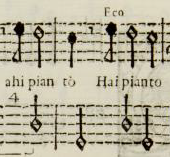
In the second strophe, the bass moves fast for nobil’ ira [noble anger], moderately for amore, is static for the serious power of posso, moves moderately in strange harmonies for ‘the most frozen minds’.


In the final strophe, the bass stops moving at non si mova. 


See also The Philosophy of La Musica and La Musica hypnotises the Heroes.

The beginning of Act I has a static bass, indicating a serious matter.


Monteverdi ‘Orfeo’ Act I

Faster changes in harmony (even though the bass-note remains static) suggest more urgent passions at oggi fatto e pietosa l’alma gia si sdegnosa de la bell’ Euridice [now the soul of beautiful Euridice – previously so spiteful – has become merciful]. Movement of the bass through bitter sharps characterises Orfeo’s sighing and crying for her in the Arcadian woods.


The Nymph evokes the Muses over a static bass, indicating another serious matter, made more gentle by the change to the soft Hexachord (modern F major).


But the steady movement of the continuo-bass at Ma tu gentil cantor indicates a more relaxed mood, inviting Orfeo himself to sing.


Orfeo’s song is in the latest style of rhetorical monody – not an Aria – and begins with a static bass, as he evokes Apollo with appropriate seriousness. The bass moves happily at lieto e fortunato amante [happy and fortunate lover]. The parallel rhetorical structures of the text Fu ben felice il giorno …. e piu felice l’hora [Happy was the day… and happier was the hour] receive the musical patterning of 17th-century aria, a repeated figure in both the Flow of Speech and the Movement of the Bass.


Act II begins with a charming sequence of diegetic songs, in dance-like arias with strophic repeats and instrumental ritornelli. The movement of the bass is slow for Orfeo’s Ecco pur ch’a voi ritorno [this is notated in steady C, even though many modern performers take it much too fast, as if it were in tripla 3/2] suggesting a certain melancholy of nostalgia, but the movement increases for the shepherds’ duets, as the passions become more active.


The arrival of the Messaggiera, announcing Euridice’s death, is marked by the sudden change to a slow-moving bass (indicating a sad and serious matter) in hard-hexachord harmonies.


I suggest that such historically informed description, linking the movement of the bass to changes in affetto, is more revealing for academic analysis and more useful to performers than any anachronistic discussion of ‘Recitative’ and ‘Aria’.

How should we perform 17th-century dramatic monody?

Equipped with appropriate terminology, we are better able to recognise typical features of the rappresentativo style, and can more readily understand how to respond as performers, linking what we see in musical scores to what we read in performance practice treatises.

In many performances today, there is little or no respect for composers’ notated rhythms. But just as we admire Monteverdi’s ensemble writing and the brilliant ornamentation of Possente Spirto, so we should recognise his genius for setting the Italian language, comparable to Lully’s excellence in setting French and Purcell’s skill in setting English.

How to perform ‘Recitative’???


Of course, period performers did take certain liberties with composed material. For example, they added their own graces and divisions to songs and ensemble-music [though generally not in rappresentativa music]. Such ornamentation is guided by principles explained in period treatises, and must remain with the rules of counterpoint and the underlying rhythm of Tactus.

So it should be for our modern-day performances of dramatic music: there are certain liberties that are permitted, even encouraged, by historical sources. But we must be guided by period principles, inspired by notated examples, and remain within the boundaries of style and the measure of Tactus.

Musica rappresentativa is NOT ‘do as you please’!


Priorities

Caccini (1601) declares the priorities of the Nuove musiche [new music] to be Text & Rhythm. Many sources prioritise the Rhetorical concept of Action – gesture, facial expression, contrasts of vocal tone-colour, body posture and movement.

The composers’ notation is a rich source of information. When we choose to depart from it, we should double-check that our personal input follows period principles.

Imitation of Speech

Dramatic Monody imitates the speaking style of a fine actor in a baroque theatre. The composed score indicates an ideal declamation by describing (as precisely as notation allows) the rhythms and pitch contours of such stylised speaking. We do not have to create our own ‘speech rhythms’, and we should certainly not  re-model the Flow of 17th-century Speech in imitation of modern-day conversation or film dialogue.

Baroque speech-making was highly Rhetorical. Declamation was pitched and timed to carry without amplification in a theatre seating up to a thousand [Cavalieri]. This need not imply vibrato in the (speaking) voice, but it does require frequent silences as the long sentence is broken up into short sense-groups. If we think of the Shakespearian style of the generation of John Gielgud, or even the portentious – and memorable! – declarations of movie super-heroes – “I’ll be back!”; “No, I am your father!”; “Space, the final frontier…” we can begin to move away from conversational and microphone styles towards vocal and text-based charisma.

Text

We need to understand every single word of the Text, not just the overall meaning of sentences, but the function of each individual word.

The articulation of musica rappresentativa demands special attention to good/bad syllables and single/double consonants. In particular, we should avoid false accents on bad syllables, especially the weak final syllable at cadences.

Singers should vary their tone-colour according to the meaning of the words. Il Corago recognises that this can be difficult for some singers, and modern vocal training emphasises consistency, rather than variety, of tone-colour. A good starting exercise is to imagine telling a fairy-story to young children.

Tactus

The dramatic timing of musica rappresentativa is measured by Tactus, even though singers should not actually beat Tactus with their hand whilst they are acting. [Singers did routinely beat Tactus in madrigals, even in solo songs, but not when representing a character in music-drama – Il Corago.]

Tactus is ‘regular, solid, stable, firm … clear, sure, fearless, and without any perturbation” [Zacconi 1592]. Almost all period images of vocal performance (and many of instrumentalists studying their part in advance) show the Tactus hand, palm outwards, ready to move up and down in the slow, steady minim beat typical of the early 17th century.

There was no conductor in 17th century music – of course! It is the continuo who ‘guide and direct the whole ensemble of voices and instruments’ [Agazzari 1607, here].


Driving the Time

Nevertheless, in such expressive genres as Toccatas, continuo-madrigals and dramatic music, the Tactus could change according to the affetto. These changes were still managed by Tactus (see Frescobaldi Rules) and were almost certainly small (see Houle 1987 Meter in Music 1600-1800). Caccini uses a slower Tactus only once, in all his example songs, Frescobaldi specifies very limited situations where changes can occur – essentially between different movements. Since the composer would already have set agitated texts to short notes, and languid texts to long notes, any Affekt-based change in Tactus will tend to exaggerate written contrasts in note-values.

What can be used more frequently is the kind of rhythmic alteration within the regular Tactus, for which Caccini gives many examples. The common feature of these examples is that long notes are made extra-long, short notes extra-short. Once again, the composer’s contrasts in note-values are exaggerated.

Sprezzatura

Caccini’s ‘cool’ manner of singing is a style of vocal production, halfway between speech and song. [The truth about Caccini’s sprezzatura] In just one instance in his example songs, he combines this with senza misura, where the voice-part floats freely over the measured bass. This jazz-like effect is notated clearly by Monteverdi, usually only once or twice per song. [Monteverdi, Caccini & Jazz]

No Ornamentation

Cavalieri, Caccini, Peri, Monteverdi, Il Corago and other period sources advise both singers and continuo-players to avoid ornamentation in dramatic music.  Cavalieri and Caccini give examples of simple cadential ornaments which are used very sparingly. The trillo – and almost all 17th-century ornamentation – accelerates towards the final note rather than slowing down. The modern cliché of a tenor cadence decorated with a upwards jump of a fourth, linear descent, and a slowing trillo is not supported by period evidence.


Prologue-roles, aria-singers and characters with divine or supernatural powers can add more ornamentation.

Expression

Many 17th-century sources emphasise the supreme importance of clear communication of the text, in order to convey emotions to the audience. Monteverdi is frequently praised for his expressive word-setting (harmonies and rhythms!). Caccini advises crescendo and/or diminuendo on a single note on exclamatory words, Ahi! Deh! etc.  Emotions in Early Opera.

Action

From Demosthenes via Cicero and Quintilian to the 17th century, Rhetoricians prioritise Action: posture and movement, facial expressions and what we nowadays call Baroque Gesture. Although we tend to view Gesture as a bolt-on extra, a special option for a particularly HIP production, period sources regard Action as fundamental, built-in to composers’ notation and performers’ training. Rhetorical gestures and stylised posture were an everday part of courtly etiquette, and can be observed in many baroque images.


This is a complex subject that requires considerable study and practice, but it’s easy to add some fundamental principles into any vocal performance:

  1. Stand still, diagonally-on (not square) to your audience, with your weight on one leg
  2. Hold your music with the LEFT hand, leaving your elegantly shaped RIGHT hand free to gesture
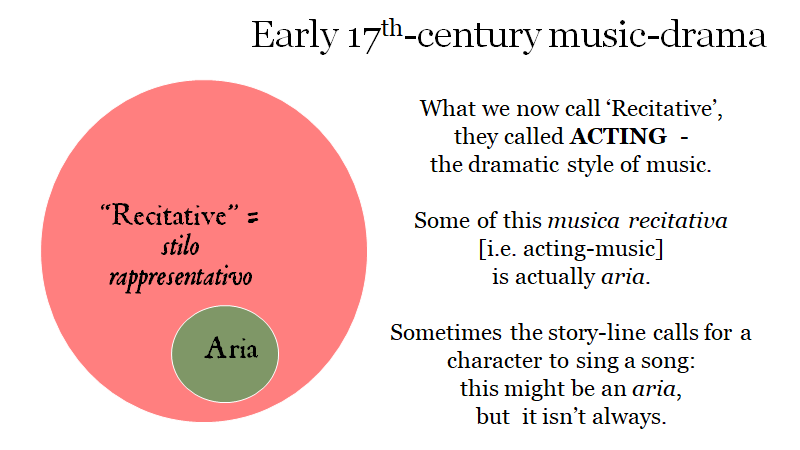
  3. Imagine that you see in front of you the scene you are describing, and point at what you talk about.

For my free on-line course in Historical Action and Baroque Gesture, start here! 

Conclusion

So now we can all be ready for the next time a singer or stage director says:

But it’s recitative, isn’t it?