The First Opera & The Beginning of Baroque

This is a slide-show introduction, based on lecture given to celebrate the 50th anniversary of Theatre Natalya Satz, Moscow (the original home of Peter and the Wolf), following the 45th performance of the theatre’s award-winning production of Anima & Corpo. Nevertheless, this post draws on the latest research findings, and there may be some surprises, even for seasoned baroque fans!


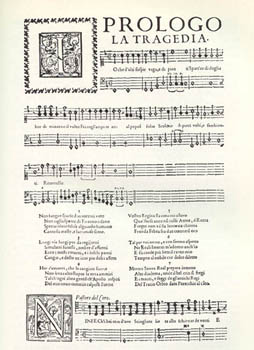
Emilio de Cavalieri's 'Rappresentatione di Anima e di Corpo' (1600) is indeed the 'first opera'. Jacopo Peri, whose 'Euridice' was performed later the same year, acknowledges Cavalieri's role as originator of the style. (Earlier music-dramas by these two composers, notably Peri's 'Dafne', have not survived.) So why would Cavalieri and his contemporaries seek to develop a new theatrical genre of fully-sung plays?
Emilio de Cavalieri’s Rappresentatione di Anima e di Corpo (1600) is indeed the ‘first opera’. Jacopo Peri, whose Euridice was performed later the same year, acknowledges Cavalieri’s role as originator of the style. (Earlier music-dramas by these two composers, notably Peri’s Dafne, have not survived.) So why would Cavalieri and his contemporaries seek to develop a new theatrical genre of fully-sung plays?

What are the three secrets of great performance

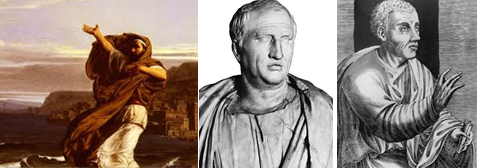
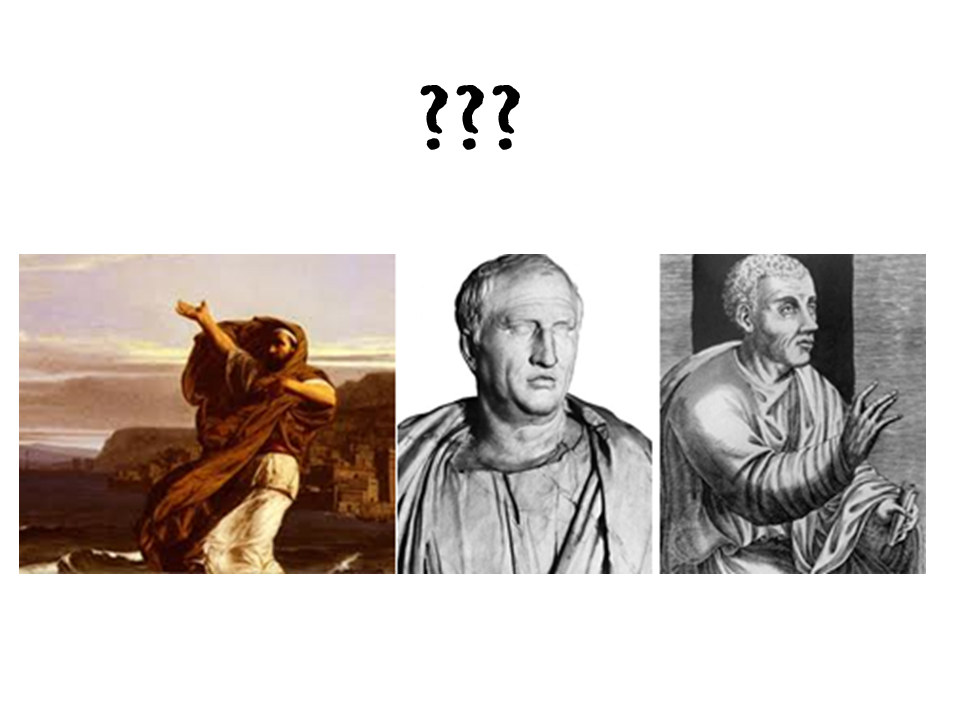
17th-century writers were still re-telling a story going back via Quintilian and Cicero to Demosthenes (4th cent. BC). The question was posed:


What are the three secrets of great performance?
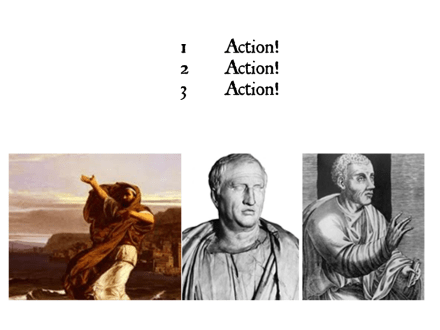
Action Action Action


Demosthenes’ first answer was “Action!”. And his second answer was “Action!”, And his third answer was also “Action”.
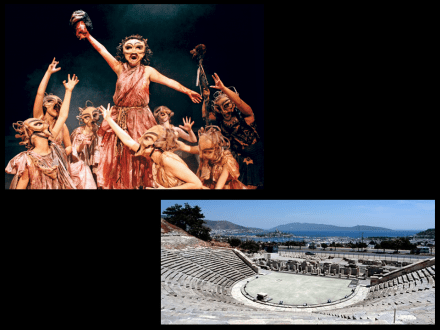
Greek Drama

Meanwhile, in the decades before the year 1600, philosophers of performance were impressed by the emotional power of the ancient Greek and Roman dramas, which (they believed) had been fully sung. So Cavalieri and his colleagues wanted Action in their music, and Music in their dramas: fully-sung music-drama was the epitome of their beliefs in the power of performance.

The modern label 'first opera' encourages us to consider all that came after Cavalieri. But to understand his work, we need to view it in its own historical context. And we should be cautious: even though this is sophisticated, dramatically powerful, fully-sung music-theatre, Cavalieri did not call it 'opera'. It is a 'Rappresentatione', a 'show'. It is not 'primitive', but it certainly is different from our modern expectations.

The modern label ‘first opera’ encourages us to consider all that came after Cavalieri. But to understand his work, we need to view it in its own historical context. And we should be cautious: even though this is sophisticated, dramatically powerful, fully-sung music-theatre, Cavalieri did not call it ‘opera’. It is a Rappresentatione, a ‘show’. It is not ‘primitive’, but it certainly is different from our modern expectations.
Tardis

Not ‘primitive’ but DIFFERENT…

… might well be our motto, as we climb into our time-machine in order to explore Planet Earth, circa 1600.


Architecture and Art

This was an age of impressive architecture: as assistant to Michelangelo, Cavalieri’s father Tommaso was closely involved with the building of St Peter’s Rome. Painting became ever more dramatic, culminating in the chiaroscuro of Caravaggio. Even religious subjects were depicted with theatrical bravura: Tommaso de Cavalieri was the model for Adam in Michelangelo’s frescos for the Sistine Chapel.

Exploration and Science

The exploration of the Americas continued, charted by sophisticated world maps. Galileo trained his telescope on the moons of Jupiter, and also experimented with gravity at the tower of Pisa.
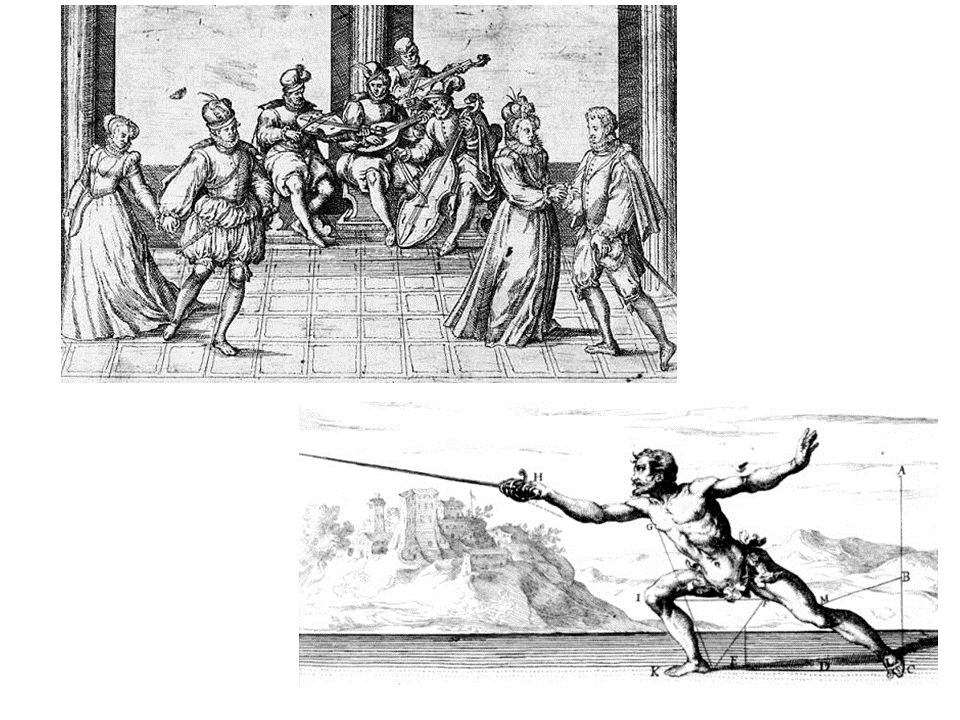
Music Dance Swordsmanship

Italian ladies and gentleman at court would spend much of their time making music in madrigal groups or consorts of viols. Several hours each day would be spent learning and performing new social dances. And a couple more hours daily were devoted to practising swordsmanship, with the fashionable rapier, well over 1 metre long, with a needle point and razor-sharp edges.
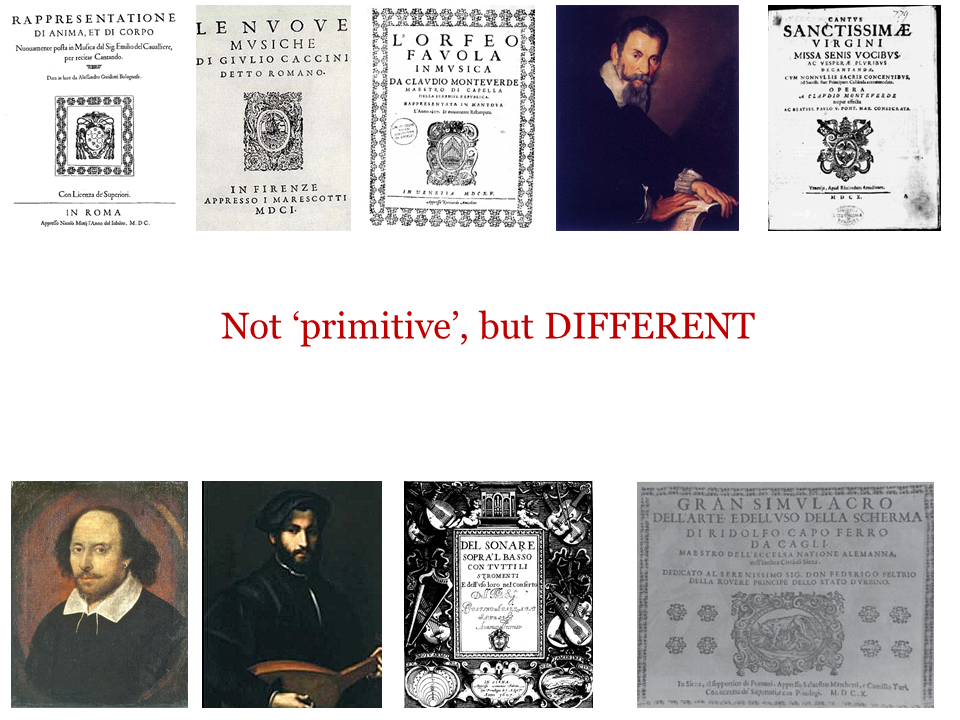
Circa 1600

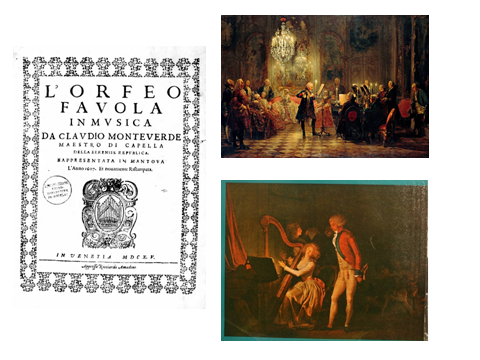
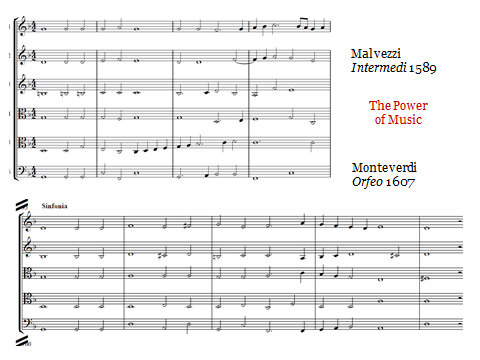
There was plenty of new music. Cavalieri’s opera was quickly followed by Caccini’s Le nuove musiche (1601/2), the first collection of songs with continuo-bass  accompaniment, which includes the famous Amarilli, mia bella. In 1607, Monteverdi’s ‘story in music’ Orfeo was performed: Aggazzari’s treatise from that year, Del sonare sopra’ l basso explains how many different kinds of instrument could improvise accompaniments from the same continuo-bass notation. In 1610, Monteverdi’s magnificent Vespers mixed old-style polyphony with the new techniques of continuo-song; Capo Ferro’s survey of rapier swordsmanship is from the same year. In England, this was the age of Shakespeare’s plays (full of music, of course) and Dowland’s melancholic lute-music.

Dowland

In 1609 Dowland also translated into English an influential book on singing, Ornithoparcus’ Micrologus, in which he emphasises the particular importance of rhythm.


Instruments

Violin family

Violin-family instruments from the late 16th century are still regarded today as the finest ever made. Praetorius’ 1619 diagram shows violin, viola, cello and related instruments, together with a surviving cello by Amati. Nowadays, these wonderful instruments have been altered, by changing the angle of the fingerboard to increase the string tension. But around 1600, violins were held in a relaxed way on the shoulder, were strung more lightly, and were not encumbered by chin-rests, tuning screws and shoulder rests. With its original set-up, the instrument is not as loud as a modern violin, but is more direct and responsive. If a modern violin is like a big, luxurious limousine, then a baroque violin is like a sports-car: lighter, more manoeuvrable, and (I would say), more fun to drive!
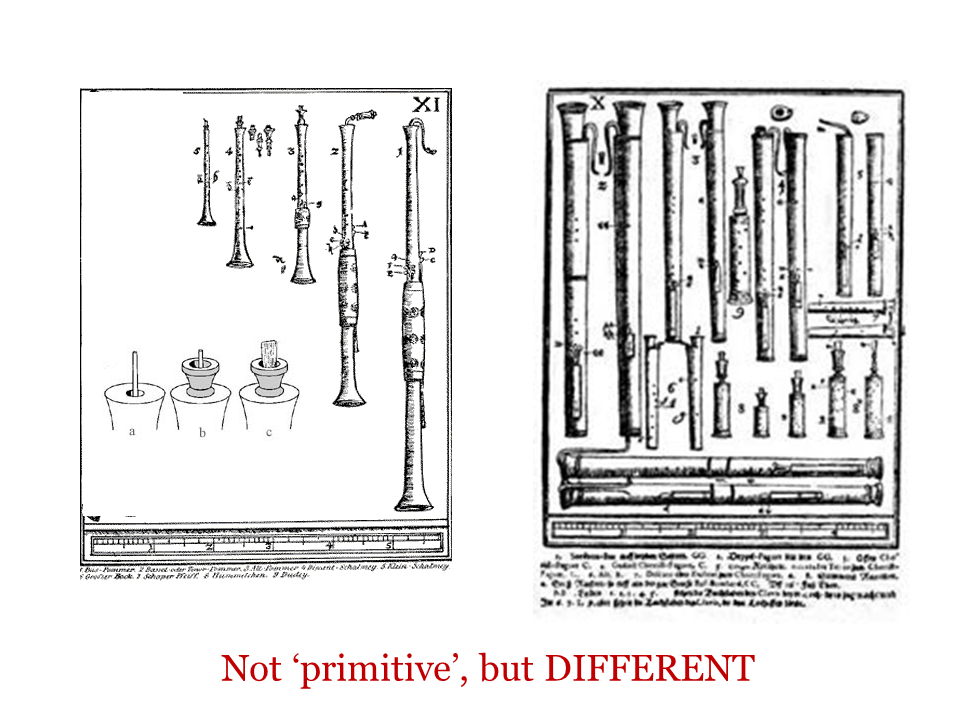
Shawms and Dulcians

The early-17th-century predecessor of the oboe was the Shawm, which was made in various sizes from soprano to bass. The double-reed is surrounded by a wooden ‘pirouette’ to support the player’s lips. The Dulcian is the ancestor of the bassoon, and also came in various sizes from bass to soprano. Whereas nowadays we consider oboes to be the high register and bassoons the low register of a single ‘family’ of instruments, in Cavalieri’s time they were two distinct consorts, each with a complete range from treble to bass.
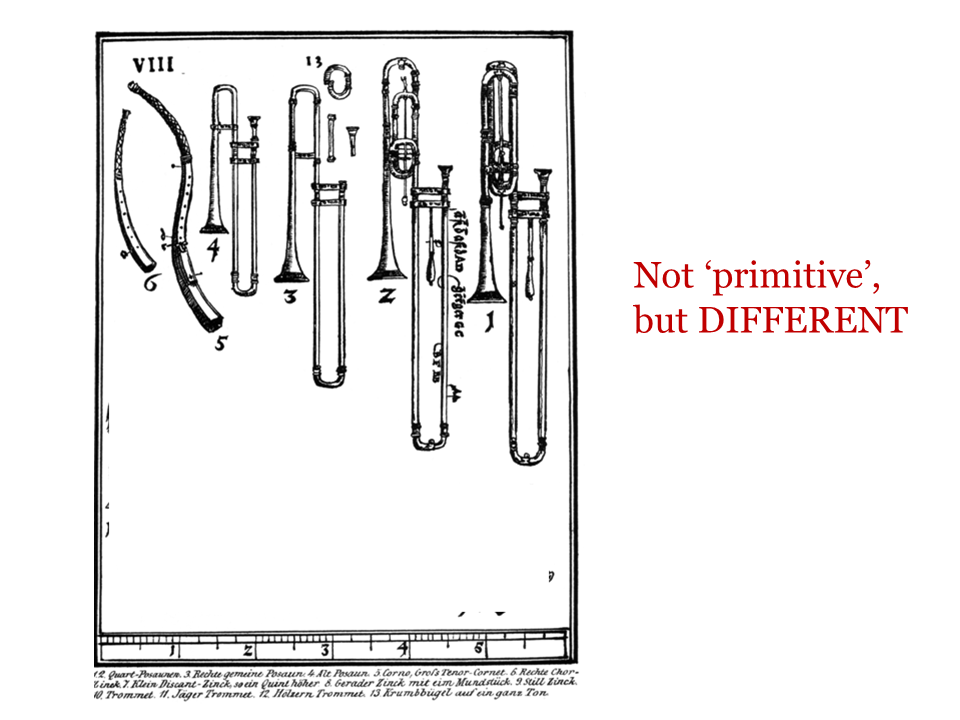
Cornetts and Sackbuts

Baroque trombones, known in English as Sackbuts, have a narrower bore than their modern descendants. Like baroque strings, they are not as loud as modern instruments, but more precise and flexible in their sound. Praetorius shows the trombone family from bass to alto. The upper register of this consort is represented by the Cornetto, made from wood, with leather wrapped around it. It has a wooden mouth-piece similar to a trumpet’s, and finger-holes in the tube similar to a flute. The sound is somewhere in-between a trumpet and a flute, and was considered in this period to be the closest to the sound of the human voice. That gives us a clue to the sound-world of circa-1600 singing: not as loud as modern opera singers, but clear, precise and very flexible.

Trumpets and Drums

Trumpets and drums were originally military instruments, and are still today associated with royalty. Baroque trumpets have no valves; the different pitches, including extreme high notes, are created with sophisticated lip-technique.
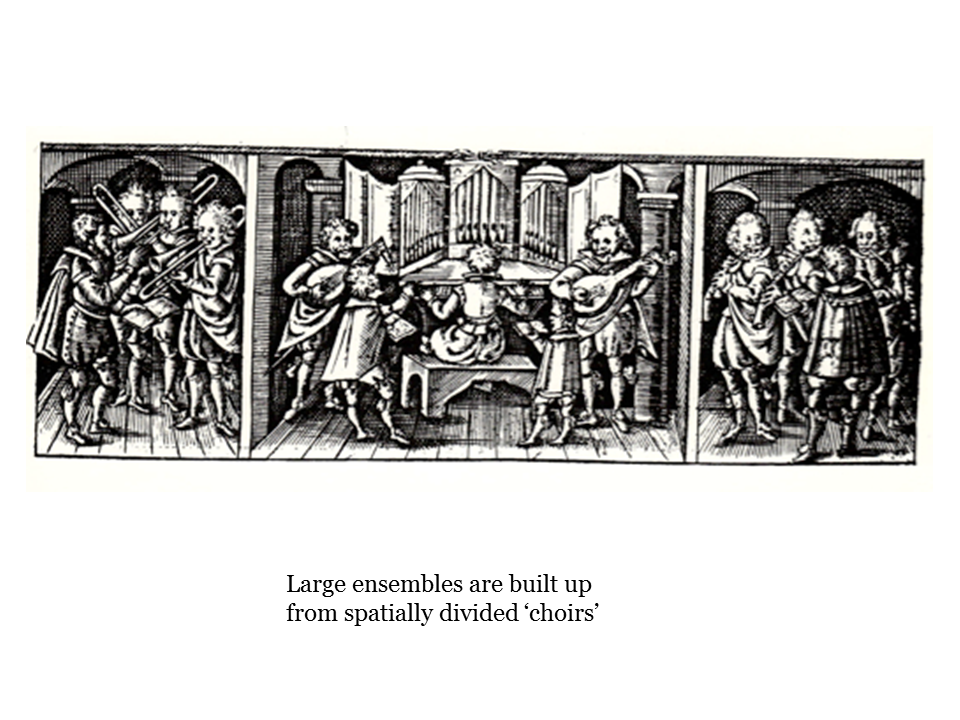
 

Divided Choirs


We can recognise the descendants of these early baroque consorts in the various sections of a modern orchestra. But around 1600, large groups of instruments were not formed into a single ensemble, but were rather distributed around the available space in groups of 4 to 7. Each group was considered to be a ‘choir’, that might mix instruments and voices, or might be homogenous, e.g. contrasting a string ‘choir’ with a wind ‘choir’.


Continuo
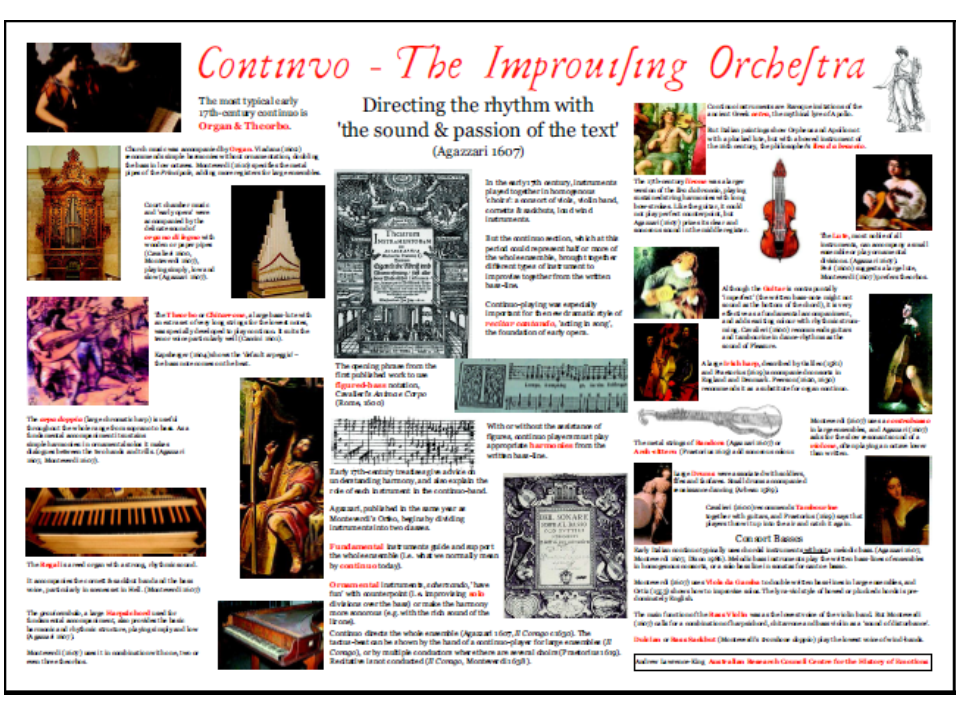
 

Continuo

You can view and download for free a full-size version of this poster here.


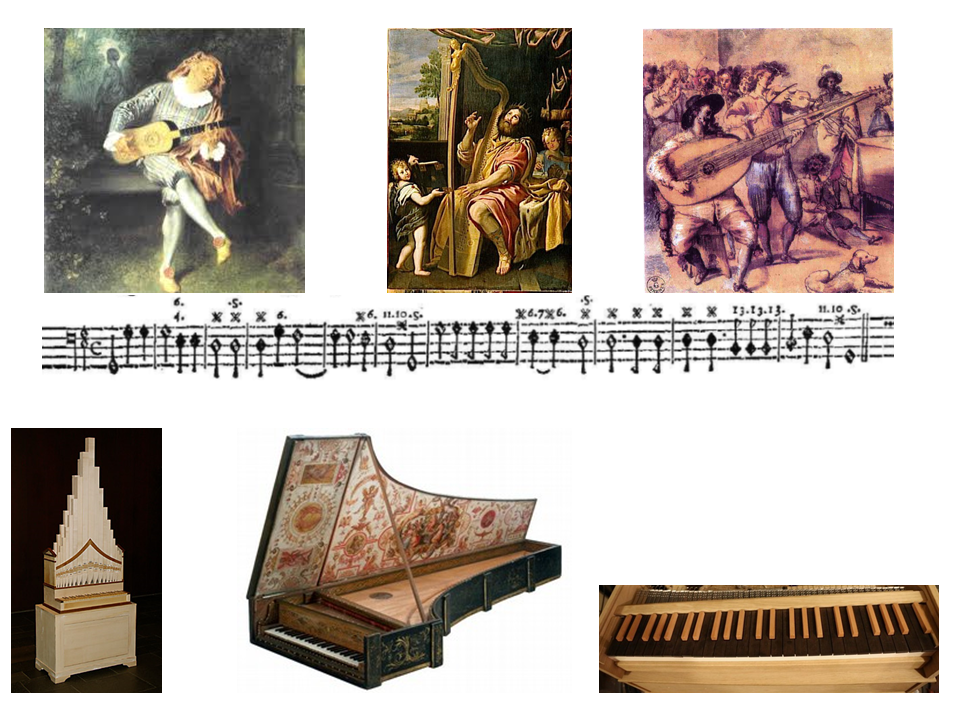
The most important instrumental section in the first operas has no equivalent in a modern orchestra. The Continuo section brings together a variety of instruments with the common purpose of providing harmonic support and rhythmic direction, guiding the entire company of instruments and voices. Like the rhythm section of a jazz-band, Continuo-players define the rhythmic structure, respond to the various soloists and add decorative touches of their own. Agazzari’s 1607 treatise Del Sonare sopra’l  basso here explains how each type of instrument contributes to the Continuo.

renaissance organ

The organo di legno, or chamber Organ, has wooden pipes, and plays sustained harmonies in the low register, to support the voices and melodic instruments.

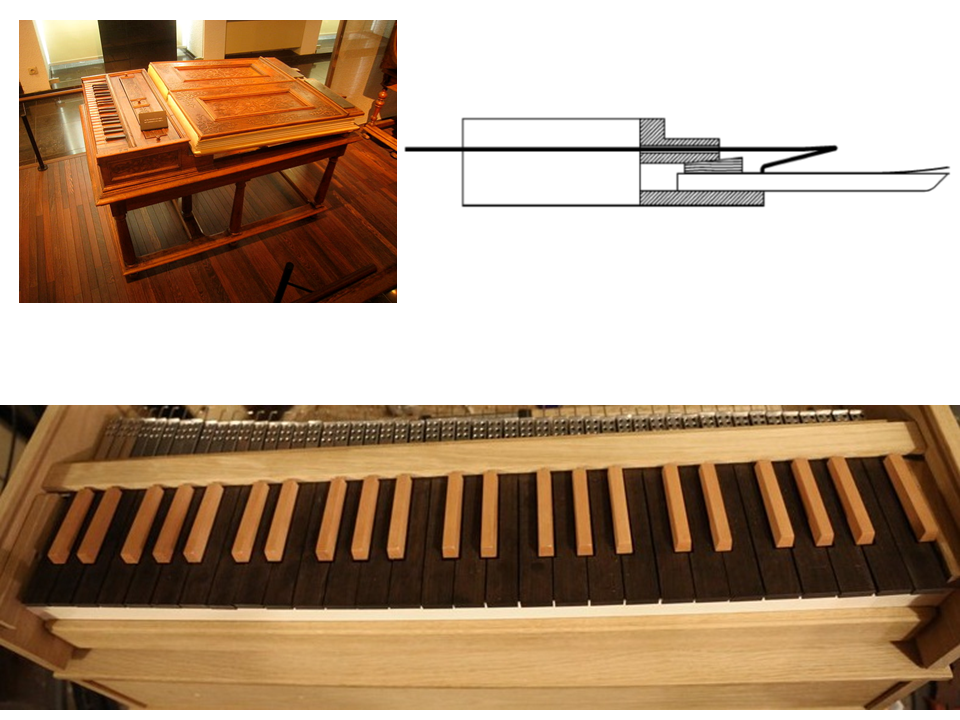
Harpsichord

The Harpsichord has metal strings; when you press a key, a wooden jack rises past the string, so that a small plectrum (shaped from a bird-quill) can pluck the string upwards. As you release the key, the jack descends and a piece of felt is lowered onto the string to stop the sound. The sound is not as loud as a modern piano, but is clear and rhythmically precise. In this style, the Harpsichord also plays simple harmonies in the low register, defining the essential harmonic and rhythmic foundation.
Regal


The Regal, or reed-organ, has metal pipes; when air enters the pipe, a metal tongue vibrates against a metal half-tube, and this vibration is amplified by the metal resonator. The sound is strong and rather nasal. If the wooden Organ suits scenes of heaven, or pastoral idylls on earth, then the Regal is ‘the organ from Hell’!
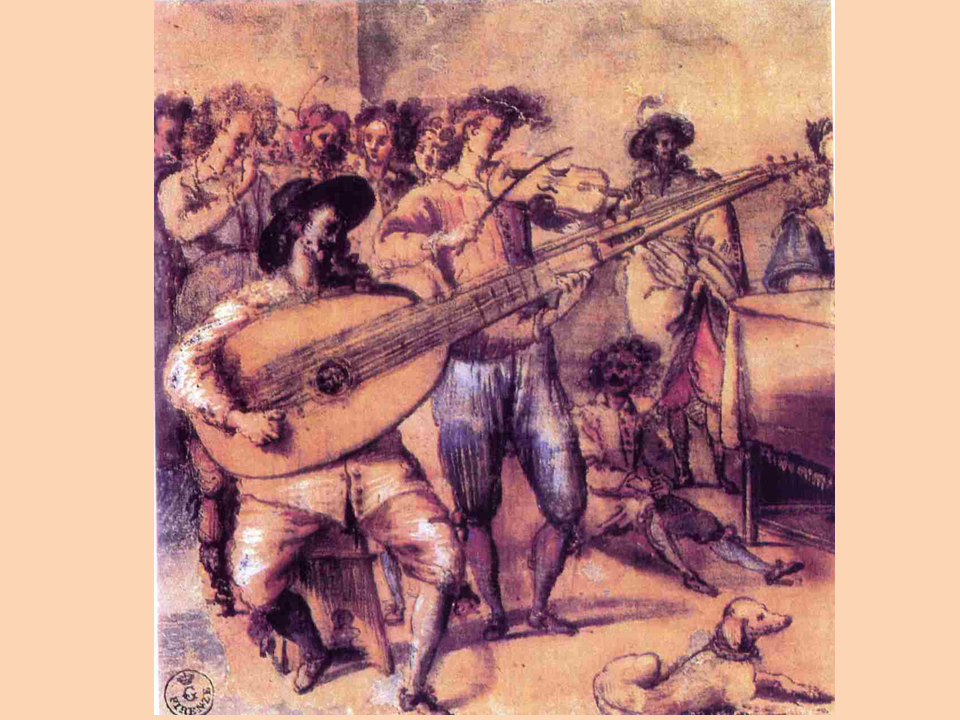
Theorbo

The most essential instrument in an early Italian continuo-section is the Theorbo, also known as Chitarrone. This is the double-bass instrument of the lute family, with two necks. The strings on the first neck run over a fingerboard, and produce a strong melodic bass, with chords in the tenor/alto register. The second neck is much longer, and these strings have no fingerboard; they give another octave of sub-bass notes, that provide a powerful rhythmic impulse and a long sustain that supports the harmonic arpeggio of the upper strings.

Arpa doppia

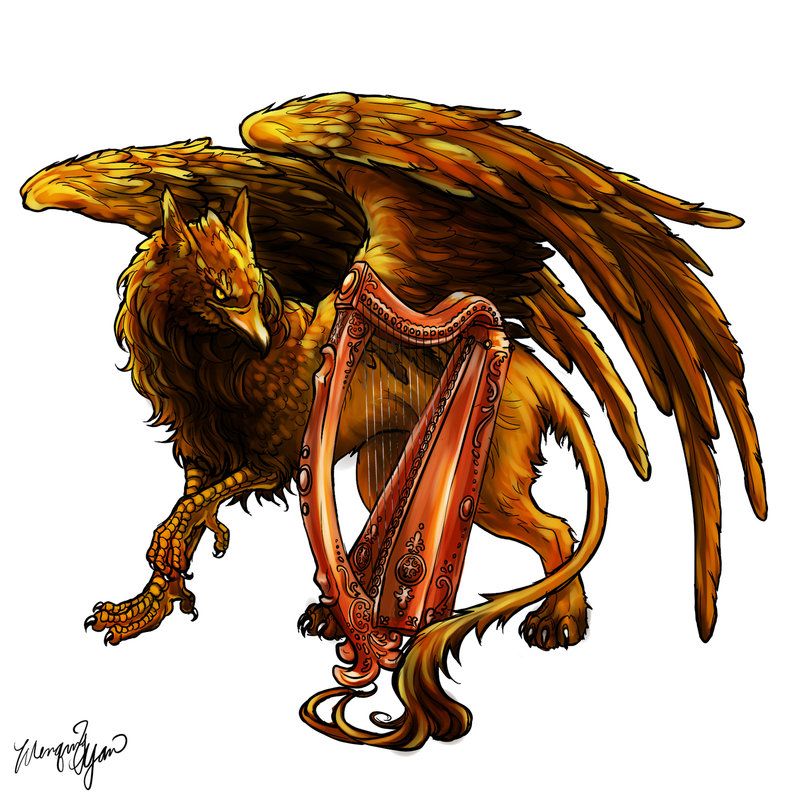
Around 1600, the harp doubled in size in order to create a strong sub-bass register comparable to the Theorbo’s. The Italian arpa doppia (double harp) has multiple rows of strings, arranged like the black and white notes of a keyboard, so that all harmonies and chromatic changes are available, just as on the harpsichord or organ.

The harp also has a full soprano register, so that it plays a unique role in the continuo section, defining fundamental structure alongside keyboards and theorbo, and also providing decorative touches in the higher register.

Baroque guitar

The baroque guitar has a plucking technique for solo repertoire, but in the Continuo section it usually provides rhythmic energy and decorative colour by strumming.

Read more about Agazzari’s categories of fundamental and decorative instruments here.
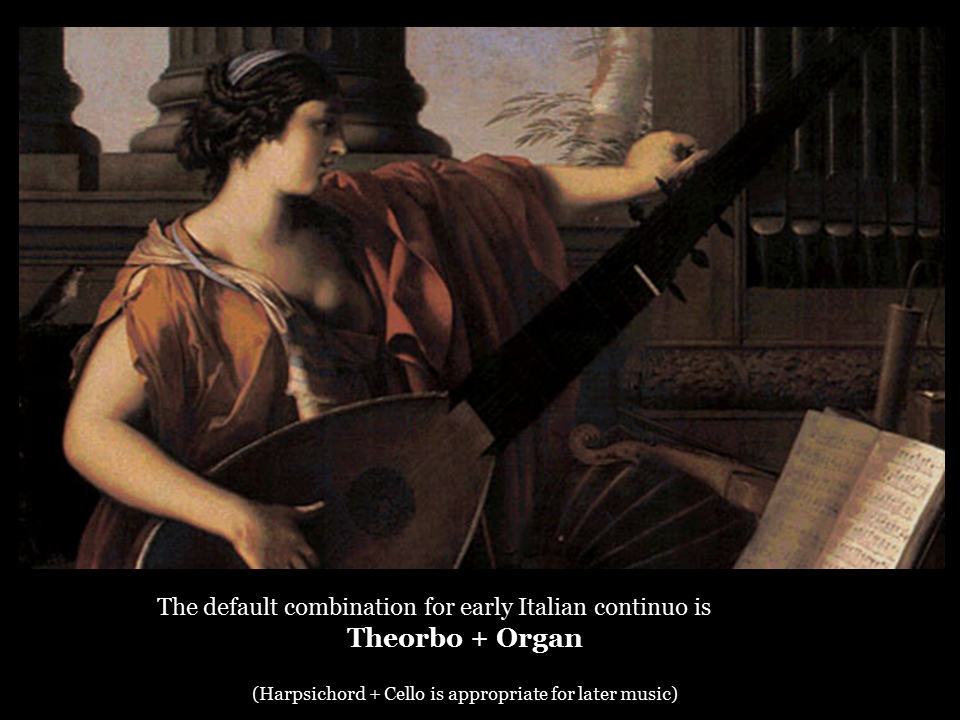
Theorbo + Organ


The combination of harpsichord and cello is typical of 18th-century music. In the early 17th-century, the usual pair is theorbo and organ.
 

Realising the Continuo

All the different instruments of the Continuo section play from the same bass-line, which may (or may not) have additional information about the harmonies indicated by figures above or below each note. But whilst they read from the same part, each player improvises the harmonies and any decorative touches according to the role and capabilities of each instrument: this is referred to as ‘realising’ the continuo.


No conducting!

No Conducting

One prominent figure in modern opera, the conductor who moulds the rhythm and guides the orchestra with his hand or baton, was not seen in the 17th century. Early Music was not conducted. The role of guiding the rhythm belonged to the Continuo section, as Agazzari tells us.

Of course, there would be someone to coordinate the rehearsals and make whatever decisions were needed. This job was done by Il Corago, who was usually the Artistic Director of the entire production, responsible not only for musical coordination, but also for guiding the actors, dancers, scene-builders, lighting technicians (sophisticated lighting effects were obtained from massed candles), and stuntmen (acrobats and sword-fighters). Cavalieri himself was a Corago, with a working knowledge of all of these disciplines, so that he could co-ordinate the contributions of each specialist.

When there was a large musical ensemble, it would be spatially divided into several groups, each of which would have a time-beater to synchronise the rhythm within the group and between one group and the others. The frontispiece of Praetorius’ Theatre of Instruments shows this practice in action, with a large ensemble divided into three ‘choirs’ of instruments and voices. Each choir has its own time-beater, and the three time-beaters watch each other to synchronise the beat.

Priorities
Modern Topics

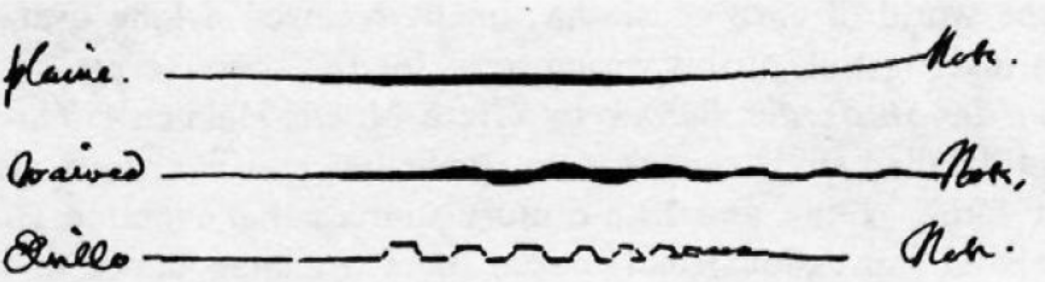
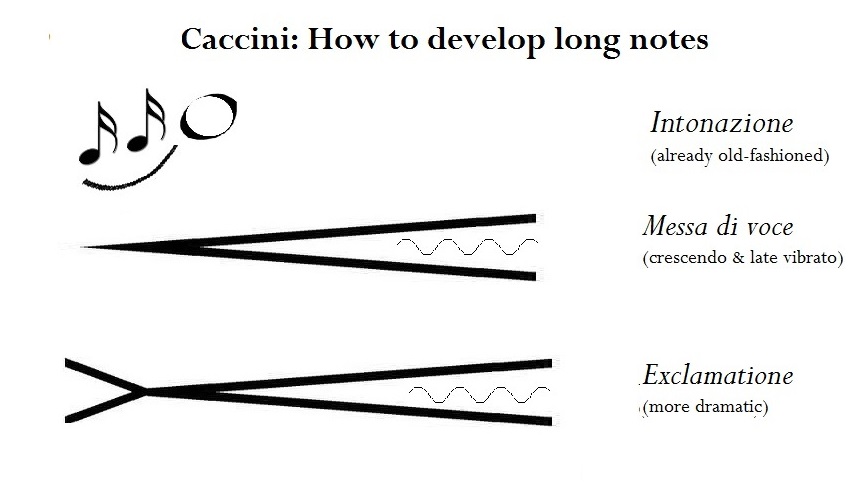
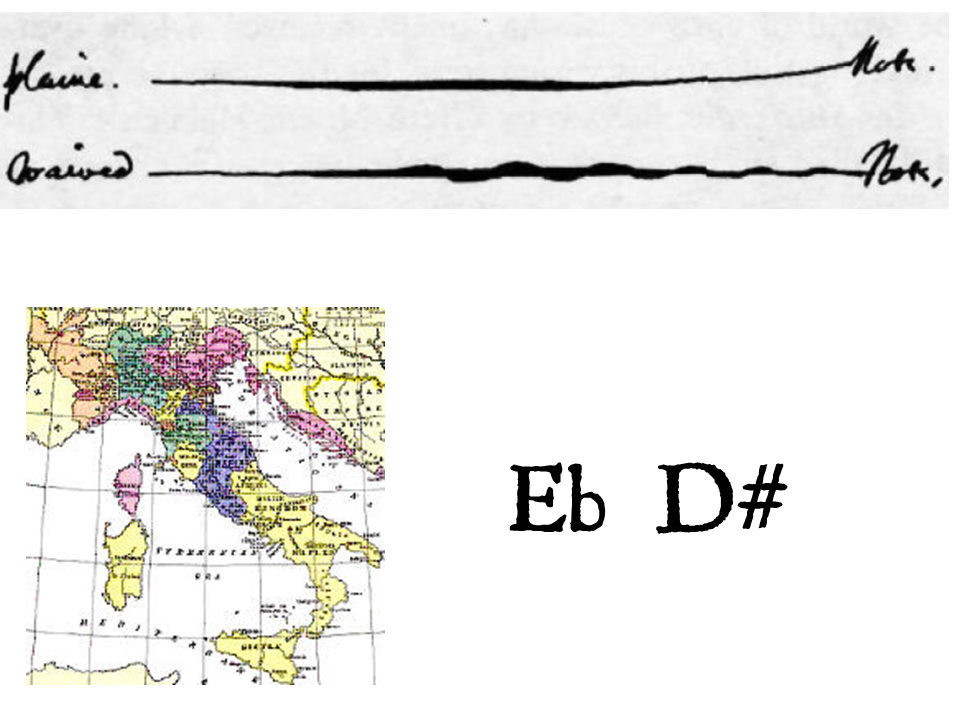
Today, discussions about Early Music often focus on the question of Vibrato. Period diagrams show the typical shape of long notes: a ‘plain note’ begins softly and then swells out (there is no vibrato); a ‘waved note’ similarly begins softly, and adds vibrato as the sound swells out.

Another topic of modern debate is the question of pitch. Around 1600, in the south of Italy, the pitch was lower than today’s standard of A440; in the north it was higher. In central Italy, it was somewhere in between. Bruce Haynes’ The Story of A here tells the History of Performing Pitch in great detail.

Subtle choices of precisely how to tune each note of a keyboard instrument or harp are studied as Temperament. Whereas on the modern piano, Eb and D# sound the same and are played from the same key, in historical Temperaments these are two subtly different pitches. Some keyboards have double keys for the black notes, baroque harps have extra strings, in order to facilitate this fine distinction. The typical Temperament circa 1600 is known as Quarter-Comma Meantone: it produces beautifully pure major thirds, making consonances sweeter and dissonances sharper.

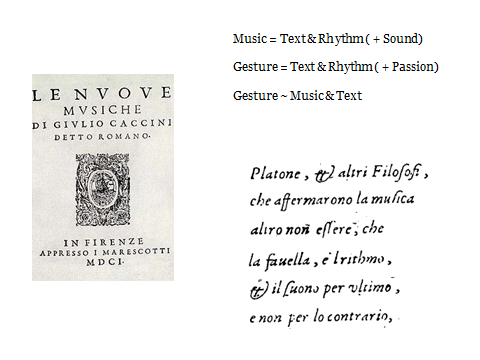
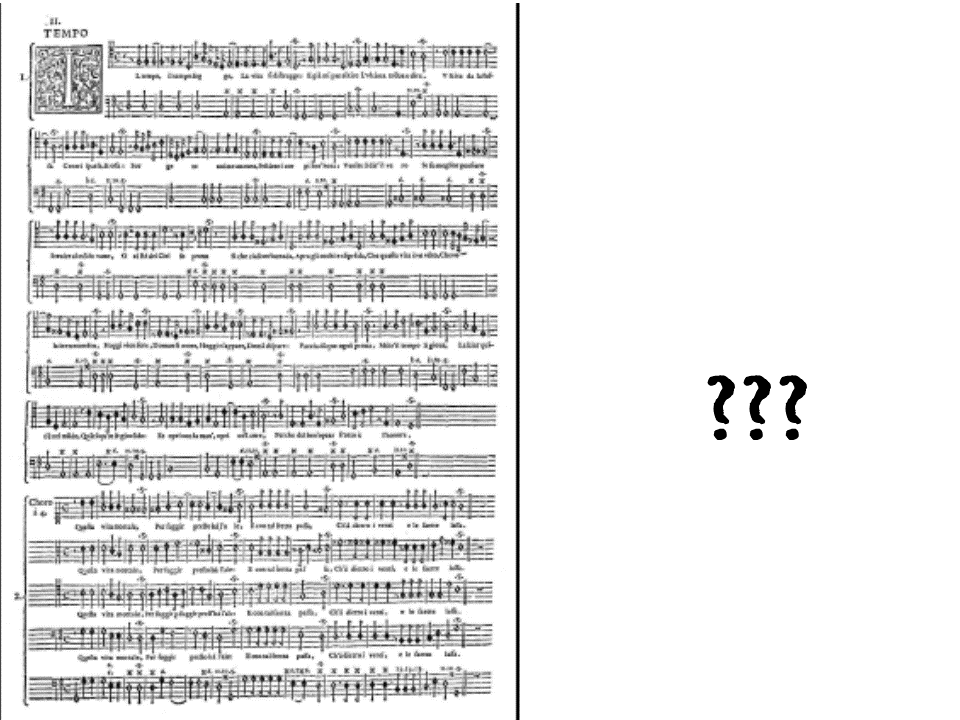
These are the hot topics amongst many of todays’ Early Music practitioners. But what were the priorities for musicians and singers performing Anima & Corpo in the year 1600? The original print is here, and Caccini’s Le Nuove Musiche tells us how to approach it:
The Interpretation of Early Music

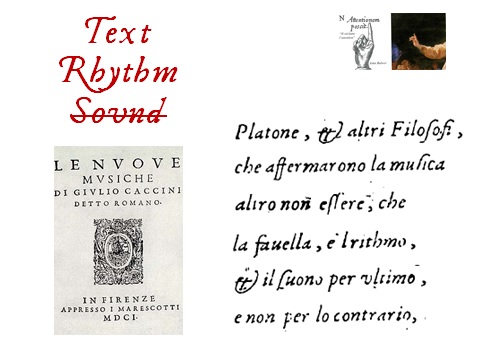
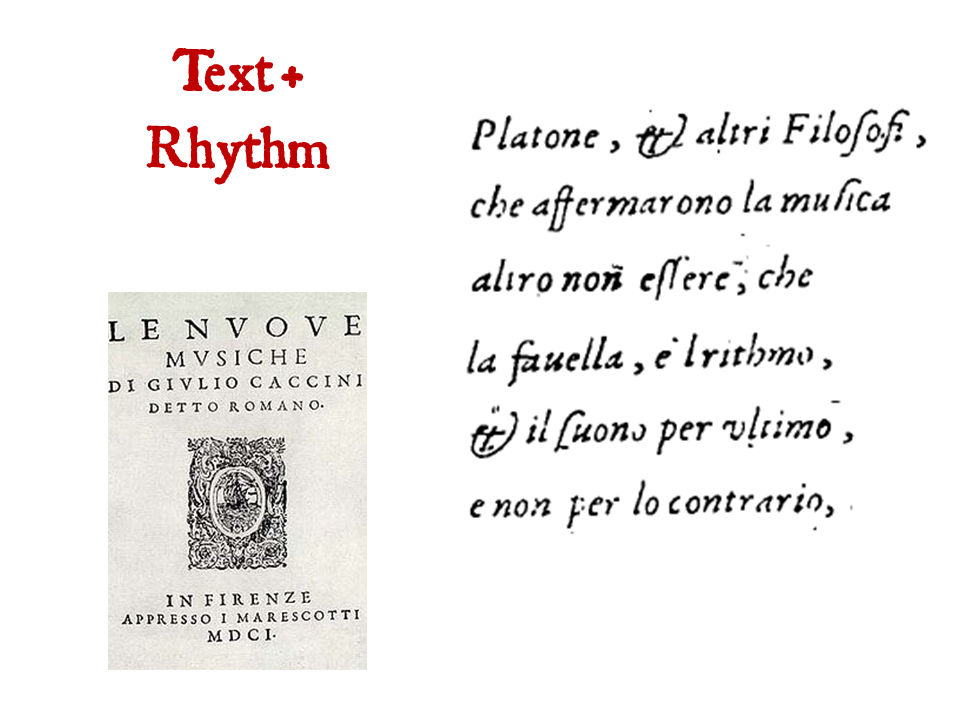
Music is Text + Rhythm, and sound last of all.

“And not the other way around”, Caccini emphasises.
Text and Rhythm

These historical priorities guided my international research program into Text, Rhythm, Action! over the last five years, reported here, and I apply them in all my practical work, training musicians and directing performances for audiences today.

Text
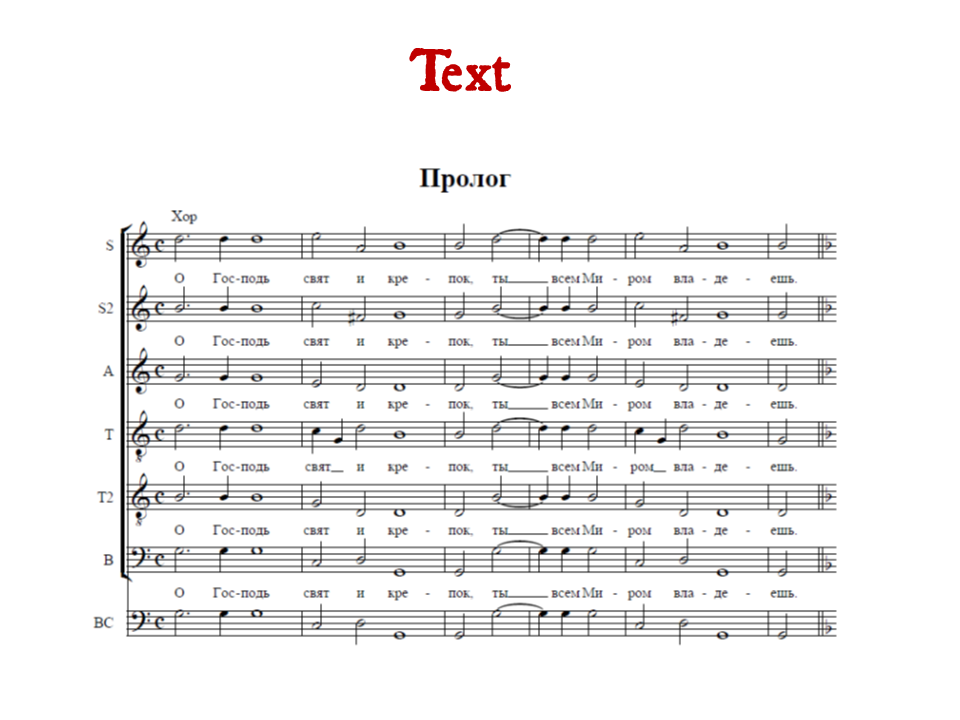
Text

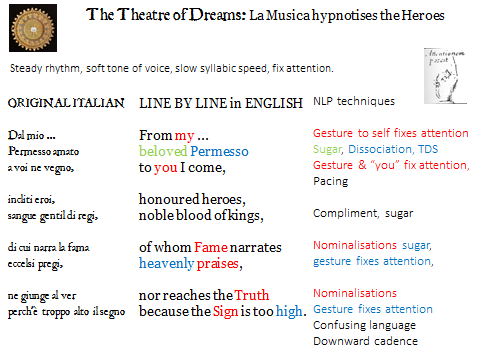
Period sources insist on the importance of communicating the text to the audience, so for the production at Theatre Natalya Satz, we wanted to speak to the audience directly in their own Russian language. Great care was taken to synchronise the translation with the ‘word-painting’ of Cavalieri’s music, in which every single word is individually set to music. Poet Alexey Parin worked together with specialist musicians Ivan Velikanov, Katerina Antonenko and myself, to preserve the close links between text and music.

Word Painting

At the beginning of the drama, the first notes are immediately repeated – not because a series of repeated Fs makes a wonderful melody, but in order to repeat the word for emphasis, just as a fine orator would do: “Time… Time”.

In this period, the term Aria has a different meaning; it signifies any repeated structure in words, rhythm, harmony or melody. The metric patterning of the verses Hoggi vien fore, Doman si more, Hoggi n’appare, Doman dispare [Today Life comes forth, tomorrow it dies; today it appears, tomorrow it disappears] is matched by similar patterns in the melodic contours, rhythms and harmonies of Cavalieri’s music. This, in early-17th-century terms, is another Aria, just like the repetition of the single word Tempo, along with its carefully set music.

If the text refers to Heaven above, ciel soprano, the singer will pitch his voice high. If the text mentions a party, festa, the music swings into fast triple-time. Just as an actor in a spoken play will raise his voice to indicate a question, so Cavalieri sets questions on rising pitches.

Text and music are so closely linked that many musical features are not Cavalieri’s compositorial choices, but rather his sensitive responses to the demands of the poetry. Similarly, many performance practices are not the performers’ artistic inspiration, but rather their sensitive responses to the demands of the text and the historical expectations of this musical style.

Treatises

Many explanatory texts survive to inform us of those historical expectations, including a Preface with Cavalieri’s own indications how to perform this kind of music-drama, Agazzari’s treatise on Continuo already mentioned, and the anonymous c1630 guide for a music-theatre’s artistic director, Il Corago.

Rhythm

Rhythm

Although there were no conductors in this period, musicians, whether soloists,or in duet, trio and larger ensembles, would beat time with their hand, palm downwards, down for about one second, up for one second. This slow, steady beat was known as the Tactus. Read more about Tactus here.

What is music

Music itself was understood to be the Music of the Spheres – mysteriously produced by the perfect motion of the stars and planets; the harmonious nature of the human body; and – last of all – actual sounds sung and played on earth. So musical rhythm represents that perfect heavenly movement, rhythm is life itself.


Proportions

Just as clockwork produces various speeds of rotation from one fundamental movement, so 17th-century musicians perceived the different orbits of the planets to be meshed together and turned by the hand of God. This philosophy is imitated in musical Proportions, by which the constant slow Tactus beat is divided into 2, 3 or 6, to create duple, tripla and sestupla metres. A Proportion of 3:2 creates Sesquialtera metre.

What is Time

Time, like Music, was celestial and embodied, measured by the cosmos and the human pulse, better than by clocks. The sun shows the time of day and fixes the moment of noon, the stars show the changes of the seasons. Our pulse measures shorter time-spans, of the order of seconds.

Galileo Pendulum


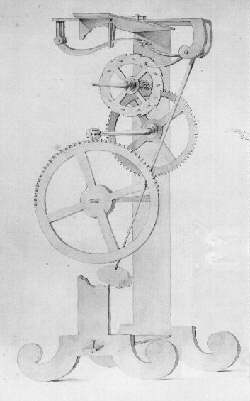
Galileo discovered the pendulum effect in 1582, observing a chandelier in Pisa cathedral, but the first pendulum clock was not built until 1656. So Galileo’s observations were timed against his own pulse – there was no more accurate clock.

Galileo Inclined Plane

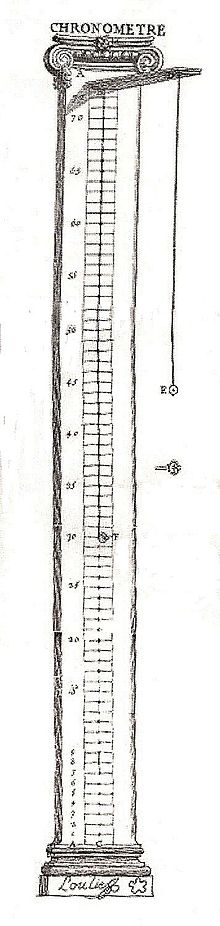
For his experiments on gravity in 1607, Galileo had to time a ball rolling down an inclined plane to an accuracy of fractions of a second. This was far beyond the capabilities of any period clock, and required finer gradations than a pulse-beat. The solution was found in the precision of musical rhythm – if a minim is about one second, then semi-quavers define an eighth of a second.

You can try for yourself an on-line simulation of Galileo’s experiment, precision-timed by lute-music, here.

Newton and Aristotle

For most of us, our intuitive understanding of Time is based on Newton’s model of Absolute Time: Time itself continues ever-onward, independent of other variables. We we can measure the accuracy of a clock, or the daily changes in the precise time of solar noon, against the fixed scale of Newton’s Time. But Newton published in 1687, and it was many decades before his concepts gained general acceptance. In the year 1600, the accepted model of Time was Aristotle’s:

Time is a number of change/movement, in respect of before and after.

Without an Absolute scale to measure by, without the assurance that Time would march independently onwards, “change/movement” was required to create a “before and after” that would allow Time to be numbered. So musical Time, i.e. rhythm, was not only indicated by the hand-movement of the Tactus, it required such movement (at least as a concept) in order to exist at all. The movement of the cosmos, driven by the hand of God, not only measured time, but created it. Just as the heart-beat sustains life, so the steadiness of the musical Tactus was necessary for human health and indeed, for the preservation of the entire universe.

Read more about the philosophy of Time and musical Rhythm here.

Action!

Plato Kronos Kairos

The first character to appear in the first opera is Old Father Time, and his first words (repeated) are Il Tempo. Time is a crucial topic in this drama, understood within Platonic philosophy. The fleeting present moment is a moving image of Eternity, the point of contact between human life and infinite destiny, between earthly actions and the eternal struggle of Good and Evil.

There are two Greek words that we translate as ‘Time’ or in Italian, tempo. Chronological time, clock time, is Greek kronos, whereas kairos signifies the moment of opportunity. For a swordsman, kairos is the crucial instant of time when you must defend yourself to save your life, or when you might safely attack your opponent.
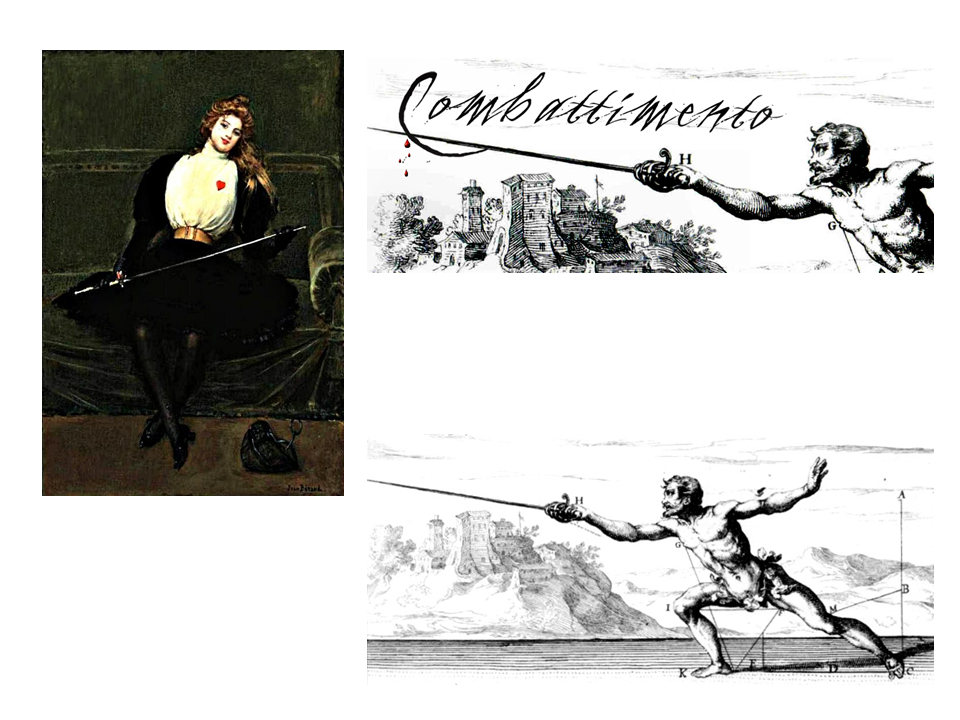
The Art of the Sword


Monteverdi wrote a one-act opera entitled Combattimento, a music-drama of sword-fighting. Opera-singer Julie d’Aubigny, known as La Maupin, was the best duellist of her age. Many dancing-masters were also fencing instructors, and the anonymous sword-master of Bologna declared that swordsmen needed the same precision timing as singers!

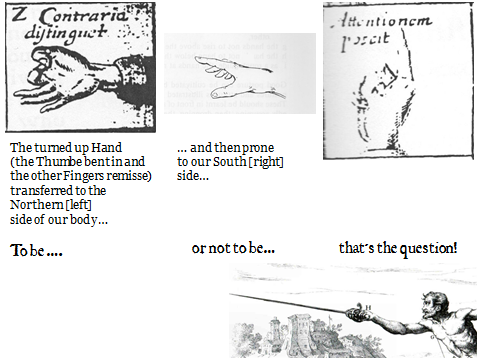
Capo Ferro’s 1610 Gran Simulacrum teaches the Art of the Sword, as applied to the long, needle-point, razor-sharp Italian rapier. If your opponent points his sword at your heart, you turn your (right) sword-hand palm-up and leftwards, so that your sword crosses his and protects you. His likely response is to dip his sword-point underneath your blade, and threaten your right shoulder instead. Now you will have to turn your sword-hand palm down and rightwards, pushing his sword aside so that you can lunge forwards and strike with the point of your sword.

Act with the hand, act with the heart!

Act with the heart, act with the hand


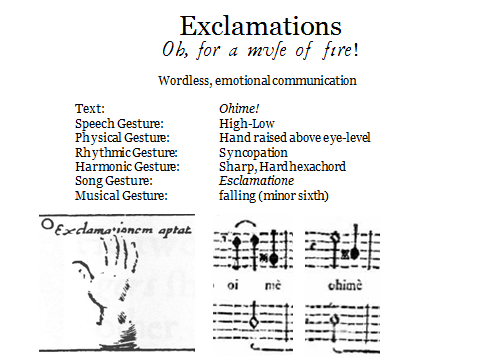
As we are told in the first scene of Anima & Corpo, historical acting linked emotional force to expressive hand-gestures. All the Action is founded on the poetic text, of course, as Shakespeare’s Hamlet instructs the Players:

Suit the Action to the Word
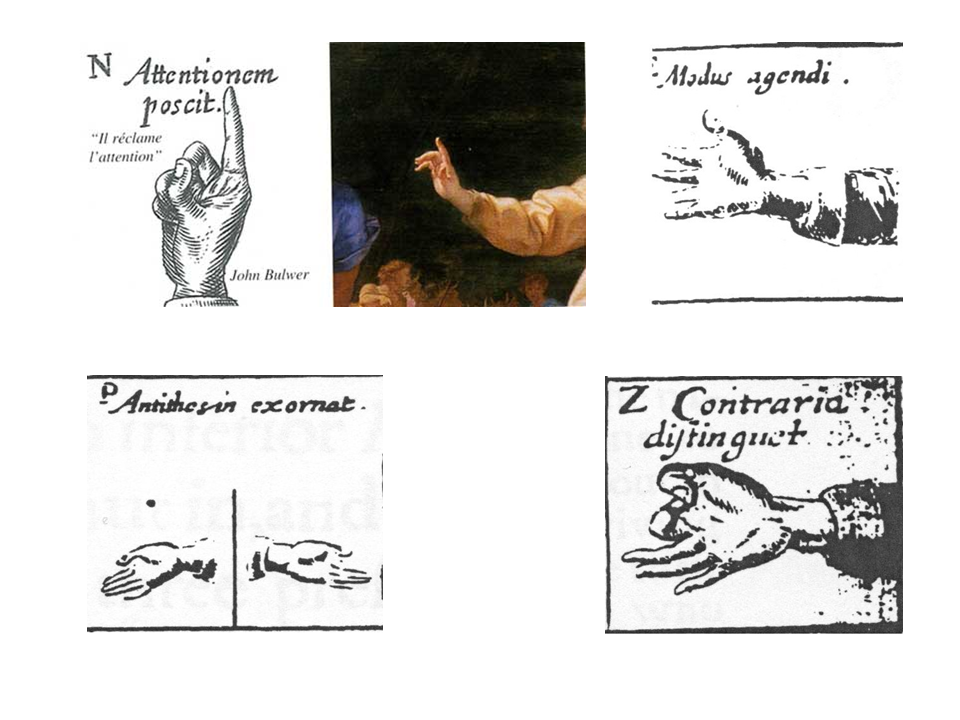
Bulwer Gestures


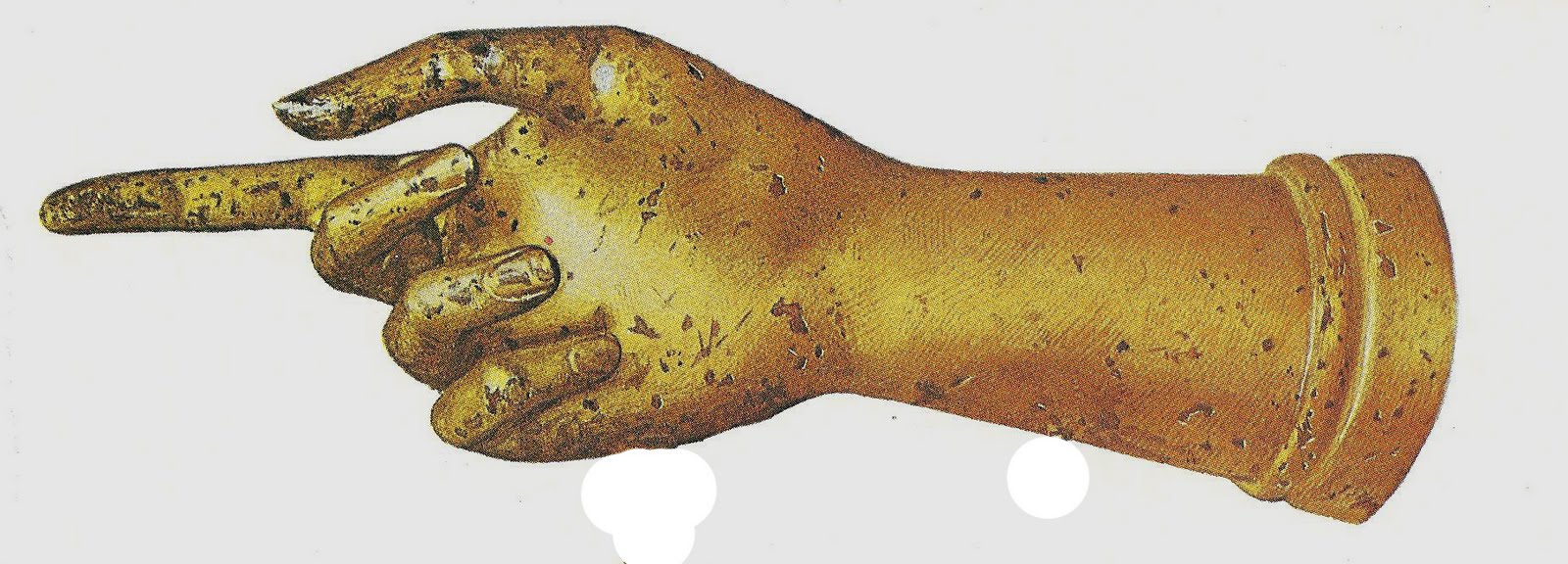
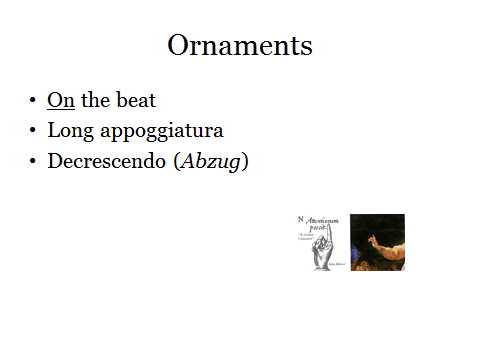
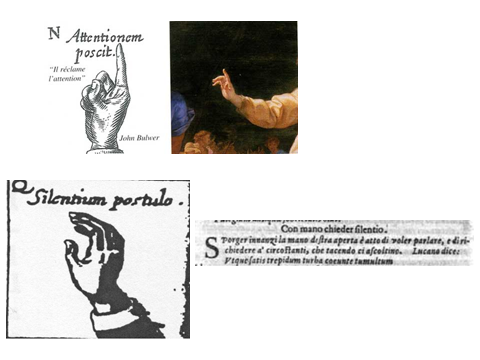
John Bulwer’s Chironomia (1644) shows gestures for Attention, for stylish Action, and for Antitheses (opposites): ‘on one hand…. on the other hand…’. Another way to Distinguish Contraries rotates the right hand palm-up and leftwards, then palm-down and out to the right.

To be or not to be


We could imagine such gestures being performed in Shakespeare’s most famous line from Hamlet:

To be or not to be, that’s the question

First we Distinguish Contraries  (to be, or not to be), and then we direct the audience’s Attention (the question). So To be (right hand palm-up and leftwards), or not to be (palm-down and out to the right), that’s (with index finger raised and the hand sent forwards, step forward to command the audience’s attention) the question.

If you try it for yourself, this sequence of movements might seem familiar to you: it is very similar to the sequence that we studied as a sword-drill, opposing to the left, turning the hand to close the line on the right, and then lunging forwards to strike.

Sword talk

Both Hamlet and Anima & Corpo are full of the language of sword-play. In Cavalieri’s masterpiece, the Guardian Angel would traditionally carry a sword, and the composer provides suitably martial music with G major harmonies and battle rhythms – the same harmonies and rhythms encountered a quarter-century later in Monteverdi’s Combattimento.

Like Shakespeare’s Hamlet, Cavalieri’s Anima & Corpo explores timeless questions of life and death by means of a fashionable vocabulary of sword-action. The English Play and the Italian Rappresentatione are each monuments of cultural achievement and artistic innovation: certainly not ‘primitive’, but endlessly fascinating and thought-provokingly different.

Anima e Corpo Golden Mask

Please join me on Facebook https://www.facebook.com/andrew.lawrenceking.9 and visit our websites www.TheHarpConsort.com

www.IlCorago.com and www.TheFlow.Zone
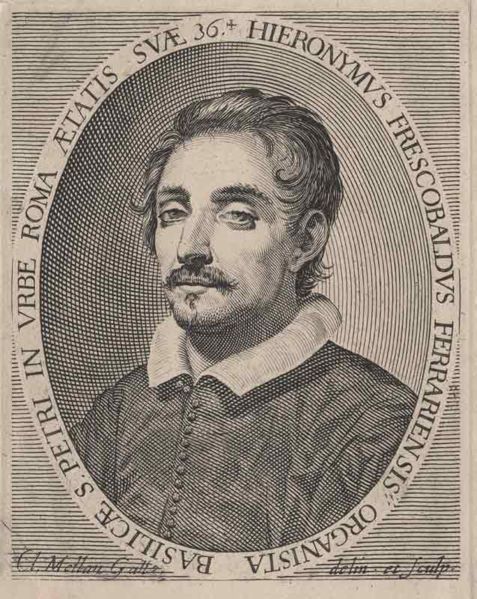
 

Frescobaldi Rules, OK?

Frescobaldi


Frescobaldi’s Preface to his 1615 collection of Toccate & Partite, transcribed at Early Music Sources here, is often cited in discussions of rhythm and tempo in early 17th-century music, but one less often encounters more profound analysis of what he actually wrote. The flowery script of the original isn’t easy to read and it’s been removed from IMSLP, but there is another transcription here (along with many other interesting historical source materials). Since Frescobaldi compares his style to concerted vocal/instrumental music, his Rules are relevant to ensemble situations well beyond solo keyboard-playing. Nevertheless, we should be cautious: precisely where and when can we apply the Frescobaldi Rules? Just how do they work in practice?

Frescobaldi – NOT!

All too frequently, we are told that “Frescobaldi says you can change the Tactus, so you can do anything that you like”. This is not only an over-simplification, but a gross distortion: Frescobaldi specifies very particular genres, situations and ways in which the Tactus might be changed. More insidiously, it implies that we can ignore the context within which Frescobaldi offered his carefully worded advice. If we replace Frescobaldi’s underlying principles with an unexamined assumption of 20th-century rubato, it is highly likely that we will misconstrue his instructions.

Toccatas and Recitative

Some Historically Informed musicians have compared the Frescobaldian toccata to Recitative. This is a thoughtful contribution, that usefully reminds us of the importance of vocal music, and by implication, Text, to this instrumental genre. But sometimes the argument is presented thus: “Frescobaldi’s toccate are like recitatives. Recitative is the most expressive genre of music. Expression demands rhythmic freedom. Therefore both toccate and Recitatives are rhythmically free”.

Every step of that argument is problematic. Frescobaldi does not mention Recitative. Circa 1600, the word Recitative was rarely used to denote the new style that we know from the first ‘operas’. See F. W. Sternfeld, ‘A Note on Stile Recitativo’, Proceedings of the Royal Musical Association 110 (1983-1984) 41-44. [This article is not openly available online, but please contact me if you can’t find it via your library]. And when the word Recitative is used, it means something different.
Recitare means ‘to act’ whether in a spoken play, a sung opera, or in silent pantomime. See Il Corago, here.  Musica recitativa thus means ‘acted music’, dramatic music: it can include aria, which in this period means any repeated unit in text, rhythm of music. So the line ‘A horse, a horse, my kingdom for a horse!’ is, in 17th-century terms, an aria within a recitative. (See Il Corago again.)
What we (mistakenly) call ‘recitative’ today, speech-like melodic patterns over a slow-moving bass (as described by Peri in the Preface to Euridice, see my annotated translation here) was called modulatione by Il Corago. Even the solo-plus-accompaniment texture of monody is rarely seen in the ‘expressive’ sections of toccate, where there is usually melodic interest in two upper parts, if not throughout the entire polyphonic texture.
So much for Frescobaldi and Recitative. Meanwhile, the baroque aim is not to ‘express’ the performer’s emotions, but to move the audience‘s passions. A subtle, but vital distinction! And, contrary to received opinion, there is no assumption circa 1600 that recitative is free. See The truth about Caccini’s ‘sprezzatura’ here.

Toccata & Continuo

Keyboard players sometimes draw parallels between the toccate and continuo realisation. This is another well-intentioned suggestion, that can be of use, if taken with caution. Frescobaldi’s famous injunction “not to leave the instrument empty”, but rather to fill out the sound with a rich arpeggio, certainly encourages continuo players to make their realisations sonorous and supportive. But other aspects of toccata style are not applicable to continuo realisation. Re-striking sustained notes and dissonances “as often as you like” would be intrusive, and is specifically contradicted by Peri – it would “make the course of speech stumble”. Many of the chord positions in the arpeggio sections are too high for use as continuo (many sources specify low register for continuo with added low octaves in the bass, and the ‘tuning A’ A440, A460 – whatever pitch you are using, the A in this octave – is a good rule-of-thumb upper limit for continuo realisation in this period). And as noted above, there is more polyphonic action in the toccate than would be appropriate for continuo, especially on harpsichord. Agazzari specifies that organ and harpsichord should play a simple, fundamental accompaniment, leaving “fun and counterpoints” for other instruments. See What is continuo? here.

Frescobaldi’s terminology


Frescobaldi repeatedly refers to battuta. This does not mean ‘bar’, as it does today, nor ‘beat’ in the sense of ‘the note on the third beat of bar two is F#’. Rather it refers to the renaissance concept of beating time, with a slow, steady down-and-up movement of the hand. I therefore translate battuta as Tactus. See Rhythm, what really counts here. But this battuta = Tactus was a philosophical principle, as much as a practical technique. Indeed, since the harpsichordist would have both hands occupied playing, no-one actually ‘beats time’ in a Frescobaldi toccata. The practice of beating time with the hand becomes a symbol for an abstract concept of a slow, steady measure that defines Time itself.

In this pre-Newtonian age, the definition of Time is Aristotle’s: Time is a number of movement in respect of before and after. Time is not an Absolute, in the way that we today understand so well from Newton; rather it depends upon movement. The steadiness of the Tactus is therefore essential for the reliability of Time itself. The philosophy of musica mondana (the heavenly Music of the Spheres), musica humana (the harmonious nature of the human body) and musica instrumentalis (practical music-making, whether instrumental or vocal) implies that earthly music is a microcosm of the entire universe, moving in perfect steadiness by divine power, and that music-making is linked to human well-being. If the Tactus fails, the heavens may fall. If your pulse stops, the music also dies. The image of the cosmos being turned by the hand of God gave enormous authority to the concept of the Tactus-hand, beating time for music on earth.

See Roger Mathew Grant’s Beating Time and Measuring Music here, and A Baroque History of Time here.

Dowland Above all things original

Changing the Tactus therefore has huge philosophical, even religious, implications. Frescobaldi therefore approaches the subject with extreme caution. So should we!


Frescobaldi frequently mentions passi, referring to the contrasting sections of his toccate. The word passo means a step, e.g. a dance-step, or a metrical ‘foot’ in poetry, so a diversity of passi suggests contrasting rhythmic structures between one section and the next. This is the opposite of the early 17th-century meaning of aria: not a nice tune, but a regular structure, especially a consistent rhythmic structure. So whilst an aria maintains a particular rhythmic footprint, two different passi have two different musical ‘steps’. Combining the meaning of ‘step’ and ‘section’, I translate passo as ‘movement’.

Affetto means ’emotion’, or to use the 17th-century English term, passion. Characteristically, the passions (plural) are moved: there are changes from one affetto to another. In this period, the word was used almost interchangeably with effetto, literally ‘effect’, as in theatrical or film ‘special effects’. An effetto is an ‘effect’, a device that produces an emotional response, an affetto. See Caccini’s use of these interlinked words, here. I translate Frescobaldi’s affetti as ‘passionate effects’

Cantabile here means ‘vocal’, without any of the connotations of continuous legato, bad rhythm, vibrato, or anything else associated with the modern concept of ‘cantabile’.

passaggio is a run of fast notes – ‘passage-work’ in modern English. A partita is a set of variations – I leave this term, and toccata, itself untranslated.

The Frescobaldi Rules

La maniera di sonare con affetti cantabili e con diversità, di passi


The style of playing with passionate vocal effects and with a diversity of movements.

Si ageuolano per mezzo della battuta

Facilitated by means of the Tactus.
  1. First; that this way of playing should not be subject to the Tactus, as we see applied in modern Madrigals, which (although they are difficult) are facilitated by means of the Tactus, beating it sometimes languidly, sometimes quickly, and even sustaining it in the air, according to their [the Madrigals’] passions, or the sense of the words.

We should read ‘subject to’ in the context of renaissance politics. No democratic citizens here, but rather subjects of an autocratic Prince. Think Machiavelli (read him here). Think of the ‘divine right of Kings’. In 1615, Frescobaldi and his contemporaries consider the Tactus to be the hand of God, that directs human musicians as if they are mere pawns, obedient ‘subjects’.

Even in his toccate and the ‘modern madrigals’ he compares them to, Frescobaldi does not suggest anarchy, a revolution that overthrows the reign of the Tactus. On the contrary, he explains that the difficulties of these compositions are ‘facilitated by means of the Tactus’. This is perhaps the most important point for modern readers to understand: Frescobaldi requires there to be a Tactus at all times, even though he specifies certain ways in which that Tactus might sometimes be changed.

Modern Madrigals refers to the new style of concerted music for voices and instruments, accompanied with a basso continuo, which (like Frescobaldi’s toccate) feature contrasting sections. Like the songs of Caccini’s Nuove Musiche, they include sections for solo voice and continuo, in which a passionate style of singing, full of vocal special effects, is required. Monteverdi’s 5th Book, in 1608, includes both old-fashioned polyphonic partsongs and ‘modern’ concerted settings; his 6th Book in 1619 is entitled Concerto and consists entirely of ‘modern’ compositions. Frescobaldi published in 1615, just as the move to ‘modernism’ was underway.

Notice that Frescobaldi does not use the word Recitative, although one of the features of ‘modern madrigals’ is what we (anachronistically) call ‘recitative’. There is no suggestion from Frescobaldi (or elsewhere) that what we call Recitative should be performed in free rhythm.

Since the Tactus beat is down-up, sustaining it ‘in the air’ implies prolonging an upbeat, or hesitating before a downbeat. This already reduces the opportunities for hesitation by 50%: Frescobaldi does not sanction holding the Tactus-hand down at the bottom of the downbeat!

The affetti in ‘modern madrigals’ can be identified by ‘the sense of the words’. But Frescobaldi’s toccate have no text, of course, so understanding which affetto, which passion, is at play becomes a crucial question. Remember that the idea of ‘moving the Passions’ implies that the affetto changes frequently, often from one extreme to its opposite (as we read in the Preface to Cavalieri’s Anima e Corpo, here).

Different Movements

2. In the toccate I took care not only that they should be full of different movements and passionate effects: but also that each of these movements can be separated one from another, so that the player has no obligation to finish them all, but can stop wherever it seems convenient to him.

The sectional construction of the toccate is a significant topic in Frescobaldi’s advice for performers. The corollary is that other genres of music in the piece, which are not constructed in contrasted sections, should not have the Toccata Rules applied to them. These Rules apply only to the specific genre of Toccata, to the related genre of ‘modern Madrigal’, and (as Frescobaldi mentions later) to other genres that fall into well-defined sections. Otherwise, the default assumption, circa 1615, remains the conservative practice of constant Tactus.

Not to leave the instrument empty

3. The opening sections of the toccate should be performed adagio and arpeggiating; and similarly in the ligature (sections with suspensions ‘tied over’) or durezze (dissonances), also in the middle of the piece. [The tied-over suspended] are struck [again] together [with the new, dissonant harmony], so as noto leave the instrument empty. This restriking can be repeated ad lib by the player.

The opening sections are notated in long notes. If you take a slow Tactus, then they end up feeling very slow indeed. Certainly, you’ll need arpeggios ‘so as not to leave the instrument empty’. I recommend following Frescobaldi’s advice, and using the Tactus to ‘faciliate’ changes of tempo, which can be ‘difficult’. Play the transition between two sections first in constant Tactus; then apply Frescobaldi’s Rules to adjust the Tactus, and play the transition with the required adjustment.

It is not clear if the ad lib restriking of dissonances refers to the suspended note only, or to the entire dissonant chord. It is also not clear whether a bene placito (which I translate as ‘ad lib’) means ‘if you want’ or ‘as many times as you want’. I have been told that Piccinini recommends something similar for the lute, but I do not have a precise reference for this. [Lutenist readers, please comment!]

Transitions between movements

 4. On the last note, both of trills and of passage-work that moves by leaps or by step, you have to stop, even if that note is a quaver or semi-quaver, or dissimilar to the following note. This pausing will avoid any confusion between one passage and another.

It’s worth noting again the context, which is the assumption of regular Tactus. Frescobaldi’s readers do NOT expect to stop on a short note, and they recognise the need to maintain the Tactus (under normal circumstances) so that contrasts in notated note-values can be understood. However, in the special case of the transition between contrasting sections of a toccata, those 17th-century assumptions are contradicted.

Adagio (not rallentando)

5. The cadences, although they might be written fast, can appropriately be somewhat sustained; and as you approach the conclusion of passage-work or cadences you go sustaining the tempo more adagio. The separation and conclusion of movements is when you find a consonance in both hands together, written in minims.

A stylistic feature of this repertoire is the use of ever-smaller note values for decorated cadences: Frescobaldi says that you don’t have to take the note-values absolutely literally, but the Tactus can be ‘somewhat sustained’. This suggests the ‘sustaining’ of the Tactus hand ‘in the air’, on the upstroke. Approaching the conclusion of a section, the entire Tactus can be slower than normal. It is not clear whether piu adagio means only ‘slower than normal’ or also ‘getting slower and slower’: we should not assume that Frescobaldi is advocating a modern rallentando. My cautious opinion, based on close reading of other sources in this period, is that rallentando is probably not intended, rather it is a one-time shift in tempo. I advise my students to vary the tempo ‘with the gear-lever, not with the brakes or accelerator’.

The Trill challenge!

6. When you find a trill in the right hand, or the left, and simultaneously the other hand has passage-work, you should not synchronise these note by note, but just try to make the trill fast, and carry the passage-work less fast and passionately: otherwise there will be confusion.

Ideally, the trill should have an elegant, subtle ‘shaping’ from slow to fast (as Caccini recommends and many other sources support), rather than being literal. The moving part in the other hand should then be slower than the fast trill, and should be played ‘passionately’. We should not confuse 17th-century passion with 20th-century rubato: Caccini suggests many ways to vary the rhythm of notated quavers, in order to ‘move the passions’, within a steady minim tactus. The concepts here (steady tactus, shapely and fast trill, passionate presentation of the moving notes, independence of the two hands) are challenging for modern readers: the execution is not easy, either!

Harpists might note that this situation occurs in the final notes of the arpa doppia solo in Monteverdi’s Orfeo (Act III, the Aria Possente Spirto): trill in the right hand (with F#, which is a little inconvenient), passionate moving notes in the left hand (fragments of upward scale, each successive fragment is an octave lower, as we descend into the depths of Hell): it is, of course, the end of a passo. Go ahead and apply Frescobaldi Rule 6 – it’s not easy, but the effetto is certainly worth the effort.

Fun with two hands

7. When you find some movement with quavers and semiquavers together in the two hands, it shouldn’t be taken too fast: and the hand that plays the semiquavers must play them somewhat dotted, that is not the first, but the second [note] should be dotted, and so on all the way through, one no, the next yes.

Good practical advice to take these movements at a steady tempo (some modern performers treat them as a race for an Olympic speed record). So whilst one hand moves in quavers (taken normally, and in steady Tactus), the semiquavers in the other hand are given a gentle ‘reverse swing’ in ‘Lombard’ rhythm (short-long). Fun!

Attack resolutely!

8. Before you play a ‘double movement’ where both hands have semiquavers, you should stop on the previous note, even if it is ‘black’ (i.e. short: crotchet, quaver, semiquaver); then resolutely play the passage-work, so that the agility of the hand will be so much more apparent.

The advice to stop before beginning a new movement fits with what we have already been told in Rule 4, although the situation here might be slightly different. Frescobaldi’s care in spelling out the details of these two, apparently very similar, situations, is a warning to us not to apply his Rules without careful checking that the situation really is appropriate. There is no general licence to ‘change the Tactus whenever you want’!

Some modern players like to start such ‘double movement’ passage-work slowly, and accelerate. Frescobaldi rules this out: he tells you to begin ‘resolutely’. This word occurs also in sword-treatises, where spotting the correct moment (also called tempo in the sense of kairos or opportunity) to attack is a vital skill. But once the opportunity to strike is there, you don’t begin slowly, you attack ‘resolutely’! This is another situation where I advise my students “don’t use the brakes and accelerator, use the gear-shift’.


Driving Time

9. In the Partite (variations), when you find passage-work and passionate effects it will be good to take the tempo largo; you should observe this also in the toccate. The other [variations] without passage-work can be played with a somewhat allegro Tactus, leaving the good taste and fine judgement of the player to ‘drive the tempo; in this [driving the tempo] lies the spirit and perfection of this manner and style of playing.

We are reminded here that the Rules are not ‘how to play toccate‘, but ‘how to play with a diversity of movements and passionate vocal effects’. So variation-sets may well have a diversity of movements, and some variations may include passionate vocal effects.

The references to ‘good taste’ and ‘fine judgement’ suggest that the changes in Tactus between adagio, largo and allegro are subtle adjustments to the normal tempo (something around minim = 60 is the ‘default’ setting for this period). Note that Frescobaldi often qualifies words of tempo change with adverbs like ‘somewhat’, ‘slightly’.

To find the correct ‘spirit’ and ‘perfection’ in these small adjustments, we need to make good use of the Tactus to ‘facilitate’ such ‘difficult’ transitions. Especially when the Tactus is going to change somewhat, or even hesitate in the air, we need to have a good understanding of precisely what the Tactus is doing. Often, players change the Tactus in the opposite way from Frescobaldi’s rules, taking the opening arpeggios at a different tempo from, but faster than the succeeding movement. The remedy is to begin by studying the piece in a consistent Tactus, and to manage transitions by focussing on the Tactus, not on the general level of activity in smaller note-values.

The reference to ‘good taste and fine judgement’ does not imply that the player can do ‘whatever they want’. Rather, they are required to be careful in how much, and in which direction, to ‘drive the tempo‘, so that Time’s winged chariot does not crash and burn.

Phaeton van Eyck

Playing with Time can be dangerous: Phaeton tried to drive Apollo’s Sun-Chariot, but he crashed it.

The Passacaglias can be played separately, whatever best pleases you, with adjustments of the tempo between one variation and another, similarly for Ciacconas.


It is not clear whether ‘separately’ means that you can play an individual set of passacaglia variations as a ‘stand-alone’ piece, or if you can select variations from within a set, in the same way that you can select movements from within a toccata. Probably the latter. But note that the Tactus can be changed between one variation and another, according to the Rules already given.

Other Prefaces

In addition to the famous 9 Rules, Frescobaldi gives other summaries of his approach.

1615a

The beginnings of the toccate should be played adagio, and the block chords should be arpeggiated. As [the toccata] continues, pay attention to the distinction between movements, carrying them more or less rapidly according to the difference in their passionate effects, which will appear as you play. In the ‘double movements’ [semiquavers in both hands], similarly you go adagio, so that they are better articulated; and in descending leaps, the last note before the leap should always be resolute and fast. It’s appropriate to stop on the last note of a trill, or other passionate effects, such as a leap, or step, even if it is a semiquaver or demisemiquaver. And usually you somewhat sustain the cadences. In the partite you set tempo giusto and with Proportions, and because in some [variations] there are fast movements, start with a comfortable Tactus; it’s inappropriate to start presto and then continue languidly. But [partite] should be carried through entirely in the same tempo. And have no doubt, that the perfection of playing is in the understanding of tempi.

This summary also reminds us of the default assumptions of the early 17th century. There is the expectation of a standard Tactus – tempo giusto – around minim = 60, and triple-metre is managed by Proportions. The normal expectation is that pieces will be played entirely with a constant Tactus.

Nevertheless, the final sentence refers to tempi, in the plural. There can be changes in the Tactus, but ‘perfection’ is in understanding precisely where, when and how.

1624 Primo libro di capricci

These works … of various tempi and variations…

In these pieces, which might seem irregular in their use of counterpoint, you should first look for the passion of the movement in question and the intention of the Composer concerning the delight of the listener and the way one should try to play. In those pieces entitled Capricci, I have not kept such an easy style as in my Ricercari. But you shouldn’t judge their difficulty before putting them into practice at the instrument, where you will recognise by study the passion they should have…

You can choose whichever you like of these movements, and finish in any of them which end in the right tonality. The beginnings should start adagio to give greater spirit and beauty to the following movement; and in the cadences sustain somewhat before you start the next movement. And in tripla [fast triple] or sesquilatera [slow triple] metres, if they are maggiori you set off adagio, if they are minori somewhat more allegro; if they are three semi-minims, piu allegro; if they are 6/4 you give their tempo by making the battuta go allegro.

It is good in some dissonances to dwell on them and arpeggiate them, so that the following movement comes out with more spirit. All this is said with every modesty, and depending on the good judgement of studious performers.

This summary also gives us additional information. Genre distinctions (Ricercare or Capriccio) are significant. To understand difficult music, search for the passion of each movement, and consider the Composer’s intentions.

In the discussion of Proportions, I have left certain terms untranslated, because there is academic debate on their meaning. But my take on this is very straightforward: triple metres might be notated under 3/1 or 3/2, but either way, long notes (three semibreves) go slowly; short notes (three minims) go medium fast. Semi-minims are black with a stick – to a modern reader they look like crotchets: they go faster. If you have a 6/4 section, this goes very fast.

This user-friendly approach to Proportions can be applied to famously challenging situations, for example the ballo in Monteverdi’s Orfeo. See Tactus & Proportions in ‘Lasciate i monti’  here.  The difference between the (consistent) time-duration of particular note-values, and the (diverse) feelings of ‘speed’ in triple metres is explored in Quality Time: how does it feel? here. I set out in detail my take on Tactus and Proportions in Getting back to Monteverdi’s Time here.

Scope

I began by urging caution. We need to understand precisely where, when and how Frescobaldi allows departures from the 17th-century default setting of constant Tactus. But close reading reveals that his Rules can appropriately be applied not only to harpsichord solos but to any repertoires in this period that exhibit sectional construction with different rhythmic structures between movements, and/or passionate vocal effects. Certainly that includes the ‘modern’ style of Madrigals around 1615, but it would also seem relevant to vocal monody and – most intriguingly – to ‘opera’.

Whilst the default assumption is that an entire work (e.g. Monteverdi’s Orfeo) has the same, consistent Tactus, Frescobaldi’s Rules suggest particular circumstances where the Tactus might be somewhat faster or slower, or might even hesitate in the air. However, these Tactus changes are between movements (not within a movement), and (I would argue) of the ‘gear-shift’ type, rather than accelerando or rallentando. And the way to study these ‘difficult’ transitions is to identify the passion, apply the appropriate (subtle) adjustment of Tactus, and facilitate the performance by keeping a grip on the Tactus.

All this is very far from ‘rhythmic freedom’ in ‘recitative’, or any general licence to play around with Time. Rather, even when the Tactus is going to change or hesitate, you facilitate the adjustment by means of the Tactus. Don’t crash the Time-Chariot.

Tactus still rules, OK?


Please join me on Facebook https://www.facebook.com/andrew.lawrenceking.9 and visit our websites www.TheHarpConsort.com

www.IlCorago.com and www.TheFlow.Zone

Opera, orchestra, vocal & ensemble director and early harpist, Andrew Lawrence-King is director of The Harp Consort and of Il Corago. From 2010 to 2015 he was Senior Visiting Research Fellow at the Australian Centre for the History of Emotions.


Monteverdi, Caccini & Jazz

The Rhythm Section by Suzanne Cerny

The Rhythm Section by Suzanne Cerny


Giulio Caccini (1551-1618) would find basic advice for today’s jazz singers rather familiar:

Your jazz singing voice should be a natural extension of your speaking voice.

In Le Nuove Musiche (1601), Caccini asks for una sorte di musica … quasi che in armonia favellare, usando … una certa nobile sprezzatura di canto. [A kind of music, almost like speaking in harmony, using a certain elegantly ‘cool’ vocal production.] Note that, contrary to received opinion, Caccini’s sprezzatura is not to do with rhythm, but with voice-production. See Play it again Sam, the truth about Caccini’s sprezzaturahere.  The complete original text of Le Nuove Musiche is here.

Your aim is to move an audience by conveying the lyrics of a song as if it were a poem.

The aim of music, and all the Rhetorical arts of the 17th century is muovere gli affetti [to move the emotions]. Caccini too searches for the forza di muovere l’affetto dell’animo [the force to move the emotions of the mind], noting that non potevano … muovere l’intelletto senza l’intelligenza delle parole [you can’t move feelings unless the words are understood]. Caccini proclaims la musica altro non essere che la favella e’l ritmo, & il suono per ultimo, e non per lo contrario. [Music is nothing other than Text and Rhythm, with sound last of all. And not the other way around!]

Now sing your song … exactly as it was originally written by the songwriter.

That should prevent you copying a particular interpretation off a recording by an admired artist: rather, you should create your own version of the song. This is very good advice for students of 17th-century song, too. It’s surprising how many interpretative touches have been passed through the Early Music movement, even when they are contradicted by well-known period sources. And all too often, Early Music singers begin introducing random rhythmic changes (in the name of ‘expressiveness’) before learning what the composer actually wrote!

Rhythmic displacement

Nevertheless, the subtle rhythmic displacement that is so important for Jazz is mentioned also by Caccini (but remember, this is not sprezzatura).

The freedom to loosen up the rhythm of a song spontaneously to add intensity is one of the joys of singing jazz. To practise rhythmic displacement, it is a good idea to begin by learning … the song. [Then], start subtly “loosening up” the timing of each phrase. The idea here is to sing the words rather like you might say them. Try shortening and lengthening different notes each time you sing a phrase and notice how playing about with the rhythm changes the emphasis on the words and can help you put your own stamp on a song. Your singing will also sound more like jazz if you leave a short space (about the length of a clap) before launching into every phrase.

For a few bars of one of his three example songs, Caccini applies senza misura [unmeasured, i.e. ‘loosened up’ timing], asking for this particular phrase to be quasi favellando in armonia con la suddetta sprezzatura [almost speaking in harmony with the above-mentioned sprezzatura]. The ‘above-mentioned sprezzatura‘ is a ‘cool’ vocal production.

The jazz citations above are from The Guardian’s online Jazz Singing Advice (2009), full text here, and having dealt with words, the anonymous columnist continues with a paragraph on Swing, paralleling Caccini’s priorities of Text and Rhythm.

Pamelia Phillips similarly mentions Rhythmic Displacement in Singing for Dummies 2nd Edition (2010). [You can read more of Phillips’ Training Requirements for Singing Jazz here.]

Jazz singers … usually change the notes and rhythms from the original music. Jazz singers create their style with rhythmic flexibility, and the singer and pianist don’t always have to be together note for note (called back phrasing).

But this rhythmic flexibility is certainly not anarchic or random. Like Caccini and the Guardian’s jazz expert, Phillips emphasises that

The jazz singer needs a great sense of rhythm.

Just as in renaissance Italy. The Anonymous swordmaster of Bologna writes in L’Arte della Spada [The Art of the Sword, MS Ravenna M-345 & M-346. There is a modern edition by Rubboli & Cesari, who date the treatise to the early 16th century, whilst the consensus view places it c1650] that swordsmen need the same sense of precision rhythm as a good singer!

L'Arte della Spada Anonimo Bolognese

The Hidden Assumption

But the Guardian, Phillips and Caccini all fail to mention (though Phillips hints at it) a vital, hidden assumption. Whilst the singer ‘loosens up the timing’ with rhythmic displacement, rhythmic flexibility or senza misura (whatever you want to call it), the accompaniment maintains a steady swing. We take this for granted in jazz, and the renaissance concept of Tactus similarly requires a steady slow pulse. (For Monteverdi, Caccini etc, evidence suggests a consensus Tactus speed of around minim = 60). The crucial point I’m making is that this concept of Tactus still pertains in the accompaniment, even when the singer is applying Caccini’s senza misura.

Monteverdi notates this practice, for example in the opening phrase of Orpheus’ aria in the underworld, Possente Spirto, from Act III of Orfeo (1607).

Possente Spirto incipit

Just as Phillips describes for jazz, singer and basso continuo are not always together.

Taking Monteverdi as a model, here is my realisation of Caccini’s example of senza misura from Le Nuove Musiche, showing how the singer might loosen up the timing, whilst the continuo maintain the Tactus.

Aure divine, ch'errate peregrine

Such a realisation fundamentally redefines the role of the continuo. Nowadays, continuo-players are asked to follow even the most random, rhythmically anarchic singers. It feels like that fairground game, where you wait, rifle (or theorbo) in hand, until a little yellow duck (the tenor) waddles into your sights, and then you fire off a chord, and hope to hit him in root position.

Duck shoot

But jazz singing, and Monteverdi’s notation of Caccini’s senza misura, require the accompaniment to maintain the swing, or Tactus. In jazz, those accompanists are called the Rhythm Section. In Monteverdi’s time, the continuo group are

Those who guide and sustain the whole body of singers and instruments of the ensemble.

quei, che guidano e sostengono tutto il corpo delle voci  e stromenti di detto concerto [Agazzari Del suonare sopra ‘l basso (1607)]. There is, of course, no conductor, so the continuo are indeed the Rhythm Section of seicento music.

None of this should be shocking to Early Music readers, except that the familiar role of the continuo as Rhythm Section, maintaining the swing of the Tactus, still pertains, even in what  Caccini calls lo nuovo stile [the new style] of what musicologists call early baroque Monody, and most performers (anachronistically) call Recitative.

[See Redefining Recitative here. Circa 1600, recitare just means ‘to act’, whether in spoken drama, opera, or silent pantomime. Musica recitativa is thus ‘acted music’, i.e. dramatic music. The period term for speech-like declamation over a slow-moving bass is modulazione. 18th-century Recitative is something else. In late 17th-century England, what Samuel Pepys calls ‘Recitative Music’ is rhythmically structured, Caccini-style. See Andrew Lawrence-King, ‘’Tis Master’s Voice: A Seventeenth-Century Shakespeare Recording?’ in R.S. White, Mark Houlahan & Katrina O’Loughlin, eds., Shakespeare and Emotions: Inheritances, Enactments, Legacies (Basingstoke: Palgrave Macmillan, 2015).]

Heavenly Tactus or Hellish Duckshoot?

At the foot of the title page of Agazzari’s treatise, there are two Latin mottos. One shows a diagram of the cosmos, a model of armonia [which in this period means not only harmony, but music in general, in particular well-ordered or ‘goodly’ music].

Armonia comes from movement.

Specifically, well-ordered music comes from the perfect movement of the stars and planets, imitated on earth by the regular swing of the Tactus-beater’s arm, conceptualised as the authority of the Tactus itself.

Ex motu armonia

All this refers to the idea of the Harmony of the Spheres, the notion that earthly music-making, musica instrumentalis, is an imitation of the perfect music of the heavens, musica mondana; both of these symbolise musica humana, the harmonious nature of the human body. Well-ordered music is related to healthy well-being. Steady rhythm is a reflection of cosmic perfection.  Thus Dowland, translating Ornithoparcus’ Micrologus, declares that steady Tactus, “Equality of Measure” is a moral imperative.

Dowland Above all things original

Agazzari’s second motto is placed ‘stage left’, rhetorically the ‘bad’ area in contrast to the cosmos diagram placed in the ‘good’ area. It captions an image of the serpent in the pit of hell, and warns ominously:

And they don’t mess up, either!


Nec tamen inficiunt


If we view Caccini’s invitation for singers to apply senza misura and Agazzari’s description of the continuo ‘guiding the voices’ through the lens of these two mottos, we see a practice that today’s jazz-musicians would recognise: a singer is free to sing before or after the beat, whilst (in the Rhythm Section) the continuo-players maintain the Tactus. “And they don’t mess up, either!”.


Conclusion

Modern advice about jazz cannot prove anything, either way, about Early Music. But the parallels I’ve drawn here show the vital significance of underlying assumptions. Today’s performers approach Caccini and Monteverdi with the anachronistic label ‘Recitative’, which encourages them to abandon the period assumption of steady Tactus. Instead, they assume that the way to ‘express emotions’ is to use 20th-century rubato. But jazz and Caccini are not ‘expressing’ what the performer feels, they seek to move the audience‘s passions. Jazz does this by allowing the singer subtle rhythmic flexibility whilst the Rhythm Section maintains the swing; Monteverdi notates precisely this; I suggest this is what Caccini meant by suggesting senza misura for singers.

The underlying assumptions about music in the early 17th century are that Rhythm is a high priority, that there is a steady Tactus, and that this Tactus is maintained by the continuo.

Agazzari frontispiece

Please join me on Facebook https://www.facebook.com/andrew.lawrenceking.9 and visit our websites www.TheHarpConsort.com

www.IlCorago.com and www.TheFlow.Zone

Opera, orchestra, vocal & ensemble director and early harpist, Andrew Lawrence-King is director of The Harp Consort and of Il Corago. From 2010 to 2015 he was Senior Visiting Research Fellow at the Australian Centre for the History of Emotions.


Logical, Captain! The implications of Peri’s Preface

Logical Captain


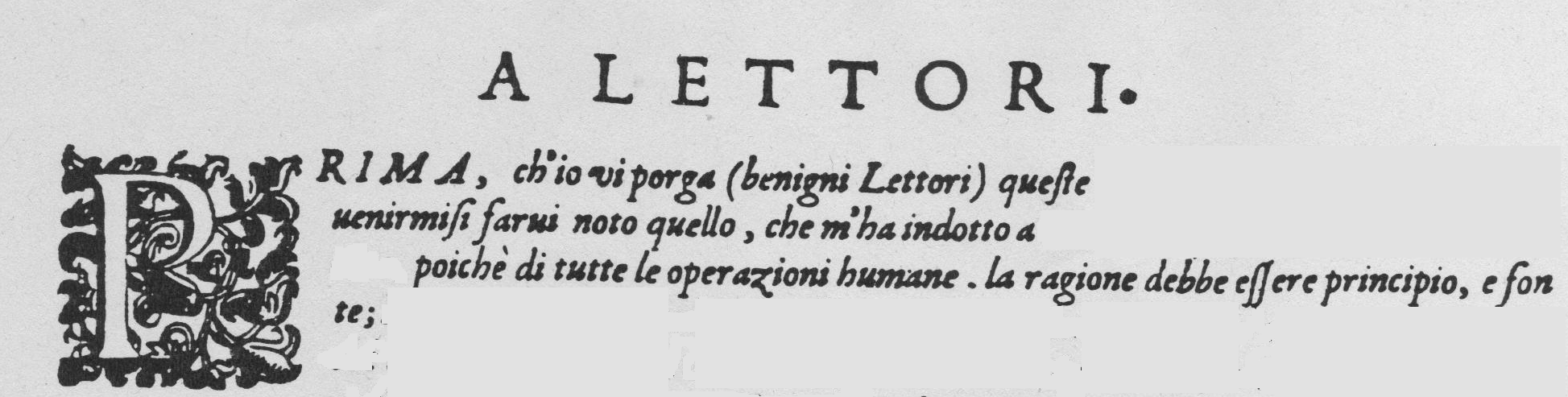
Before I offer you, dear Readers, this analysis of mine, I think I ought to bring to your attention what has led me to re-examine this well-known Preface, for in all human operations logic should be the beginning and source…

Peri Euridice Preface incipit


SUMMARY


Here is a statement of my own, about Jacopo Peri’s Preface to his setting of Euridice (1600), the earliest surviving secular ‘opera’.


I reduced the Preface to its essential point, so that the process of reading should not need (in a kind of way) to ‘plough through’ every sentence. That’s the principle of a summary, whereas the  complete Preface naturally requires detailed examination.


I modelled this statement on Peri’s sentence structures, but working logically through the 17th-century formulations, it should be clear that:


  • I am discussing a summary.
  • There are differences between a summary and the complete Preface.
  • I made the summary by reducing the Preface to its essential argument.
  • The idea is to avoid ‘ploughing’ by means of the reduction of the Preface.


There are two further implications:


  • Normally, with the complete Preface, the attentive reader will indeed ‘plough through’ every sentence.
  • Even in a summary, readers will follow me, though they don’t ‘plough through’.


Now here is a summary of Peri’s most famous statement about the composition of dramatic music, explaining how he imitates ‘the course of speech’ in song [his complete text is below]:


I reduced the Bass to its essential pulse, so that the course of speaking should not seem (in a kind of way) to ‘dance’ to the movement of the Bass. That’s the principle for sad or serious material, whereas happier texts naturally require more movement in the Bass.

Working logically through Peri’s 17th-century formulations, it should be clear that:


  • Peri is discussing music for sad or serious texts.
  • There are differences between sad or serious material, and happier texts.
  • Peri made his serious music by reducing the Bass to its essential pulse.
  • The idea is to remove ‘dancing’ by means of the reduction of the Bass.


There are two further implications:


  • Normally, in happier texts, stylish singing will indeed ‘dance’ to the movement of the Bass.
  • Even in sad or serious material, singers will follow the Bass, though they don’t ‘dance’.


Peri’s Preface has often been misunderstood as an appeal for ‘rhythmic liberty’, and its most famous statement mis-interpreted as ‘singers should not follow the Bass’. Those frequently repeated distortions fit comfortably with the 20th-century notion of rubato and free rhythm as the epitome of expressiveness, and with the modern convention that accompanists must follow the soloist. But period sources from Agazzari to CPE Bach and Leopold Mozart insist that the Bass lays down the Tactus, and that soloists follow this essential pulse (just as in today’s jazz). Sometimes the singing ‘dances’, sometimes it is sad or serious, but it always has the essential pulse of Tactus, led by the Bass. Before the year 1800, soloists follow the accompaniment, because accompanists have particular responsibility for maintaining the Tactus.


Meanwhile, the ‘liberties’ Peri asks for are not to do with rhythm, but relate to musical ‘grammar’ – the rules of dissonance, l’uso delle false. When he does talk about rhythm, he draws attention to the great variety of note values he employs, linked to the emotions of the text. Contrasts in note-values would be destroyed, if there was no underlying pulse to structure all that variety: indeed such destruction of notated contrasts is just what happens in many modern ‘free’ performances of early 17th-century monody.


Throughout  Peri’s Preface, there is nothing to contradict the general (historical) assumptions for all music of this period:


  • There is a regular Tactus pulse.
  • Soloists follow the Bass.

You can read more about Tactus here. And you can read about how Tactus structured early 17th-century music here.


One last observation: Peri never uses the word ‘recitative’. His topic is nuova maniera di canto (a new kind of song, a new way of singing) for Musica su le scene (Theatrical Music). And he refers to even the most poignant speeches of Orpheus, of the lamenting shepherd Arcetro and of Dafne (the Messaggiera) as arie. The word aria in this period does not necessarily mean a ‘tuneful melody’, but rather refers to elements of repeated structure, for example a ground bass, or any repeated rhythmic fragment.


Peri’s complete text with my translation and commentary are below.

Peri Euridice Preface vale

And may you live happily!

Spock


Annotated translation:

Jacopo Peri Preface to Euridice (Florence, 1600)

The original Italian text is here, along with the music of Euridice (mostly by Peri himself, but with some items contributed by Caccini).


Editorial procedure: I have tried to stay close to Peri’s word-order, and to use English cognates whenever possible, to help the reader follow the Italian text in parallel. Any serious discussion of this key text has to be made using the original Italian text, since translation (and the specific 17th-century meaning) of Peri’s terms is inevitably open to question.

Jacopo Peri 

Before I offer you, dear Readers, this Music of mine, I think I ought to bring to your attention to what has led me to invent this new manner of song, for in all human operations, reason should be the beginning and source; And he who cannot show reason easily leads one to believe that he worked by chance.


Peri offers a Scholastic defence for the Humanist project of creating a new kind of music. Ritrovare, which I have translated as ‘invent’, also means ‘to find out again, or to retrieve’ (Florio Dictionarie of the Italian and English tongues. London, 1611). Although Peri’s ‘manner of song; is ‘new’, the artistic endeavour was to re-discover Ancient music. This suggests interesting comparisons to today’s Early Music!


Although by Signor Emilio del Cavaliere, before any other that I know, with marvellous invention our Music was made to be heard on the Stage; nevertheless it pleased Signori Jacopo Corsi and Ottavio Rinuccini (at the end of the year 1594), that I should apply it [our music] in another guise, setting to notes the fable of Dafne, written by Signor Ottavio, to make a simple test of what singing could do in our era.


Peri properly acknowledges Cavalieri’s achievements, and presents his own previous experience. Corsi was a patron of ‘early opera’, Rinuccini one of the greatest libretto poets. Caccini is not mentioned, in spite of his strong claims to have invented the new style himself, but Peri quietly positions his 1594 Dafne well in advance of the rival settings of Euridice  and Caccini’s Le Nuove Musiche (1601/2). Peri’s Euridice, which includes some music by Caccini, was the first to be performed, but Caccini rushed his own complete setting into print before Peri’s was published.


From this it is seen that we were dealing with dramatic poetry, but if one should imitate in song how one speaks (and without doubt, no one ever actually spoke by singing), I esteem that the ancient Greeks and Romans (who according to the opinion of many sang entire Tragedies on the Stage) used a musical style, which going beyond that of ordinary speaking, descended so much from the melody of singing, that it took the form of something intermediate; And this is the reason by which we see in this Poetry there is a place for the Iambic, which is not exalted like the Hexameter, but merely is said to advance beyond the confines of everyday discourse.


There was no difficulty in setting to music diegetic songs and dances (theatrical scenes which represented the characters making music) and it was accepted as a convention that Prolouges, Choruses, Gods and similar other-worldly figures might sing. The question Peri grapples with here is the theatrical representation of speech. In the Platonic tradition, imitare implies also ‘artistic expression or representation’. Peri admits that people don’t normally sing when they speak, and looks to Ancient Greece and Rome for an intermediate form, something between speech and song. He compares this to blank verse, which is intermediate between prose and poetry..


Armonia can mean ‘harmony’, but often has a wider meaning as any kind of musical organisation, especially rhythmic, as well as melody: here, I translate it as ‘musical style’, for Peri is concerned with the melodic and rhythmic patterns of speech. Peri’s ‘something intermediate’ reminds us of Caccini’s sprezzatura, a nonchalant, ‘cool’  voice-production, something between singing and normal speech.


Contrary to received opinion. Caccini’s sprezzatura is NOT rhythmic freedom.  Read what Caccini actually wrote, here.      


And so, having rejected any other manner of song heard until now, I devoted myself totally to researching the representation needed for these Poems; and I consider that the sort of tones, which the Ancients assigned to singing, and which they called Diastematica (as if drawn out and suspended) could sometimes be taken faster, and take a moderate course between the movements of song (slow and suspended) and speech (speedy and fast), & be adapted to my proposition (as they [the Ancients] also adapted it [Diastematica] when reading Poetry and Epic verses) to approach that other [sort of tone] of speaking, which they called Continuous; This is what our modern people (although perhaps for another end) have already done in their music.


‘Researching’ translates Peri’s ricercare, which – like ritrovare – carries also the suggestion of rediscovering or searching again. The word reminds us of abstract polyphonic music designated ricercar, recalling the concept – of music being ‘found’ rather than invented – at the root of the word Troubador.  


‘Tones’ translates Peri’s voci: his word takes oin the concepts of ‘voice’, ‘note’, ‘syllable’, ‘vowel’.  Again, Peri proposes something ‘intermediate’ between slow singing and fast speech: he also suggests that that the syllable speed would vary.  He makes a parallel with different ways of reading lyric and epic verse. Around 1600, it was already customary, even in polyphonic music, to set text to varied note-values.    

Peri on Recitative

I know similarly that in our speaking some tones are pitched in such a way that there one could lay a musical foundation, and in the course of speech many other [tones] pass by, which are not pitched, until one returns to another [tone] suitable for movement of a new harmony, & having respect for those modes and those accents which are needed in lamenting and rejoicing & in similar matters, I made the Bass move in the time of these, sometimes more, sometimes less, according to the emotions, and kept it unmoving through the dissonances and through the correct consonances, until – running through various notes – the tone of the speaker arrives at that [syllable] which in ordinary speaking would be pitched: [this] opens the way to a new harmony;


Peri takes his inspiration from the sustained syllables of declamatory speech, for which a musical pitch can be assigned, and/or a harmonious accompaniment created. Again, the word ‘tones’ should be read to  include also the concepts of ‘the voice’, ‘syllables’ and ‘vowels’. The word accenti carries the meanings of  ‘expressive words’ and ‘expressive notes’: in this period it also means a particular expressive ornament. Armonia can mean the pitch of the sung note, or a harmony in the accompaniment.


Peri constructs a bass-line according to the musical requirements of varying emotions .Those emotions dictate the rhythm of the bass, which moves ‘sometimes more, sometimes less’. Sometimes he keeps the bass fixed in spite of some dissonances in the voice-part. After many quick, light, ‘unpitched’ syllables, the bass plays a new harmony with the next sustained, pitched syllable.     

Peri Euridice Preface 'dance' to the bass

And this is not only so that the course of speaking should not wound the ear (as if stumbling as it encounters the repeated strings of more frequent harmonies) or that [the course of speaking] should not seem in a kind of way to dance to the movement of the Bass, principally in matters  either sad or serious, other happier [matters] naturally requiring more frequent rhythms:


Peri’s word corde, ‘strings’ implies the notes played by the continuo-bass. The bass should not play too often, because this  would disrupt the proper course of speech. Here I think Peri refers to the pitch-level of the ‘course of speaking’ which would ‘stumble’ upon the dissonances created with an unchanging bass-note, if that note were repeated. It is significant that he associates the continuo-bass with the plucked string of a theorbo, harpsichord or harp (bowed strings and organ can sustain, they would not need to repeat their notes). Nevertheless, the word corda can also refer to a note played on the organ. This first sub-clause refers to problems of harmony, rather than rhythm. 


In the next sub-clause, Peri turns to the question of rhythm. His famous, and oft-quoted phrase that the course of speech should not ‘dance’ to the movement of the Bass needs to be read very closely. The implication is that the singer does follow the bass, and even ‘dances’ in other, happier, music. The singer still follows the bass in ‘sad and serious’ music, but the bass moves less and the singer does not ‘dance’. 


It is precisely because the singer expects to follow the bass that Peri has to reduce the amount of activity in that bass for ‘sad or serious’ music. The effect of ‘dancing’ is avoided, if the singer only has to coincide with the bass on those significant syllables that are properly pitched and accompanied with a new harmony, and when the bass only moves in long notes, i.e. at the Tactus level of minims and semibreves. In happy music, the bass is more active, the Tactus pulse is rhythmically sub-divided, leading to the effect of ‘dancing’.


But also, because the [correct] use of dissonances would either reduce or cover up the advantage we gain from the necessity of pitching every note, which perhaps the ancient Music did not need to do.


Peri’s phrase uso delle false carries the meaning of ‘the correct procedures of dissonance’. Peri knows that his proposed infrequent movement of the bass is contrary to the normal rules of counterpoint. Since, in the voice part, he has to set even light & quick syllables to some specific note, there are passing dissonances between voice and bass that are not properly prepared and resolved. He wonders if ‘ancient music’ didn’t actually pitch every single note!


But (although I do not dare to assert this to have been the song used in Greek and Roman fables), so I believe it to be the only [song] that can be given from our Music to accommodate to our speech.


Conclusion


In this famous description of his composing method, Peri presents several fundamental concepts of early 17th-century music, familiar to academics, but contrary to the standard operating procedures of many today’s early music performers:


  • The voice normally follows the rhythm of the bass
  • The voice follows the rhythm of the bass even in ‘sad or serious’ music
  • The emotion is built into the rhythm of the bass, as well as into harmonies and melodic figures
  • In sad, serious ‘recitative’ the fixed rhythmic points of the bass occur less frequently
  • In light, happy music the fixed rhythmic points of the bass occur more frequently
  • Between these fixed rhythmic points, the ‘song’ follows the ‘natural course of speaking’
  • The  ‘course of speech’ refers to the poetic metre of the syllables, & the approximate pitch of the speaking voice
  • The ‘in-between’ syllables should be passed over quickly and lightly, almost without musical pitch 
  • The ‘freedom Peri asks for in his speech-like music is the freedom to ignore the normal rules of counterpoint.


Peri’s ‘new style for theatrical music’ is ‘intermediate’ in several ways:

  • The syllabic speed is intermediate between normal speech (which is faster) and normal singing (which is slower).

This is exactly what results, if one performs the ‘new style’ music with a consistent Tactus at approximately minim = 60. Many modern performances are too slow, too ‘sung’.

  • The voice production is intermediate between normal speech (which is not pitched) and normal singing (which is fully pitched)

Most modern performances are fully sung: it is hard to re-create this voice production, but try lightening up the unaccented syllables, maintaining the Tactus, and not singing too loud! The early operas were sung softly, compared to contemporary church music.

  • The coordination with the bass is intermediate between normal speech (which has no Tactus) and normal singing (which might even ‘dance’ to the bass-line’s subdivision of the Tactus).

Peri’s ‘reduced’ bass typically moves in semibreves and minims,  corresponding to Tactus and semi-Tactus. So in ‘sad or serious’ music the singer fits ‘the course of speech’ within the framework of steady Tactus, in happy music, the singer ‘dances’ to the more active movement of the Bass.   

Peri describes a kind of music in which the bass moves infrequently, whilst the voice sustains significant syllables, and then passes lightly and rapidly over several less important syllables. We see this kind of music in his setting of Euridice, which follows this Preface. Today, we call this Recitative, but Peri does not use the words recitativo or musica recitativa. According to the anonymous (c1630) MS, Il Corago, what we nowadays call ‘Recitative’ was known as modulazione, and music with any kind of repeating structure (rhythmic, harmonic or melodic) was called aria.  Musica recitativa meant ‘dramatic music’ and it included both modulazione and aria. Recitare meant ‘to act’, whether in spoken drama, music-theatre, or even silent pantomime.


These differences in historical nomenclature remind us that we cannot apply our modern assumptions about ‘Recitative’, nor performance practice for 18th-century recitative, to Peri’s theatrical music. There is nothing to suggest that Peri’s ‘sad or serious’ music was rhythmically free. Rather, it is built on the foundation (Peri’s word is fondare) of a slow-moving bass, whereas happy music ‘dances’ to a fast-moving bass.


Having explained how he composed his modulazione, in the second part of the Preface Peri discusses how it was performed. I’ll translate and comment on that in another post.


Until then, “may you live happily!”

Peri Euridice Prologo

Please join me on Facebook https://www.facebook.com/andrew.lawrenceking.9 and visit our websites www.TheHarpConsort.com

www.IlCorago.com and www.TheFlow.Zone

Opera, orchestra, vocal & ensemble director and early harpist, Andrew Lawrence-King is director of The Harp Consort and of Il Corago. From 2010 to 2o15 he was Senior Visiting Research Fellow at the Australian Research Council Centre for the History of Emotions.


Play it again, Sam! The truth about Caccini’s ‘sprezzatura’

Casablanca Poster


Play it again, Sam!

As the well-informed readership of this blog will know already, in the 1942 film Casablanca, nobody ever says that most famous phrase “Play it again, Sam”. They use similar words, but somehow, the whole world has picked up the wrong version. In this post, I’m looking again at what Caccini actually wrote in his famous Preface to Le Nuove Musiche (Florence 1601/2), separating the facts from popular myths.

So let’s be clear from the outset that Caccini never mentions

sprezzatura di ritmo

Actually, he only mentions sprezzatura twice, in the whole Preface. He only uses it once, in all his extensive music examples. Sprezzatura was not his priority. Sprezzatura was applied only to whatever did not matter. In contrast, he talks much more about divisions and   exclamations, and he uses these much more in his example songs. His priorities were text and rhythm.

But there is one other concept that he discusses far more than any other. [You can see my summary of what Caccini did say, at the end of this post.]
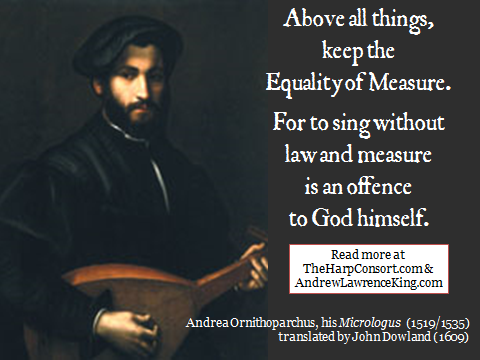
If you perform early seicento music, don’t trust what your teacher once told you his teacher told him, don’t even accept what I write here without proper scientific scepticism: you will want to read Caccini for yourself. The standard modern edition (Giulio Caccini, edited by H. Wiley Hitchcock, Le Nuove Musiche, A-R editions, 1970, second edition 2009) is widely available, and includes an English translation of the Preface. That translation has a few questionable moments, but it includes well-researched additional notes. But be careful with Hitchcock’s transcriptions of the songs themselves: not all the printed time-signatures – vital for establishing Proportions – are original.

English translations from the Preface have been printed in many source-book anthologies, beginning with an excerpt in John Playford Introduction to the Skill of Music 1664. This is available free online in the 1683 reprint here. (See Directions for singing after the Italian manner, pages 34-39)
Probably the most influential English translation is Oliver Strunk (editor) Source Readings in Music History (1950), page 370. The 1942 translation by Alfred Ashfield Finch has many editorial additions, and cannot be trusted: I mention it only because it is available online. The extract translated by Zachariah Victor is better (though he mistranslates sprezzatura di canto), it can be downloaded free here.

But best of all, the original print can be downloaded free, with the full Italian text of the Preface, Caccini’s worked examples (in which he applies his own advice to three sample songs), and all the songs themselves, including his greatest hit, Amarilli mia bella. It’s all here.

Caccini Nuove Musiche title page


Re-assessing Le Nuove Musiche

In Baroque Music 1.0, we all learnt that Caccini’s Le Nuove Musiche represents the paradigm-shift that brought about a musical revolution, defined Basso Continuo, ushered in the Baroque Age, and led to the Development of Opera. That over-simplistic view has been re-assessed: Caccini was a clever self-promoter, and in this book as in his hasty publication of his music for the ‘first opera’ Euridice (1602), he was deliberately positioning himself as the hero of a new style. Caccini’s Musiche are not really so nuove (new); in many ways, he was less innovative than his rival, Jacopo Peri, principal composer of the first-performed version Euridice (1600). Similarly, Caccini’s advice on performance practice is a summary of developments over the last decades, rather than an ‘epoch-making’ breakthrough. Again, Peri is more daring, in the Preface to his Euridice, which I will discuss in a future post.


The songs of Le Nuove Musiche include 12 strophic Arias which Caccini calls  canzonette a aria, ‘Canzonets’, and plenty of ‘old-fashioned’ diminutions, even in the 12, supposedly more modern, ‘Madrigals’. These madrigals look very much like the ornamented solo versions of four-voice part-songs heard in the Florentine Intermedi (1589). Indeed, it’s so simple an exercise to construct a four-voice madrigal from the solo and figured bass of Amarilli mia bella, that I suspect Caccini originally wrote the piece as a part-song. As Victor Coelho writes, “we know now through the work of Claude Palisca, Tim Carter, John Walter Hill, Howard Brown, and others, that Caccini’s works were closely connected to earlier and long-standing musical traditions”. Coelho’s article in the Journal of Seventeenth-Century Music here places Le Nuove Musiche in the context of the previous century and of a manuscript containing intabulated accompaniments of works by Caccini, Peri, and Rasi .


Sprezzatura in the 16th century


Caccini’s sprezzatura is also a 16th-century concept, discussed in Baldassare Castiglione’s Libro del Cortegiano (1528), transcribed into modern Italian here Castiglione was translated into English by Sir Thomas Hoby in 1561 as The Courtyer here. It’s known in English today as The Book of the Courtier. In Chapter XXVI, Castiglione introduces the idea:
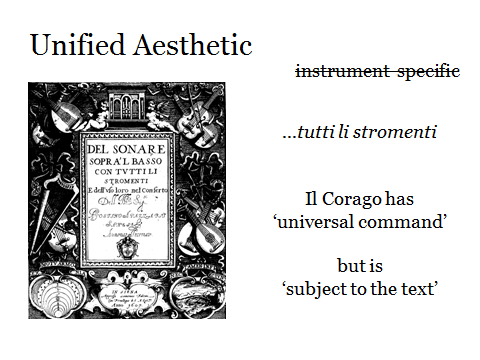
per dir forse una nova parola, usar in ogni cosa una certa sprezzatura, che nasconda l’arte e dimostri cio che si fa e dice venir senza fatica e quasi senza pensarvi. Da questo credo io che derivi assai la grazia

Here is Hoby’s 1561 translation:

(to speak a new word) to use in every thyng a certain Reckelessness, to cover art withall, and seeme whatsoever he doth and sayeth to do it wythout pain, and (as it were) not myndyng it. And of thys do I beleve grace is muche deryved 

In modern editions, sprezzatura is translated as ‘disdain’ [which is literal, but unhelpful] or ‘nonchalance’ [better]. I like the translation ‘cool’. Castiglione links sprezzatura to grazia (grace, elegance), a word so evocative of the qualities of an ideal Courtier that it occurs 150 times. Sprezzatura occurs a further 8 times, in connection with dancing, as not to be overdone, as praiseworthy in itself, in contrast to attillatura (neatness of dress, also seen as praiseworthy in itself), in contrast to affectation (seen as highly negative), in contrast to ‘pestiferous affectation’ and linked to the ‘extreme grace of simplicity’, and in the context of playing a character role in costume.

This last mention is not often cited in the secondary literature, but it seems especially relevant to Caccini’s use of sprezzatura in the musical context of singing in the period of the first operas, so here it is in full, from Book II Chapter XI:

esser travestito porta seco una certa liberta e licenzia, la quale tra l’altre cose fa che l’omo po piglare forma di quella in che si sente valere, ed usar diligenzia ed attillatura circa la principal intenzione della cosa in che mostrar si vole, ed una certa sprezzatura circa quello che non importa, il che accresce molto la grazia:

Hoby translates this section in 1561 as:

To be in a maske bringeth with it a certaine libertie and lycence, that a man may emong other thinges take uppon him the fourme of that he hath best skill in, and use bente studye and preciseness about the principall drift of the matter wherin he will shewe himselfe, and a certaine Reckelesness aboute that is not of importaunce, whiche augmenteth the grace of the thinge

Hoby’s translation of valere as ‘to have skill’ is doubtful in this context: the principal meaning according to Florio’s 1598 dictionary here reprinted and extended in 1611 is ‘to be worth, to be of value, to be much or greatly esteemed’. So here is my translation:

To wear a character costume brings with it a certain liberty and licence. Amongst other things, it allows a man to take the form of something that he feels to be of great worth, and to exercise careful attention and preciseness about the principal purpose of the event in which he wants to appear, but a certain ‘cool’ about whatever doesn’t matter. This greatly increases his elegance.

Attillatura usually refers to preciseness in dressing, but it seems that Castiglione intends this example to illustrate a more general concept: even when you are doing something very important, you can be attentive and precise about the important things, and show a certain ‘cool’ in whatever does not matter.

Il Cortegiano frontispiece 1562


Caccini’s Preface


Returning to the 17th century and Le Nuove Musiche, we can hear echoes of Castiglione in Caccini’s use of such words as sprezzatura, grazia and nobil (noble, which with its derivatives occurs 122 times in Il Cortegiano). But which words and phrases does Caccini use most often, what is his ‘principal purpose’?

[Square brackets like this separate my commentary from excerpts of Caccini’s text, which I report in the third person, and shorten to focus on Caccini’s discussion of style. My summary is at the end of this post]

Good Style


Caccini calls his practice la nobile maniera di cantare (the noble manner of singing), and says he learnt it from Scipione del Palla, who was active in Naples at the time of Caccini’s birth, 50 years earlier.

He claims for himself the development of lunghi giri di voci semplici, e doppie, cioe raddoppiate, intrecciate l’una nell l’altra (long turns of notes, simple and double, i.e. re-doubled, interwoven one with another). He positions these as the modern alternative to quella antica maniera di passaggi (that old-fashioned manner of divisions), which he considers more suitable for wind or string instruments than for voices.

He associates la buona maniera di cantare (the good way of singing) with crescere e scemare della voce, l’esclamazione, trilli e gruppi (crescendo and diminuendo of the note, exclamation, single-note trills, two-note trills with final turn). As the Preface continues and in the example songs, it becomes clear that crescendo and diminuendo are on one note, not throughout a whole phrase, and precisely what is meant by trillo and gruppo.

He now discusses the advantages of canto per una voce sola (solo songs, as opposed to polyphonic part-songs). He claims that recent times (moderni tempi passati) were not accustomed to musiche da quella intera grazia (music of that complete grace) that he himself hears nel mio animo resonare (resonating in his spirit). Grazia has connotations of divine, spiritual qualities as well as of artistic beauty and sweetness. Animo is the mind or spirit, as opposed to anima (the spirit or soul, in the religious sense), core (heart, fount of emotions), and the lower body, vita. 

Caccini values what he learnt at Bardi’s Florentine Camerata, with its membership of noble amateurs, musicians, intellectuals, poets and philosophers, above his long training in counterpoint. These intendentissimi gentilhuomini (gentlemen of great understanding) convinced him not to prize that kind of music which does not allow the words to be understood well (non lasciando bene intendersi le parole), because it spoilt the meaning and the poetry and distorted the Long and Short syllables. [Long and Short syllables correspond to Good and Bad notes; more about Good and Bad here].

Caccini and the Camerata follow a Platonic, philosophical ideal that:

La musica altro non essere che la favella e’l rithmo, & il suono per ultimo, e non per lo contrario.

Music is text and rhythm, & sound last of all, and not the other way around.

[Hitchcock’s translation is misleading here, ignoring the effect of seicento conventions of punctuation, and disregarding that ultimo is singular. His ‘speech’ is a reasonable translation of favella but since Caccini wishes to distinguish this favella from sound, ‘text’ is probably better. His mangled version –  ‘speech, with rhythm and tone coming after’  – seems to me symptomatic of 20th-century musicians’ refusal to accept the possibility that rhythm could be noble, another mistake resulting from the unquestioning assumption that expression must be linked to 20th-century rubato.]

[Caccini’s bold statement of priorities – text and rhythm – backed up with the full authority of the Florentine Camerata, has received little attention from performance practice scholars, especially compared to all the ink spilled over discussions (often skewed) of sprezzatura. But I find these priorities inspiring and noble, a breath of fresh air amongst all the arguments over vibrato, pitch and temperament that clog today’s Early Music. Caccini’s priorities (combined with the Rhetorical priority of Action, i.e. persuasive, fully embodied delivery with gestures, facial expressions, contrasts of timbre) gave the title and rehearsal methodology for my three-year project Text, Rhythm, Action! within the Performance program of the Australian Centre for the History of Emotions, with 20 staged productions of historical music-dramas, and master-classes, lectures & workshops all over the world.]   

Caccini and the Camerata want music to penetrare nell’ altrui intelletto e fare quei mirabili effetti (penetrate the listener’s mind and create those marvellous effects) described by Classical writers, i.e. moving audiences to tears and laughter. This cannot be done by polyphonic music, not even by solo songs to a string instrument if there are too many diminutions, moltitudine di passaggi, applied indiscriminately to Bad as well as Good syllables [the normal rule is to ornament only the Good syllables]. According to Caccini, only plebs admire such empty vocal display (passaggi … della plebe esaltati). Such music can do no more than titilate the ears. It’s impossible to move the mind, muovere l’intelletto, without an understanding of the words, senza l’intelligenza delle parole.

So Caccini had the idea [he writes, boldly claiming the territory] to introduce a kind of music in which performers could quasi che in armonia favellare – almost speak in harmonies. [This is paralleled in Peri’s more detailed description, in his Preface to Euridice, of taking the pitches of syllables that would be sustained in declamatory speech, and accompanying those pitches with suitable harmonies.] In this music, Caccini uses a certain noble sprezzatura of song, a ‘cool’ way of singing.

una certa nobile sprezzatura di canto

[Musicologists and musicians have leapt to the conclusion that this sprezzatura is some kind of rhythmic freedom. But Caccini does not say this, not at all. Rather, it is canto song itself, that is treated with sprezzatura. We can combine Castiglione’s dictum  – that one should be precise about the priorities, and apply sprezzatura to whatever is less important – with the musical priorities of Caccini and the Camerata – text and rhythm, with sound last of all. The result confirms that we should apply sprezzatura to the sound, to song itself, to the sonic qualities of singing. We should be precise about text and rhythm, and cool about vocal sound-production. As Caccini writes, we should hardly sing, we should ‘almost speak in harmonies’.]

Caccini describes how the voice-part passes through various dissonances whilst the bass stays on the same note – what we today call recitative. [This is a kind of sprezzatura  of composing, a nonchalant way of dealing with the normal rules of counterpoint. These dissonances are not prepared and resolved, as would normally be required.] Sometimes Caccini does use dissonance in the conventional manner, with the polyphonic ‘inner voices’ played on an instrument, to express some emotion, per esprimere qualche affetto.

[I take Caccini’s somewhat ambiguous final clause non essendo buone per altro to mean that the ‘inner voices’ are not useful for anything else, i.e. as another negative comment about polyphony. ‘Dissonances are not good for another kind of emotion’ and other readings are also possible.]

According to Caccini, this was the origin of those modern solo songs which have more power to delight and move, piu forza per dilettare e muovere, than many voices together. [‘Delight and move’ recalls the Rhetorical aims of docere, delectare, muovere in Cicero’s De Oratore.] Caccini gives examples of his work – Perfidissimo volto, Vedro’l mio Sol, and  Dovro dunque morire. [The first of these makes considerable use of the ‘recitative’ technique of a static bass, the second has one brief moment of ‘recitative’: in the third, the bass often moves fast under a sustained note in the voice. The common element of modernity seems to be reduced polyphony, rather than ‘recitative’ as such.] Caccini picks out his setting of the eclogue of Sannazaro [now lost] in particular as in the style of his music for the first Florentine ‘operas’, quello stile proprio … per le favole … rappresentate cantando.

Caccini now name-checks various nobles who had never before heard music for solo voice accompanied by a simple string instrument, which had such force to move the emotions of the spirit tanta forza di muovere l’affetto dell’ animo. He attributes his success to his new style, lo nuovo stile, and also to the superiority of his specially composed solos over arrangements for solo voice of part-songs. By 1601, everyone who writes for solo voice uses this style, especially in Florence, where Caccini claims to have worked for the Medici for 37 years.

In both Madrigals and Arias, Caccini always tries to imitate the ideas of the words,  concetti delle parole, searching out notes that would be more or less emotional according to the sentiments of the words quelle corde piu e meno affettuose secondo i sentimenti. In particular, there will be grazia because he has hidden as much as possible the art of counterpoint. [Here Caccini brings together Castiglione’s idea of the elegance of hidden art with the Camerata’s ideal of reducing polyphony.]


Passaggi

Caccini again mentions the proper distinction between Good and Bad syllables, observed in his harmonies and his ornamentation. When he does ornament a Bad syllable, this doesn’t last long, and can be considered not as a passaggio (which would be inappropriate) but as un certo accrescimento di grazia si possono permettere (a certain increase of grace, that can be permitted). But since he has already complained about the misuse of long turns of notes, malamente adoperati quei lunghi giri di voci he advises that the passaggi are not strictly necessary for the good manner of singing necessarii per la buona maniera di cantare. Rather, they titillate the ears of those who understand less about passionate singing, una certa titillatione a gli orecchi di quelli che meno intendono che cosa sia cantare con affetto. For those who understand, passaggi are hateful, abborriti, there is nothing more contrary to emotion, non essendo cosa piu contraria di loro all’ affetto.

This is why Caccini spoke about ‘misuse’: his own ornaments are introduced only in music that is less passionate, meno affettuose, on the Good syllables not on the Bad, and at final cadences. For these lunghi giri the vowel u is better for sopranos than for tenors; the vowel i is better for tenors. Other vowels are in common use, but open vowels are more sonorous than closed, and therefore more suitable for exercising such vocal agility esercitare la disposizione. Again Caccini tells us to use these giri di voci according to his rules and not just anyhow, e non a caso. 

Whilst others who want to sing solos stylishly, cantar solo e fare maniera think first about the practice of counterpoint, Caccini has better advice about the good manner of composing and singing in this style, la buona maniera di comporre e cantare in questo stile. [This distinction between comporre and cantare supports the interpretation of his sprezzatura di canto as a performance practice of ‘almost speaking’, not as the compositional technique of ‘recitative’.] What is needed much more is l’intelligenza del concetto, e delle parole il gusto (the understanding of the meaning, and the flavour of the words). This flavour should be imitated in passionate notes and also expressed by singing with passion, l’imitazione di esso cosi nelle corde affettuose, come nello esprimerlo con affetto cantando. [Again, Caccini distinguishes between the work of composer and performer].

So counterpoint is not much use, Caccini uses it only to coordinate the two parts, to avoid obvious errors, and to create some dissonances, durezze, more to support the emotion than to employ artistry, piu per accompagnamento dello affetto che per usar arte. Composing according to the gusto del concetto delle parole (flavour of the meaning of the words) and singing with good style, buona maniera di cantare, are more effective and delightful than all the art of counterpoint. This is what brought Caccini to this way of singing maniera di canto for solo voice, and where to use the lunghi giri di voce.

The Passionate style


Now he discusses the use of  crescere e scemare della voce, l’esclamazioni, trilli, gruppi (crescendo and diminuendo on one note, exclamations, single-note and two-note trills).  These are often used indiscriminately, indifferentemente, in passionate music, musiche affettuose, where they are required more, and in light dance-songs canzonette a ballo [where they would be inappropriate]. Some people create an ultra-passionate manner of singing, una maniera di cantare … tutta affettuosa, and with the general rule that crescere e scemare della voce  and esclamazioni are the foundation of that passion (affetto), they apply them in all kinds of music, without noticing whether the words require such passion, se le parole il richieggiono. Those who understand well the meanings and sentiments of the words, che bene intendono i concetti e i sentimenti delle parole, can distinguish where such passion is more necessary or less required, ove piu o meno si richieggia esso affetto.   

[This is excellent advice, which I will summarise as : Don’t pour a rich sauce of fake emotion over an innocent text! Such down-to-earth honesty is all the more necessary, as we approach Caccini’s next quotable quote]

Quest’ arte non patisce la mediocrita

This Art does not admit mediocrity. The more exquisite details there are that are required for excellence in this Art, the more hard work and diligence we who profess the Art must find in all our studies.  [So, stick with it, even if Caccini’s sentences sometimes seem endless!] From written sources [the Italian word scritti  hints at holy scriptures] we receive the light of Science [this word has cosmic, divine significance in the 17th century], and all the Arts. So we need Love too, the kind of love that inspired Caccini to leave a glimmer of light in his music and discussion of the art of singing solo above the harmony of the Chitarrone or other stringed instrument.

For singers, the first and most important fundamental is to be to start the phrase on any note l’intonazione della voce in tutte le cordi , neither too low nor too high, and in good style, la buona maniera. Caccini discusses the ornamental start from a third below, which should be not be sustained but scarcely hinted at, a pena essere accennata. This does not always fit the harmony, and is often over-used. Many singers consider starting with a steady crescendo to be the good style of putting forth the voice with elegance, la buona maniera per mettere la voce con grazia. Caccini prefers this crescere la voce, but he is always seeking novel means to attain the goal of the musician, il fine della musico, cioe dilettare e muovere l’affetto dell’animo.

A musician’s goal is to delight and move the passions of the mind & spirit.

 So Caccini claims that he invented a more passionate way, maniera piu affettuosa, starting the note with the contrary effect of a decrescendo, intonare la prima voce scemandola. [In all this discussion, we have to understand voce as ‘voice’ and/or ‘sung note’, sometimes even as ‘a word’. Similarly, corda can be ‘string’ and/or ‘note’, whether sung or played.]

But the most principal means of moving the passion, mezzo piu principale per muovere l’affetto, is the Exclamation, esclamazione. As you make the decrescendo, nel lassare della voce [this could also mean ‘just before you leave the note’], make a bit of a crescendo, rinforzarla alquanto. Caccini notes that this crescendo can become unbearably harsh in the high part, especially with falsettists. But without doubt, as a passionate ornament (affetto) to move the emotions (per muovere), the effect (effetto) is better starting the note with decrescendo, intonare la voce scemandola, than with crescendo. [Note that Caccini here uses affetto to mean not only a passion, but also an ornament that moves the passions.] Crescendo la voce per far l’esclamazione (crescendo on a note as an Exclamation) requires a further crescendo as you relax/leave (lassar) the note, and this seems forced and harsh, sforzata e cruda. But contrariwise, with decrescendo on a note (scemarla), as you relax/leave it (lassarla) giving it a bit more spirit, il darle un poco piu spirto, makes it more and more passionate, sempre piu affettuosa.

You can also vary one or other intonazione. Variety is most necessary in this art, as long as it is used for the purpose [of delighting and moving the passions].

This is the greatest part of elegance in singing in order to move the passions of the spirit, maggior parte della grazia nel cantare atta a poter muovere l’affetto dell’ animo. It applies to those subjects in the text (concetti) that are more suitable for such passions, ove piu si conviene usare tali affetti. You can learn this most necessary elegance, quella grazia piu necessaria, from written sources, but after studying the theory and the rules, perfection is attained through practice.

This leads Caccini to his music examples, demonstrating two Exclamations, languida (languid) and piu viva (more lively). You can experiment to see which way of starting the note (intonato) produces more or less elegance, maggiore o minor grazia. On the word cor, start (intonare) the first note, make a decrescendo little by little (scemandola a poco a poco), and on the second note crescere la voce con un poco piu spirito (crescendo on the note with a little more spirit). This is the esclamazione assai affettuosa (moderately passionate) for a note descending by step.     

Caccini Nuove Musiche Exclamazione


On the word deh, the exclamation is much more spirited, molto piu spiritosa, because it does not continue by step, but very sweetly with the fall through a sixth. With this Caccini demonstrates the esclamazione, which can be of two qualities, one more passionate (piu affettuosa) than the other.The way the note is started (intonate) is an imitation of the word, imitazione della parole, as long as that word has significant meaning, significato con il concetto

Otherwise, as a general rule esclamationi can be used in any passionate music (tutte le musiche affettuose) on every occurrence of dotted minim plus crotchet [this is my reading of Caccini’s ambiguous phrase, tutte le minime e semiminime col punto]. They will be more passionate (affettuose) if the following note runs fast (corre). Don’t do them on semibreves, where there is more space for crescendo and diminuendo on the note (crescere e scemare della voce) without esclamazioni.

In light music (musiche ariose) or little dance-songs (canzonette a ballo), instead of these passionate ornaments (affetti), just use the liveliness of the voice (vivezza di canto), which usually comes from the rhythm of the song itself [aria in this period has a wide range of meaning: a repeating rhythmic unit, a tuneful song that includes such repeating rhythmic units, or a tuneful strophic song over a repeating ground bass].  If there are some esclamazioni, they should leave the same liveliness (vivezza) and not bring in any languid emotion, affetto alcuno … languido.


Musicians need to exercise their own judgement, beyond the rules of Art. In the example above, there is more elegance, maggior grazia,  in the first setting of the word languire with the second quaver dotted, than in the second setting with all four quavers equal. There are many elements which create maggior grazia  in the good manner of singing la buona maniera di cantare. Although they are written in one way, they make a different effect (effetto) in another way, so some are said to sing with more grace, others with less, cantare con piu grazia o meno grazia.

Trillo & Gruppo

Caccini Trillo & Gruppo

The Trillo is on one note. Caccini taught it this way to his two wives and daughters. It starts with a crotchet, and beats with the throat (ribattere …con la gola) until the final breve. [Note that the trillo gets faster, not slower, and flows directly into the final breve]. Similarly with the Gruppo. Listeners could report how exquisitely, in quanta squisitezza, these were performed by Caccini’s second wife.

Learning the Trillo and Gruppo is a necessary first step towards many things described here, that are effects of that elegance that is most sought after in good singing, effetti di quella grazia, che piu si ricerca per ben cantare. They are written one way, and performed another to make a different effect (contrario effetto) than the usual. Here are all these effects (effetti) written in the same note-values, so that from written examples combined with practice one can learn all the subtleties (squisitezze) of this Art.

Caccini rhythmic alteration examples  

In the examples above, the second version has piu grazia.


Three Sample Songs


The next examples (below) have the words underlayed, a bass for the Chitarrone, and all the most passionate movements, tutti passi affettuosissimi. By practising them you can acquire ever greater perfection, ogni maggior perfezzione.


Caccini Nuove Musiche example 1


Caccini Nuove Musiche example 2


Caccini Nuove Musiche example 3


[It’s worth doing some simple counting. In the three examples immediately above, there are 13 mentions of esclamazione, 11 of trillo, the word gruppi occurs once and the ornament is written out 4 times. Sprezzatura occurs only once.

Senza misura (without measure) also occurs only once, in response to a strong cue from the words errate peregrine (you wander afar, erratically). Punctuation separates that instruction from quasi favellando in armonia con la suddetta sprezzatura (almost speaking in harmonies with the nonchalance mentioned above). In the passage above, that nonchalance applied to voice-production, ‘almost speaking’, and not to rhythm. Text and Rhythm are described above as the two highest priorities, the elements that, according to Castiglione, would receive Attention and Precision.

Monteverdi and others notate how such senza misura works in practice, with the singer floating in a cool way, over a regular bass. There are many descriptions of this practice throughout the baroque period and even as late as Chopin. In the Aria Possente Spirto from Monteverdi’s Orfeo, the singer’s ornaments do not coincide with the tactus beats, nor with the movement of the harmony from G to D.

Possente Spirto incipit

Here is one possible realisation of Caccini’s senza misura, according to Monteverdi’s model, and following Caccini’s instruction (below) to make some notes just half their written length.

Aure divine, ch'errate peregrine

The important points are that this senza misura applies to the voice-part, whilst the continuo continues in measure; that this special effect is used only once in all the examples; that this is not the sprezzatura that Caccini mentions in the next clause.

There is one mention only (in the whole Preface) of con misura piu larga (in rhythm, but with a slower pulse). Again, this is in response to a strong cue from the words ch’io me ne moro (for from this I am dying). The change to a slower Tactus imitates the slower heart-beat of the dying singer.]


Caccini’s commentary on the examples above is that they show all the best passionate ornaments, tutti i migliori affetti, which can be used within the nobility of this way of singing, la nobilita di questa maniera di canti. They show where to crescendo and diminuendo the note, crescere e scemare la voce; where to do esclamazioni, trilli and gruppi, and to sum up, all the treasures of this art, tesori di quest’ arte. These ‘treasures’ are not written into the songs that follow, but the examples above are models to be followed, according to the passions of the words, gli affetti delle parole.

[Now follows Caccini’s only discussion of rhythmic freedom.] The noble way (nobile maniera) is not dominated by strict measure, often reducing the value of notes by half according to the ideas of the words, facendo molte volte il valor delle note la meta meno secondo i concetti delle parole. [See my realisation of Caccini’s example 3, above].

The noble way then gives birth to a song (canto) that’s cool, in sprezzatura as it’s called. There you can use all the effects (effetti) for the excellence of this art, l’eccelenza di essa arte: a good voice (la buona voce), and effective breathing (la respirazione del fiato).  Sing solos to the Chitarrone or other string instrument. Since there are no other singers, choose the pitch that suits you so that you can sing full, natural voice (in voce piena e naturale) and avoid falsetto (isfuggire le voci finti). You waste a lot of breath faking or forcing, trying to ‘cover’ the tone. Rather, you need the breath to give more spirit to the crescendo and diminuendo on the note, per dar maggiore spirito al crescere e scemare della voce, to esclamazioni and all the other effects (effetti). Don’t run out of breath when you need it!

There is no nobility of good singing in falsetto notes. Dalle voci finte non puo nascere nobilita di buon canto. It comes from a natural voice, at ease in all the notes (una voce naturale, comoda per tutte le corde). Use the breath only to show yourself as master of all the best passionate ornaments, padrone di tutti gli affetti migliori, which pertain to this most noble way of singing (nobilissima maniera di cantare).

The love of this style and of all music burns in me by nature, and from years of study. This art is most beautiful (bellissima) and naturally delightful (dilettando naturalmente). By practising and teaching it, it becomes a true semblance of that perpetual motion of the celestial harmony, sembianza vera di quelle inarrestabili armonie celesti, from which all earthly good derives, awakening the minds of listeners to contemplation of the infinite delights of Heaven.

[Notice that in this conventional comparison of fine earthly music to the Harmony of the Spheres, the rhythm of the celestial harmony is unstoppable, inarrestabili.]

In the bass part, where there is a tie, re-strike the harmony but do not restrike the bass note. [This applies particularly to cadences, where the change of harmonies 4 3 on the dominant is notated over tied notes in the bass]. The Chitarrone is especially suitable for accompanying the voice, especially the tenor voice. Use good judgement about where to repeat the bass note in other places. Antonio Naldi, ‘il Bardella’, is credited for inventing this style of accompanying and as the finest Chitarrone-player. Caccini’s final paragraph complains that many people are not prepared to give others due credit for their inventions. [Is he hinting that he himself should receive more credit for his invention of the good manner of singing?]


SUMMARY

Caccini’s text is dominated by the interlinked concepts of affetto (passion, or a passionate ornament) and effetto (a passionate ornament or the effect of such an ornament on the listener’s passions). He mentions affetto and its derivatives 32 times: include the 8 occurrences of effetto, and this interlinked concept has 40 hits. There is also an exclamatione affettuosa in the first of the three example songs.

This suggests that what is really ‘new’ about the nuove musiche is Caccini’s focus on passion (affetto), combined with the linking of such passion to a particular class of ornaments (affetti/effetti) and to the emotional effect on the listener (effetto).

Moving beyond that principal focus, other concepts grazia (14), nobilita (8)buona maniera (7),  crescere (8), scemare (6) esclamazione (12),  trilli (9), giri and passaggi (5) are all mentioned far more often than sprezzatura (2).

In his examples, Caccini has 13 esclamazioni, 11 trilli, 4 gruppi. Sprezzatura occurs only once. Senza misura only once. Con misura piu larga also only once.

Caccini does not equate sprezzatura with free rhythm.

The priorities for Caccini and the Camerata are Text & Rhythm. Sound is the lowest priority. Castiglione indicates that sprezzatura is applied to low-priority elements, suggesting that Caccini’s sprezzatura should be applied to Sound. Caccini’s phrases are sprezzatura di canto and canto in sprezzatura. He associates sprezzatura with ‘almost speaking’.

Caccini’s sprezzatura is a nonchalant voice-production that is ‘almost speaking’.

Caccini emphasises that although plebs might delight in flashy singing, the noble art depends on deep understanding of the words.

The fundamental things apply…

  1. Prioritise text and rhythm.
  2. Don’t sing so much, almost speak.
  3. Move the listener’s passions.


Play it again Sam


Please join me on Facebook https://www.facebook.com/andrew.lawrenceking.9 and visit our website www.TheHarpConsort.com . Further details of original sources are on the website, click on “New Priorities in Historically Informed Performance”

Opera, orchestra, vocal & ensemble director and early harpist, Andrew Lawrence-King is director of The Harp Consort and of Il Corago, and Senior Visiting Research Fellow at the Australian Research Council Centre for the History of Emotions.

www.historyofemotions.org.au

Quality Time: how does it feel?

During a workshop on 18th-century music that I taught in Moscow recently, there was what diplomats call ‘a frank exchange of views’ [i.e. a heated argument]. I stated that mid-18th century musicians did not use mechanical clocks to measure musical time. A historian there objected strongly: suitably high-precision clocks had been invented in the 17th century already. I managed to restore peace, on the basis that we were both correct.

TIME AS A NUMBER OF MOTION


Galileo Pendulum

According to the Galileo Project [directed by Prof Albert Van Helden at Rice University] here, Galileo observed this chandelier in Pisa cathedral in 1582, and made notes on the pendulum effect in 1588. His serious experiments on the subject were begun in 1602. Around 1641, he designed a pendulum clock, but it was not built. The best clocks during the first half of the 17th-century marked the seconds, but did not measure them accurately: their best accuracy was plus/minus 15 minutes per day.

Galileo Pendulum Clock

Around 1636, Mersenne and Descartes further investigated the pendulum effect. Mersenne defined the Tactus as one beat per second, and in 1644 he  measured the length of a 1-second pendulum as a little less than 1 metre. Christian Huygens was the first actually to build a pendulum clock, in 1656. The accuracy of the best clocks was greatly improved, to within about 15 seconds per day.

Huygens first pendulum clock

In 1696, Etienne Loulié published Élements in which he described his chronomètre, which was essentially a variable-length pendulum combined with a ruler for measuring the pendulum-length, gradated in inches. The machine was 72 inches (almost 2 metres) tall, giving a slowest possible beat around 44 beats per minute. The middle of its range (i.e.  a pendulum length a little less than 1m) was about 60 beats per minute (corresponding to Mersenne’s one-second Tactus).

Loulie Chronometre 1696

18th-century devices were also very large, measuring slow beats in the range 40-60 beats per minute. The more compact, double-weighted metronome was invented by Winkel and first manufactured by Maezel in 1816.

So during the 18th century, mechanical devices for measuring musical time did exist, and were reasonably precise – good enough for all practical purposes, one would think. Their inconveniently large size is evidence of the importance of a slow count (Tactus) throughout this period. The one-second pendulum, i.e. 60 beats per minute, had a particular significance, in scientific studies.

Nevertheless, in spite of the availability of precision machines for measuring time, 18th-century musicians did not make much use of this technology. They continued to describe Tactus in the old ways. For example, Quantz  Versuch einer Anweisung die Flöte traversiere zu spielen (1752) here mentions Loulié and his chronomètre, but says (XVII -vii – 46) that nobody uses it, in spite of its reliability and precision. Instead (47), he describes musical Tempi in terms of the human Pulse, and for each different type of movement (Allegro, Adagio etc) relates this Pulse to a particular note-value.

So it seems that increasing precision about Time itself did not tell baroque musicians what they needed to know about musical Time. Musicians were not so interested in the absolute Quantitative measurement of Time, they were concerned with the subjective Qualitative nature of musical Time. Their question was not, “how fast does it go?”, but rather:

What is the Quality of Time? How does it feel?


This question places the investigation of Time within the study of the History of Emotions. [Read more about the Australian Research Council’s Centre for the History of Emotions, here.]

The Galileo Project characterises the slow change in concepts of Time from Aristotle via Galileo and Newton to the modern era as the shift from the ‘qualitative and verbal’ to the ‘quantitative and mathematical’. You can read more about Philosophies of Time, ancient, baroque, our own everyday assumptions, Einstein’s 20th-century revolution and Hawking’s 21st-century paradoxes, in A Baroque History of Time here, where I too emphasise the continuing importance circa 1600 of Aristotle’s idea of Time as ‘a number of motion’ [some translations have ‘a number of change’] circa 1600.

You can also watch a video discussion of What is Time? here 

For the Metaphysics of Quality, be sure to read Robert M Pirsig Zen and the Art of Motorcycle Maintenance (1974).

Quality (Zen and the Art of Motorcycle Maintenance)

QUALITY TIME

In this post, I’d like to consider how historical philosophy affects practical music-making, in terms of Quality. What was the Quality of baroque Time? How did it feel?

In Ars Cantandi (1696), Carissimi makes it clear that 17th-century musicians appreciated the difference between Quantity and Quality of Time.

The triple-metres all agree with regard to quantity, division and proportion, as is easily understood, but in the slow or fast quality, known by the Italians as tempo and by the French as mouvement, they are utterly different.

So in the various triple-metres, the relationships between note-values agree: a semi-breve in 3/1 has the same duration as a semi-breve in 3/2.  Whatever the proportion sign, a semibreve can be divided into two minims, a minim can be divided into two semi-minims. As Carissimi says, the Quantities all agree.

But the Quality, how it feels, is very different, depending on whether the music proceeds as Sesquialtera (feeling groups of three semibreves); as Tripla 3/2 (feeling groups of three minims); or as Sestupla 6/4 (feeling groups of two dotted minims). Sesquialtera feels slow, Tripla feels medium-fast, Sestupla feels fast, even though the Quantities agree, each note-value has its true, consistent worth, the same value in all three triple-metres.

We can acquire a feeling for the Quality of early 17th-century musical Time by reminding ourselves what Music itself is, in this period. As we read in many sources, for example Dowland’s Micrologus (1609) here [translating probably the 1535 edition of Ornithoparcus: the almost-indentical 1519 edition is here], what we think of today as “music”, music as sound, practical music-making, was the least important meaning. [Read more about What is Music? here]

  1. Music is firstly Mondana, Dowland’s ‘musicke of the world’, the heavenly Music of the Spheres created by ‘the very wheeling of the Orbes.. the motion of the starres and the violence of the Spheares’.
  2. Next, music is Humana, Dowland’s ‘humane musicke’, the harmonious nature of the human body, ‘by which the spirituall nature is ioyned with the body…that Musicke which euery man that descends into himselfe finds in himselfe’
  3. In third place, music is Instrumentalis, Dowland;s ‘instrumentall musicke’, the actual music that we play and sing here on earth.

Three kinds of Music

Music was also divided into Practical (what Dowland calls Active or Pracktick) and Theoretical or Inspective:


Inspectiue Musicke, is a knowledge censuring and pondering the Sounds formed with naturall instruments, not by the eares, whose iudgement is dull, but by wit and reason.
 Such Speculative Music included many kinds of intellectual investigations, for example such contrapuntal brain-teasers as the Puzzle Canons that were popular in the 16th century.
So we end up with four types of music. The three types placed higher in the hierarchy can tell us a lot about the Quality of Time for the lowest-placed type, that is to say, for actual practical music played or sung here on earth.
What is Time
Like Music itself, the Quality of Time is Cosmic. It is a slow beat, reliable, perfect (think of the circular orbits that period science insisted upon), it is divinely-ordered. Mere mortals should not trifle with it.
The Quality of Time is like the human Heartbeat. It has a double-beat, it is live-giving, essential, not to be stopped. It may in certain circumstances beat faster or slower. It is very scary to suspend it even for a tiny moment.
The Quality of Time is seen Instrumentally by beating time with your hand, tapping your foot, waving the end of your theorbo, walking, or with a long (1 to 2 metres) pendulum. This beat is known as Tactus, Dowland’s ‘Tact’.
Tact is a successiue motion in singing, directing the equalitie of the measure: Or it is a certaine motion, made by the hand of the chiefe singer, according to the nature of the marks, which directs a Song according to Measure.
Notice that Tactus is ‘motion’ [recalling Aristotle’s definition of Time as a ‘number of motion’, discussed here], that Tactus ‘directs’, that Tactus maintains ‘equalitie’ ‘according to Measure’. Tactus is not just a tool with which a performer controls time, according to his own arbitrary conceit; Tactus itself maintains the equality of measure. Dowland again:
Above all things, keep the equality of measure!
Dowland Above all things


TACTUS


[See also Rhythm: what really counts here.]
Tactus is vitally important for us practising musicians – it is the practical means by which musical time operates. Tactus is “How to Do Rhythm” for Early Music. To employ a modern conductor, or to add rubato and other modern means of managing time, is a gross anachronism, like putting a modern piano into the Monteverdi Vespers. You can do it, of course, but if you do, you can’t pretend that it’s HIP.
Tactus, the visible sign of musical Time, brings together the same set of hierarchical categories as Music itself – heavenly & human, practical & theoretical. Tactus is the Divine Hand that turns the cosmos, Tactus is the Human Hand that keeps earthly musica instrumentalis in equality of measure, Tactus is related to the heart-beat. Considering musica speculativa, Tactus is where real Time for practical music (cosmic, human and actual sound) intersects with the theory of musical Time (as written in musical notation). Specifically, around the year 1600, Tactus calibrates the notational system against real time at the level of the semibreve.
Beating Tactus in duple metre, the semibreve is divided, down-up, into two minims. This is perhaps a good moment to consider what one might call the ‘Hobbit Question’,  aka ‘There and Back Again’.
The Hobbit or There and Back Again
The Tactus Hand goes ‘there and back again’, down and up. Similarly, a pendulum goes to and fro, and a semibreve is divided into two minims. When today’s musicians think about a metronome beat, they think of the click in each direction. But when mathematicians and physicists consider a pendulum, they define the Period as the time taken to swing there and back again. Strictly, we ought to use Tactus to mean a semibreve, the movement of the hand down and up again; each beat (down only, or up only) is properly called ‘semi-tactus’. But today, and also in 17th-century sources, musicians tend to use the word Tactus more generally to mean “the beat”, without always being specific about whether a minim (down only, or up only) or a semibreve (down and back up again) is meant.
So in my discussion above (and in many discussions by modern historians and musicologists), the pendulum ‘beat’ refers to the movement in one direction only, the same way musicians define a metronome beat today. In this sense, a 1-metre pendulum gives a beat of approximately MM 60 – this is Mersenne’s ‘one- second pendulum’, and he equates this 1 second to the minim. Strictly, this should be called semi-tactus.
Strictly speaking, the modern scientific definition of the Period of a pendulum, and the academic definition of Tactus around the year 1600 refer to “there and back again”. Mersenne’s approximately-one-metre pendulum goes there and back again in 2 seconds, which he would equate to the semibreve. Dowland agrees, clarifying the concept of ‘there and back again’ as ‘reciprocal motion’:
The greater [Tactus] is a Measure made by a slow, and as it were reciprocall motion. The writers call this Tact the whole, or totall Tact. And, because it is the true Tact of all Songs, it comprehends in his motion a Semibreefe.
Ornithoparcus, Dowland’s source from almost a century earlier, has an academic’s scorn for the habit amongst practical musicians of framing discussions in terms of Semi-Tactus:
The lesser Tact, is the halfe of the greater, which they call a Semitact. Because it measures by it motion a Semibreefe, diminished in a duple [i.e. a minim]: this is allowed of onely by the vnlearned.
Well, plenty of learnéd 17th-century musicians did discuss rhythm in terms of minim and semitactus! The insistence on the semibreve is already old-fashioned and theoretical, by Dowland’s time. For practical purposes today, it is a sufficient challenge for most conservatoire-trained musicians to get used to thinking in the slow beat of minim = approx 60. They (and many early music specialists too!) might find it very hard to work with the ultra-slow beat of semibreve = approx 30. Nevertheless, it’s worth keeping in mind that there is plenty of evidence to suggest that 17th-century musicians did indeed manage to work with this long beat, the whole Tactus. Certainly, an awareness of the very big, ultra-slow, count of semibreve = approx 30 is a big help when it comes to Sesquialtera proportion.
[More about Proportions – in search of a practical theory here, with discussion of proportions for the ballo in Monteverdi’s Orfeo here]
Another source of confusion is that some earlier 16th-century music was counted with a semibreve to each beat, and a breve to the complete Tactus. Some of this music remained in the repertoire of cathedral choirs etc. Theorists, and choir-singers performing a mix of old and current repertoire, had to reconcile these two different systems in theory and in practice.

For the rest of this post, I will continue as I started, with the more practical, less ‘learnéd’ nomenclature, discussing what is strictly called Semi-Tactus, a minim beat (down only, or up only; not there and back again).

TACTUS AS QUANTITY

Stopwatch

So, having dealt with the Hobbit Question, we can now consider how to calibrate our Tactus: to line-up the musical notation of note-values against Time in the real world of early 17th-century Italian music.   We have plenty of sources to put us ‘in the right ball-park’. The double heart-beat of the Tactus semibreve is divided into two minims, down-up, with each beat at minim = approximately 60, i.e. one minim beat per second. And around the year 1600, this was as accurate as they could get, they had no way to measure it more exactly.
Try to estimate a second, without looking at any kind of modern watch, clock, mobile phone etc. To help, try imagining a 1-metre pendulum, or think about your relaxed heart-beat. Did you make your estimate? That’s how long a minim is.
In Quantitative terms, circa 1600, we cannot know any more exactly. The minim was somewhere around one second, whatever you feel one second to be. It could be slower, for practical reasons, in certain circumstance, e.g. when there is lots of complex ornamentation. (In his 1610 Vespers, Monteverdi specifies a slower Tactus for Et exultavit, because the tenors have lots of fast notes. He also warns performers not to take his Ballo Tirsi & Clori  too fast, because the ensemble music is complex). How music feels depends on the size of the ensemble and the acoustic of the venue. To get the same feeling in a more resonant acoustic, it’s plausible that you might count your seconds a bit slower.
This calibration of a notated minim as a real Time second is inevitably subjective. Although a minim, or a second, are in principle fixed units, individuals will differ in how they estimate them. I remember being told as a child to estimate an English yard (a bit less than a metre, about the length of a one-second pendulum) as the distance from the tip of my nose to the end of my arm, and realised even then that not everyone’s arms are the same length (not to mention noses!). Of course, highly trained musicians could be expected to remember the duration of a minim better than the average person, just as some musicians today can remember the pitch of a tuning fork, or of the organ in a particular church. But, in the absence of a precision measurement of time, it’s your memory against mine. And if I trained with a maestro di capella who had a slower idea of one second than your teacher, we would probably continue that difference into our adult careers. So each individual will perceive Tactus slightly differently.
Tactus is also subjective in that it depends on one’s emotional state. Although I fondly imagine that I am keeping the ‘equalitie of measure’ , my sense of a one-second beat might well be a little faster when I am under stress, excited or angry; a little slower when I am especially relaxed or even drowsy.
Note that these subjective differences are not individual choices. Nor are they expressive interpretation. It’s just that my best, humanly fallible guess of the duration of one second  might be different from your guess, and might also vary according to my emotional state. Long training and repeated experience of the ‘equalitie of measure’ would have helped 17th-century musicians make consistent estimates.

TACTUS AS QUALITY

Since performers’ emotional state can alter their perception of an ‘equal measure’, a singing-actor representing a character’s strong passions might act out the affetto in dramatic music (in genere rappresentativo) by letting that passion alter the speed slightly. Of course, this only works, if the audience don’t notice the trick: if they become aware that you are just going faster, the illusion is gone.

In the early 17th century, such writers as Caccini and Frescobaldi suggest subtle changes to the Tactus, according to the affetto of the sung text. Frescobaldi suggests imitating this vocal practice (which he derives from dramatic madrigals) even in instrumental music, with subtly different tempi for the various movements of a Toccata. Early violin sonatas have markings of tarde and velociter etc to show such subtle changes of Tactus, corresponding to changes in affetto. We can understand this as a performer acting out a change of Passion, as if his own heart began to beat slower or faster, in response to a poetic text, or to the affetti of such poetry imitated in instrumental music.
With such changes, the desired result is that the audience’s passions are moved. The audience should notice a change of affetto, in fact they should feel that emotional change themselves. If they simply notice a change of speed, the performance has failed. With such changes, the alteration in Tactus is small. If the composer wants double-speed, he can show that with shorter note-values. If he wants one-third faster, he can show that with Sesquialtera proportion. As George Houle writes in Metre in Music 1600-1800 (1987):
 In the early seventeenth century, tarde, velociter, adagio and presto distinguished between fast and slow, that is degrees of change intermediate to those determined by diminution (2:1) or proportion (usually 2:1, 3:1 or 3:2).
(My added emphasis)
So these changes for the sake of the affetto are subtle changes. In particular, a gross change to double-speed may not be perceived at all by your audience. They will still feel the same Tactus, and just assume that the note-values have been halved.
Jazz suggests a good model for the Quality of these subtle changes. Whatever the actual, Quantitative tempo, jazz musicians recognise that one can play “on the front” of the tempo or “laid back”. What is essentially the same Quantitative speed can feel different, more urgent or more languid; its Quality can be varied.
In early 17th-century music, a change of Tactus according to the affetto will tend to reinforce whatever changes of note-values the composer has written. If the affetto is urgent, the composer will write short note-values. And then the performer takes a slightly faster Tactus, making those short notes even quicker. And the converse for languid affetti.
Another important point is that these changes are not gradual acceleration or rallentando, but a step-change in time. In what Frescobaldi calls ‘driving the time’, guidare il tempo, you don’t use the accelerator and the brakes, you use the gear-shift! Such gear-changes, even when by subtle amounts, are very strong medicine, all the more so in the context of ‘equality of measure’ throughout the rest of the performance.
Finally, even when the Tactus changes, there is still Tactus. Frescobaldi explains that although Tactus no longer rules absolutely in his toccatas, the performance is still facilitated by means of Tactus, a Tactus which now can be slightly faster or slower, changing at the intersection between movements and according to the affetto. I will discuss Caccini’s, Peri’s and Frescobaldi’s specific comments about Tactus in future posts.
Perhaps the most important Quality of early 17th-century musical time is that musicians are striving to make it as constant and consistent as they can. Although its precise Quantity is subjective, and might even be deliberately adjusted to take account of particular circumstances, or to create a subtle illusion for the audience, time is supposed to be stable, otherwise the heavens will fall. If your heart stops beating, the music also dies.
The myth of Phaeton tells of an ill-fated attempt to ‘drive time’. Phaeton grabbed the reins of Apollo’s sun-chariot, but could not control the time-horses, He crashed and burned.
Sun Chariot


THE QUALITIES OF DANCES

In the second half of the 17th century, in France, the quality of Time was linked to how it felt to perform the movements of a particular dance. Each dance had its own vrai mouvement (as Muffat calls it, in Florilegium 1698) – ‘true movement’. This deceptively simple phrase has many meanings: the particular steps of each dance, a speed-range within which those steps ‘feel right’, a particular metre (duple or triple), and also what a modern musician might call a particular ‘groove’, a regular pattern of Good and Bad beats, a tendency towards certain characteristic rhythms. Time itself ‘moves’ truly, but differently, for each dance. And of course, each dance-type is associated with a certain range of emotions. In short, each dance-type has its own feeling, its own Quality.

Modern musicologists and dance historians have worked hard to understand the precise Quantity, the actual speed for each dance-type. Commonly encountered speeds around 84 beats per minute for some dances look rather like a proportion of the earlier Italian Tactus =  a bit less than 60. But perhaps too much focus on Quantity is again the wrong approach to the whole question. We might better seek to understand the Quality of each mouvement, learn how it feels. We can find a typical range of feelings, in the sense of emotions, affetti, by examining texts sung to each dance-type. We can try to discover the right groove within the Tactus, the appropriate swing of inégalité in the shorter notes,  and – most importantly – we can learn how it feels, physically, to dance its characteristic steps.

When I first started playing the harp, I studied renaissance and baroque dance and spent a lot of time playing for dancers. I count this a most valuable part of my Early Music education. I quickly discovered that dancers are very sensitive to the precise speed of each dance, so as a dutiful young professional musician, I would measure their ideal speed in rehearsal with a metronome, and then use a silent metronome to reproduce this speed in performance. This was Quantitatively accurate, but it didn’t work at all.  Dancers’ appreciation of speed is highly subjective – it depends on the nature of the floor surface, on the size and shape of the available floor area, on their physical condition and mood at the moment of performance. It’s not a question to be answered with a metronome; it’s a matter of How does it feel?

My solution, as an instrumentalist playing for dancers, was to learn the dance-steps so that I could watch whilst playing and allow the dancer to set the tempo in the opening bars. Of course, the ‘ball-park’ tempo was known from rehearsal, but the ‘fine-tuning’ of speed was left to the performer, in the moment. Once set, this speed, the rhythmic ‘groove’, the inégal swing, the complete vrai mouvement  is maintained until the very end of the dance, just as Muffat says.

Because each dance has its own vrai mouvement, its own Time, the Quality of musical time in late 17th-century France is complex and multifarious. Time is still cosmic and divine. Indeed, dance itself is a metaphor for the perfect movement of the heavens, as well as for a perfectly organised society with Louis XIV himself as the divinely appointed principal dancer around whom everyone else must orbit. Melody, harmony and vrai mouvement (in all its meanings) work together as the head, heart and soul  of the human body. Tactus is still shown by an up and down movement of the hand, or of the big stick that led to Lully’s death. Muffat recommends that dance-musicians should tap their feet in Tactus (on the downbeat of each bar). Meanwhile, the dancers’ feet strike out faster-moving beats within the Tactus, moving with the groove of the music as they step, rise and sink, turn and balance.

French dance-Time still has the Quality of being ‘true’, rather than arbitrarily chosen according to the whim of performers. But now there are many truths, as many different types of vrai mouvement as their are types of dance. The significance of individual dance-steps within the slow count of the Tactus encouraged French musicians to think more about the ‘equalitie of measure’ beat-by-beat in crotchets. The actual speed was determined according to the Quality of each dance, rather than by the Quantity of mathematical proportions. As Houle observed in 1987, these different ways of thinking were essentially incompatible, and the attempts to reconcile them make for confusing reading in late 17th-century sources.

Logical extensions of mensural principles were sometimes in conflict.

Just as the 17th century saw opposed national styles of Music (French and Italian), so each national style had its own approach to questions of musical Time. When the musical tastes were re-united, gradually and not always completely, during the 18th century, so attitudes to Time were also gradually brought closer into alignment.

Tomlinson dance a 2


THE QUALITY OF A PENDULUM

Today, when we think about beating time, we may be reminded of the Qualities of a metronome, or of a modern conductor. Experiments we carried out at Scoil na gCláirseach (2013) and at the Royal Danish Academy of Music (2014) demonstrated that a long, slow-beating pendulum (about one metre long, at a Tactus speed of around one beat per second in each direction) has quite different Qualities.

A metronome gives a sharp click, and conductors are taught to make the precise moment of the beat as sharply defined as possible. But a pendulum slows down and stops momentarily as it turns, so that the actual moment is not sharply defined. This allows a musician to ‘place’ the beat subtly, communicating the particular feeling of this note, this harmony, the quality of this moment of time, letting the audience enjoy the moment of ‘smelling the roses’ as they walk steadily along the path of the music.

Valentini’s Trattato della battuta musicale (1643) allows the downward movement of the Tactus hand to last one quaver (approximately 1/4 sec) after which the hand remains down for three quavers (3/4 sec); similarly for the upward movement. Try this for yourself: it looks very different from modern conducting, and (like a pendulum) leaves the subtle ‘placing’ to the musician, within limits of the order of magnitude of a 1/4 sec.

Within the steady Tactus, shorter note-values need not be precisely equal. Descriptions of the ‘intrinsic’ hierarchy of Good and Bad notes (buone & cattive) remind us that the concept of a ‘half’ in this period does not necessarily imply precisely 50%.  Muffat (Florilegium 1698) explains that

Good notes are those that seem naturally to give the ear a little repose. Such notes are longer, those that come on the beat or essential subdivisions of measures.

It is not easy to put this difference in Quality between Good and Bad notes into words. Rameau in his Traité de l’harmonie (1722) asks for a certain je ne sais quoi on the Good beats, which he contrasts with a ‘slight leaning’ (appuyer un peu) on the Bad beats.

To get a feeling for the Quality of Good and Bad sub-divisions of the Tactus, first establish steady one-second Tactus. Then try saying simple words like piano, forte, dolce, arpa, pasta, pizza in your best Italian accent, one syllable on the down-position, the next on the up-position of your steady Tactus. [Don’t ‘bang’ the initial consonants, savour the vowels]. Can you reconcile the result of this tactus-beating with Valentini’s instructions above?

This subtle difference between Good and Bad (not loud and soft, but something of Long and Short) on the principal divisions of the Tactus (the ‘groove’ of a dance-movement)  is not to be confused with the stylised inégalité on shorter note-values (the ‘swing’ of short notes in French music).  Read more about The Good, The Bad, & the Early Music Phrase here. Watch a video about Good & Bad notes here.

Whereas a modern conductor might struggle to control a wayward soloist, or a modern accompanist might struggle to follow, a pendulum just swings to and fro, maintaining the ‘equalitie of measure’ calmly and gently. This quality of calm steadiness is a vital skill for a baroque accompanist to acquire. As Agazzari writes in Del Sonare (1607), the continuo’s role is to ‘guide and support the entire ensemble’: the continuo maintain the Tactus, even if a soloist chooses to place a certain note before or after the beat. But this is not an aggressive power-struggle, the continuo can remain as calm as a perfect slow-swinging pendulum.

A jazz-band provides a good model for baroque continuo, with the rhythm section keeping a steady groove, whilst the soloists syncopate or drift elegantly around the beat, depending on the affetto. 

Like a pendulum or the classic swinging pocket-watch, the calm, slow, steady beat of Tactus can be powerfully hypnotic, taking musicians and audiences into a shared trance, a dream-world where the cosmic and the human are mysteriously connected, a magical space where emotions are felt more intensely, where music unites performers and audience in a shared spiritual experience.

Did Dowland perhaps refer to the inner focus of trance in his description of musica humana as ‘that Musicke which euery man that descends into himselfe finds in himselfe’? This spiritual quality of time is enhanced by calm steadiness – any random alteration would jar. One strand of my research investigates how ‘early opera’ made deliberate use of these hypnotic qualities in the first decades of the 17th century. Read more here.


swinging watch


THE QUALITY OF BAROQUE TIME

The essential Quality of baroque Time emerges from the fact that 18th-century musicians did not use machines to determine time accurately, even when such machines became available. No matter how closely we investigate period sources, we cannot know the precise Quantity of baroque Time. And actually, we don’t want to, because to ask the question of Quantity doesn’t give us a useful answer. The objectively “right” metronome speed will still “feel wrong” if the subjective situation changes.

So we want Quality Time. Time that is calm, steady and deeply significant, like the movement of the heavens or the beating of our hearts. And we must work hard to maintain it. Here is my personal take on baroque Quality time:

If the Tactus breaks, the heavens will fall. If your pulse stops, the music also dies.

As we begin to appreciate the subtle Quality of baroque time, we can appreciate how period writers struggled to explain its mysteries, to define the ineffable. Here is my anonymous hero, Il Corago circa 1630:

Per lo che in quanto alla tardita e velocita de’ movimenti, o vogliamo dire brevita o lunghezza di tempo nel quale si pronunziano i suoni o voci musicali, i moderni reducono e et essaminano il tutto ad una certa misura, come a suo proprio paragone, la quale essi chiamano battuta et e quel tempo che si mette nell’ abbassare et elevato la mano o piede o altra cosa che sia in una determinata velocita che d’alcuni et in alcuni casi piu prestamente di altri et in particolari occasioni meno velocimente si muove, ma pero dentro una certa latitudine o determinazione di tempo, come piu l’esperienza s’impara che chiaramente si possa esporre con lo scrivere.

Concerning the slowness and speed of movements, or we might say brevity or length of time in which musical sounds, notes or words are pronounced, modern [i.e. early 17th-century] musicians examine the whole question and reduce it all to a certain measure, as if to its own bench-mark, which is called battuta [Tactus, or ‘beat’] and which is that time which is put into the lowering and raising of the hand, or foot, or other object, which should be at a specific speed which for some people and in some situations goes faster than others, and in certain circumstances less rapidly, but however within a certain latitude or precision of time, which experience teaches more clearly than can be explained in writing.

Tactus is the seicento musician’s paragone, defined in Florio’s 1611 dictionary as ‘paragon (i.e. model/example of excellence), a touch-stone to try gold, or to distinguish good from bad.’ Tactus is the Champion of Time. Tactus is the ideal or bench-mark of Time, the gold standard.

Tactus is Quality Time.

Golden Hand 

Please join me on Facebook https://www.facebook.com/andrew.lawrenceking.9 and visit our website www.TheHarpConsort.com . Further details of original sources are on the website, click on “New Priorities in Historically Informed Performance”


The Theatre of Dreams: La Musica hypnotises the Heroes

La Musica Hypnotises the Heroes

The Theatre of Dreams is Joe Griffin’s metaphor for the REM-state, that part of the sleep pattern characterised by Rapid Eye Movement and associated with dreaming. See Such stuff as dreams are made on, here.

Griffin’s Theory of Dreams suggests that an evolutionary breakthrough gave humans access to the REM-state whilst waking, in day-dreams and in hypnotic trance. Griffin and his co-writer, Ivan Tyrrel characterise this development, ‘the Mind’s Big Bang’, as the origin of consciousness, language and creativity. Their work also explains the often-noted connection between high creativity and mental illness.

My OPERA research project studies Operatic Performance as an Early-modern REM-state Activator. I hypothesise that around the year 1600, the first operas and Shakespeare’s plays ‘moved the passions’ of their audience by means of what we would now call Hypnosis. More about Music & Consciousness research strands here.

Of course, every fine performer somehow ‘casts a spell’ over their audience, but my research explores exactly how that spell functions. The aim of early opera was muovere gli affetti, to move the audience’s passions. Although present-day researchers are properly sceptical about period reports of audiences ‘laughing and weeping’, we know that music and drama does sometimes produce such emotional responses, even today.

I argue that the emotional response to music-drama might be heightened by hypnosis. And I hope to show that performance practices circa-1600 were particularly closely aligned with trance-induction processes, in order to create the psychological conditions in which the audience’s passions could indeed be moved.

In this post, I analyse one of early opera’s most famous Arias, La Musica (the Prologue to Monteverdi’s Orfeo, 1607), in terms of Neuro-Linguistic Programming and as an Induction into Hypnotic Trance.

The Theatre of Dreams

There is still considerable debate amongst researchers as to what Hypnotism actually is, and there is no single accepted scientific definition. The traditional view (shared by many academics) considers someone to have been hypnotised only if they have received a formal induction including the word “Hypnosis” after which they pass specific tests, for example arm levitation.

The modern view (shared by most practitioners, and largely derived from the practice of Milton Erickson in the late 20th century) considers that trance is a naturally-occurring state that we all enter and leave many times every day. Different people can reach different levels of trance in a variety of circumstances.  In this view, self-hypnotism is easily achievable, and can be highly beneficial. Erickson’s methods were developed into the science of Neuro-Linguistic Programming (NLP), which studies how subtle use of language can alter the listener’s mental processes.

In spite of the lack of a formal definition, there is general agreement that Hypnotism involves heightened attention, absorption (being so concentrated on the focus of attention as to be unaware of other stimuli), and an imaginative experience so vivid that the boundary between internally generated perceptions and external reality becomes blurred. Hypnotism is often (but not always) linked to deep relaxation and an experience of inner calm and well-being.

As reported in the Oxford Handbook of Hypnosis, neuro-scientific observation has confirmed activation of specific areas of the brain in Hypnosis, consistent with an increase in focussed attention, a decrease in automatic vigilance (i.e. less watching out in case a sabre-tooth tiger should suddenly attack), and dissociation of the brain’s control and/or monitoring systems. It is this dissociation that leads to the subjective experience of things happening ‘by themselves’.  Low-level unconscious processes instruct your arm to lift, and if those processes are dissociated from the normal conscious monitoring and/or control systems, you may have no conscious awareness of how or why your arm moved.

The intensification of inwardly generated experience together with reduced awareness of external stimuli outside a narrow focus of attention can lead to increased intensity of emotional reactions in Hypnosis.

Orfeus Party

Are you sitting comfortably? Then I’ll begin…

There are many ways to induce Hypnosis, but most Inductions mimic one or more of the characteristics of trance, in order to facilitate some kind of dissociation and direct the mind inward. Ericksonian hypnotists would say that ‘Once upon a time…’  can be considered an Induction, since these words tend to relax the listener, dissociate attention from the present moment and invite an imaginative response to whatever story follows. Temporal and spatial dissociation – ‘A long time ago in a galaxy far, far away’ – also encourages the mind to turn inwards and imagine whatever details are missing from the information stream of external reality.

Academic researchers are encouraged to use a Standard Induction, a prescribed script read in a monotone, often recorded so that the same Induction can be administered to a large group of experimental subjects. If the Induction is ineffective, the subject is presumed to be non-hypnotisable.

In contrast, most practitioners use different Inductions for different clients, observing that individuals vary greatly in what they respond to best. Someone whose primary sensory system is visual may respond very well to an Induction involving Guided Imagery, whereas someone more kinaesthetic might respond better to Progressive Relaxation. A logical thinker might readily dissociate when confronted with Confusing Language, a deep thinker might turn inwards to search for missing meaning in what he is told.

Many practitioners do not accept the validity of hypnotisability tests based on Standard Inductions. Richard Bandler, co-founder of NLP, is particularly scathing about such tests, which – he opines – only measure the ineffectiveness of the standard induction, and say nothing useful about the hypnotic abilities of the subject. Bandler believes that anyone can be hypnotised, if they permit it, and if the hypnotist has the necessary skills.

The core strategy of Ericksonian Hypnotism is ‘accept and utilise’. If at first the Induction does not work, then rather than labelling the failure as ‘Client Resistance’, the Hypnotist should accept the response as genuine, and utilise any information gathered to guide the choice of a new approach. For example, if the subject responds to an invitation to relax by getting more tense, the Hypnotist would be well advised to abandon an ineffective Progressive Relaxation Induction, and try something different, perhaps attention-locking and ‘sleight of mouth’ (see below).

Many Hypnotic Inductions have been published (there is an online selection here) and recorded on audio media. There is a large Hypnotism industry selling Inductions over the internet as mp3 files for download (I think Hypnotism Downloads are good, here). Once you understand the principles, you can easily write or improvise Inductions, for yourself or your friends. There is a list of books and links for further information, here.

In my research generally, and for this post in particular, I’m considering Hypnosis in practice, from the viewpoints of the Hypnotist and of the Subject, the person going into Trance. In academic language, this is a phenomenological and experiential approach: what happens, what is experienced? I take Trance to be an everyday, natural state. I consider that hypnosis is entered into willingly, as a collaborative process permitted, often actively encouraged by the Subject, within a safe environment created by a sense of mutual rapport. In NLP, it’s assumed that Hypnotist and Subject will both enter trance, each of them in a (subtly different) altered state of consciousness that optimises unconscious communication, deep learning, heightened emotions and hypnotic suggestibility.

In the special case of a performer entrancing an audience (or at least, those audience-members who are willing to ‘suspend their disbelief’ and become absorbed in the on-going drama), the performer’s altered state of consciousness is a particular type of Flow (also known as the ‘Zone’, an optimal state for elite, highly-skilled performance whether in the arts, sports or any other challenging situation). More about Flow here. More about connections between Flow and Hypnosis here.

Hypnotic Inductions are related to the typical phenomena experienced in Trance. Often, an Induction creates that characteristic blend of relaxation and concentration, or evokes specific physiological responses are evoked, so as to mimic the Trance state. Then the two-way nature of the mind-body link does the rest. [In a similar way, if you put a big smile on your face, you naturally feel happier and more relaxed. In fact, it’s sufficient to use electrodes to stimulate the smile-muscles, producing an utterly artificial smile on your face – you’ll still feel happier and more relaxed.]

So the traditional cliché of hypnosis, “follow the movement of this swinging pocket-watch” creates attention, focus, rapid eye movement and also a relaxing steady rhythm, all of which mimic the sensations of trance.

swinging watch

The rhythm of music circa-1600 is directed by Tactus, a slow beat at around one pulse per second. This steady pulse mimics the slow heart-beat of someone who is thoroughly relaxed. More about Tactus, here.

Now, as the Subject begins to slip into trance, it’s the moment for a Suggestion that encourages Dissociation , perhaps an invitation to imagine some far-away place. If that place is pleasantly dreamy, so much the better. ‘Imagine yourself lying on the beach, with the warm water lapping gently on the sand …’

Of course, TV adverts for tourist destinations use hypnotic techniques. And perhaps now you can appreciate why so many early operas are set in Arcadia.

Arcadia

According to NLP-guru, Richard Bandler, the most important elements of a successful Induction are:

  • Rate of speech
  • Timbre of voice
  • Intonation (the ‘melody’ of speech)
  • Breathing

Good Hypnotic speech employs a slower-than-normal rate of speaking, a soft tone of voice with downward inflections at the end of phrases. That downward inflection can transform the grammatical construction of a question – “You’d like to go into trance now, wouldn’t you?” – into a plausible statement. If the speaker emphasises certain words with an altered tone of voice, the phrase even becomes a command: “You’d like to go into trance now, wouldn’t you.”

Around the year 1600, the first opera-singers sang softly, in the intimate spaces where such court ‘operas’ as Monteverdi’s Orfeo were staged.

“One sings in one way in churches and public chapels and in another way in private chambers. In [church-music] one sings in a full voice … and in chamber-music one sings with a lower and gentler voice, without any shouting.”

Zarlino (Le institutioni harmoniche, Venice, 1558)

The pace of operatic Recitative varies with the drama of the moment, but (as we read in an anonymous c1630 guide for an opera theatre’s Artistic Director, Il Corago) in general it is somewhat slower than everyday speech. At the end of each short phrase, the last accented syllable is often considerably lengthened, and the most frequently used cadence has the melody descend to the final note. Il Corago and Jacopo Peri (in the preface to Euridice, 1600) agree that the modulazione of the voice, the melodic contour of recitative, is modelled on the ‘course of speech’ of a ‘fine speaking actor’.

Singers have to control the out-breath as they sing, and breathe in quickly between phrases. For audience members, exhaling more slowly than you inhale creates relaxation. For this reason, Hypnotists speak in short phrases, with frequent pauses in between, in a rhythm aligned with the Subject’s slow breathing.

These short phrases are chained together into long, flowing streams with few full stops. “Each time you breathe out … you feel more relaxed … and the more you relax… the more you feel… that you’d like to go into trance now… wouldn’t you.” We see the same structure in 17th-century sentence construction; many phrases are linked together; those phrases are separated by semi-colons; there are few full stops.

In operatic recitative, the composer similarly breaks up long sentences into short phrases: In questo lieto e fortunato giorno … ch’a posto fine a gl’amorosi affanni … del nostro semideo … cantiam, Pastori … in si soavi accenti … che sian degni d’Orfeo …. nostri concenti. [On this happy and lucky day …. which has put a stop to the relationship problems … of our godlike hero … lets sing, shepherds …. in such soft tones … that we honour Orfeo … with our music.] Notice again the ‘soft tones’. And by the end of this article, you’ll be able to recognise many more hypnotic techniques in this speech.

Monteverdi 'Orfeo' Act I

Monteverdi ‘Orfeo’ Act I


There are many Hypnotic techniques for obtaining compliance by means of subtle encouragement, as well as direct commands.

  • Universal Quantifiers

General statements that “People find that music takes them naturally into trance”, or “Every dramatic performance alters the spectator’s state of consciousness” normalise the expected response and reassure the Subject.

  • Implied Compliment

A more subtle approach informs that “intelligent and highly-creative people find it particularly easy to enter trance”. The implied compliment lowers resistance and encourages the Subject to align themselves with the complimented group.

A lot of advertising works on these hypnotic principles of implied compliments and universal statements. Buy this product and belong to the group of beautiful people shown in the advert. “Things go better with Coke”.

  • Double Bind

This seems to offer a choice, but any choice produces the desired result:

“You can go into trance immediately, or you can take a few moments to relax gently before you go into a deep trance”.

  • Embedded Commands

Subtle emphasis can create Embedded Commands, within such Generalities and Binds.  “You can go into trance immediately, or you can take a few moments to relax gently before you go into a deep trance”.

  • Analogue Marking

This emphasis, marked by changes in tone of voice, in the speaker’s gestures or position, can communicate directly to the unconscious mind by suggesting alternative meanings. “Now, your unconscious ( = now you’re unconscious) can deepen the transformation ( = deepen the trance)”

  • Confusing Language & Trans-Derivational Search (TDS)

Unfamiliar words or confusing constructions lead the Subject to turn the mind inwards, in a search for hidden or ambiguous meanings. The technical term for this is Trans-Derivational Search. Confusing language, or confused emotions, might be delivered with unusually fast rate of speaking, or a silence might be left after a strange word: either way, the conscious mind is baffled, so that the unconscious takes over the search for meaning.

Suggestions for relaxation are often effective, but it’s even more effective to direct the mind inwards with subtle questions. “Close your eyes, and focus your attention on your hands. Notice if the right hand is more relaxed than the left. Or is the left more relaxed?” And every time the Subject breathes out slowly, or when the Hypnotist observes some small reduction in tension, this can be reinforced with an encouraging “Good. That’s right”. Feldenkrais Method uses these hypnotic techniques to optimise the mind/body link for effective learning of posture and movement.

As the conscious mind begins to let go, you can mix all this up with Confusing Language: “If the relaxed hand is right, you only have the other hand left, right? So right now, with your eyes left closed right up, see if you can write with the left, so the right is left to relax, and the left is right because it’s already relaxed, right? What’s left now is to go right into trance, right now, that’s right, you’ve left it all right behind you.”

  • Silence

A good Hypnotist is not afraid of silence. Once there is relaxation and concentration, a long silence can be powerfully hypnotic.

  • Attention Fixing & Eye Rapid Movement

Many Inductions relying on Attention Fixing, and/or creation of Rapid Eye-Movement. Experts use such methods for Speed Induction, with impressive results. See Richard Nongard’s demonstrations of Speed Induction, here.

Transit of Venus

Sleight of Mouth

A conjurer’s sleight of hand focuses your attention in a certain way, whilst he carries out the trick right in front of your eyes. In NLP, ‘sleight of mouth’ similarly dissociates the mind’s conscious attention on the actual words, away from the unconscious attention on the underlying meaning. Whilst the conscious mind deals with the surface details, the Hypnotist’s underlying message goes direct to the Subject’s unconscious. We’ve already seen examples of sleight of mouth: Universals, Binds, Embedded Commands, Analogue Marking, Confusing Language.  Here is a quick check-list of some more techniques:

  • Cause & Effect

It helps if the statement of cause is plausible, but the link to effect does not have be genuine. “Because you are reading this …” [that much is obviously true] “you will find it easy to learn self-hypnosis” [since the conscious mind accepted the first part, the unconscious is primed to accept the second part too].

“Because music is so charming to the ear, it can entrance your unconscious mind.”

  • Links

Cause & Effect can be suggested more subtly, by replacing ‘because’ with another, less obvious link:

“Music usually charms your ears, and in that way it uses spiritual power to entrance your mind”

Whilst I am singing, nothing moves”

  • Sugar

A pleasant-sounding word works like the spoonful of sugar that helps the medicine go down.

Happily, most people find it easy to relax into a gentle Trance.”

  • Pacing

This links an obvious statement about the Subject’s current experience to a Suggestion.

“Every time you breathe out, you become more relaxed”.

  • Presupposition

Rather than giving a command, the choice of words assumes the desired response:

“Whilst I am singing, nothing else will be heard.”

  • Guided imagery

The Subject is encouraged to imagine that they are in some especially peaceful place. The idyllic surroundings support relaxation; relaxation and imaginative dissociation bring about hypnosis. A good Hypnotist will be artfully vague with his guidance, to leave maximum space for the Subject’s imaginative response, and to avoid jarring the subject out of trance with an over-specific suggestion that conflicts with the Subject’s inner experience.

I prefer radio to TV, because the pictures are better.

Similarly, the bare stage of a Shakespearian theatre leaves space for the audience’s imaginative response.

“Think when we talk of horses, that you see them

Printing their proud hoofs i’ the receiving earth;

For ’tis your thoughts that now must deck our kings…”

 Shakespeare Henry V Prologue

Globe Theatre

  • Multi-Sensory Absorption

Guided imagining that involves all the senses offers a rich and absorbing experience for the Subject. Absorption encourages hypnosis. Appealing to several senses also allows for individual differences between Subjects: some people are more creative with images, others with sounds, others with taste, smell or physical sensations (touch, or the position of the body).

  • Sensory Confusion

Confusing sensory information and synaesthesia (crossed-over senses: a warm colour, a blue note) create a surreal, dream-like experience and direct the mind inwards in the search for meaning.

  • Emotional confusion

“I can calm every troubled heart, and now with noble anger, now with love, I can enflame even the most frozen mind”

  • Nominalisation

Nominalisation is an NLP term for replacing active verbs – to love, to understand – with abstract, semantically complex nouns – Love, Understandings. Abstraction, ambiguity and complexity send the mind inwards in a search for meaning.

Compare the active language of  ‘Many people know about you and praise you. But they still underestimate you, because you are so cool!’ with these nominalisations:

Fame narrates heavenly Praises about you, but does not reach the Truth, because the Sign is too high.”

  • Selectional restriction violation

This is the NLP-term for re-attributing the Hypnotist’s Suggestion to some abstract concept or inanimate object:

“Your chair wants you to go into trance”.

  • Now

This one word is very powerful. ‘Now’ focusses attention and suggests an immediate response.

“Now, you can identify these Induction techniques at work in La Musica’s Prologue.”

Prologo La Musica


In the first strophe, La Musica introduces mild spatial Dissociation with the mention of far-away Permesso (a river sacred to the Muses – a more thought-provoking name than the expected Parnassus, the sacred mountain-home of the Muses). The actor Relaxes the audience with generous compliments, and fixes their Attention with varied gestures. High gestures are particularly hypnotic: rolling the eyes upwards is itself a marker of trance, and fixing the gaze a little above the horizon is often used to begin an Induction.


La Musica hypnotises the Heroes: Strophe 1

La Musica hypnotises the Heroes: Strophe 1


The Ritornello gives about 12 seconds pause, in which the listeners might come out of their developing trance. This is another hypnotic technique, known as Fractionation, in which letting the Subject come partially out of trance helps them go deeper in again, afterwards. Strophe 2 introduces Emotional Confusion and a Post-Hypnotic Suggestion: in the next hour or so, your emotions will be moved by a ‘story in music’.


La Musica hypnotises the Heroes: Strophe 2

La Musica hypnotises the Heroes: Strophe 2


The next strophe Suggests much more profound influence, by means of a subtle Link and Selectional Restriction Violation: some special kind of musical instrument takes you into the deepest part of your unconscious. “The more…. the more” is another NLP technique: the more you listen to La Musica, the more you will go into trance.


La Musica hypnotises the Heroes: Strophe 3

La Musica hypnotises the Heroes: Strophe 3


In the penultimate strophe, the intensity of the Induction is temporarily reduced (Fractionation), but the language of ‘desire spurs me’ holds the Attention. La Musica starts to tell a story (story-telling is a favourite method for hypnotherapists to deliver Suggestions) with vivid imagery, super-natural events and locations. Mention of far-off, idyllic places – the mountains of Pindus and Helicon, both homes of the Muses – Relaxes again, and encourages spatial Dissociation.


La Musica hypnotises the Heroes: Strophe 4

La Musica hypnotises the Heroes: Strophe 4


The final strophe is the most powerfully hypnotic, taking the audience deep into trance just before the drama itself begins. Attention is fixed three times with ‘Now!’, several sleight of mouth techniques are interwoven, with a strong Embedded Command: “Don’t move!”, which creates the catalepsy characteristic of profound hypnotism. Pastoral imagery simultaneously suggests Relaxation.

The line “and it’s not heard” is particularly subtle. Italian ne (= and not) makes a confusing link. And once you are told “it’s not heard”, you strain your ears to listen for whatever it is (we are not told what it is, until after a hypnotic pause).

“Sounding wave” would have been more unusual, more synaesthetic, to a 17th-century audience than it is to us: we are accustomed to the scientific concept of Sound as a Wave, they were not. This strophe mixes sensory channels, imagery and emotion, and then suddenly …. stops!


La Musica hypnotises the Heroes: Strophe V

La Musica hypnotises the Heroes: Strophe V


And as La Musica holds all the audience in trance with a commanding gesture, Monteverdi notates an 8-seconds silence before the orchestra plays again. The Prologue is ended, La Musica leaves, and the favola in musica (story in music) begins.

theatre-palais-cardinal Louis XIII

This kind of hypnotism is not authoritarian, it cannot be forced; it needs the listener to collaborate. It relies on the audience suspending their disbelief, engaging their imagination, and voluntarily relinquishing some control to La Musica. And if you let her ‘influence your soul’, her story of Orpheus can make you laugh and cry. You don’t make yourself cry, the drama does it. But you could have stopped yourself, if you had chosen to, especially if you had decided at the beginning of the show to resist becoming involved.

La Musica’s Induction is an invitation to participate deeply in an imaginative experience.

01 Mantua 1575

When this hypothesis of seicento hypnosis first came to me, I was concerned at the apparent anachronism: after all, the word ‘hypnosis’ was invented by James Braid around 1841. But the knowledge and practice of hypnosis is much older, of course; there is evidence of it in shamanic traditions and other ancient cultures. And there is a 17th-century word for the persuasive use of unusual, image-laden, semantically dense, sometimes confusing language, in order to sway the listeners’ emotions, the study that today we call NLP: Rhetoric.

Rhetoric is the Neuro-Linguistic Programming of the Renaissance

Remember you are dreaming


Please join me on Facebook https://www.facebook.com/andrew.lawrenceking.9 and visit our website www.TheHarpConsort.com . Further details of original sources are on the website, click on “New Priorities in Historically Informed Performance”

Opera, orchestra, vocal & ensemble director and early harpist, Andrew Lawrence-King is director of The Harp Consort and of Il Corago, and Senior Visiting Research Fellow at the Australian Research Council Centre for the History of Emotions.

www.historyofemotions.org.au

“such stuff as Dreams are made on”: Representing Emotions in Metaphors

Griffin Harp

A groundbreaking new theory that puts dreaming at the heart of our emotional well-being…


Why do we dream? What do dreams mean? Why is the content of our dreams so very often bizarre? Why do our dreams seem so intense and significant when we experience them, and yet are usually forgotten afterwards?

How do dreams connect with emotions? What is the link between learning and dreaming? Why does everyone love a good story?

In what has been described as

One of the most important scientific breakthroughs of the last hundred years

Dr Farouk Okhai (consultant psychiatrist and psychotherapist at the Milton Keynes Primary Care NHS Trust)

Joe Griffin discovered how and why dreaming evolved in mammals and helped unravel what dreams actually mean. Thanks to Griffin’s work, we now know what dreams are doing for us: they keep us sane, or, in certain circumstances, can drive us mad. The explanation turns out to be strikingly simple and satisfying. And this knowledge opens up wonderful new possibilities for humanity: greater creativity, improved mental health and deeper understanding of who we are.

Griffin and Tyrrell convincingly show that dreaming is vital for mental health and that the brain state we associate with dreaming (the REM state) also has crucial importance for when we are awake. This understanding of the REM state explains not only how our brains construct a model of reality, but also explains hypnosis, how creative behaviour works, and why we develop mental illnesses such as depression and psychosis.

The conclusions arrived at in Dreaming Reality are breathtaking, and considering the freedom the reader has to apply them to his or herself, they prove to be astonishing. This book gives such rational explanations that the culminative effect is like turning a light on in a room of shadows.

Mental Health Practice (the UK’s leading practice-based journal and e-resource for professionals)

Dreaming Reality

Those introductory paragraphs come from the publishers’ blurb to  Griffin and Tyrell’s 2004 book Dreaming Reality.

In my own words, I’ll now attempt to summarise Griffin’s model and show why it is so significant for music, drama and History of Emotions studies in general, as well as for the Australian Research Council’s Centre for the History of Emotions (CHE, to which I am attached) in particular. More about CHE here. 

Joe Griffin is a research and clinical psychologist based in Ireland. His work was initially published in The Therapist magazine from 1993, and brought together as a monograph The Origin of Dreams (1997).

The Origin of Dreams

This was updated and revised in non-technical language with co-author Ivan Tyrell (psychotherapist and Principal of MindFields College, which trains over 12,000 NHS and social welfare staff each year) as Dreaming Reality (2004). A further update has just been published, Why we Dream: the definitive answer (2014).

Why we dream

Griffin’s theory of Dreams suggests a new Organising Idea with wide applications across many fields, and has led to the founding of a new school of Psychotherapy, based on the  Human Givens (Griffin & Tyrell 2003). More about the Human Givens College here.

Human Givens

The Expectation-Fulfiment Theory of Dreams

Joe Griffin’s Expectation-Fulfilment Theory of Dreams offers a psychological, biological and evolutionary explanation that is consistent with neuroscientific data and has already led to measurable clinical success. It amounts to a new Organising Idea, a simple fundamental concept that underpins many observed complexities. In essence, Griffin claims that:
  • Dreams are associated with the Rapid-Eye-Movement (REM) state during sleep
  • The biological function of Dreams is to resolve unfulfilled expectations (positive or negative), generated whilst awake
  • Dreams re-present unfulfilled expectations in Metaphors, so that they can be resolved by pattern-matching to recalled memories.
  • Some 40,000 years ago, humans evolved the ability to access the REM-state whilst awake: this facilitated learning, language, tool-making and higher culture.

Griffin’s metaphor for the REM-state is the Theatre of Dreams.

Griffin suggests that the evolutionary moment when human beings achieved waking access to the REM-state was associated with the development of language, and with conscious awareness of past, present and future. This idea, connecting dreams with creativity, emotional expression and high culture, is explored in more detail in Godhead: The Brain’s Big Bang (Griffin & Tyrell, 2011).  

Godhead

Application to mental health


Griffin’s theory offers an explanation of the observed links between creativity and mental illness. It also offers a new model for the treatment of Depression, one that has proved highly effective in clinical work.

The model predicts that anti-depressant drugs will be largely ineffective (except in so far as they reduce the amount of REM-sleep in sufferers), that Freudian therapy involving deep introspection about negative events in the past will have a negative effect, and that the Cognitive Behaviour Therapy and other talking therapies will be more effective if re-aligned in accordance with the Griffin model. These predictions seem to be borne out in practice.

The practical application of the model and clinical results are reported in Griffin & Tyrell How to lift depression – fast (2005) This book is written in non-technical language, and is intended to help sufferers and their families.

How to lift depression ... Fast

Applications to History of Emotions studies


Emotions drive our lives – in Tyrell’s words, “Emotions motivate behaviour change, so that emotional needs can be met” (private communication). The Human Givens concept compares the psychological resources evolution has given us to the basic human needs. Those needs, Tyrell points out, are hierarchical: food & shelter are fundamental to basic survival; security, control, status, privacy and attention are necessary for mental well-being. Once these lower needs are met, higher needs emerge: intimacy, achievement, a sense of meaning, learning, exploring. These higher requirements satisfy the needs of the spirit.

Thus Human Givens presents “a clear framework of what all human beings need to live mentally healthy and fulfilling lives – based on a solid understanding of the essentials needs and resources we are all born with, whatever our circumstances or cultural background… Because this knowledge about human psychology, emotional health and behaviour is so fundamental to every human interaction and endeavour, the skills and knowledge encompassed in this approach are widely applicable to a wealth of other fields.” Tyrell seeks to provide “a shared language – a lingua franca – that also allows clear and jargon-free communication between practitioners of different disciplines”.  [Human Givens College]

It would seem that the Griffin & Tyrell’s Human Givens approach might have much to offer Emotions studies of historical Change, as well as for improving understandings of mental and spiritual well-being within many different cultures and social groups, both historical and modern.

Dream Theory & the creative arts


But let’s now look at that area of History of Emotions studies that is concerned with the creative arts, whether literary, visual or aural, crafted or performed. Griffin’s theory of Dreams and the REM-state explains how the mind’s capacity to pattern-match, to resolve emotionally charged expectations by means of Metaphors, is the fundamental human resource that enables the power of music, drama and art-works of all kinds. Griffin’s model places Metaphor and Story-telling at the centre of human processing of intense emotions. It therefore offers an evolutionary, biological and psychological underpinning to the creative arts, as well as to emotional engagement with daily life, social interactions and major events throughout history.

Waking access to the REM-state offers a scientific model for religious visions, artistic creativity, historical events that appear to evidence mass-emotions etc. Specific historical phenomena featuring in CHE’s investigations (histories of religion, witchcraft, historical attitudes towards soul/mind/body, emotional connections that shape the modern) would appear to be case studies for which Griffin’s model may offer a theoretical framework.

With its explanation of the fundamental significance of Dreams and Metaphors, Griffin’s work offers a theoretical underpinning for literature, music, fine art and indeed almost any human cultural expression, as well as for experiences of religious visions or demonic voices. It links metaphors and emotions to mental well-being. It also explains the observed susceptibility of highly creative individuals to mental illness. I suggest that it is highly relevant, indeed that it could become a keystone for History of Emotions studies.

Dream Theory & the Australian Centre for the History of Emotions

For CHE in particular, there are two additional features of the theory that are highly attractive. The theory offers a profound and subtly different understanding of mental illness, in particular Depression, in which sleep disturbance (typically, greatly increased amounts of REM sleep) is not merely a symptom, but rather is the major cause of loss of energy, drive and enthusiasm whilst awake. It explains why Depression is increasingly prevalent in modern societies. It explains why treatment with anti-depressant drugs is only slightly more effective than placebos, and shows how to re-focus talking therapies most effectively.
 Dreamtime Ku-ring-gai_Chase_-_petroglyph
And of course, Dream-Time is where history, religion, arts, performance and social well-being meet in Australian native culture.
I believe that Griffin’s work might provide a framework that could allow CHE to tell a compelling story, a story that could be relevant to Australians from all walks of life, and appreciated even by politicians and fund-holders.
A new, profound yet elegantly simple scientific theory supports all kinds of varied, detailed historical research across many humanities disciplines. New insights relate Early Modern History to modern life, offering simple and inexpensive ways to improve the mental well-being and quality of life of the entire population. There is a special connection to Australia and to native Australians, whose culture preserves a beautiful metaphor of the modern theory in their ancestral Dreaming.
I think CHE could be proud to tell such a story.
Dreamtime

New Investigations with Dream Theory

Meanwhile, in practical terms, I’m confident that Griffin’s work can provide illuminating insights for many investigators. It certainly has for me. Dream Theory has meshed perfectly with my current CHE investigation into Enargeia (the emotional power of detailed visual descriptions, linked to so-called ‘word-painting’ in early operas, and to Shakespeare’s spoken evocations of imagined scenes, performed on the bare stage of the Globe Theatre).
Enargeia
And Griffin’s ideas about the REM-state have sparked off two new projects:

Accessing Super-Creativity: May the Flow be with you!


I hypothesise that Flow, as described by Csikzentmihalyi, is an Altered State of Consciousness, which can be understood within the Griffin model of the REM-state. I link Flow also to Eriksonian hypnosis and Ericsson’s Deliberate Practice.

My aim is to build on existing work, and draw on my differing personal experiences of Flow as an elite performer (music), professionally competent sailor, and elementary student (fencing), in order to develop exercises, teaching techniques, training conditions and rehearsal methodologies that facilitate entry into Flow.

Accessing Super-Creativity

The Theatre of Dreams: 

Operatic Performance as an Early-modern REM-state Activator


Period performance practices around the year 1600 show a strikingly close correlation to known gateways into trance (e.g. Ericksonian hypnosis).

Working from Griffin’s model of the REM-state as the “theatre of dreams”, I hypothesise that singers in the first operas were inducing their audiences into an Altered State of Consciousness by means of regular rhythm, particular patterns of speech, persuasive suggestion and authoritative commands, in which deep relaxation in slow rhythm was mixed with sharp calls for attention.

In the REM-state, audience members would be highly susceptible to the metaphors and story-telling of 17th-century drama, which might well then succeed in ‘moving the passions’.

The Theatre of Dreams

You can read more about all these research strands within my investigations for CHE here. 

Please join me on Facebook https://www.facebook.com/andrew.lawrenceking.9 and visit our website www.TheHarpConsort.com .

Opera, orchestra, vocal & ensemble director and early harpist, Andrew Lawrence-King is director of The Harp Consort and of Il Corago, and Senior Visiting Research Fellow at the Australian Research Council Centre for the History of Emotions.

How did it feel? A History of Heaven, Hearts & Harps

HISTORY OF EMOTIONS

We can imagine a time-travelling Arts journalist asking: “You just heard the first opera… you played continuo next to Claudio Monteverdi… you fought a duel  with Rudolfo Capo Ferro… you danced with Louis XIV … you acted for William Shakespeare … you went drinking with Henry Purcell … you built a pendulum clock according to Galileo’s theories … you can see with your own eyes that the sun goes around the earth… Domenichino Zampieri made you a harp with three rows of strings… How did it feel?”


How did it feel


This question – easy to ask, but rich in potential for surprising answers and further, more profound investigations – might well be the unofficial motto of the Australian Research Council’s Centre for the History of Emotions. From nodes at major universities and conservatories across Australia, in research and performance projects around the world, and across a wide range of humanities disciplines, CHE’s investigators not only look at Emotions in History, but also use Emotions studies as a lens by which to view a broad field of historical themes, and to understand how Emotions and History continue to Shape the Modern.

I am a Senior Visiting Research Fellow for the Centre, attached to the University of Western Australia, and this post was first presented at a joint event of the World Harp Congress and the Centre for the History of Emotions in Sydney,  Australia in July 2014.

CHEWHC Sydney 2014 logo


At the beginning of the baroque, around the year 1600, the period aim to muovere gli affetti – move the passions – gives us confidence that Emotions studies are historically appropriate, as we try to understand the role of the harp within the music and culture of the time.

So whose passions are we trying to move? Simply to ask the question re-locates the focus onto the audience, a much-needed counter-balance to the academic tradition of studying composers and works, and to the conservatoire habit of concentrating on what performers do.

Audience Studies are a vital new area of musicological investigation – what makes music meaningful for the listener? How can we attract new listeners? Why are we losing touch with some listeners?  I’m privileged to collaborate on such research with Prof John Sloboda at the Guildhall School of Music & Drama. And studies of Historical Audiences are an important part of our work at CHE, led by Dr Penelope Woods.

theatre-palais-cardinal Louis XIII

EARLY MUSIC & THE HARP

This harp-flavoured post introduces some general ideas concerning Early Music, and connects these ideas to the aesthetics of two particular cultures: Italy around 1600, the period of Monteverdi’s first opera, Orfeo, in which the harp plays a major solo, as well as within the continuo ensemble; and the late 18th-century, where we have the Mozart Concerto for traverse flute and single-action harp, and CPE Bach’s Sonata (it’s debated whether this is for Italian triple harp or French single-action harp). Orfeo, CPE Bach, Mozart

One of my tasks here is to do some myth-busting, correcting some favourite misunderstandings of what Early Music is about, and pointing out some alarming discrepancies between what we see in historical sources and the standard operating procedures of today’s Early Music. So I have some images to help identify a popular myth, and to show when we’ve bust it. But since I wasn’t quite sure what a myth should look like, and I didn’t want to start exploding sacred cows, I’ve chosen the metaphor of Vampires, both modern and pseudo-old, which (like mistaken ideas) hang around half-dead, until someone arrives to slay them.  And according to the principles of the baroque opera stage, the good guys will be on my right, the bad guys on my left.

myth busting

And I have this genuinely 17th-century image to draw your attention to important historical information that you might want to follow up for yourselves later. You can read more on my website: www.TheHarpConsort.com  as well as elsewhere in this blog.

Attentionem poscit and art


Right side… Good Doggy.

Not Authentic

Over the last half-century, recording companies helped to create an audience for Early Music by promoting performances that were advertised as “on authentic instruments”, “on period (or original) instruments”. Of course, this was just a shorthand way to label what was meant to be a fundamentally different approach to music-making, but it left a misleading impression that the instruments themselves, whether original or modern reproductions in period style, were the most important ingredient for achieving Authenticity.

HIP not Authentic

Nowadays, we tend not to use the A-word, since we all recognise that complete historical Authenticity is impossible. And taking the other meaning of that word, Authentic in the sense of true to one’s personal beliefs, we also recognise that every musician assembles their musical identity from many influences, that historical information as well as inspiring teaching or convincing performance can shape what each of us feels to be “true” to our personal values. So let’s leave behind us the rather negative concept of Authentic Instruments, and use the modern phrase, Historically Informed Performance, abbreviated as HIP. After all, the only alternative to being Historically Informed is to be Historically Uninformed!

A more recent attempt to describe what we mean by Early Music (that term is still frequently used, informally and amongst performers, but its more hip to say “HIP” in academic circles), was that the musicians would seek to respect ‘the composer’s intentions’. This phrase has also been rejected, because it plays into the old-fashioned, Romantic idea of idolising the Master Composer, and because baroque composers didn’t want you to play what they wrote. Like a modern singer-song-writer, or a jazz-composer, baroque composers expected you to take their idea and make it your own, with improvised variations, your own touches of arrangement, even wholesale re-writing.

Respecting the composer's intentions

LOOKING BACKWARDS THROUGH HISTORY?

Looking backwards through history

Another, more subtle danger is that we find ourselves looking back into the past, from our modern perspective. The recent past (that fun CD released last year) looms large; close behind are ghostly shadows of our early musical education, and of the education that shaped our first teachers. We might be smart enough to avert our gaze from all those Romantic geniuses who clog the middle distance, and there at the far end of a dark tunnel we can just make out Mozart, Handel, Bach and (very far off now) Monteverdi. The problem here is that we are looking the wrong way down a telescope – the object of our study appears very distant and small – and we are looking the wrong way through time.

The way to understand Monteverdi is not via Mozart, Handel and Bach. Even if we know those later guys better, Monteverdi didn’t know them at all. We need to approach Monteverdi from inside the culture of his own time, not looking backwards into the past, but looking around us in his historical present.  We need to look sideways, not only at the harp, but at other kinds of music, at other performing arts, at literature and paintings, at period science, at dancing and swordsmanship. To understand his culture fully, we need to start a bit earlier – perhaps with the generation of his teachers – and move forwards through time with him. Then we might have a better idea of “how does it feel”.

Looking sideways inside history


Otherwise, if we view old music only from our modern perspective, we may end up trying to squeeze an ancient culture into an utterly different framework, a round peg into a square hole.

As we begin to read what period writers themselves considered important, we quickly realise that our modern concepts of Technique and Interpretation, and of Conservatoire teaching in general are inappropriate. But much of the discussion amongst today’s Early Musicians is also dominated by topics that are hardly mentioned by 17th-century writers. The pages of Early Music Magazine, and online discussion groups give a lot of space to arguments about pitch, temperament and vibrato.

Today's priorities


But there is nothing about any of these subjects in the most important documents describing the performance practices of the early seicento: the preface to the first opera, Cavalieri’s Anima e Corpo (1600), the preface to the second opera, Peri’s Euridice (also 1600), Caccini’s Le Nuove Musiche (1601), Viadana’s figured-bass motets of 1602, Monteverdi’s Orfeo and Agazzari’s guide to continuo-playing, Dal Sonare Sopra’l Basso (both 1607) and the preface to Gagliano’s Dafne (1608), Monteverdi’s Vesperae (1610), his prefaces to Combattimento and the Lamento della Ninfa (1636), Shakespeare’s advice to the players in Hamlet (1600) and the anonymous circa-1630 guide for a music-theatre’s artistic director, Il Corago.

Sources circa 1600


Meanwhile, we know that renaissance courtiers spent several hours every day for most of their lives, practising dancing and training with swords. If we want to know how did that feel, how such training affects posture, musculature, and modes of thought, we can read and try out the recommendations of the Book of the Courtier, Castiglione’s Il Cortegiano (1528 and many reprints across 20 European cities and six languages, it was one of the most widely-read books of the time), Negri’s dance-treatises (1602 & 1604) and Capo Ferro’s Gran Simulacro of the Art of Swordfighting (1610).

Sources circa 1600 list

FALSE FRIENDS

The past is a foreign country Hartley and Howard

When learning a foreign language, we have to take care with so-called ‘false friends’, words that sound familiar but have quite a different meaning in the other language. For example, if you are new to Australia, it might help you to to know that a hot Barbie is not a blonde doll.Smiley

So it is with the language of the past – familiar-sounding words mean something quite different, and we need to understand a different set of assumptions.

Hexachord


There were only six notes in the 17th-century scale, the Hexachord, so that ascending above A-la imposes a choice between B- fa and B-mi. This choice is guided by different rules in different periods, and it’s often left to the performer to make an appropriate decision: the notation may leave the question open. We absolutely cannot assume that What You See Is What  You Get. The meaning of the notation itself has changed, over the centuries.

And when we move out from tiny details to the big picture, we see utterly different use of language, showing that the underlying assumptions are also utterly different. Around the year 1600, what is Music? First, and most importantly, it was the Music of the Spheres, musica mondana, the perfect music made by the movement of the stars and planets as they danced in their circular orbits around the earth, turned by the motion of the highest sphere, the primum mobile. This is the music of the cosmos, turned by the hand of God. Secondly, we have musica humana, the harmonious nature of the human body. Last of all comes musica instrumentalis, actual sounds made down here on earth, with our voices and harps.

Three kinds of Music

Some other 17-century ‘false friends’ to beware of are Harmony (which just means, organised sound; the most significant organisation is usually rhythmic rather than chordal harmony in the modern sense); and  Tempo (which just means time, measured in semibreves, whole notes, which last about two seconds).

False friends

ASSUMPTIONS

So much for language. Let’s explore some basic assumptions.

What is important? In his  Preface to Le Nuove Musiche (the book containing that famous song, Amarilli mia bella), Caccini prioritises Text and Rhythm, with Sound last of all. And not the other way around! This contrasts strongly with modern conservatoire teaching, which focusses on sound-production, and even with the concentration of today’s Early Music Movement on vibrato, pitch and temperament, certainly with the tendency to focus on ‘original instruments’. All those questions of Sound came “last of all” to the 17th-century mind. Rather, they were thinking about Text and Rhythm.

Text, Rhythm and Sound

Who is important? We should try to clear from our minds the Romantic image of the genius performer, expressing his (and in the 19th-century it was mostly his) sublime emotions in front of the reverent, silent audience of nobodies, sitting in the dark, worshipping at the temple of culture. 17th-century music privileges the Audience. As La Musica says at the very beginning of Monteverdi’s Orfeo, “I’ve come from by beloved Permesso to you, great heroes, noble race of Kings, to narrate whose fame even heavenly praise would not reach the truth, since your reputation is so high”. Only in verse two does she introduce herself, “I am Music”.

Audience, not Performer

What is music for? As a Rhetorical Art, music seeks to persuade the mind, delight the senses, and move the emotions. The period language muovere gli affetti, to move the passions, reminds us that multiple, contrasting emotions are at play – not just the intensification of a single emotion, as in Romantic music. The audience’s feelings are engaged by the movement of the passions. And so we performers might well want to explore a History of Emotions.

Docere Delectare Movere

RHYTHM

So let’s consider those historical priorities of Text and Rhythm. I’ll come to Text in due course, but in order to understand musical Rhythm, we first have to ask What is Time?  Our assumption today is that musical rhythm sits, with various degrees of freedom, within Time itself, which is Absolute. We can measure this Time rather accurately, with our digital watches, and we can impose it on our music with metronomes, although we feel that the higher art is to bend time into something more ‘musical’, with rubato. All of that is an essentially 20th-century view of Time, even though it has now been updated by Einstein’s relativity,. But that 20th-century view is utterly irrelevant to the period before Isaac Newton.

What is Time

17th-century Time is cosmic, measured by the perfect, but very slow-moving, clock of the sun and stars. Time is human, measured by the body-rhythm of our pulse or heartbeat, at about one per second when we are relaxed. In the lowest, practical sense, Time is measured by Music, since around the year 1600 a minim (half-note) is one second, as close as human beings can make it.

The best clocks could just about count the seconds. So when Galileo discovered the pendulum effect, observing a swinging chandelier in Pisa Cathedral, he checked it against his own pulse. When he needed split-second timing, to measure the acceleration due to gravity, he used the highest precision timing system in the known world: music. He got his lute-player to play fast variations (divisions, as they were called back then), which literally divided up the minims/seconds into crotches, quavers and semi-quavers, giving him precision measurement down to 1/8 of a second.

You can try the experiment for yourself in an online simulation, here.

What is Time

Just as the movement of the cosmos is driven by the most divine, outermost, slowest sphere, so musical time is organised by a constant slow beat, and the faster notes fit inside this. So baroque musical rhythm is defined by Tactus, a slow steady beat, like a perfect clock, like the clock of the cosmos, or the steady beat of the human pulse.  If your pulse falters, you are sick: if your heart stops, the music also dies.

Guidar il tempo

But early 17th-century sources describe certain, highly specific ways to Drive the Time in passionate music. This is dangerous stuff – if you lose control of the Time Chariot, the sun will crash into the sea. But just as you can raise your pulse rate by exercise or emotion, or lower it by relaxation (adagio means ‘at ease’, ‘take it easy’), so Frescobaldi (1615) explains how to change the time between sections in different rhythms, or how to suspend the beat in the air, momentarily. And Caccini talks about sprezzatura, nonchalant or ‘cool’ rhythm, in which the singer floats freely above a steady tactus in the continuo bass.

Music of this period was not conducted, although we often see conductors in today’s Early Music. That is a gross anachronism. Agazzari and Il Corago tell us clearly that the entire ensemble is guided by the continuo, Dowland tells us that it is Tactus itself that “directs a song in measure”. Peri expects that singers will “dance to the rhythm of the bass”, so for recitative (where speech-like rhythms are needed on the level of individual syllables) he reduces the continuo activity to semibreves and minims, just enough to maintain the Tactus.

Continuo not conductor

One of the consequences of this historical view of Time, of organising Rhythm by the slow count of Tactus, is that melodies have to fit inside the tactus. And it’s the accompaniment that maintains the Tactus. So accompanists do not follow soloists, rather soloists must fit with the accompaniment. Peri expects that singers will dance to the rhythm of the bass.

This is a big shock to modern classical musicians, and even today’s Early Musicians mostly ignore the clear historical evidence. Playing continuo today can be like a fairground game: you wait there with your triple harp or theorbo, until a little yellow duck (the tenor) waddles into your sights, and then you fire off a chord, and hope to hit him in root position.

Duck shoot

The take-home message is that music pre-1800 has a slow steady pulse (even if the actual notes are going fast), and the melody is guided by the bass. No rubato, no conductors.


 Tactus

TEXT

Agazzari writes that instruments should play with the affetto e somiglianza delle parole, with the emotion and the semblance of words. For singers, the sung text shows the emotional changes from one word to the next. Notice that, in this style, there are many different, changing, contrasted affetti. Frequently there is an abrupt change in text and music to the contrary emotion – an opposto – signalled by the word ma (but), or by images and gestures that point to opposite sides of the stage: here and there, heaven and hell, you and me.

Text and Rhythm

In this period, instrumental pieces are often taken from vocal originals. So we can take the emotional changes from the original words, just as Agazzari instructs. In a piece where there are no words, we can still recognise emotional changes from characteristic melodic figures, so that an early Sonata shows the same strong contrasts and abruptly changing opposti that we’ve learnt to expect in vocal music.

But what about Agazzari’s somiglianza, semblance of, similitude to words? To imitate on the harp the effect of speech, we need to think about the sound of language. In Italian, many common words have two syllables, accented-unaccented, or (in period terminology) Good-Bad: piano, forte, dolce, arpa, pasta, pizza, Roma. Three syllables can be accented Bad-Good-Bad allegro adagio sonata Caccini Firenze, Milano, spaghetti; or Good-Bad-Bad: table is tavola, the last one, ultimate, is ultimo, Claudio Monteverdi worked in Mantua.

Articulation Good & Bad syllables

These common words form the typical patterns of the language, two or three syllables, more or less alternating Good and Bad. Where the syllables are joined together, the join can be smooth with single consonants, as in the word legato, or it can be a bumpy join with a double consonant, as in the word staccato. And of course, the consonant that starts each syllable has its own colour su, giu (up & down), no, si (no & yes) ma (but). All of this joining and separating between syllables is what Early Musicians mean by ‘articulation’. Just we ‘articulate’ our words, in order to speak articulately, on an early instrument we ‘articulate’ the notes, in order to sound as if we are speaking.

So baroque harps, baroque flutes, baroque violins, harpsichords all aim to imitate the sound and emotions of speech. This fundamental consideration is much stronger than the subtle differences between one instrument and another. In this period, musical style and passionate rhetoric are not instrument-specific. That’s good news for us harpists, since much of our best-known early repertoire is shared with, or stolen from other instruments: the Luduvico fantasia was published for vihuela in imitation of the Spanish harp; Handel’s concerto was published for Organ, even if first played on Welsh harp; the CPE Bach sonata might have had a second instrument to play continuo, and we don’t know for sure which kind of harp he meant; the Mozart concerto is shared with the flute.

But in each of these periods, the local aesthetic is derived from text and vocal music, common to all instruments, and unified across all the arts.

Unified aesthetic

In contrast to a modern opera production, in which the text, the music and the staging tell three different stories, in baroque opera everything tells the same story, all directed by the artistic director Il Corago, who has ‘universal command’ over every element of the production, but who is subject to the structures, sounds and emotions of the poetic text.

THE TRUE ART

This unity of aesthetic means that baroque harpists can learn from other instruments, and that we can expect to find a high level of agreement about essential priorities as we compare different sources. In the second half of the 18th century, our guides to the CPE Bach sonata and Mozart concerto are the three great treatises of the 1750s, as well as the harp methods of the 1760s, 70s and 80s; their fundamental agreement far outweighs their subtle differences.

Of course, historical teaching books have plenty of detailed information to offer, but we can also come to understand the underlying assumptions of period aesthetics by studying the big picture of how writers organise their material, from Milán in the 16th century, and Ribayaz in the 17th; to Quantz, CPE Bach and Leopold Mozart in the mid-18th; Meyer, Cousineau and Ragué in the following decades. We can follow a chronological story, as the broad consensus gradually changes.

The True Art

All these writers deal very quickly with sound-production: hold the instrument the right way up, and tune it like this. Of course, there are further subtleties, but we won’t find them in period teaching books. We have to reverse-engineer the technical means from our knowledge of the aesthetic end-goals, from iconography, from information about other instruments etc.

Milan teaches how to compose renaissance polyphony, Ribayaz how to play baroque dances.

All the 18th-century books are structured in the same order, to teach Articulation, Ornamentation and Good Delivery.

18th-century teaching books

Articulation (as we have just seen) is how to make the instrument ‘speak’.

Ornamentation is not only decoration but also a kind of musical grammar, just as those funny marks on French words are not just typographic decoration, but a basic requirement of the language. café, garçon, fête, naïf, près. In language and in music, these small marks are mentally added even if the writer forgets them; they change the sound and the meaning.

Good Delivery is not quite the same as modern ‘interpretation’. A baroque musician is not an ‘interpreter’ who translates the music into a new language, or comes up with his own explanation of it. Rather, the baroque musician is like a fine speaker, who delivers poetic lines well, who communicates to an audience the sound of the words, the meaning of the words and the emotions of the words. The term Expression is another ‘false friend’: the performer’s aim is not to express his own emotions, but to convey the emotions of the music to the audience, just as an actor does not express his own feelings, but conveys to the audience the emotions of his character. Peri and Il Corago emphasise that baroque music is modelled on the speech of a fine actor.

Some baroque books include a section on accompaniment – filling out the left hand with improvised harmonies (Ribayaz) or improvising harmonies to accompany a soloist or orchestra (CPE Bach). In the CPE Bach sonata, the continuo might be realised by the same harpist who plays the right hand, or perhaps by a second instrument. We don’t know the composer’s original intention.

So let’s take the period organisation of Articulation, Ornamentation, Good Delivery and Continuo, and apply some of the detailed historical information to the baroque harp. Articulation is produced in different ways on different instruments – with tonguing syllables tiri liri or diddle diddle on the flute; with bow strokes on the violin; with choice of fingers on harps, lutes and keyboards – but the common aim is to imitate the sound of speech. So we need Good and Bad syllables, and for Monteverdi we need to link them in the patterns of typical Italian words piano, forte, dolce, pizza, pasta, arpa. Good links to Bad.

On the harp, we match Good and Bad syllables, Good and Bad notes, to Good and Bad fingers. For 17th-century Italian harp, 1 is Good, 2 is Bad, 3 is Good. Just as the word-accents mostly alternate Good and Bad, so the scale fingerings alternate. 3-2 ascending, and 1-2 descending. With this fingering, scales are not homogenous – dadadada – but are articulated. Think of Frank Sinatra – dooby-dooby-doo. The technical procedure matches the sound of the language also by joining together Good-Bad. Piano, forte, dolce, pizza, pasta.

The whole shape of the Early Music phrase is not like the long curved lines we see engraved into 19th-century scores. Rather it alternates Good and Bad, and has the principal accent almost at the end of the line.

To be or not to be, that’s the Question.

But the last syllable is unaccented, a Bad. This leads to a general practice in HIP of not arriving triumphantly on the last note, with a massive false accent. Rather, the assumption is that the last note is a Bad syllable, unaccented.

However, today’s Early Music performers mostly ignore clear period advice not to slow down or break before the last note. At cadences, we often hear a rallentando and a hesitation before the final note – whereas Caccini and many other 17th-century sources ask for ornaments to accelerate and run smoothly into the last, unaccented note.

Metre and Accent

Those most famous words of Shakespeare To  be or not to be, that’s the Question have a very similar pattern to the famous first line of Dante’s Inferno: Nel mezzo del camin di nostra vita. The subtle difference is that Italian has more two-syllable words joined Good-Bad mezzo, nostra, vita whereas English has many monosyllables grouped into iambics Bad-Good, to be / or not / to be. So we can play the harp in the historical accents of different languages. Monteverdi should sound Italian. Bach should sound German. But what about Mozart in Paris: does his music speak Italian, French or German?

We can play Continuo also with Good and Bad chords; more notes and a quick roll on the Good, fewer notes and plaque on the Bad. With carefully use of resonance and damping, we can join Good and Bad, Italian-style. Piano forte dolce pizza pasta  Or Bad-Good, to be / or not  / to be. This is how continuo-players can imitate the somiglianza, the semblance of words described by Agazzari.

In his theorbo-book, Kapsberger shows how to make the arpeggio commune – ‘default arpeggio’ across two beats. This is how continuo-players can maintain the Tactus, so that they direct the song in measure, as Agazzari and Dowland recommend.

Text and Rhythm work together in music in the same way that word-accent and metre do in poetry. Tactus corresponds to poetic metre, it is like a clock that counts the time steadily. The music itself follows the patterns of word accents, which may, or may not, coincide with the ticking of the tactus clock. Sometimes the Good syllables match the Tactus: “When /I do /count the /clock that /tells the /time“. But sometimes they are subtly syncopated: “If /Music /and sweet /Poe/try a/gree“. Similarly in baroque music: there is a steady count (the Tactus), but the accents don’t always fall on the downbeat.

Early Musicians are often asked to be ‘free from the tyranny of the bar-line’. This phrase is helpful, if we understand it to mean that the word-accent does not have to coincide with the first beat of the bar, i.e. with the Tactus beat. But some modern players think that they should completely ignore the Tactus and play in free rhythm. Period sources make it clear: the Tactus is kept, slow and steady, like an old clock; but you don’t necessarily put the word-accents on the Tactus beats. This concept, of measured rhythm and independent accents (rather than accentual rhythm), is perhaps the most significant difference between modern and pre-1800 approaches. You can read more in George Houle’s excellent survey of Performance, Perception and Notation 1600-1800, Metre in Music, here.

OTHER TECHNICAL QUESTIONS

Other technical questions are not answered in the teaching books, but have to be investigated through historical images, via other instruments, or reconstructed on a pragmatic basis, once we understand the end-goal. So we see that the historical position for the Italian triple harp is with the instrument high, the player seated low; the low-tension strings require less strength, more relaxation in the hand; the hands rest on the soundboard (surviving instruments show wear-marks), the thumb crosses underneath the fingers (as with the lute), the finger-strokes are slow.

ORNAMENTS

This is a huge subject, but the take-home message about 18th-century Ornaments comes from combining the information in Quantz’s CPE Bach’s and Leopold Mozart’s treatises. Play ornaments on the beat, with a long upper auxiliary, and with decrescendo (the so-called Abzug, phrasing off). On the harp, don’t try to make too many iterations, rather concentrate on being on the beat and getting that Abzug. There are fingerings for trills in the 18th-century harp methods.

You need the Abzug also for appoggiaturas; Leopold Mozart says that you should ‘ooze’ into the second note, hineinschleifen in the original German. The 18th-century harp methods also focus on the appoggiatura.


Ornaments


EMOTIONS

But in a historical style that does not rely on Rubato, constant Vibrato, constant Legato, nor Conductors, where can we find the Emotions?  Singers move the passions with the changing meaning of each word, alternating happy and sad, as Monteverdi’s La Musica explains:

I am Music: with my sweet phrases I can make tranquil any troubled heart;

And now with noble anger, now with Love, I can inflame the most frozen mind.

For sustaining instruments like the flute or violin, long notes are highly sensual, drawn-out with a slow bow or a languid breath, releasing the long suspense with a touch of vibrato at the end of the note. Whitney Houston demonstrates baroque long notes perfectly in And I will always love you, here.

But what about us harpists, with neither text nor sustain to play with? Quantz explains in detail the Good Delivery for dissonance and resolution. The dissonance is played loud, the resolution soft (another Abzug), and the more intense the dissonance, the louder it is played, and the softer the following resolution. On the harp, we can also move down even more près de la table to make a more painful sound on the dissonance, and then up the string for a soothing resolution. Most importantly, we can feel the effect of the dissonance as an increase in tension, with a relaxation at the resolution.

Where is the emotion

DREAM-TIME

Just before I finish, I’d like to let you know about a completely new area of research that is opening up right now, one that may revolutionise our ideas about Emotions in Music and in History, and about musical pedagogy for any repertoire.

Over the last twenty years, clinical and research psychologist Joe Griffin has developed a new theory of Dreams, which offers a convincing biological, evolutionary and psychological model, replacing the outworn ideas of Freud and Jung.

Dream Time


Griffin shows that Dreams are the mind’s way of dealing with those powerful emotions of the previous day which were not dealt with at the time. Dreams resolve unfulfilled expectations (whether good or bad). But what we experience in our dreams is not the actual situation that brought on the unresolved emotion; rather the dream is a metaphor, a mix of memories that matches the pattern of the unresolved situation.

Dreams operate in a particular mode of sleep, characterised by rapid eye movement. The dream state is therefore known as the REM-state. There are other altered states of consciousness that allow us to enter REM-state whilst we are awake, such as day-dreaming or hypnosis. Griffin calls the REM-state the Theatre of Dreams. A signal from the lower brain, a so-called PGO-spike, calls attention to the beginning of the dream.

Many musicians, sportsmen and women, creative writers and composers know the special state of consciousness known as Flow, or being ‘in the zone’. It’s that Zen thing. It’s related to Mindfulness. You’re relaxed, but wonderfully concentrated on the task at hand; you feel quietly confident that you can manage it, you feel calmly exhilarated at the challenge it presents to you; you don’t feel self-conscious, you are just ‘there’, in the moment, in the groove; in a certain way, Time seems to slow down, so that you can calmly take in all the incoming information, and calmly make an elegant decision and execute your reponse perfectly; your artistic intentions and your manual actions unite perfectly; you are working at high efficiency, but you could continue for hours without getting tired; you feel happy, even elated.

It’s a great feeling, and it is being in Flow that makes the difference between an elite performer, musician, martial arts practitioner or sportsman and one who is merely ok. It is being in Flow that can lift any of us beyond the limits of our normal abilities. There is exciting work going on in Hungary and Holland about teaching Flow to musicians. Not just Technique and Interpretation, but how to get into Flow.

My own research project hypothesises that Flow is another REM-state. I’m suggesting that such elements of Historically Informed Performance  as the slow, steady count of Tactus, a kind of meditation on rhythm, and baroque gesture with its frequent calls for attention, might function as gateways into Flow. And not only for the performer, but also for the audience. Specific features of baroque stage-practice – Historical Action – support the hypothesis that Baroque Operas (and Shakespeare’s dramas) are a Theatre of Flow, where performers and audiences share an REM-state, the mind’s Theatre of Dreams, in which emotions can be communicated powerfully through the metaphors of poetry and music.

REM-state allows us to reach something beyond our everyday experience – that spiritual dimension to art that every music-lover believes in, whatever we choose to call it. In 17th-century philosophy, music connects us humans to the cosmos. Many of you will know about so-called Dreamtime, in which indigenous Australians connect to their family’s homeland and traditional beliefs through a spiritual state of music, art and story-telling. The Star Wars idea of a Force that we all share, that we can all learn to use, is perhaps not so far off.

Super-human instruments

And it’s around the year 1600, just as opera is being invented, that we see the invention of larger-than-life, super-human instruments like the theorbo and arpa doppia, with super low-notes and uber-chromaticism. With such an instrument, a super-hero like Orpheus can travel to Hell and back, and use his super-powers to persuade Charon into a magic sleep – another REM-state, of course.

We could almost imagine Monteverdi’s T-shirt: my super-power is Flow, what’s yours?

My super-power is FLOW

CONCLUSION

Leaving aside these dreamy speculations, as we study the emotional language of historical music, we can view that history from the inside if we adopt period priorities and appreciate ‘foreign’ assumptions. We can consider what we would like the audience to receive, rather than what we performers want to send out. We can concentrate on Text and Rhythm, not Sound. We can search for the shared aesthetic that unifies many arts within one culture, one region, one period; as well as for the contrasts between one culture and another.

HIP summary

Our harps will speak eloquently, if we focus on short-term phrasing, two or three notes at a time, articulating them with Good and Bad, giving them the semblance and emotions of words. As harpists speaking the language of historical music, we are like actors playing a role, and like actors we want to present our lines with Good Delivery, which will include all the skills of Rhetoric and Historical Action: what we do with our bodies, hand gestures and facial expressions. One of the hot areas of current Early Music research is baroque gesture, or (as it was called at the time) historical Action.

The 17th-century writer John Bulwer quotes the great orator Quintilian, quoting Cicero, quoting the Greek rhetorician Demosthenes, who was asked: What are the three secrets of Good Delivery?

Demosthenes Cicero Quintilian


 What are the three secrets of Good Delivery?

Action! Action! Action!


Please join me on Facebook https://www.facebook.com/andrew.lawrenceking.9 and visit our website www.TheHarpConsort.com .

Opera, orchestra, vocal & ensemble director and early harpist, Andrew Lawrence-King is director of The Harp Consort and of Il Corago, and Senior Visiting Research Fellow at the Australian Research Council Centre for the History of Emotions.


Inexplicable Dumb-Shows & Noise? Languages of Emotion in Early Opera

These representations in music, a spectacle truly of princes and moreover most pleasing to all, as that in which is united every noble delight, such as the invention and disposition of the tale;

sententiousness, style, sweetness of rhyme;

art of music, concertos of voices and instruments, exquisiteness of song;

grace of dance and of gesture.

Landi "La Morte d'Orfeo" (1619) First Staged Production i Modern Times International Baroque Opera Studio (2013)

Landi “La Morte d’Orfeo” (1619) First Staged Production i Modern Times International Baroque Opera Studio (2013)

This paper was presented at a recent Collaboratory “Languages of Emotion”, organised by the Australian Research Council’s Centre for the History of Emotions. More about CHE here.

The earliest-surviving opera, Cavalieri’s Anima & Corpo (1600) has just notched up three seasons in repertoire at the Theatre Natalya Satz, Moscow (the original home of Peter and the Wolf) in Georgy Isaakian’s modern yet highly sympathetic production, which won the 2013 Golden Mask, Russia’s most prestigious music-theatre award. Over the years, new singers, musicians and continuo-players, even the Theatre’s brand-new Chorus have joined the show, so we have been constantly in rehearsal, continuously developing the performance.

Georgy Isaakian on Opera

Georgy Isaakian: Three “texts” to be delivered

 In a rehearsal break last year, Georgy commented to me that in opera, the libretto, the music and the stage production are each “texts” for the performers to deliver, each of which tells its own story. In the context of modern opera direction he is absolutely right. And we might paraphrase his comment for the purposes of this discussion, to claim that Text, Music and Action are each “languages of emotion”, “languages of performance”.

Il corago

But that 17th-century theatre director, Il Corago, would fundamentally disagree with the second part of Georgy’s remark, that Text, Music and Action each tell their own story. In the 17th-century productions, the same story was told simultaneously in all the languages of performance. Rather than any particular detail of historical accuracy, I would argue that it is this unity, this telling of the same story, that should today distinguish a historical production from a ‘modern’ one, and it is that simultaneity which will make a historical production a good one, in the sense of being effective for the audience.

 The imitation … must take into consideration only the present, not the past or the future, and consequently must emphasise the word, not the sense of the phrase.

Monteverdi Letter to Striggio 7 May 1627


Thus all the languages of emotion are aligned and synchronised in performance, like the co-ordinated pulse of a laser-beam, to move the passions muovere gli affetti of the audience. As composer, Monteverdi is praised for


adapting in such a way the musical notes to the words and to the passions that he who sings must laugh, weep, grow angry and grow pitying, and do all the rest that they command, with the listener no less led to the same impulse in the variety and force of the same pertubations.

Anon Argomento to Le Nozze d’Enea in Lavinia (c1640) cited in Tim Carter Monteverdi’s Musical Theatre

Note that it is the words, or perhaps even more fundamentally, the passions, that ‘command’. And notice the connection between ‘variety’ i.e. dramatic contrast and the emotional ‘force’ of the performance. In the Preface to Anima e Corpo, Cavalieri is particularly insistent on such variety, a crucial difference to the 19th-century approach of intensifying one particular emotion until the cathartic moment is reached.

It’s obvious that in good poetry, each particular image should create an appropriate metaphor for the underlying message. But the sound of the words too should be appropriate, as Dante observed as he descended into the last circle of Hell:

 If I had rhymes both rough and stridulous,

As were appropriate to the dismal hole

Down upon which thrust all the other rocks,

 I would press out the juice of my conception

More fully; but because I have them not,

Not without fear I bring myself to speak;


Actually, Dante manages quite well to find suitably “rough and stridulous”sounds, such as occe and uco:


S’io avessi le rime aspre e chiocce,

come si converrebbe al tristo buco

sovra ‘l qual pontan tutte l’altre rocce,

 io premerei di mio concetto il suco

più pienamente; ma perch’io non l’abbo,

non sanza tema a dicer mi conduco;

Dante Inferno 32

Dante Divine Comedy

Even in instrumental music, Agazzari requires instruments to imitate the emotion and semblance of words, imitatione dell’affetto e semiglianza delle parole. (More on Agazzari’s continuo treatise Del Sonare sopra’l  basso (1607) here).

Meanwhile, a singer’s acting also has to match the emotions:

 When she speaks of war she will have to imitate war; when of peace, peace; when of death, death; and so forth. And since the transformations take place in the shortest possible time, and the imitations as well – then whoever has to play this leading role, which moves us to laughter and to compassion, must be a woman capable of leaving aside all other imitations except the immediate one, which the word she utters will suggest to her.

 Monteverdi, ibid.

 As Shakespeare has Hamlet tell the Players, “Suit the Action to the Word”. And this will be matched in the music:

 [She must] be fearful and bold by turns, mastering completely her own gestures without fear or timidity, because I am aiming to have lively imitations of the music, gestures, and tempi represented behind the scene; … the shifts from vigorous, noisy harmonies to soft, sweet ones will take place quickly, so that the words will stand out very well.

 Monteverdi, Letter to Striggio 10 July 1627

 Text, Music and Action must be united:

 They make the steps and gestures/actions in the way that the speech expresses, nothing more nor less, observing these diligently in the timing, hits and steps, & the instrumentalists [observe] the aggressive and soft sounds; and the Text [observes] the words in time, pronounced in a manner that the three actions [fight, music, text] come to meet each other in a unified representation.

 Monteverdi, Preface to Combattimento 1636

 All of this proceeds from the Rhetorical principle of Decorum, that every element should be suitable, appropriate to its rhetorical purpose. As we already observed, the starting point is the emotions embedded in the Text. In a 17th-century opera house, there is a single artistic director, Il Corago, who has “universal command” over every aspect of production, but is ‘subject to the text’. The anonymous c1630 book Il Corago therefore devotes considerable attention to the requirements for a good libretto. Advising how to put on a good music-drama, Cavalieri’s Preface to Anima e Corpo similarly concentrates on the libretto, and we saw how Monteverdi carefully negotiates with his librettist, Striggio, in order to get a libretto that will give him the dramatic and musical opportunities he needs.

With the madrigalism, or ‘word-painting’ so typical of this period, composers ‘paint’ the emotion of a particular word, synchronising the musical effect with the text. This was one of the toughest challenges, as we translated the libretto of Anima e Corpo into Russian: we had to preserve the word-order of the original Italian, so that Cavalieri’s musical effects would still coincide with the correct word.

Caccini & Quintilian

I’ve written here  and here  about the importance of rhythm in 17th-century music. As Caccini writes in Le Nuove Musiche (1601), music consists of “Text and Rhythm, with Sound last of all.” But rhythm is also crucial for period gesture.

The thunderbolts of Demosthenes would not have such force but for the rhythm with which they are whirled and sped upon their way.

Quintilian, citing Cicero

 The motions of the body also have their own appropriate rhythms

Quintilian

 Demonsthenes, Cicero, Quintilian

Demonsthenes, Cicero, Quintilian

This rhythm is synchronised also with the words, and with the emotions themselves:

 The movement of the hand should begin and end with the thought that is expressed. Otherwise the gesture will anticipate or lag behind the voice, both of which produce an unpleasing effect.

Quintilian

 Action, Music and Text are not only unified, but also synchronised.

 Every gesture and every step should fall on the beat of the sound [i.e. music] and of the song [i.e. text].

Marco da Gagliano Preface to Dafne 1608

LANGUAGES OF EMOTION?

It’s tempting to go along with the idea that music is a language, “nature’s voice, through all the moving wood of creatures understood, the universal tongue to none of all its race unknown”, as Purcell’s St Cecilia Ode (1692) proclaims. Music does have a kind of grammar, with certain Parallels of fifths and octaves to be avoided, Cadences that function rather like punctuation, and Ordered Chunking of Preparation-Dissonance-Resolution that could be compared to sentence-order of subject-verb-object.  We can discern some meaning in the emotional contrasts of music, and particularly in the word-painting of 17th-century madrigalism, but we cannot translate precisely between music and text in the way we can between English and Italian.

In 1644, John Bulwer makes extravagant claims that gesture is a language. “This naturall language of the Hand” does have a “significant varietie of important motions” but it’s hard to find here any grammar, unless one counts the rule of avoiding the left hand (or at least favouring the right), in all but highly negative gestures. In L’arte dei Cenni (1616) Giovanni Bonifaccio similarly claims that the “visible speech” or “mute eloquence” of gestures (here not limited to the hand, but extended to the whole body from head to toe, not omitting “gestures of the genitalia” – you’ll have to read it for yourselves!) is a universal language.

Bulwer & Bonifaccio


The meanings of gesture are supposedly clear and universal, but in practice gestures are often incomprehensible – you might not recognise the gesture that “explains more subtill things” or another that “inculcates Logick, as with a horn” – or local. The street-theatre players with whom I appeared in a medieval show on tour around Greece found out the hard way that the friendly thumbs-up gesture with which they saluted the audience has a local meaning corresponding to the middle finger in other countries, or the V-sign in England.

3 Bulwer gestures

Even in their own period, Bulwer’s and Bonifaccio’s claims obviously fail. Yet there are so many close parallels in their work, that we might consider accepting the idea of a ‘universal language’, if we confine their ‘universe’ to the narrower domain of the Western European, Christian, educated, middle and upper social classes of their readership, who shared a common background of Biblical and Classical literature, whether they were English or Italian. After all, any language is only a language for those that understand it, otherwise it is just meaningless noise. And a meaningful word in one language may be just noise, or have a different, even an obscene meaning, in another. My favourite modern example is the Vauxhall car, the Nova, which sold very badly in Spain. In Spanish, no va, means “it doesn’t go”.

So, since we have seen that Music and Gesture are closely aligned with performed Texts, in particular with the Emotions of those Texts, let’s side-step any debate over “what is a language” and look at each of these ‘languages of performance” to see what they can say about Emotions in early opera. Can we ‘translate’ between them, perhaps not in quite the same way we can translate between English and Italian, but with sufficient precision to extract emotional meaning? As many CHE researchers have commented, Emotions studies are necessarily “messy”, and inherently holistic. We have already seen that Text, Music and Action are complexly interconnected. So performers must try to isolate particular elements that they can work on in rehearsal, and prioritise amongst all the possible options.

TEXT

  1. From the Text performers can extract factual information: Io la Musica son, I am Music. Da mio Permesso amato a voi ne vengo, I come to you from Permesso. Incliti eroi, sangue gentil de regi, the audience is honoured as famous heroes, noble blood of kings.
  2. The Text also gives cues for specific emotions: tranquillo calm, turbato agitated, nobil ira righteous anger, amore love, infiammar fired up, gelati menti frozen minds– all these in one four-line stanza.
  3. Text also shows the character of the speaker: “with this golden harp I’m accustomed to charm mortal ears, but with the heavenly lyre I can even involve your souls.” All these examples come from the Prologue to Monteverdi’s Orfeo (1607).

Information, Emotion and Character are the Rhetorical divisions of Logos, Pathos and Ethos, which correspond also to three 17th-century performance options.

  1. A text may be read appropriately, but without personal involvement, as a modern newsreader would adopt a suitable tone for a serious report, whilst preserving a proper professional detachment.
  2. A performer can invest more emotion in the delivery, in the manner of a fine poetry-reading, but without identifying themselves with the subject of the piece. So a woman might read a poem in the male voice, or a vocal ensemble perform an amorous madrigal.
  3. But around 1600 in both Italy and England, there is a fascination with the genere rappresentativo, with embodying a character in dramatic music, with what Shakespeare’s contemporaries called Personation.

But in whichever mode the performer communicates a Text, the movement of the passions that concerns us is from the text to the audience. It is not about performers expressing their own emotions – this is an essential difference from the romantic tradition – even if performers, like audiences, get swept along by the passions that are constantly on the move.

MUSIC

Music as Caccini tells us is Text, Rhythm and Sound. This sets the first priority as

  1. Articulation, the clear enunciation of the words by a singer who should

seek to chisel out the syllables so as to make the words well understood, and this is always the chief aim of the singer in every occasion of song, especially in reciting.  And be persuaded that the true delight arises from the understanding of the words.

 Marco da Gagliano, Preface to Dafne 1608

For an instrumentalist, Articulation means creating speech-like patterning by means of keyboard, harp or lute fingering; bowing on violins or viols; and tonguing on wind instruments. This creates Agazzari’s ‘semblance of words’, giving opportunity for the passions of the words to be imitated too.

2.  Rhythm in this period is structured around regular Tactus and mathematically precise Proportions, inside which the accented and unaccented syllables of renaissance poetry can be pronounced Long and Short. (These syllables are often referred to as Good/Bad, but Caccini and others refer to them as Long/Short. In spoken Italian, Good syllables are usually lengthened anyway).

3.  Period writers discuss the Sound of early opera as Harmony, in particular processes of dissonance and resolution, and Modulazione, the imitation of speech contours as the ‘melody’ for recitatives. In the Preface to Euridice, composer, harpist and tenor Jacopo Peri praises the emotional effectiveness of these speech-like elements, as opposed to the old-fashioned style of beautiful singing and elaborate ornamentation, as championed by soprano Vittoria Archilei.

Vibrato – the topic that dominates many discussions today – is simply not on the agenda of serious aesthetic debate: there are simple rules for applying it, just as there are for other types of ornament. At the end of a long Good note. That’s it, basta, The End.

Plain note (with messa da voce),  Waived note (with messa da voice and late-arriving vibrato) Trillo (with accelerating trill and diminuendo) Roger North (1695) cited in Greta Moens-Hanen  "Das Vibrato in der Musick des Barock"

Plain note (with messa da voce),
Waived note (with messa da voice and late-arriving vibrato)
Trillo (with accelerating trill and diminuendo)
Roger North (1695)
cited in Greta Moens-Hanen
Das Vibrato in der Musick des Barock

ACTION

We could similarly classify Action, perhaps from small to large, from

  1. what Bonifaccio calls cenni – outward and visible signs of inner passion, i.e. gestures, facial expressions, small movements;
  2. large-scale postures and movements of the whole body – positioning on stage, walking onto stage or around the stage, dance, sword-fighting, costumes; and
  3. stage sets, backdrops, lighting.

We’ve just presented Monteverdi’s 1610 Vespers, in a version strongly influenced by CHE research, and as the first-ever performance in Russia, and this brought to my attention that 17th-century religious liturgy also includes Action of all these classes.

Solemn Vespers


RHETORIC

Passions are Nature’s never-failing Rhetorick, and the only Orators that can master our Affections.

 The English Theophrastus (1708)

 As languages of performance, Text, Music and Action are governed by the canons of Rhetoric. As we consider the communication from performer to audience we are concerned not so much with Invention (even if performers in this period often improvised) and Arrangement, rather with Style, Memory and especially Delivery. From the perspective of a History of Emotions, we are less concerned with what is said, than with how you say it. After all, the meaning of bare words is only the tip of the emotional iceberg: “I just asked her what time dinner would be ready, and she flew into a rage”.

Simply moving the word accent, fundamentally changes the subtext:

“What are you doing?” [neutral] “What are you doing?” [you, not me] “What are you doing?” [don’t just think about it] “What are you doing?” [disbelief] “What are you doing?” [exasperation]. A musical setting might underline one or other choice. Thus in the opening speech of Act I of Orfeo, “in questo lieto e fortunato giorno“, Monteverdi underlines the emotional words ‘happy’ and ‘lucky’, rather than the neutral fact of ‘this day’.

In questo lieto

Gesture also underlines particular words and clarifies meaning. Alan Boegehold’s When a Gesture was expected provides “a selection of examples from Archaic and Classical Greek literature” of when a gap in the Text would have been filled by a Gesture. In seicento opera, Gesture is expected on many often-encountered words, especially on Deictics, pointing words. The frequent use of the most powerful deictics – Here! Now! Me! – in early opera points to the frequent and emotionally powerful use of Gesture, and suggests immediacy.

DEICTICS - pointing words "Here!" "Now!" "Me!" Pointing gestures: To show, indicates, refers to self

DEICTICS – pointing words “Here!” “Now!” “Me!”
Pointing gestures:
To show, indicates, refers to self


Other Gestures that might seem optional or unfamiliar to us would fit almost automatically into a 17th-century hand. “To be, or not to be, that’s the question” – the famous Words suit the Actions (less well-known today) of Bulwer’s “distinguish between contraries” and “pay attention”. To any gentleman of Shakespeare’s time, these movements are utterly familiar to the hand as a rapier swordsman’s disengage from quarta (Mercutio’s punto reverso) to  to seconda, followed by an attack in terza (Mercutio’s stoccata) – “a hit, a very papable hit”!

To be or not to be gestures

Traditionally, historical musicology has used Text to explain the Music set to it. Insights gleaned from such studies have informed today’s performers. In contrast, it has been widely assumed that we don’t know enough to attempt to reconstruct period Action, and/or that the attempt would be meaningless for a modern audience. I strongly disagree. We have lots of information, albeit as a series of stills. But study of period dance, and more recently of historical swordsmanship, can help us “join the dots”. But the difficulty is that putting your hand in the right place is not sufficient. Good gesture requires exquisite timing and powerful intention: otherwise the audience accurately read the performer’s real intention “to put my hand into the right place”. What is often missing from modern productions with ‘baroque gesture’ is the rich network of interconnections between gesture, music and text: audiences are therefore left unmoved by the emotions that should flow through those networked connections. What matters is not what you do with your hand, it’s what your hand “means to say”.

LANGUAGES OF EMOTIONS IN RECITATIVE

One particular result of my ‘Text, Rhythm, Action’ investigation within CHE’s Performance program has been to suggest a re-defining of Recitative, the musica recitativa of the first operas, not as ‘the boring bit in between the nice tunes’ but according to its literal meaning in Italian as “acted music”. (Read more here) In this new dramatic style, an  innovation around the year 1600, the composer uses musical notation to recreate the dramatic timing, rhythmic patterns and pitch contours of theatrical speech. Peri explains how to do this:

 I know similarly that in our speaking some tones are pitched in such a way that they could create music, and in the course of narration many other [tones] pass by, which are not pitched, until one returns to another [tone] suitable for movement of a new harmony …. And I made the Bass … according to the emotions, and kept it unmoving through the dissonances and through the correct consonances, until the tone of the speaker running through various notes, arrives at one which in ordinary speaking would be pitched, [this] opens the way to a new harmony;

Peri Preface to Euridice (1600)


This is just what we see in Monteverdi’s setting of in questo lieto e fortunato giorno.

 Il Corago emphasises that singers should vary their tone-colour, so that recitative sounds just like the speech of a fine actor, which – as Shakespeare agrees – was learnt by rote: “Speak the speech, I pray you, as I pronounced it to you”. Cavalieri and Il Corago emphasise variations in speech patterns, variations of pitch and syllabic lengths, just as we see in Cavalieri’s, Peri’s and Monteverdi’s notation of recitative. In Gibbons’ Cries of London, too, variety of pitch and syllable lengths in the persuasive calls of street sellers is contrasted with the dreary monotone of that 17th-century news-announcer, the Town Crier. Shakespeare similarly contrasts his ideal of declamation, speech rhythms that dance  “trippingly on the tongue” – with the Town Cryer’s habit to ‘mouth it’.

But within this essentially aural tradition of acting, there were strong conventions allowing less freedom than one might expect in the delivery of a particular line:

 In recitative… there is but one proper way of discoursing and giving the accents.

Samuel Pepys

Jacopo Peri, Samuel Pepys & the Town Crier

Jacopo Peri, Samuel Pepys & the Town Crier

Perhaps you remember James Alexander Gordon reading the classified football results “The best way to do it is to get the inflection right. If Arsenal have lost, I’m sorry for them. If Manchester have won, I’m happy for them. So it would go something like this: Arsenal 1, Manchester United 2. And so on, and so forth.” (See a video interview with JAG here).

If  baroque actors declaimed particular lines in a consistent manner, we should therefore expect corresponding consistency in 17th-century musical settings, and as part of my new CHE investigation into musical imagery, “Enargeia: Visions in Performance”, Katerina Antonenko and I have already begun to find supporting evidence.

For example, Monteverdi sets the word “Signor” with the same upward inflection, a rising minor third, as pronounced both by Poppea and (in Orfeo) by Proserpina. We can easily imagine that this follows a conventional speech pattern of courtly etiquette: “My Lord?” Signor?

Signor


It’s well known that the word sospiro (a sigh) is almost invariably associated with a short rest in the music. Less well known is that in 17th-century Italian, such short silences are not called pausa (this is the term for longer silences) but sospiro. Still less well-known is that 17th-century lovers sighed on the in-breath, Ah! not Ha! And Katerina has noticed that many sighs in Orfeo are associated with  the same pitch, around low F#.


When for you (Ah!) I sighed You (Ah!) sighed crying (Ah!) and sighing After a deep sigh (Ah!) she expired in my arms

When for you (Ah!) I sighed
You (Ah!) sighed
crying (Ah!) and sighing
After a deep sigh (Ah!) she expired in my arms

Note the link between inspiring the breath of emotion as Orfeo sighs for love, and expiring the breath of life, as Euridice dies. This breath is Pneuma, the renaissance spirit of passion. It is very likely that 17th-century actors (and singers) sighed (on the in-breath) audibly at such moments, though this is seldom done today.

EXCLAMATIONS: EMOTIONS WITHOUT TEXT

Exclamations – Ah! Oh! – are pure emotion, essentially without text. Around the year 1600, the exclamatione was a novel vocal technique, following the fashion for more emotional delivery. Caccini gives three ways to start a phrase: intonazione, messa da voce and most up to date and emotional, exclamatione.

Intonazione, Messa di voce, Exclamatione

Consistently, Monteverdi sets exclamatione to medium-high notes, D or E.

Tancredi in "Combattimento" Messaggiera in "Orfeo"

Tancredi in Combattimento
Messaggiera in Orfeo


Orfeo (2 examples) Euridice & Messaggiera in "Orfeo" Orfeo (3 examples) ALL from "Orfeo"

Orfeo (2 examples)
Euridice & Messaggiera
Orfeo (3 examples)
ALL from Orfeo


Another exclamation, ohime!  frequently combines medium high pitch, around D, with a falling  inflection, and dissonant harmony.

And Orfeo’s delivery of the word lasso (Alas, wretched me!) is similar to the Messagiera’s pronunciation of the feminine equivalent lassa.

Note that when several exclamations follow one another, the pitch of the note follows the rules of rhetoric, either building upwards, or (for three iterations) high, low, higher. The rhythm is syncopated, off the beat, showing that something is wrong. A bass-note from the continuo defines that beat…

Ohi… BASS-NOTE … me!

which might be reinforced by the actor changing his stance, even stamping his foot on that beat.

And pitch contour and rhythm combine perfectly with the appropriate gesture, throwing out the hand high, above the head for Ohi… and then returning it to the chest (perhaps even striking the chest audibly) at …me!

Exclamations


As Il Corago tells us, pitch contours communicate emotion very effectively. This is true even without words – think of mother/baby talk, or the BBC children’s series the Clangers, in which characters ‘spoke’ only with inflected whistling sounds, performed by leading comedic actors of the day, on swanee-whistles. (If you don’t know the Clangers, you can hear them here).

Quintilian agrees:

 The second essential is variety of tone, and it is in this tone that delivery really consists… Take as an example the opening of Cicero’s magnificent speech… Is it not clear that the orator has to change his tone almost at every stop?

GESTURE: EMOTIONS WITHOUT WORDS

Bulwer and Bonifaccio consider gestures to be wordless expressions of emotion:

Gesture, whereby the body, instructed by Nature, can emphatically vent, and communicate a thought, and in the propriety of its utterance expresse the silent agitations of the mind

Bulwer

And in Elizabethan times there was a fashion for silent pantomime, or Dumb Show. [See Dieter Mehl The Elizabethan Dumb Show: The History of a Dramatic Convention (1965)]. Some of Bulwer’s gestures can be confusingly similar:

"Munero" I give money to you "Demonstro non habere" I show I have nothing

“Munero” I give money
“Demonstro non habere” I show I have nothing


And Elizabethan Dumb Shows were, if not inexplicable, certainly hard to understand. So after the pantomime, the actors might re-enter, whilst someone explains what it all had meant:

 Sir John, once more bid your dumb-shows come in,

That, as they pass, I may explain them all.

 Munday’s Downfall of Robert, Earl of Huntington

So also in Shakespeare’s Hamlet, where after watching the Dumb Show, Ophelia asks: “What means this, my Lord”, and when the Prologue enters, she asks again: “Will he tell us what this show meant?”

SINFONIA: PICTURES WITHOUT TEXT

In Recitative, music imitates the declamatory rhythms and pitch-contours of dramatic speech. And in all kinds of music, composers used the technique of madrigalism to ‘paint the words’, so that the music creates a detailed sound-picture of the text. Ut pictura musica – music is like a picture. This extends even to instrumental music, labelled sinfonia or ritornello in early operas. Just as with spoken declamation, there were strong conventions at work.

One of the first conferences presented by CHE was on the Power of Music, which was a highly significant topic around the year 1600. Many of the early operas explore the Orpheus myth, in which the protagonist has the power to influence nature with his music (birds, animals even trees come to listen, stones weep), to persuade Hell, even to conquer death. This cosmic, super-natural, super-human power is related to the three-fold identity of Music as

  1. Musica Mondana – the Harmony of the Spheres, the perfect music created by the slow dance of the stars and planets
  2. Musica Humana – the harmonious nature of the human body
  3. Musica Instrumentalis  – actual music, played or sung

Three kinds of Music

Many philosophical concepts are depicted in musical ‘paintings’ of the Power of Music. Orpheus’ lyre (or his father, Apollo’s) is represented by an ensemble of bowed strings. The stability of the cosmos is reflected in root-position chords and simple harmonies – corresponding to the fundamental mathematical ratios that structure music itself, and were believed to describe the circular orbits of heavenly bodies. The ‘universal string’ is tuned of course to Gamut, low G, the lowest note of renaissance music theory (even if in actual practice, lower notes were frequently used). The benevolence of heaven is heard in the gentler sounds of the Soft Hexachord, of B-molle, i.e. G minor. The perfect movement of the heavens is a slow, formal dance. And ascending and descending scales represent in music the mathematical relationships between one Sphere and the next.

Two of the most famous soundscapes of the Power of Music, Malvezzi’s Sinfonia representing the Music of the Spheres in the first of the Florentine Intermedi (1589), and Monteverdi’s Sinfonia representing the power of Orpheus’ lyre to persuade Hell (the same Sinfonia is heard again in the last Act, when Apollo descends from heaven to rescue Orfeo from despair), show all these features:

  • string ensemble
  • root-position chords
  • G with a ‘key-signature’ of Bb
  • pavan rhythm
  • scales moving through the texture

Power of Music

UNITING THE LANGUAGES OF EMOTION

In spite of the possibilities of ambiguity in Dumb Shows, in Peindre et dire les passions (2007) Rouillé has convincingly used Gesture to identify the precise words, and hence the emotions, depicted in baroque paintings. She shows consistency of baroque Gesture between John Bulwer’s English diagrams and French paintings, e.g. the gesture for “Pay attention!”We can see similar matches between Bulwer’s English gestures and Bonifaccio’s Italian cenni, e.g. the sign to an audience for “Silence, I intend to speak”.

Gestures united

Musicologist Louise Stein has drawn attention to a strongly consistent dramatic style in Spanish theatrical laments. The heroine (such laments are always given to a female role, even though male roles were also acted by female actors) exclaiming on high notes, calls upon all nature to rescue her, and dividing the entire cosmos into related sets:

 Sovereign spheres, powerful gods; heaven, sun, moon, stars; rivers, streams, seas; mountains, peaks, cliffs; trees, flowers, plants; birds, fish and beasts; sympathise with me, have mercy on me… air, water, fire and earth!

 Calderón/Hidalgo Celos aun del aire matan (1660)

 We are currently working on a Russian translation of Celos for a production in Moscow, and with recent CHE findings fresh in my mind, I suddenly realised one more reason why this model of lament would be emotionally effective on stage – the conventions call for actors to point at what they speak about. So the actress exclaims and laments with many thrilling high notes and dramatic changes of register as the music ‘paints the words’, and simultaneously her gestures are equally powerful: hands sometimes raised high above the head, then swept dramatically downwards. Spanish Laments represent visual as well as musical exclamations.

Lament of Aura (Celos)

The only practical difficulty is that a few lines earlier, the goddess Diana (who is about to execute our heroine) has commanded: “Tie her to a tree trunk, with her hands behind her”. This would prevent the actress from gesturing at all. But as the Lament begins, the command has not yet been executed, as the Text reveals: “Tie her up, what are you waiting for”.  As any theatre producer knows, the spoken (or sung) text provides many details of Stage Directions.

This convention, that actors point at what they speak about, extends to poetic imagery which might be realised in stage scenery, or simply imagined by the actor. “To the hills and the vales, to the rocks and the mountains, to the musical groves, and the cool shady fountains” sing the Chorus in Purcell’s Dido & Aeneas. Singers would point out each feature, whether it is actually visible in the theatre or not, so that the audience ‘see it’, either in the ‘reality’ represented on stage or imagined, in the mind’s eye. In many early operas, poetic imagery in the libretto matches the real-life surroundings of the theatre, so that actors point outwards towards what they imagine, and the audience already knows, is actually there, outside in the real world.

BACK & FORTH

If we accept that Action and Music have at least some characteristics of language, then meaning must flow not only from, but also back to, the performed Text. ‘Suit the Action to the Word, and the Word to the Action.’  Meaning also flows to and fro between Music and Action, Music and Text.

Historically Informed performers usually work from the Text and seek to move the passions of their audiences. At first glance, problematising the language of historical Emotions threatens to saw off the branch we are sitting on. If we question the meanings of historical words of emotion, how can we understand the music attached to those word? But given the reversible flow of meaning between Text and Performance, perhaps Music and Action can contribute to the linguistic debate.

 FROM MUSIC BACK TO TEXT AND PASSION

In early music, well-understood historical principles of harmony (dissonance/resolution) and melody (hard/soft hexachords) allow us to assess objectively the intensity and character of an affective turn of phrase. If such an accento can be consistently linked to a passionate Word, we can reach a better understanding of that Word’s Emotional significance.

B natural, any sharps, and harmonies on the sharp side are associated with the Hard Hexachord, and therefore with hard emotions – dry Humours, Melancholic or Choleric. B flat, any flats, and harmonies on the flat side are associated with the Soft Hexachord, and therefore with soft emotions – wet Humours, Sanguine or Phlegmatic. So in his (Italian) Lament, Orfeo alternates between sadness in soft G minor and anger in hard A major. The most acute contrast of opposites comes at the words “on my troubles have pity”, moving from hard G# on mal to soft Bb on pietate, with an unsettling chromatic twist that matches the turn of the emotional screw.

S'hai del mio mal pietate

Investigation of musical emotions in standard repertoire has sometimes focussed on moments of particular intensity, thrilling, spine-chilling moments, the ‘tingle factor’. We have informally collected audience reports of such moments in early opera, and many of them are linked to a particular turn of harmony towards the soft hexachord. This corresponds to an emotional truism, that it’s not the hardest moments that make you cry, but the moment when amidst the toughness, you are offered a hint of sympathy. It’s the easing of the emotional pressure, the change of affetto, the move to the wet Humour that allows the tears to flow.

Particularly strong examples we’ve observed in 36 performances so far of Anima & Corpo are Anima’s last words (moving from hard G major to soft C minor), and the chorus at Corpo’s final exit (the body ages and dies, even though the soul is eternal), which moves even further from hard A major to the same soft C minor. This moment regularly reduces audiences and many of the company too to tears.

canti la lingua e le risponda il core

canti la lingua e le risponda il core

At this moment of emotion, the meaning of the words (shown here in the Russian edition and original Italian) is highly significant: “the tongue sings, and the heart responds”.

Another tear-jerker is the final scene of Monteverdi’s Combattimento: Clorinda’s dying words move from hard E major to soft D minor. “Heaven opens, I go… -that’s the moment – in peace”.


Heaven opens I go  [in peace]

Heaven opens, I go
[in peace]

At the conclusion of the CHE-supported performance in London there was a very extended silence, broken only by the sound of an audience member crying.

Musicologists have a good understanding of the relative intensity of particular harmonies, according to 17th-century conventions. So as we look at the harmonies a composer assigns to particular words of the text, we have a reliable impression of the emotional intensity, moment by moment, word by word. Analysing the harmonies of Cesare Morelli’s setting for Samuel Pepys of To be or not to be on a simple scale of 1-5 allows us to chart the emotional intensity during this famous speech. Morelli’s setting is thought to have been inspired by the declamation of Thomas Betterton.

Harmonic Tension in To be or not to be

Whilst it would be unrealistic to expect a perfect mapping of meaning, or even the kind of translations we can make between say Italian and English ,the transforming ‘languages’ of historically informed Performance might help shape a modern understanding of the Emotional Meaning of historical Words.

In future investigations, it would be interesting to study contrafacta, where a new text is set to existing music. What are the emotional parallels between the original and new texts? How do these ‘emotional synonyms’ translate the music’s language of emotion?

FROM GESTURE BACK TO PASSION

Gesture is both cause and result of emotion, creating a spiral of intensity.

These motions of the body cannot be done, unlesse the inward motions of the mind precede,

the same thing again being made externally visible,

that interiour invisible which caused them is increased,

and by this the affection of the heart, which preceded as the cause before the effect…. doth increase.

Bulwer

Gestures are preceded by emotion, and make that emotion outwardly visible. But that physical movement then increases the inward emotion. Modern scientific studies support the traditional belief of actors that Emotions work not only from inside outwards, from the performer’s intention to exterior display, but also ‘from outside inwards’. Paul Ekman has shown that accurately reproducing the changes in facial musculature associated with a particular emotion calls up that very emotion, without any other stimulus. If the hypothesis of ‘mirror neurons’ is believed, then here is a mechanism that might explains one mode by which audiences themselves feel the same emotions portrayed by the performers they are watching.

At a recent workshop on the Feldenkrais Method, I witnessed a very telling demonstration that physical processes (in this case, the precise position of one particular neck vertebra), vocal production and emotion are closely intertwined. After the therapist had showed the singer how to reposition her head over her spine, she sang again the song she had sung moments before: the sound was utterly different. The singer was shocked, re-started, and then burst into tears. The voice was resonating freely, the emotions were flowing freely. And an audience member commented that the phrase sung after physical repositioning also  communicated more emotion to listeners.

All of this fits perfectly with the renaissance theory of Pneuma, which links the mysterious Spirit of Passion (communicating emotion from performer to audience) with a flow of mystic energy in the body (rather like Oriental Chi) that promotes proprioception and relaxed movement. The same Pneuma is also associated with the divine energy of creation, the breath of life itself. The three-fold nature of Pneuma parallels the three kinds of Music.

006 3 kinds of Pneuma and of Music

We might therefore experiment with using historically informed Action, suited to a period Word, to re-create physical sensations, to re-embody and (in some way) ‘experience’ a historical Emotion.

DICTIONARIES OF LANGUAGES OF EMOTION

This brings me to the idea of Emotional Dictionaries, charts of Meanings between one discipline to another, an idea that regularly emerges in CHE discussions. For Historically Informed Performance, I think we need to compile dictionaries that function in the opposite direction to the historical sources: not from Gesture to Word (as Bulwer and Bonifaccio inform us), but from Word, or better still, from Passion to Gesture. This is the approach I’ve taken in my work-in-progress guide to Historical Action, which we continue to test and develop in CHE performance projects around the word.

Cross-connection dictionaries would be interesting too: from Gesture to Harmony, from Scenery to Heaxchord, and (for instrumentalists) from Music to Words. As you will remember, high D- low F# means “Ohime!”.

CONCLUSION

Below the tip of the Text iceberg lies the emotional subtext – this is what really concerns performers and – even more importantly – their audiences. It’s not what you say, it’s how you say it. It’s not the notated words and notes, but how you deliver them, with posture, gesture, and with variety of vocal colour. It’s not about where you put your hand, it’s what you mean to say with your gesture. It’s not about the sound, it’s about the pictures. It’s not about singing at the audience, but about telling them a story.

It’s about uniting and synchronising all the languages of emotion, putting Text and Music into Action. As Bulwer writes, quoting Quintilian quoting Cicero quoting Demosthenes:

 What are the three secrets of great delivery?

Action, Action, Action!

ALK TRA


Please join me on Facebook https://www.facebook.com/andrew.lawrenceking.9 and visit our website www.TheHarpConsort.com .

Opera, orchestra, vocal & ensemble director and early harpist, Andrew Lawrence-King is director of The Harp Consort and of Il Corago, and Senior Visiting Research Fellow at the Australian Research Council Centre for the History of Emotions.