Sherlock Holmes and the Wedding Dance: Tactus & Proportions in Monteverdi’s ‘Lasciate i monti’

Sherlock Holmes

“We must look for consistency. Where there is a want of it we must suspect deception.”


In a fine article, Dancing at a Wedding (Early Music magazine 2008 here) Virginia Christy Lamothe offers “some thoughts on performance issues in Monteverdi’s ‘Lasciate i monti’ (Orfeo, 1607) from her particular viewpoint as a musicologist and dancer. In a chapter for the multi-authored book edited by Timothy Watkins, Performance Practice: Issues and Approaches (Ann Arbor, 2009) she applies her expertise to Monteverdi’s Ballo delle Ingrate.

Lamothe examines these staged dances in the light of Roger Bowers’ theories of highly conservative, ‘medieval’ notation of Proportions (Bowers on Proportions in Orfeo here). Her own contribution is to place these dances in the context of period manuals for social dancing, Caroso Il Ballarino (1581) here  and Negri Le Gratie d’Amore (1600) and Nuovi Inventioni di Balli (1604) here.

There is certainly much to be learnt from Lamothe’s approach, to which we should add information specifically about theatrical dancing, in particular the Preface to Cavalieri Anima e Corpo (1600) here  and the anonymous c1630 treatise Il Corago (edited by Fabbri & Pompilio here). Both recommend that a ballo should be choreographed by an expert dancing-master, both mention specific dance-steps, continenze, gagliarda, canario that we see also in choregraphies for social dancing.

Il corago

Theatrical Dances

Cavalieri identifies slow steps such as riverenze, continenze and other passi gravi which are performed by the whole company con gravita. He suggests that singers might dance with instruments in their hands, and reminds us of his famous all-singing, all-dancing finale to the 1589 Florentine Intermedi, the Ballo del Gran Duca. But he distinguishes these slow, walking steps from the kind of ballo saltato (jumping steps) with gagliarda, canario, capriole (capers) etc, that would be performed by dance soloists (either two or four, depending on the size of the stage) without singing.

Listen to a duet version of Cavalieri’s Ballo del Gran Duca with Andrew Lawrence-King & Xavier Diaz Latorre here:


Monteverdi’s Balletto (Orfeo)


Lasciate i Monti scoring


The stage directions in the original print of Monteverdi’s Orfeo describe Lasciate i Monti as a balletto (diminuitive), and indeed it is small-scale compared to Cavalieri’s 1589 spectacular. It is shorter than many choregraphies for social dances. But nevertheless, the ensemble is larger than for Monteverdi’s Tirsi & Clori, designated a ballo.  Here, in Orfeo, we have 5 voices and 13 instruments. I will write about the instrumental ensemble in another post.

This balletto has three sections, in three time-signatures: C, 3/2, and 6/4.

Lasciate C

C: Lasciate i monti


Lasciate 3.2

3/2 Qui miri il Sole


Lasciate 6.4

6/4 Ritornello


Lamothe equates these with three movements commonly encountered in social dances: a opening section of riverenze, continenze and other passi gravi; a central gagliarda; a final salterello (jumping dance). The dotted rhythms of the final section of Lasciate i monti strongly suggest one particularly vigorous dance, the canario.

Galliard?

I agree with these identifications of the first and third sections. But I am not convinced that the central section is a gagliarda. It’s not a problem that the first phrase starts with an upbeat qui | miri il sole – Lamothe’s gagliarda example from Caroso does this.
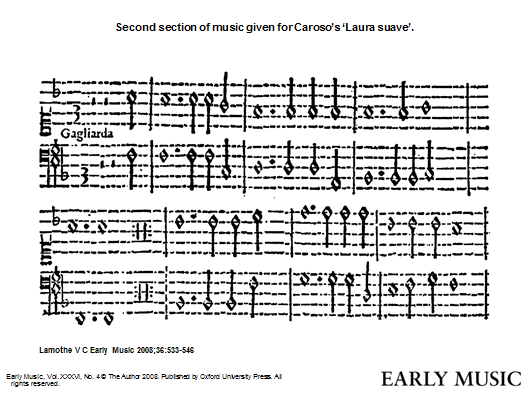
Caroso gagliarda

Caroso gagliarda


But Monteverdi chose to make every phrase start this way, even when the word-accents suggest something different vos- | tre carole. In contrast, galliard phrases normally start on the first beat of the bar, even if the second note takes the word accent.

My thoughts are winged incipit

Dowland Galliard: My thoughts are winged with hopes, my hopes with love,


As Lamothe writes, “Specific types of dances followed particular rhythmic patterns.”. “Each galliard step requires six counts”, including gettati in aria, throwing yourself into the air, on the fourth count.

But the phrasing of qui miri il sole consistently contradicts the phrasing of the galliard step. If Monteverdi had wanted a galliard here, he could have written it like this.

Qui miri galliard

How ‘Qui miri il Sole’ could have been a galliard


Not everything in 3/2 is a galliard. Many of Negri and Caroso’s social dances include movements in 3/2 that are not galliards. Cavalieri tells us that theatrical galliards are danced without singing.  I conclude that Monteverdi’s sung 3/2 movement, Qui miri il sole, is not a galliard.

Monteverdi’s balletto and Cavalieri’s ballo

As we try to identify the three sections of Monteverdi’s 1607 balletto, there is an excellent match with Cavalieri’s 1600 ballo, the grand finale of Anima e Corpo, This is a larger-scale piece, with six strophes and many singers (Cavalieri asks the whole cast, whether on or off-stage, to sing). But the essential structure is the same: C (sung, major mode); 3/2 (sung, minor mode); jumping dance (major mode, instrumental). The texts of both link the movement of celestial bodies to earthly dancing. Cavalieri’s central movement also begins before the beat, in this case with two upbeats – it too, is not a galliard.

Cavalieri’s galliard comes as the jumping dance at the end of the first strophe, with perfectly regular phrases beginning on the beat, and obvious galliard rhythm. And – just as we read in his Preface – after the second strophe, the final dance is varied: now it’s a canario, with dotted rhythms in 6/4, and beginning (like Monteverdi’s canario) after the downbeat. The even-numbered strophes of Cavalieri’s ballo exactly match Monteverdi’s balletto:

  1. C (sung, major mode, could be danced by singers, riverenze, continenze etc) This section is con gravita.
  2. 3/2 (sung, minor mode, starts with upbeat, could be danced by singers but not with jumping steps, definitely not a galliard)
  3. 6/4 (instrumental, major mode, starts after the downbeat, canario, vigorous dance for the dancing-masters)

Cavalieri’s ballo has six strophes, so this particular sequence of three movements comes three times. Monteverdi’s balletto seems also to come three times: the sequence is two iterations of the balletto , some dialogue, and a final reprise of the balletto.

Repeats?

One of the challenges in reconstructing choreographies of this period is figuring out the precise repeat schemes. Lamothe problematises the repeats of the various sections of Monteverdi’s balletto. The music of the C section is written out twice, with a new text the second time;  the 3/2 has the music written out only once, with two strophes of text underlayed; the 6/4 is written out twice, but when the whole ballo is reprised a few minutes later, the repeat of the final section is indicated by repeat marks.

Whilst period choreographies show many different repeat schemes for different dances, the ABC ABC form usually adopted for modern performances of  Lasciate is not typical of Negri and Caroso’s social dances. However, we’ve seen that Monteverdi’s balletto is closer to Cavalieri’s staged ballo than to social dances.

I agree with Lamothe that the question of repeats is problematic. There is much to be said for her suggestion of ABB*C.   (B* means the B music with a new text). The effect for the listener is logical, since Monteverdi’s music has writtten-out repeats for A and C sections, but not for B. So the listener (unaware of how the music was notated) would hear an effect of AA*BB*CC. (The C section is untexted, of course). If one agrees with this logic, then the reprise of the ballo (a few minutes later) could be taken the same way.

I recommend this solution. But I do not rule out (as Lamothe does) the ABC AB*C …. ABC that we hear in many performances today. Her example of a social dance by Caroso is an arrangement of Cavalieri’s Ballo del Gran Duca (1589). Tellingly, the original theatrical ballo and the social dance arrangement have different repeat schemes. Theatrical and social dances were related, but not identical.

Galliard tempi

Lamothe draws attention to particular features of the Galliard movement in social dances, in particular that it is often specifically marked as gagliarda. She suggests that this implies the tempo of the galliard could be specific to that dance (i.e. not in proportion), or variable. Certainly it is true that the physical demands of this jumping dance require that the dancing master has just the tempo he needs. In The Harp Consort, our standard operating procedure for galliards (when performed as a single item, i.e. not as part of a larger ballo ) is to allow the dancer to set the tempo.

Contrary to what one might at first suppose, a slow galliard is physically more demanding than a fast one. At a slow tempo, the dancer must remain in the air longer – this allows more time for capriole, leg-beats in the air – which inevitably requires a higher jump. So slow galliards are more ornamented (just as with musical ornamentation in madrigali passegiati, where a slower Tactus may be taken). And slower, ornamental galliards with their extreme physicality were particularly for men.

Lamothe cites Yvonne Kendall, a scholar of early dance and music, who “reminds us that … the rhythm associated with a particular dance may not be tied to a particular metre signature.” Monteverdi notates galliard sometimes in 3/2 minims (which I take to be tripla, i.e.   three minims to one tactus at about MM60). This is a fast tempo, and we find it for example in Ballo delle Ingrate, which was danced not by singers, nor by the dancing-masters, but by the aristocratic ladies of the court.
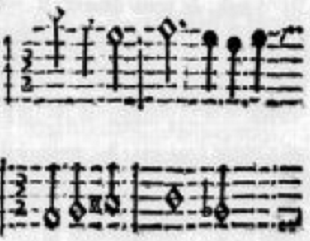
Ballo delle Ingrate gagliarda

Ballo delle Ingrate gagliarda


But in the ballo ‘De la bellezza le dovute lodi’ the galliard is in 3/2 semibreves (which I take to be sesquialtera, i.e. three semibreves to two tactus beats). This is a slow tempo, and is set to the words Ben fallo Alcide il forte referring to that mythical strongman, Hercules.
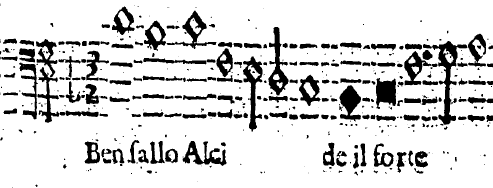
De la bellezza galliard (bass)

De la bellezza galliard (bass)


The agreement of fast/slow tempi with the physicality of fast/slow galliards and with texts associated with women/men seems to support my interpretation of proportions, in which the note-values (minims or semibreves) give us the information we need, to choose between tripla and sesquialtera proportions.
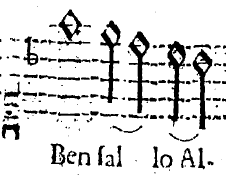
De la bellezza galliard (cantus 1)

De la bellezza galliard (cantus 1)


By the way,  in the cantus primus part for ‘De la bellezza’, there is no time-signature for that same galliard at Ben fallo Alcide. According to Roger Bowers’ theory, this would be a fatal error, a singer would not be able to interpret the notation. According to my theory, the absence of a time-signature is a minor problem; the time signature doesn’t tell the singer anything they didn’t already know.

"What do you make of it, Holmes?" "It is obviously an attempt to convey secret information."

“What do you make of it, Holmes?” “It is obviously an attempt to convey secret information.” “But what is the use of a cipher message without the cipher?”


Since dance movements in 3/2 may or may not be galliards, I suggest that the marking gagliarda in Caroso and Negri indicates not so much the tempo of the movement but rather the particular rhythmic pattern, the characteristic  ‘groove’ of this specific dance. Lamothe again: “specific types of dances followed particular rhythmic patterns.”

We see the same idea with her example from Caroso’s social dance, where the final jumping dance is specifically identified as a salterello. The fast tempo and dotted rhythms might otherwise have suggested a canario (although there are other rhythmic clues in Caroso’s salterello that would contradict an initial diagnosis of canario). 

Caroso saltarello

Caroso saltarello

Who were the dancers?

We should move away from the conventions of Grand Opera in the Romantic period, away from the modern categories of soloists, chorus and corps de ballet. The first ‘operas’ were performed with small casts, who doubled several roles. Soloists often sang as the chorus, too. Chorus members, even soloists might dance.

Lamothe takes into account Tim Carter’s calculations of a company of 9 or 10 singers, a typical size for early ‘opera’, that could have performed Orfeo. But there is strong argument that the first performance in 1607 involved only 8 singers, SSATTBB plus Francesco Rasi as Orfeo. Either way, the singers for the balletto will be mostly, if not entirely, one-to-a-part.

It is possible that singers might sing one-to-a-part and simultaneously dance. This was done by the three female soloists in the 1589 Ballo del Gran Duca – they even played instruments too! But castrato Giovanni Gualberto Magli, who sang three roles (plus chorus parts) in Orfeo, arrived in Mantua eight days before the performance, knowing only the Prologue, and much concerned about ‘so many notes’ that he had to learn. I find it implausible that he would have learnt a dance too, although period commentators report that he performed well when it came to the show.

Certainly, singers could not have sung Qui miri il Sole one-to-a-part and simultaneously danced a galliard, with its combination of three low jumps and one high jump every two seconds. (Try it for yourself!) At most, they could have done some passi gravi during this section. This supports my argument that this section is not a galliard. 

In Mantua in 1607, female courtiers were not allowed to appear on stage – that is why castrato Magli had to be brought in from Pisa. I assume that this prohibition would apply to dancing just as much as to singing. The courtly ladies who danced the Ballo delle Ingrate in 1608 (that year saw a change of policy, which also allowed La Florinda to sing the title role in Arianna), could not have represented the ninfe who are invited to leave the mountains and dance the balletto in 1607.

The most likely explanation is that the dancers were the court dancing-masters. On the model of social dances, they could have danced all three sections. Or ,on the model of Cavalieri’s theatrical ballo, the singers could have done simple movements (riverenze, continenze etc) in the slow C movement, and other passi gravi  in the sung 3/2 (but not a jumping galliard). The instrumental Ritornello then featured a jumping dance, almost certainly a canario, performed by the (male) court dancing masters. Maybe four, or perhaps just two of them, since the performing space for Orfeo was small, and there are already 13 musicians and 5 singers on stage.

One of the court castrati, Issachino Massarini, was also a dancing-master (though he was elderly by 1607). Lamothe speculates that this singer might have sung the role of Euridice, and also danced the balletto. In this interpretation, Rasi as Orfeo would also have to dance the balletto. I haven’t found anything about Rasi’s dancing skills (he was a singer, theorbo player and composer), but I’m sceptical that he would find dancing a vigorous canario the ideal preparation for his great song, Rosa del Ciel, which comes about half a minute afterwards, even if he was not needed for the chorus parts of the balletto. I also find it hard to believe that old Issachino would have managed the sequence of ballo choruses, galliard dancing, and Euridice’s recitative, followed by more chorus-singing, another galliard and the chorus Vieni Imeneo, all in the space of a few minutes.

Nevertheless, Lamothe’s suggestion reminds us that a male dancing master might have danced this balletto as a female character, just as the castrati singers sang female roles.

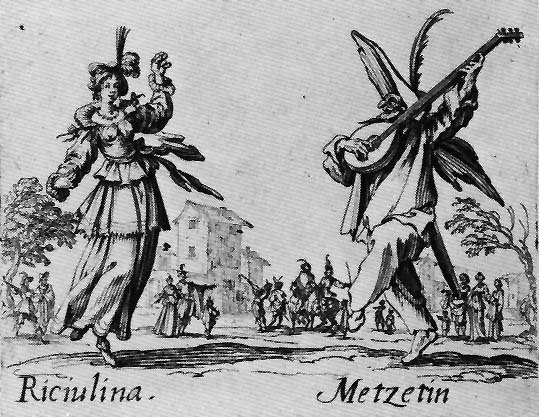
Another possibility is that some of the 13 on-stage instrumentalists could have danced and played – more plausibly in the passi gravi of the first two movements, than in the canario. But since Stephen Player of The Harp Consort has often played guitar whilst simultaneously dancing a canario, perhaps there was a dancing-master or two amongst Monteverdi’s players. Perhaps not the bass-violinist, harpsichordists or the harpist, but what about the three chitarrone-players? We do have period images of dancers with lutes and long-necked instruments.
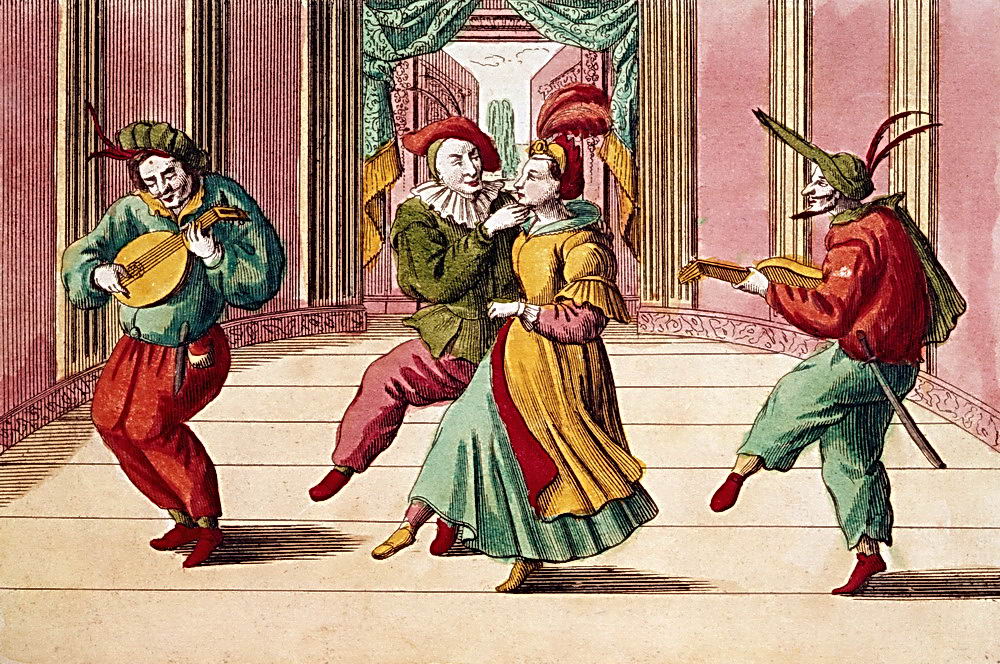
Eighteenth-century Engraving of Commedia dell'arte Actors on Stage


Riciulina and Metzetin


Consistency

Part of Lamothe’s argument is that Proportions might not apply to dancers. Dancers (and many conductors) are sometimes reluctant to struggle with the intellectual and practical challenges of Proportions, but period philosophy and historical musicology combine to emphasise that they are essential.

Ha, ha, keep time! How sour sweet music is / When time is broke and no proportion kept!

William Shakespeare Richard II (c1595) Act V scene v

To support the argument for inconsistency, Lamothe cites musicologist Jeffrey Kurtzman, who is certainly correct to draw attention to the complexity of evidence from period theorists. Working within the scholastic method, theorists had to reconcile the new practices of the 17th century – Monteverdi’s seconda prattica,  the novelty of continuo-notation and (I argue) a simplified use of proportional notation – with the conservative traditions of previous generations. As George Houle observes in Meter in Music 1600-1800, changing usages were fundamentally incompatible with older notation systems, and the theorists’ attempts to unite the irreconcilable were confused, confusing, and in vain.

I do not see that inconsistent realisations could work, in a period when there was often no rehearsal at all. And I do not agree with Bowers’ position, that musicians of Monteverdi’s generation were still putting into practice highly conservative, ‘medieval’ systems – Bowers’ theories are too complicated to work in real time, when sight-reading. Yes, something of the old ways was conserved in the notation, and period theorists struggled to make sense of this. But the actual Use had moved on, and (as just continuo notation replaced intabulated accompaniments) the practice (as opposed to the theory) of Proportions had been simplified, made more practical.

We can be sure that practising musicians found pragmatic solutions that worked, that provided consistent and unambiguous realisations of proportions for ensembles sight-reading together. For, unlike opera, most 17th-century ensemble performances had very little or no rehearsal. I argue:

Practical musicians must have found workable, consistent solutions.

You can examine my theory of proportions here.
Holmes theories

“The theories which I have expressed there, and which appear to you to be so chimerical, are really extremely practical — so practical that I depend upon them for my bread and cheese.”


In addition to arguing that period musicians realised Proportions consistently, I also reject the suggestion that 17th-century dancers had a different way of thinking. Such a divergence may happen today, but the familiar concept of the Renaissance Man reminds us that historically there was an aesthetic unity across many artistic disciplines, guided by high philosophy, i.e. period Science.

In Mantua, Massarini danced and sang; Rasi composed, sang and played theorbo; Monteverdi sang, composed and played the viol. Elsewhere we know of dancer/swordsmen, swordsman/vihuelists, and many dancing violinists, and continuo-playing singers.

It’s clear that there must have been a consistent approach across all these disciplines. We must therefore synthesise all the available information.

It is a capital mistake to theorize before one has data. Insensibly one begins to twist facts to suit theories, instead of theories to suit facts.

“It is a capital mistake to theorize before one has data. Insensibly one begins to twist facts to suit theories, instead of theories to suit facts.”


I suggest that the missing links in Lamothe’s and Bowers’ arguments about Lasciate i Monti are the links: the link from the previous speech, the link to the next speech. Their suggested metronome mark of approximately 50/60 as  the Tactus Aequalis is certainly highly plausible. And Bowers agrees that the notation implies the same Tactus for the whole opera:

There thus appears to be every indication of the prevalence of a single tempo for the entirety of these pages, the fundamental durations of the unblackened semibreve, minim and semiminim remaining constant throughout.

Houle goes further, showing  considerable evidence of the same Tactus for the entire repertory, within this period.

But this ‘single tempo for the entirety’ must be minim = approx 60, not semibreve.

The confusion here is one that we find in period sources too, between Tactus (which strictly means the complete down-up movement) and Semi-Tactus (which is the proper name for the down-movement alone, or the up-movement alone). Many sources use the word Tactus for both, which leads to some theoretical confusion.

But in practice, there is no confusion. Just try the recitative Ma tu gentil cantor  that follows the first part of the balletto,  
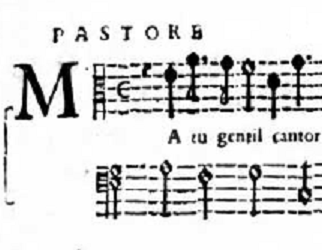
Minim = 60? Maybe. Semibreve = 60? Impossible!

Minim = 60? Maybe.
Semibreve = 60? Impossible!


or Euridice’s speech Io non diro qual sia before the reprise,

Minim = 60? Maybe. Semibreve = 60? Impossible!

Minim = 60? Maybe.
Semibreve = 60? Impossible!


or the chorus afterwards, Vieni Imeneo.
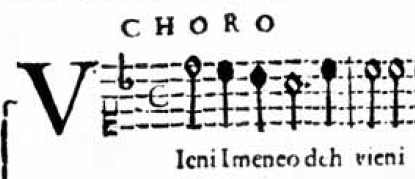
Minim = 60? Maybe. Semibreve = 60? Impossible!

Minim = 60? Maybe.
Semibreve = 60? Impossible!


All work well at around minim = 60, none could be imagined at semibreve = 60!


Chain Missing Link Question

When considering Proportions, Tactus supplies the missing link


So, according to the well-agreed principle that the whole work has a unified Tactus, around MM 60,  I’m convinced that the C section of  Lasciate goes at approximately minim = 60. This is slower than many modern performances, but corresponds to the period description of this kind of movement as con gravita, with passi gravi.

Combining Tactus & Proportions

And here is perhaps the most powerful tool for the scholar of Proportions. If we combine the period principle of Proportions with the period principle of Tactus, we can eliminate many theoretical options as impossible. Starting with minim ~ 60 for Lasciate i monti (unfamiliar to our modern ears but certainly possible), the big question is what proportional relationship to apply at Qui miri il sole.

Eliminating the impossible I – Sesquialtera

If we follow Bowers’ theory and apply Sesquialtera to Qui miri il Sole, we would have dotted semibreve (three minims) = 30, i.e. minim = 90. I find this too slow for Qui miri, but not necessarily impossible.  (Bowers himself arrives at a faster tempo, by applying Sesquialtera, but starting impossibly fast in the previous C section). But what about the Ritornello after the balletto reprise?

Minim = 90? Impossible!

Minim = 90? Impossible!


Or (killer example) the final Moresca at minim = 90? Impossible!
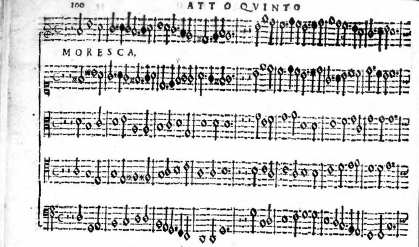
Moresca from Orfeo

Minim = 90? Impossible!


Eliminating the impossible II – Sextupla

Alternatively, if we apply the very fast (Sextupla) proportion to 3/2 Qui miri il Sole, we would get dotted semibreve (three minims) = 120..  I find this too fast, but not necessarily impossible. But now the 6/4 canario would be dotted minim (three crotchets) = 240. Impossible!

Dotted minim = 240? Impossible!

Dotted minim = 240? Impossible!


What remains?

My practical theory of proportions (here again) indicates Tripla, dotted semibreve = 60 for Qui miri il Sole. (This would work as a fast galliard tempo, but I don’t think this is relevant, since the movement is not a galliard.) Then the canario comes out at dotted minim = 120 (i.e. the same dotted semibreve = 60 as in the previous movement). This (as Latrophe agrees) is a good canario tempo.

As Sherlock Holmes said:

When you have eliminated the impossible, whatever remains, however improbable, must be the truth.

[Sir Arthur Conan Doyle, The Sign of the Four (1890), page 111]
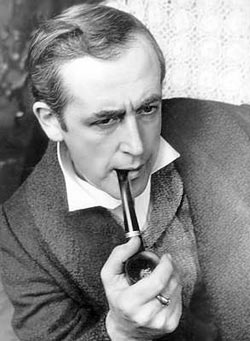
Livanov as Holmes

Holmes never said, “Elementary, my dear Watson”


I find this balletto an interesting and significant test-case, for which my theory of Proportions provides a plausible solution.

But I’m certainly not so arrogant as to insist that anyone else should accept my theory. And I’m just having some fun by quoting Conan Doyle, even if investigating period performance practice can be something like Holmes’ Detective Science. However, I do suggest that you might apply my methods to test your own theory of Proportions. A good theory should be consistent, unambiguous, and easily applied for quick decisions in the real world of practical music-making.

So, as Sherlock Holmes said on the next page of The Sign of the Four:

You know my methods, apply them!


Please join me on Facebook https://www.facebook.com/andrew.lawrenceking.9 and visit our website www.TheHarpConsort.com . Further details of original sources are on the website, click on “New Priorities in Historically Informed Performance”

Opera, orchestra, vocal & ensemble director and early harpist, Andrew Lawrence-King is director of The Harp Consort and of Il Corago, and Senior Visiting Research Fellow at the Australian Research Council Centre for the History of Emotions.

www.historyofemotions.org.au


How did it feel? A History of Heaven, Hearts & Harps

HISTORY OF EMOTIONS

We can imagine a time-travelling Arts journalist asking: “You just heard the first opera… you played continuo next to Claudio Monteverdi… you fought a duel  with Rudolfo Capo Ferro… you danced with Louis XIV … you acted for William Shakespeare … you went drinking with Henry Purcell … you built a pendulum clock according to Galileo’s theories … you can see with your own eyes that the sun goes around the earth… Domenichino Zampieri made you a harp with three rows of strings… How did it feel?”


How did it feel


This question – easy to ask, but rich in potential for surprising answers and further, more profound investigations – might well be the unofficial motto of the Australian Research Council’s Centre for the History of Emotions. From nodes at major universities and conservatories across Australia, in research and performance projects around the world, and across a wide range of humanities disciplines, CHE’s investigators not only look at Emotions in History, but also use Emotions studies as a lens by which to view a broad field of historical themes, and to understand how Emotions and History continue to Shape the Modern.

I am a Senior Visiting Research Fellow for the Centre, attached to the University of Western Australia, and this post was first presented at a joint event of the World Harp Congress and the Centre for the History of Emotions in Sydney,  Australia in July 2014.

CHEWHC Sydney 2014 logo


At the beginning of the baroque, around the year 1600, the period aim to muovere gli affetti – move the passions – gives us confidence that Emotions studies are historically appropriate, as we try to understand the role of the harp within the music and culture of the time.

So whose passions are we trying to move? Simply to ask the question re-locates the focus onto the audience, a much-needed counter-balance to the academic tradition of studying composers and works, and to the conservatoire habit of concentrating on what performers do.

Audience Studies are a vital new area of musicological investigation – what makes music meaningful for the listener? How can we attract new listeners? Why are we losing touch with some listeners?  I’m privileged to collaborate on such research with Prof John Sloboda at the Guildhall School of Music & Drama. And studies of Historical Audiences are an important part of our work at CHE, led by Dr Penelope Woods.

theatre-palais-cardinal Louis XIII

EARLY MUSIC & THE HARP

This harp-flavoured post introduces some general ideas concerning Early Music, and connects these ideas to the aesthetics of two particular cultures: Italy around 1600, the period of Monteverdi’s first opera, Orfeo, in which the harp plays a major solo, as well as within the continuo ensemble; and the late 18th-century, where we have the Mozart Concerto for traverse flute and single-action harp, and CPE Bach’s Sonata (it’s debated whether this is for Italian triple harp or French single-action harp). Orfeo, CPE Bach, Mozart

One of my tasks here is to do some myth-busting, correcting some favourite misunderstandings of what Early Music is about, and pointing out some alarming discrepancies between what we see in historical sources and the standard operating procedures of today’s Early Music. So I have some images to help identify a popular myth, and to show when we’ve bust it. But since I wasn’t quite sure what a myth should look like, and I didn’t want to start exploding sacred cows, I’ve chosen the metaphor of Vampires, both modern and pseudo-old, which (like mistaken ideas) hang around half-dead, until someone arrives to slay them.  And according to the principles of the baroque opera stage, the good guys will be on my right, the bad guys on my left.

myth busting

And I have this genuinely 17th-century image to draw your attention to important historical information that you might want to follow up for yourselves later. You can read more on my website: www.TheHarpConsort.com  as well as elsewhere in this blog.

Attentionem poscit and art


Right side… Good Doggy.

Not Authentic

Over the last half-century, recording companies helped to create an audience for Early Music by promoting performances that were advertised as “on authentic instruments”, “on period (or original) instruments”. Of course, this was just a shorthand way to label what was meant to be a fundamentally different approach to music-making, but it left a misleading impression that the instruments themselves, whether original or modern reproductions in period style, were the most important ingredient for achieving Authenticity.

HIP not Authentic

Nowadays, we tend not to use the A-word, since we all recognise that complete historical Authenticity is impossible. And taking the other meaning of that word, Authentic in the sense of true to one’s personal beliefs, we also recognise that every musician assembles their musical identity from many influences, that historical information as well as inspiring teaching or convincing performance can shape what each of us feels to be “true” to our personal values. So let’s leave behind us the rather negative concept of Authentic Instruments, and use the modern phrase, Historically Informed Performance, abbreviated as HIP. After all, the only alternative to being Historically Informed is to be Historically Uninformed!

A more recent attempt to describe what we mean by Early Music (that term is still frequently used, informally and amongst performers, but its more hip to say “HIP” in academic circles), was that the musicians would seek to respect ‘the composer’s intentions’. This phrase has also been rejected, because it plays into the old-fashioned, Romantic idea of idolising the Master Composer, and because baroque composers didn’t want you to play what they wrote. Like a modern singer-song-writer, or a jazz-composer, baroque composers expected you to take their idea and make it your own, with improvised variations, your own touches of arrangement, even wholesale re-writing.

Respecting the composer's intentions

LOOKING BACKWARDS THROUGH HISTORY?

Looking backwards through history

Another, more subtle danger is that we find ourselves looking back into the past, from our modern perspective. The recent past (that fun CD released last year) looms large; close behind are ghostly shadows of our early musical education, and of the education that shaped our first teachers. We might be smart enough to avert our gaze from all those Romantic geniuses who clog the middle distance, and there at the far end of a dark tunnel we can just make out Mozart, Handel, Bach and (very far off now) Monteverdi. The problem here is that we are looking the wrong way down a telescope – the object of our study appears very distant and small – and we are looking the wrong way through time.

The way to understand Monteverdi is not via Mozart, Handel and Bach. Even if we know those later guys better, Monteverdi didn’t know them at all. We need to approach Monteverdi from inside the culture of his own time, not looking backwards into the past, but looking around us in his historical present.  We need to look sideways, not only at the harp, but at other kinds of music, at other performing arts, at literature and paintings, at period science, at dancing and swordsmanship. To understand his culture fully, we need to start a bit earlier – perhaps with the generation of his teachers – and move forwards through time with him. Then we might have a better idea of “how does it feel”.

Looking sideways inside history


Otherwise, if we view old music only from our modern perspective, we may end up trying to squeeze an ancient culture into an utterly different framework, a round peg into a square hole.

As we begin to read what period writers themselves considered important, we quickly realise that our modern concepts of Technique and Interpretation, and of Conservatoire teaching in general are inappropriate. But much of the discussion amongst today’s Early Musicians is also dominated by topics that are hardly mentioned by 17th-century writers. The pages of Early Music Magazine, and online discussion groups give a lot of space to arguments about pitch, temperament and vibrato.

Today's priorities


But there is nothing about any of these subjects in the most important documents describing the performance practices of the early seicento: the preface to the first opera, Cavalieri’s Anima e Corpo (1600), the preface to the second opera, Peri’s Euridice (also 1600), Caccini’s Le Nuove Musiche (1601), Viadana’s figured-bass motets of 1602, Monteverdi’s Orfeo and Agazzari’s guide to continuo-playing, Dal Sonare Sopra’l Basso (both 1607) and the preface to Gagliano’s Dafne (1608), Monteverdi’s Vesperae (1610), his prefaces to Combattimento and the Lamento della Ninfa (1636), Shakespeare’s advice to the players in Hamlet (1600) and the anonymous circa-1630 guide for a music-theatre’s artistic director, Il Corago.

Sources circa 1600


Meanwhile, we know that renaissance courtiers spent several hours every day for most of their lives, practising dancing and training with swords. If we want to know how did that feel, how such training affects posture, musculature, and modes of thought, we can read and try out the recommendations of the Book of the Courtier, Castiglione’s Il Cortegiano (1528 and many reprints across 20 European cities and six languages, it was one of the most widely-read books of the time), Negri’s dance-treatises (1602 & 1604) and Capo Ferro’s Gran Simulacro of the Art of Swordfighting (1610).

Sources circa 1600 list

FALSE FRIENDS

The past is a foreign country Hartley and Howard

When learning a foreign language, we have to take care with so-called ‘false friends’, words that sound familiar but have quite a different meaning in the other language. For example, if you are new to Australia, it might help you to to know that a hot Barbie is not a blonde doll.Smiley

So it is with the language of the past – familiar-sounding words mean something quite different, and we need to understand a different set of assumptions.

Hexachord


There were only six notes in the 17th-century scale, the Hexachord, so that ascending above A-la imposes a choice between B- fa and B-mi. This choice is guided by different rules in different periods, and it’s often left to the performer to make an appropriate decision: the notation may leave the question open. We absolutely cannot assume that What You See Is What  You Get. The meaning of the notation itself has changed, over the centuries.

And when we move out from tiny details to the big picture, we see utterly different use of language, showing that the underlying assumptions are also utterly different. Around the year 1600, what is Music? First, and most importantly, it was the Music of the Spheres, musica mondana, the perfect music made by the movement of the stars and planets as they danced in their circular orbits around the earth, turned by the motion of the highest sphere, the primum mobile. This is the music of the cosmos, turned by the hand of God. Secondly, we have musica humana, the harmonious nature of the human body. Last of all comes musica instrumentalis, actual sounds made down here on earth, with our voices and harps.

Three kinds of Music

Some other 17-century ‘false friends’ to beware of are Harmony (which just means, organised sound; the most significant organisation is usually rhythmic rather than chordal harmony in the modern sense); and  Tempo (which just means time, measured in semibreves, whole notes, which last about two seconds).

False friends

ASSUMPTIONS

So much for language. Let’s explore some basic assumptions.

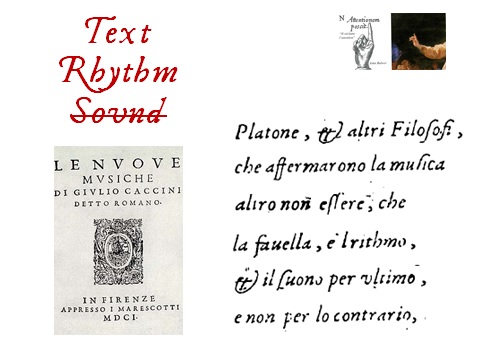
What is important? In his  Preface to Le Nuove Musiche (the book containing that famous song, Amarilli mia bella), Caccini prioritises Text and Rhythm, with Sound last of all. And not the other way around! This contrasts strongly with modern conservatoire teaching, which focusses on sound-production, and even with the concentration of today’s Early Music Movement on vibrato, pitch and temperament, certainly with the tendency to focus on ‘original instruments’. All those questions of Sound came “last of all” to the 17th-century mind. Rather, they were thinking about Text and Rhythm.

Text, Rhythm and Sound

Who is important? We should try to clear from our minds the Romantic image of the genius performer, expressing his (and in the 19th-century it was mostly his) sublime emotions in front of the reverent, silent audience of nobodies, sitting in the dark, worshipping at the temple of culture. 17th-century music privileges the Audience. As La Musica says at the very beginning of Monteverdi’s Orfeo, “I’ve come from by beloved Permesso to you, great heroes, noble race of Kings, to narrate whose fame even heavenly praise would not reach the truth, since your reputation is so high”. Only in verse two does she introduce herself, “I am Music”.

Audience, not Performer

What is music for? As a Rhetorical Art, music seeks to persuade the mind, delight the senses, and move the emotions. The period language muovere gli affetti, to move the passions, reminds us that multiple, contrasting emotions are at play – not just the intensification of a single emotion, as in Romantic music. The audience’s feelings are engaged by the movement of the passions. And so we performers might well want to explore a History of Emotions.

Docere Delectare Movere

RHYTHM

So let’s consider those historical priorities of Text and Rhythm. I’ll come to Text in due course, but in order to understand musical Rhythm, we first have to ask What is Time?  Our assumption today is that musical rhythm sits, with various degrees of freedom, within Time itself, which is Absolute. We can measure this Time rather accurately, with our digital watches, and we can impose it on our music with metronomes, although we feel that the higher art is to bend time into something more ‘musical’, with rubato. All of that is an essentially 20th-century view of Time, even though it has now been updated by Einstein’s relativity,. But that 20th-century view is utterly irrelevant to the period before Isaac Newton.

What is Time

17th-century Time is cosmic, measured by the perfect, but very slow-moving, clock of the sun and stars. Time is human, measured by the body-rhythm of our pulse or heartbeat, at about one per second when we are relaxed. In the lowest, practical sense, Time is measured by Music, since around the year 1600 a minim (half-note) is one second, as close as human beings can make it.

The best clocks could just about count the seconds. So when Galileo discovered the pendulum effect, observing a swinging chandelier in Pisa Cathedral, he checked it against his own pulse. When he needed split-second timing, to measure the acceleration due to gravity, he used the highest precision timing system in the known world: music. He got his lute-player to play fast variations (divisions, as they were called back then), which literally divided up the minims/seconds into crotches, quavers and semi-quavers, giving him precision measurement down to 1/8 of a second.

You can try the experiment for yourself in an online simulation, here.

What is Time

Just as the movement of the cosmos is driven by the most divine, outermost, slowest sphere, so musical time is organised by a constant slow beat, and the faster notes fit inside this. So baroque musical rhythm is defined by Tactus, a slow steady beat, like a perfect clock, like the clock of the cosmos, or the steady beat of the human pulse.  If your pulse falters, you are sick: if your heart stops, the music also dies.

Guidar il tempo

But early 17th-century sources describe certain, highly specific ways to Drive the Time in passionate music. This is dangerous stuff – if you lose control of the Time Chariot, the sun will crash into the sea. But just as you can raise your pulse rate by exercise or emotion, or lower it by relaxation (adagio means ‘at ease’, ‘take it easy’), so Frescobaldi (1615) explains how to change the time between sections in different rhythms, or how to suspend the beat in the air, momentarily. And Caccini talks about sprezzatura, nonchalant or ‘cool’ rhythm, in which the singer floats freely above a steady tactus in the continuo bass.

Music of this period was not conducted, although we often see conductors in today’s Early Music. That is a gross anachronism. Agazzari and Il Corago tell us clearly that the entire ensemble is guided by the continuo, Dowland tells us that it is Tactus itself that “directs a song in measure”. Peri expects that singers will “dance to the rhythm of the bass”, so for recitative (where speech-like rhythms are needed on the level of individual syllables) he reduces the continuo activity to semibreves and minims, just enough to maintain the Tactus.

Continuo not conductor

One of the consequences of this historical view of Time, of organising Rhythm by the slow count of Tactus, is that melodies have to fit inside the tactus. And it’s the accompaniment that maintains the Tactus. So accompanists do not follow soloists, rather soloists must fit with the accompaniment. Peri expects that singers will dance to the rhythm of the bass.

This is a big shock to modern classical musicians, and even today’s Early Musicians mostly ignore the clear historical evidence. Playing continuo today can be like a fairground game: you wait there with your triple harp or theorbo, until a little yellow duck (the tenor) waddles into your sights, and then you fire off a chord, and hope to hit him in root position.

Duck shoot

The take-home message is that music pre-1800 has a slow steady pulse (even if the actual notes are going fast), and the melody is guided by the bass. No rubato, no conductors.


 Tactus

TEXT

Agazzari writes that instruments should play with the affetto e somiglianza delle parole, with the emotion and the semblance of words. For singers, the sung text shows the emotional changes from one word to the next. Notice that, in this style, there are many different, changing, contrasted affetti. Frequently there is an abrupt change in text and music to the contrary emotion – an opposto – signalled by the word ma (but), or by images and gestures that point to opposite sides of the stage: here and there, heaven and hell, you and me.

Text and Rhythm

In this period, instrumental pieces are often taken from vocal originals. So we can take the emotional changes from the original words, just as Agazzari instructs. In a piece where there are no words, we can still recognise emotional changes from characteristic melodic figures, so that an early Sonata shows the same strong contrasts and abruptly changing opposti that we’ve learnt to expect in vocal music.

But what about Agazzari’s somiglianza, semblance of, similitude to words? To imitate on the harp the effect of speech, we need to think about the sound of language. In Italian, many common words have two syllables, accented-unaccented, or (in period terminology) Good-Bad: piano, forte, dolce, arpa, pasta, pizza, Roma. Three syllables can be accented Bad-Good-Bad allegro adagio sonata Caccini Firenze, Milano, spaghetti; or Good-Bad-Bad: table is tavola, the last one, ultimate, is ultimo, Claudio Monteverdi worked in Mantua.

Articulation Good & Bad syllables

These common words form the typical patterns of the language, two or three syllables, more or less alternating Good and Bad. Where the syllables are joined together, the join can be smooth with single consonants, as in the word legato, or it can be a bumpy join with a double consonant, as in the word staccato. And of course, the consonant that starts each syllable has its own colour su, giu (up & down), no, si (no & yes) ma (but). All of this joining and separating between syllables is what Early Musicians mean by ‘articulation’. Just we ‘articulate’ our words, in order to speak articulately, on an early instrument we ‘articulate’ the notes, in order to sound as if we are speaking.

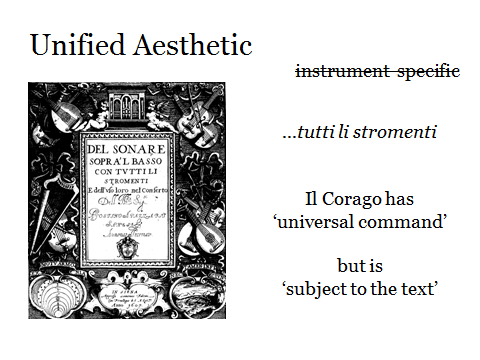
So baroque harps, baroque flutes, baroque violins, harpsichords all aim to imitate the sound and emotions of speech. This fundamental consideration is much stronger than the subtle differences between one instrument and another. In this period, musical style and passionate rhetoric are not instrument-specific. That’s good news for us harpists, since much of our best-known early repertoire is shared with, or stolen from other instruments: the Luduvico fantasia was published for vihuela in imitation of the Spanish harp; Handel’s concerto was published for Organ, even if first played on Welsh harp; the CPE Bach sonata might have had a second instrument to play continuo, and we don’t know for sure which kind of harp he meant; the Mozart concerto is shared with the flute.

But in each of these periods, the local aesthetic is derived from text and vocal music, common to all instruments, and unified across all the arts.

Unified aesthetic

In contrast to a modern opera production, in which the text, the music and the staging tell three different stories, in baroque opera everything tells the same story, all directed by the artistic director Il Corago, who has ‘universal command’ over every element of the production, but who is subject to the structures, sounds and emotions of the poetic text.

THE TRUE ART

This unity of aesthetic means that baroque harpists can learn from other instruments, and that we can expect to find a high level of agreement about essential priorities as we compare different sources. In the second half of the 18th century, our guides to the CPE Bach sonata and Mozart concerto are the three great treatises of the 1750s, as well as the harp methods of the 1760s, 70s and 80s; their fundamental agreement far outweighs their subtle differences.

Of course, historical teaching books have plenty of detailed information to offer, but we can also come to understand the underlying assumptions of period aesthetics by studying the big picture of how writers organise their material, from Milán in the 16th century, and Ribayaz in the 17th; to Quantz, CPE Bach and Leopold Mozart in the mid-18th; Meyer, Cousineau and Ragué in the following decades. We can follow a chronological story, as the broad consensus gradually changes.

The True Art

All these writers deal very quickly with sound-production: hold the instrument the right way up, and tune it like this. Of course, there are further subtleties, but we won’t find them in period teaching books. We have to reverse-engineer the technical means from our knowledge of the aesthetic end-goals, from iconography, from information about other instruments etc.

Milan teaches how to compose renaissance polyphony, Ribayaz how to play baroque dances.

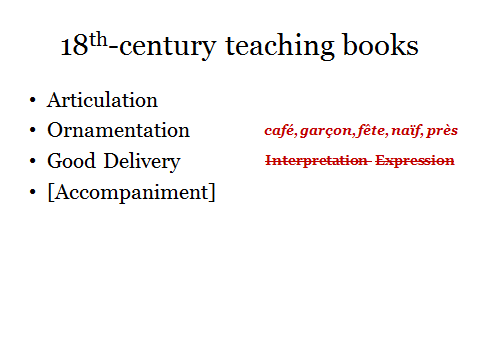
All the 18th-century books are structured in the same order, to teach Articulation, Ornamentation and Good Delivery.

18th-century teaching books

Articulation (as we have just seen) is how to make the instrument ‘speak’.

Ornamentation is not only decoration but also a kind of musical grammar, just as those funny marks on French words are not just typographic decoration, but a basic requirement of the language. café, garçon, fête, naïf, près. In language and in music, these small marks are mentally added even if the writer forgets them; they change the sound and the meaning.

Good Delivery is not quite the same as modern ‘interpretation’. A baroque musician is not an ‘interpreter’ who translates the music into a new language, or comes up with his own explanation of it. Rather, the baroque musician is like a fine speaker, who delivers poetic lines well, who communicates to an audience the sound of the words, the meaning of the words and the emotions of the words. The term Expression is another ‘false friend’: the performer’s aim is not to express his own emotions, but to convey the emotions of the music to the audience, just as an actor does not express his own feelings, but conveys to the audience the emotions of his character. Peri and Il Corago emphasise that baroque music is modelled on the speech of a fine actor.

Some baroque books include a section on accompaniment – filling out the left hand with improvised harmonies (Ribayaz) or improvising harmonies to accompany a soloist or orchestra (CPE Bach). In the CPE Bach sonata, the continuo might be realised by the same harpist who plays the right hand, or perhaps by a second instrument. We don’t know the composer’s original intention.

So let’s take the period organisation of Articulation, Ornamentation, Good Delivery and Continuo, and apply some of the detailed historical information to the baroque harp. Articulation is produced in different ways on different instruments – with tonguing syllables tiri liri or diddle diddle on the flute; with bow strokes on the violin; with choice of fingers on harps, lutes and keyboards – but the common aim is to imitate the sound of speech. So we need Good and Bad syllables, and for Monteverdi we need to link them in the patterns of typical Italian words piano, forte, dolce, pizza, pasta, arpa. Good links to Bad.

On the harp, we match Good and Bad syllables, Good and Bad notes, to Good and Bad fingers. For 17th-century Italian harp, 1 is Good, 2 is Bad, 3 is Good. Just as the word-accents mostly alternate Good and Bad, so the scale fingerings alternate. 3-2 ascending, and 1-2 descending. With this fingering, scales are not homogenous – dadadada – but are articulated. Think of Frank Sinatra – dooby-dooby-doo. The technical procedure matches the sound of the language also by joining together Good-Bad. Piano, forte, dolce, pizza, pasta.

The whole shape of the Early Music phrase is not like the long curved lines we see engraved into 19th-century scores. Rather it alternates Good and Bad, and has the principal accent almost at the end of the line.

To be or not to be, that’s the Question.

But the last syllable is unaccented, a Bad. This leads to a general practice in HIP of not arriving triumphantly on the last note, with a massive false accent. Rather, the assumption is that the last note is a Bad syllable, unaccented.

However, today’s Early Music performers mostly ignore clear period advice not to slow down or break before the last note. At cadences, we often hear a rallentando and a hesitation before the final note – whereas Caccini and many other 17th-century sources ask for ornaments to accelerate and run smoothly into the last, unaccented note.

Metre and Accent

Those most famous words of Shakespeare To  be or not to be, that’s the Question have a very similar pattern to the famous first line of Dante’s Inferno: Nel mezzo del camin di nostra vita. The subtle difference is that Italian has more two-syllable words joined Good-Bad mezzo, nostra, vita whereas English has many monosyllables grouped into iambics Bad-Good, to be / or not / to be. So we can play the harp in the historical accents of different languages. Monteverdi should sound Italian. Bach should sound German. But what about Mozart in Paris: does his music speak Italian, French or German?

We can play Continuo also with Good and Bad chords; more notes and a quick roll on the Good, fewer notes and plaque on the Bad. With carefully use of resonance and damping, we can join Good and Bad, Italian-style. Piano forte dolce pizza pasta  Or Bad-Good, to be / or not  / to be. This is how continuo-players can imitate the somiglianza, the semblance of words described by Agazzari.

In his theorbo-book, Kapsberger shows how to make the arpeggio commune – ‘default arpeggio’ across two beats. This is how continuo-players can maintain the Tactus, so that they direct the song in measure, as Agazzari and Dowland recommend.

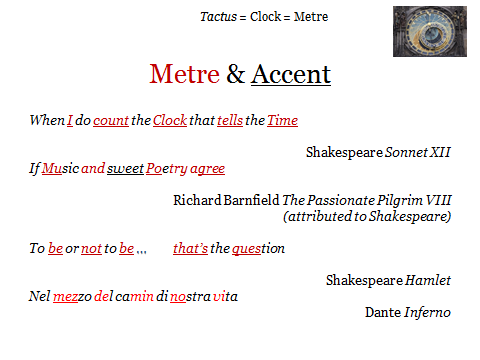
Text and Rhythm work together in music in the same way that word-accent and metre do in poetry. Tactus corresponds to poetic metre, it is like a clock that counts the time steadily. The music itself follows the patterns of word accents, which may, or may not, coincide with the ticking of the tactus clock. Sometimes the Good syllables match the Tactus: “When /I do /count the /clock that /tells the /time“. But sometimes they are subtly syncopated: “If /Music /and sweet /Poe/try a/gree“. Similarly in baroque music: there is a steady count (the Tactus), but the accents don’t always fall on the downbeat.

Early Musicians are often asked to be ‘free from the tyranny of the bar-line’. This phrase is helpful, if we understand it to mean that the word-accent does not have to coincide with the first beat of the bar, i.e. with the Tactus beat. But some modern players think that they should completely ignore the Tactus and play in free rhythm. Period sources make it clear: the Tactus is kept, slow and steady, like an old clock; but you don’t necessarily put the word-accents on the Tactus beats. This concept, of measured rhythm and independent accents (rather than accentual rhythm), is perhaps the most significant difference between modern and pre-1800 approaches. You can read more in George Houle’s excellent survey of Performance, Perception and Notation 1600-1800, Metre in Music, here.

OTHER TECHNICAL QUESTIONS

Other technical questions are not answered in the teaching books, but have to be investigated through historical images, via other instruments, or reconstructed on a pragmatic basis, once we understand the end-goal. So we see that the historical position for the Italian triple harp is with the instrument high, the player seated low; the low-tension strings require less strength, more relaxation in the hand; the hands rest on the soundboard (surviving instruments show wear-marks), the thumb crosses underneath the fingers (as with the lute), the finger-strokes are slow.

ORNAMENTS

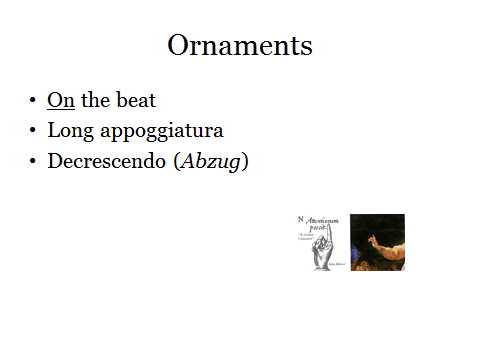
This is a huge subject, but the take-home message about 18th-century Ornaments comes from combining the information in Quantz’s CPE Bach’s and Leopold Mozart’s treatises. Play ornaments on the beat, with a long upper auxiliary, and with decrescendo (the so-called Abzug, phrasing off). On the harp, don’t try to make too many iterations, rather concentrate on being on the beat and getting that Abzug. There are fingerings for trills in the 18th-century harp methods.

You need the Abzug also for appoggiaturas; Leopold Mozart says that you should ‘ooze’ into the second note, hineinschleifen in the original German. The 18th-century harp methods also focus on the appoggiatura.


Ornaments


EMOTIONS

But in a historical style that does not rely on Rubato, constant Vibrato, constant Legato, nor Conductors, where can we find the Emotions?  Singers move the passions with the changing meaning of each word, alternating happy and sad, as Monteverdi’s La Musica explains:

I am Music: with my sweet phrases I can make tranquil any troubled heart;

And now with noble anger, now with Love, I can inflame the most frozen mind.

For sustaining instruments like the flute or violin, long notes are highly sensual, drawn-out with a slow bow or a languid breath, releasing the long suspense with a touch of vibrato at the end of the note. Whitney Houston demonstrates baroque long notes perfectly in And I will always love you, here.

But what about us harpists, with neither text nor sustain to play with? Quantz explains in detail the Good Delivery for dissonance and resolution. The dissonance is played loud, the resolution soft (another Abzug), and the more intense the dissonance, the louder it is played, and the softer the following resolution. On the harp, we can also move down even more près de la table to make a more painful sound on the dissonance, and then up the string for a soothing resolution. Most importantly, we can feel the effect of the dissonance as an increase in tension, with a relaxation at the resolution.

Where is the emotion

DREAM-TIME

Just before I finish, I’d like to let you know about a completely new area of research that is opening up right now, one that may revolutionise our ideas about Emotions in Music and in History, and about musical pedagogy for any repertoire.

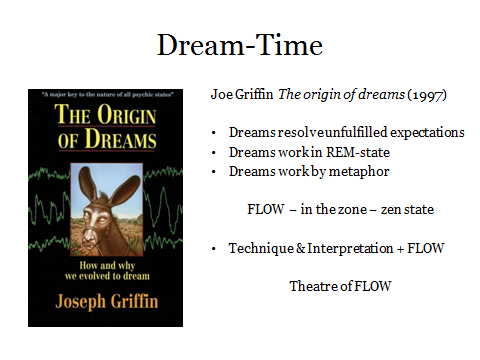
Over the last twenty years, clinical and research psychologist Joe Griffin has developed a new theory of Dreams, which offers a convincing biological, evolutionary and psychological model, replacing the outworn ideas of Freud and Jung.

Dream Time


Griffin shows that Dreams are the mind’s way of dealing with those powerful emotions of the previous day which were not dealt with at the time. Dreams resolve unfulfilled expectations (whether good or bad). But what we experience in our dreams is not the actual situation that brought on the unresolved emotion; rather the dream is a metaphor, a mix of memories that matches the pattern of the unresolved situation.

Dreams operate in a particular mode of sleep, characterised by rapid eye movement. The dream state is therefore known as the REM-state. There are other altered states of consciousness that allow us to enter REM-state whilst we are awake, such as day-dreaming or hypnosis. Griffin calls the REM-state the Theatre of Dreams. A signal from the lower brain, a so-called PGO-spike, calls attention to the beginning of the dream.

Many musicians, sportsmen and women, creative writers and composers know the special state of consciousness known as Flow, or being ‘in the zone’. It’s that Zen thing. It’s related to Mindfulness. You’re relaxed, but wonderfully concentrated on the task at hand; you feel quietly confident that you can manage it, you feel calmly exhilarated at the challenge it presents to you; you don’t feel self-conscious, you are just ‘there’, in the moment, in the groove; in a certain way, Time seems to slow down, so that you can calmly take in all the incoming information, and calmly make an elegant decision and execute your reponse perfectly; your artistic intentions and your manual actions unite perfectly; you are working at high efficiency, but you could continue for hours without getting tired; you feel happy, even elated.

It’s a great feeling, and it is being in Flow that makes the difference between an elite performer, musician, martial arts practitioner or sportsman and one who is merely ok. It is being in Flow that can lift any of us beyond the limits of our normal abilities. There is exciting work going on in Hungary and Holland about teaching Flow to musicians. Not just Technique and Interpretation, but how to get into Flow.

My own research project hypothesises that Flow is another REM-state. I’m suggesting that such elements of Historically Informed Performance  as the slow, steady count of Tactus, a kind of meditation on rhythm, and baroque gesture with its frequent calls for attention, might function as gateways into Flow. And not only for the performer, but also for the audience. Specific features of baroque stage-practice – Historical Action – support the hypothesis that Baroque Operas (and Shakespeare’s dramas) are a Theatre of Flow, where performers and audiences share an REM-state, the mind’s Theatre of Dreams, in which emotions can be communicated powerfully through the metaphors of poetry and music.

REM-state allows us to reach something beyond our everyday experience – that spiritual dimension to art that every music-lover believes in, whatever we choose to call it. In 17th-century philosophy, music connects us humans to the cosmos. Many of you will know about so-called Dreamtime, in which indigenous Australians connect to their family’s homeland and traditional beliefs through a spiritual state of music, art and story-telling. The Star Wars idea of a Force that we all share, that we can all learn to use, is perhaps not so far off.

Super-human instruments

And it’s around the year 1600, just as opera is being invented, that we see the invention of larger-than-life, super-human instruments like the theorbo and arpa doppia, with super low-notes and uber-chromaticism. With such an instrument, a super-hero like Orpheus can travel to Hell and back, and use his super-powers to persuade Charon into a magic sleep – another REM-state, of course.

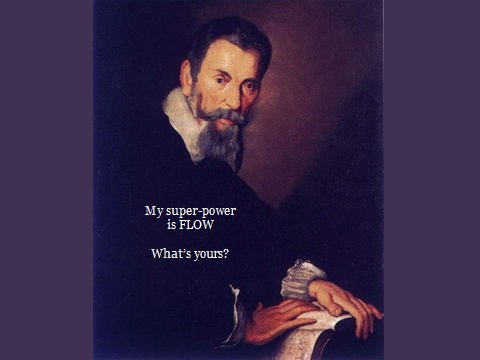
We could almost imagine Monteverdi’s T-shirt: my super-power is Flow, what’s yours?

My super-power is FLOW

CONCLUSION

Leaving aside these dreamy speculations, as we study the emotional language of historical music, we can view that history from the inside if we adopt period priorities and appreciate ‘foreign’ assumptions. We can consider what we would like the audience to receive, rather than what we performers want to send out. We can concentrate on Text and Rhythm, not Sound. We can search for the shared aesthetic that unifies many arts within one culture, one region, one period; as well as for the contrasts between one culture and another.

HIP summary

Our harps will speak eloquently, if we focus on short-term phrasing, two or three notes at a time, articulating them with Good and Bad, giving them the semblance and emotions of words. As harpists speaking the language of historical music, we are like actors playing a role, and like actors we want to present our lines with Good Delivery, which will include all the skills of Rhetoric and Historical Action: what we do with our bodies, hand gestures and facial expressions. One of the hot areas of current Early Music research is baroque gesture, or (as it was called at the time) historical Action.

The 17th-century writer John Bulwer quotes the great orator Quintilian, quoting Cicero, quoting the Greek rhetorician Demosthenes, who was asked: What are the three secrets of Good Delivery?

Demosthenes Cicero Quintilian


 What are the three secrets of Good Delivery?

Action! Action! Action!


Please join me on Facebook https://www.facebook.com/andrew.lawrenceking.9 and visit our website www.TheHarpConsort.com .

Opera, orchestra, vocal & ensemble director and early harpist, Andrew Lawrence-King is director of The Harp Consort and of Il Corago, and Senior Visiting Research Fellow at the Australian Research Council Centre for the History of Emotions.


The Right Time for a New Vision: Monteverdi’s 1610 Vespers

Monteverdi vespers image

Claudio Monteverdi’s most famous work, the 1610 Vespers of the Blessed Virgin Mary, evokes all the glory of the Italian seicento, combining plainchant melodies, exquisite polyphony and the drama of the newly invented operatic style. This Vespers has been linked with the cathedrals of St Peter, Rome and St Mark, Venice, but the inclusion of the Gonzaga family fanfare (also featured in Monteverdi’s 1607 opera, Orfeo) confirms a stronger link to the church of St Barbara, Mantua.

Mantua by night

The publication of the Vespers in 1610 places this collection of religious music in the context of the first operas – Cavalieri’s Anima & Corpo, Peri’s and Caccini’s Euridice all in the year 1600 – and Shakespeare’s plays (e.g. Hamlet c1600); of Caccini’s secular songs Le Nuove Musiche and Viadana’s sacred Concerti Ecclesiastici, both 1602); of Monteverdi’s own operas Orfeo (1607) and Arianna (1608); of Agazzari’s continuo treatise Di suonare sopra’l basso (1607); and of the publications of Orfeo (1609) and of Capo Ferro’s famous swordfighting treatise, Gran Simulacro (1610).

Context

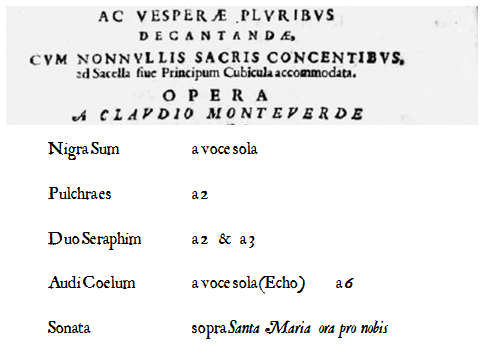
The title-page of the collection refers to some Sacred Concertos ‘suitable for the Chapel or a Princely chamber’. Musicologists debate whether these pieces are substitutes for the plainchant Antiphons specified in the liturgy of Vespers, or independent, non-liturgical additions. Either way, they alternate with the Vespers Psalms to create a fascinatingly varied publication, or indeed a modern concert. The size of the ensemble and the complexity of the music increases from one piece to the next. Meanwhile, the term ‘sacred concertos’ recalls Viadana’s publication for voices and continuo, suggesting that Viadana’s technical advice might be applied also to Monteverdi’s music. That advice emphasises the subtlety and delicacy of the ‘sacred concerto’ style, to be performed with solo voices. Viadana also gives detailed instructions for realising the continuo.

Sacred Concertos

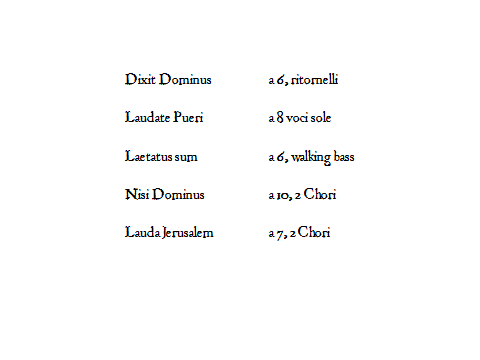
The ‘sacred concerti’ most obviously demonstrate Monteverdi’s modern style, his secunda prattica, but even if the psalm settings are more conservative, with plainchant cantus fermus throughout and exquisite polyphony, they too are full of variety. Each Psalm exploits different techniques. Dixit Dominus weaves the plainchant into rich prima prattica polyphony, and also into fashionable soprano or tenor duets. Choral recitation on a single note might be heard as highly conservative and derived from liturgical chant, but it also suggests the most up-to-date styles of operatic recitative and dramatic madrigals, for example the choral recitation in Monteverdi’s Sfogava con le stelle. Instrumental ritornelli add another fashionable touch to this Psalm.

Laudate Pueri explicitly calls for eight solo voices (not a large choir), which Monteverdi combines in many ways: as a single ensemble, as two four-voice choirs, and in pairs of equal voices. Laetatus is unified by its catchy walking-bass, another modern touch. Nisi Dominus and Lauda Jerusalem might appear similar, both for double choir, but are quite different. The block contrasts of Nisi remind us of the first metaphor of the text, God as the heavenly builder, whereas in Lauda the alternations of the two choirs come faster and faster, until the voices overlap.

Psalms

It is not known if the 1610 Vespers was ever performed in the composer’s lifetime – perhaps its constituent parts were assembled only as an attractive package for publication – but it has become a world-wide baroque hit, a tour-de-force of early baroque vocal, instrumental and ensemble skills, and an icon of seicento style.

07 Claudio Monteverdi

The original print has 8 part-books. Additional parts (voices or instruments) are included here and there amongst those books, but the combined parts are carefully layed out, with page-turns synchronised so that the books could well have been used in actual performance. If they were, then the combination of voices, or voice and instrument, in a single book, gives interesting information about the spatial positioning of the performers. It is noticeable that Monteverdi does not write Echos into a different partbook, even when an additional performer and an additional partbook are available: there is no change of performer or partbook when the music changes from a duet of equals to echo effects.

Part books

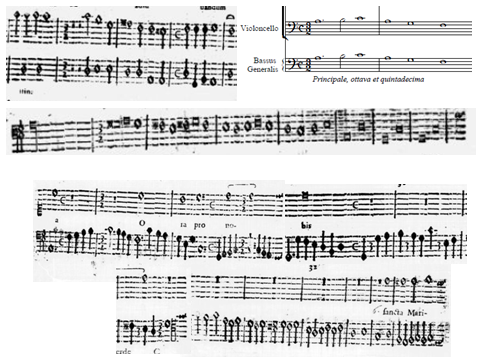
The Bassus Generalis partbook has a short score, since the entire performance would be guided by the continuo (as Agazzari tells us in 1607). But otherwise, no original score exists, only the individual partbooks. And there are significant differences between the Bassus Generalis and the other partbooks.

Deus in adjutorium meum

On 1st June 2014, the Cathedral of St Peter & Paul, Moscow, was filled to capacity for a landmark concert, the first-ever performance in Russia of the Monteverdi Vespers, which I had the honour to direct. Amongst many musicians and early music fans in the audience, distinguished guests included prominent Russian opera directors & international conductors, leading arts journalists, representatives of several Christian confessions, even the great-grandson of Giuseppe Verdi.  The concert was the flagship event of the festival La Renaissance (artistic director Ivan Velikanov), produced by the Moscow Conservatoire and supported by the French Cultural Institute. The performance was recorded and broadcast by Russia’s largest classical music station, Radio Orphee.

Vocal and instrumental soloists were brought together from Moscow, St Petersburg, Ukraine, Lithuania, Colombia, France, Germany and UK. Many of the team have worked together with me in previous baroque projects in Russia, including the first baroque opera –  Cavalieri’s Anima e Corpo (1600), soon to begin its fourth season in repertoire at the Natalya Satz Theatre Moscow in Georgy Isaakian’s Golden Mask-winning staging; the first staged production in modern times of Stefano Landi’s La Morte d’Orfeo (1619)  – with the International Baroque Opera Studio and Il Corago at the St Petersburg Philharmonia last December; and the compilation I made of Shakespeare’s Musicke at Festival La Renaissance 2013.

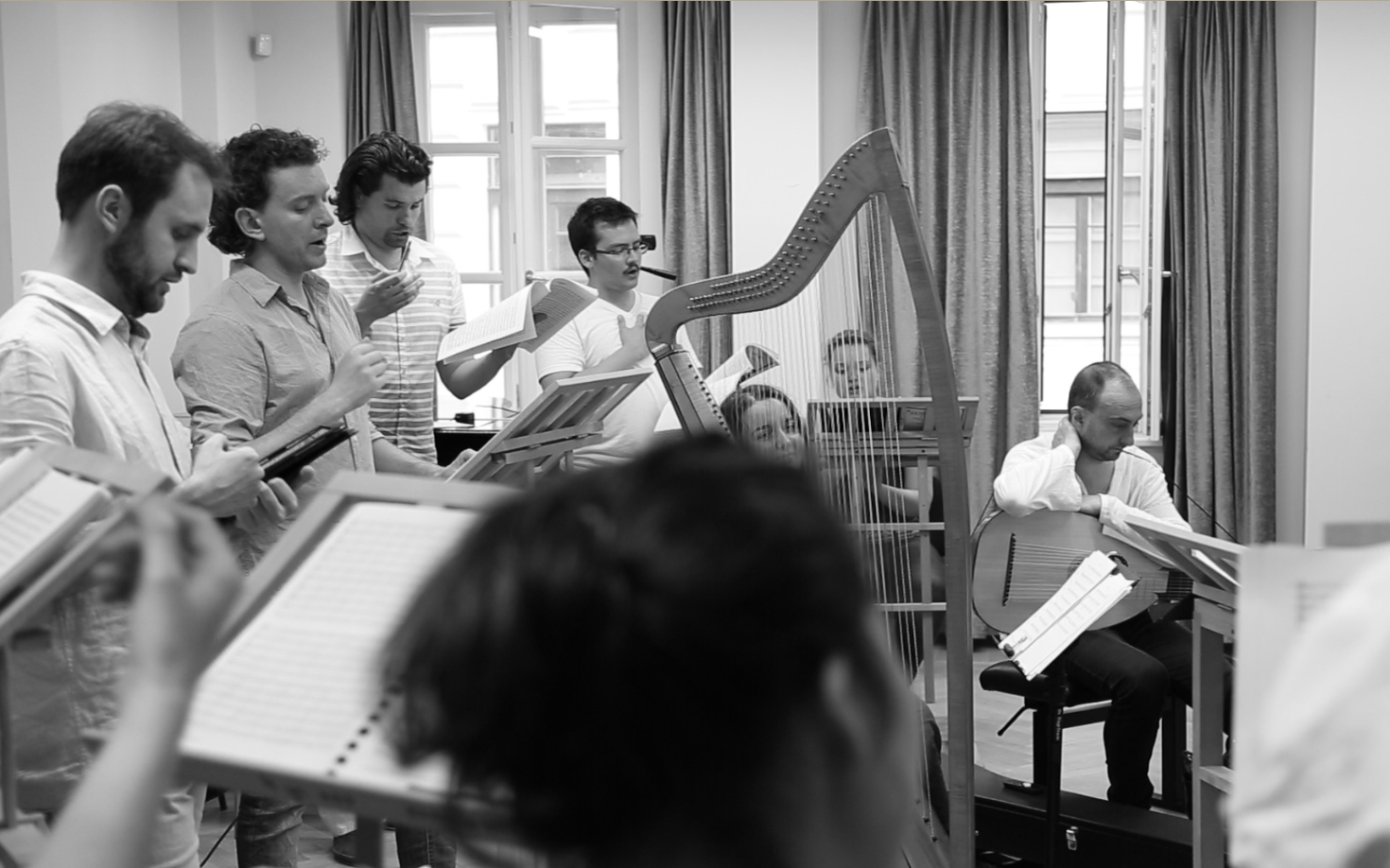
Rehearsal

Even though there are many fine modern performing editions available, I made a new edition for this project. The new edition re-examines some questions, but does not make too many startling new choices. Rather, it presents all the information- including the variants in the Bassus Generalis book – at a glance, so that performers can make their own choices. Continuo players had (my transcription of) the original Bassus Generalis partbook to play from. At first they found this disconcerting, since it is not a complete score, but we gradually discovered the benefits of not having a full score. The original notation encourages continuo-players to play simply, structurally, and to lead in steady rhythm, rather than trying to follow the singers.

BG part book

Some singers also experimented with singing from facsimile of the original partbooks – they are clearly printed, and have very few mistakes, apart from the usual miscounting of rests. (That is to say, the original printers miscounted the rests, not our singers!).  

Solemn Vespers

The Moscow concert reflected state-of-the-art Historically Informed Performance practice.  Solo voices (rather than a large choir) offered the listeners direct, personal communication of the text, whilst still creating impressively sonorous tuttis in the clear but generous acoustic of the Cathedral (a large building, but on the scale of St Barbara, Mantua rather than the enormous spaces of St Marks Venice or St Peter’s Rome). The chiavetti notation of the final Psalm and Magnificat was respected, so that these movements were transposed downwards to the standard renaissance vocal line-up, with high tenors (not falsettists) on the Altus parts. Cornetts, sackbuts and strings played only where called for by Monteverdi, creating dramatic contrasts by their appearances, and a more intimate atmosphere when they were silent. As the original part-books require, the famous Echos were sung and played from the same positions as the principal solos, with echo-performers turning away from the listeners to allow the acoustic to create a natural echo effect (rather than trekking off to some remote location).

And of course, we used quarter-comma meantone: there was certainly no thought of introducing the anachronism of the modern early music scene’s “one size fits all” Vallotti temperament (from the year 1779).


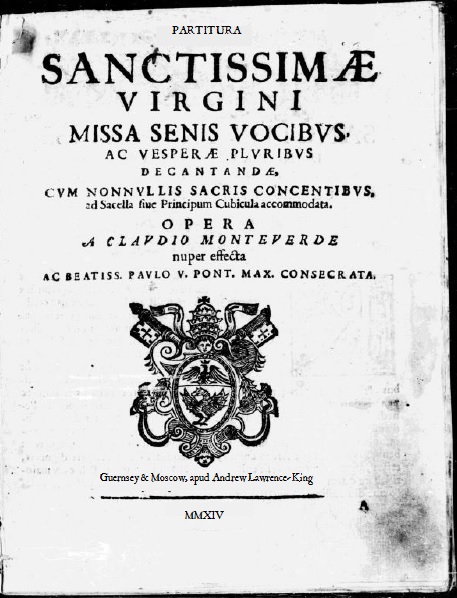
ALK title page Score


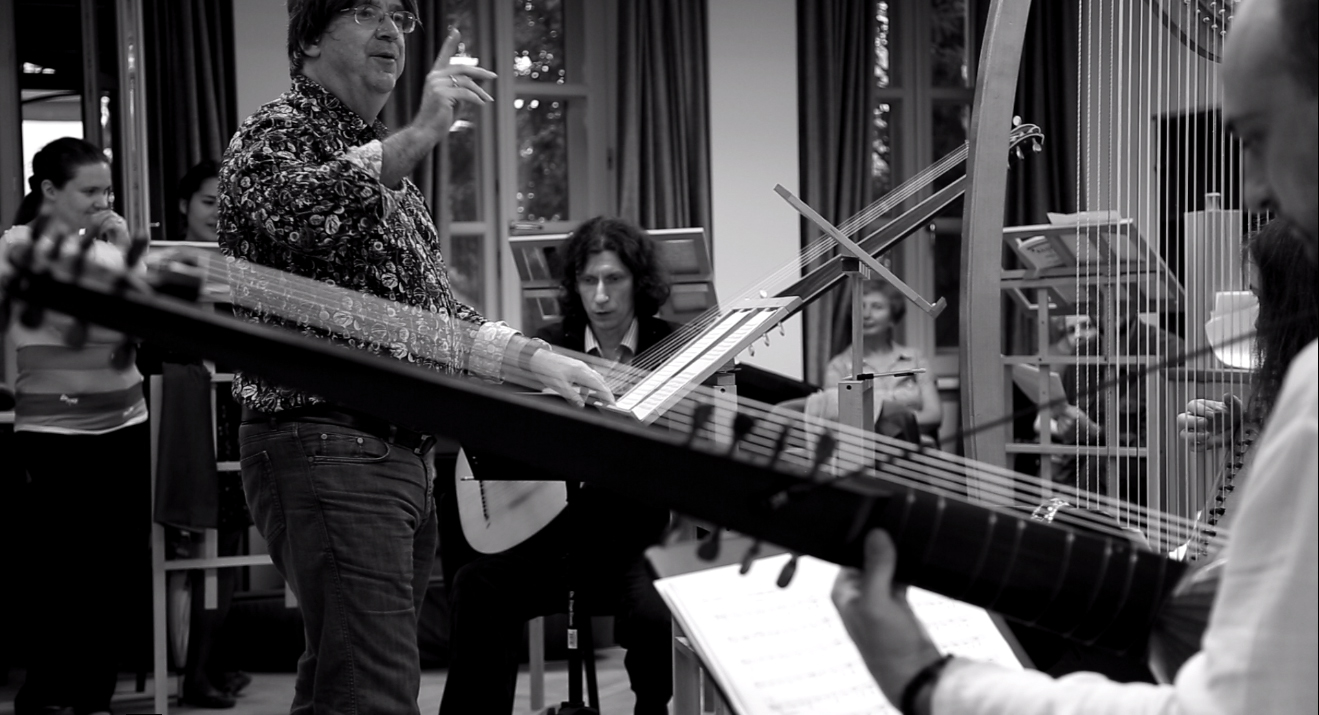
Most significant, and immediately visible to the audience, was the absence of a conductor. The entire performance was guided (just as period sources describe) by the instrumentalists of the continuo section (organ, regal, theorbos and harps), with each singer taking individual responsibility for maintaining the steady beat of the baroque “Tactus”.

Continuo

It is well known that music was not conducted in this period, but nevertheless even specialist Early Music ensembles often introduce the gross anachronism of a modern conductor.

No conducting


The project also benefitted from the latest research findings of my Text, Rhythm, Action!investigations for the Performance program of the Australian Research Council’s Centre for the History of Emotions. In Monteverdi’s Rhythm, the steady beat of the Tactus represents the perfect clock of the cosmos, the Music of the heavenly Spheres. Just a couple of decades after Galileo’s discovery of the pendulum effect, seicento music itself is still the most precise clock available on earth, with duple and triple metres alternating in regular Proportions. The Tactus is a rhythmic heartbeat, maintained throughout the whole work (except for certain movements where Monteverdi specifically indicates a more relaxed speed). With no anachronistic conductor, there are also no arbitrary changes of tempo. As a result, the composer’s notated contrasts of activity are more effective. (See Rhythm: What Really Counts here and also The Times they are a-changin’ here )

Galileo Pendulum

Proportions

All this ancient philosophy was put to practical use in rehearsals, with a lot of time spent working on Text and Rhythm. With no conductor at the front, all the singers took on the role of “conductor”, beating time in seventeenth-century style, with a slow, constant down-up movement of the hand, like a pendulum moving for one second in each direction. When the music changes into triple metre, the fast Proportion of Tripla is counted down-two-three, up-two-three. But the Proportion of Sesquialtera counts a slow three against the two movements, down-up, of the hand. This slow Proportion is less familiar to today’s baroque musicians, but it occurs much more often in the Vespers than in secular works.

Hand Tactus in rehearsal

In another rehearsal exercise, we asked the singers to use their hands to show the accented syllable of each Latin word, the so-called Good syllable. Sometimes these word-accents coincide with the Tactus, sometimes they are syncopated against it. This exercise helped bring out the lively rhythms and syncopations of Monteverdi’s writing. Using the hand to show the Tactus kept the ensemble together and made the music safe: showing the Good syllables emphasised contrasts and made the music interesting.

Tactus and word-accent

In a development of the Good syllable exercise, we varied the hand-movement to make it long and sustained or quicker, depending on the length of the Good note. This helps to bring out the contrasts in Monteverdi’s notated note-lengths, and the long, sustained accents create a thrilling, emotionally committed sound, especially when one particular voice has long accents where others do not.

Hand Accents in rehearsal

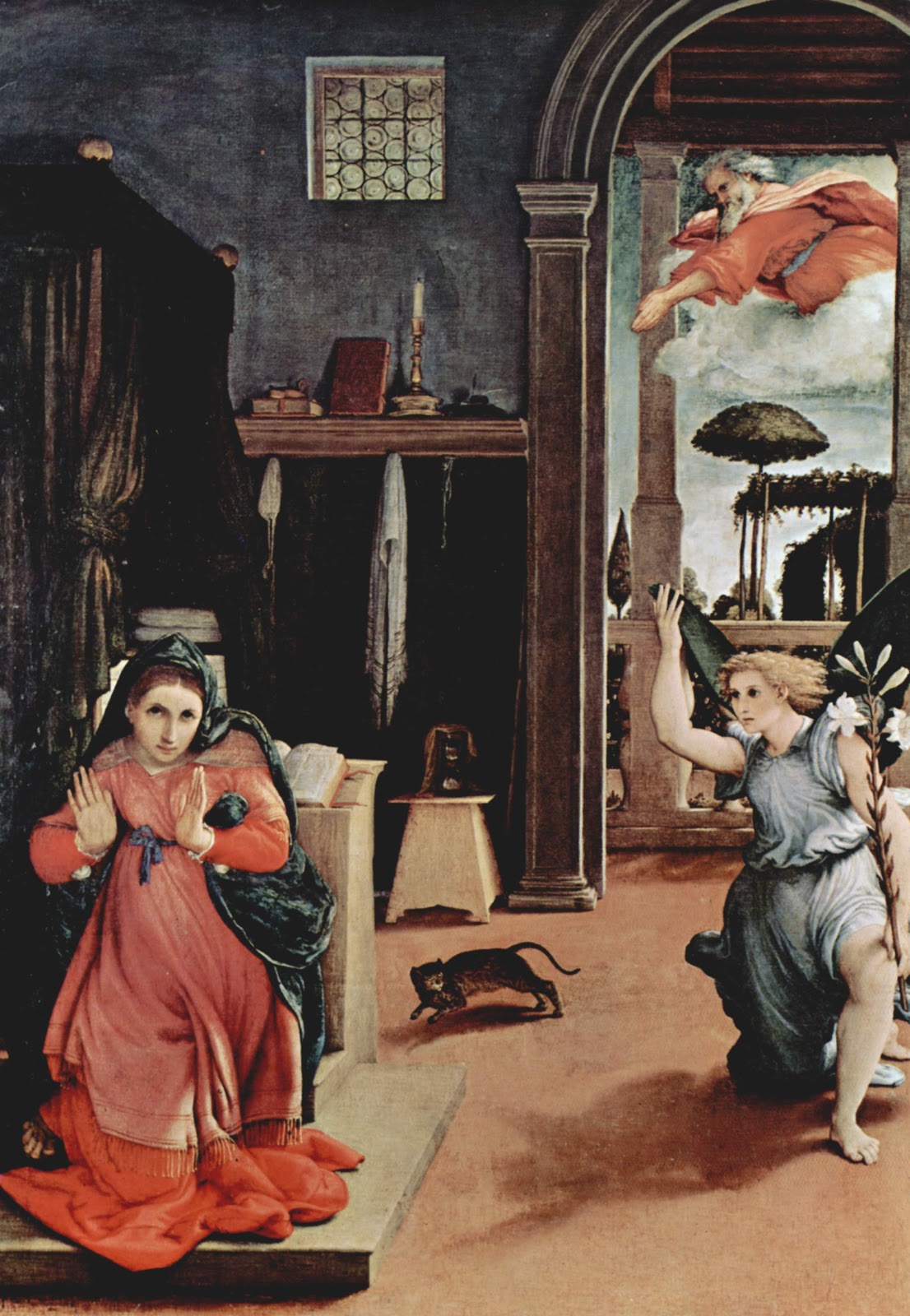
But the highest priority in early baroque music is the Text. As a madrigalist and opera composer, Monteverdi responds passionately to the poetic imagery and dramatic Action of the Vespers texts. His music for the Magnificat verse Quia respexit sets the Annunciation scene with high wind instruments (played ‘with as much force as possible’) representing the Spirit of God. Pairs of quiet instruments suggest the dialogue between the Angel Gabriel (sackbut) and Mary (flute), before the whole ensemble plays again for omnes generationes: ‘all generations shall call me blessed’.

Annunciation

In rehearsal, we discussed in detail the meaning of each verse, and what significance the texts would have for seventeenth-century listeners. Although this was not a theatre project, we did explore in rehearsal the baroque gestures that would be used for similar words on stage, as a way to experience the emotional force of particular words. Even in performance, hand gestures were used, but with appropriate decorum, suited to liturgical music in the sacred space of the church. But the most useful rehearsal exercise was to combine a hand-gesture on the Good syllable (this optimises the sound of the text) with simultaneous concentration on the meaning of that particular word (this synchronises the emotions of the text).

ALK in rehearsal


Rehearsing the text in this way revealed to us how Monteverdi cast particular voices in certain roles, just as one would find in a baroque opera. A duet for two tenors is a favourite seicento device, and obviously suits a text about two angels, Duo Seraphim. When the second part of the text begins Tres sunt (there are three), the appearance of a third tenor transforms the musical texture into something rich and strange, appropriate not only to the simple number three, but even to the divine mystery of the Trinity which the text continues to expound.

In the Psalm, Laudate Pueri, a tenor duet at the words excelsus super omnes gentes is again a conventional choice. But here the plainchant cantus firmus is given, rather unusually, to high soprano, vividly illustrating the text “in the highest heaven, above all the people”. In that same Psalm, a bass duet is a most unusual choice – there are very few duets for basses in the entire repertoire. But here, and again in the Magnificat, this combination (deep sounds, and the super-human effect of two powerful voices at once) represents God himself: Quis sicut Dominus Deus noster? (Who is like the Lord our God?) and sanctum nomen eius (Holy is his name).

Barocci_Annunciation

In the verse et de stercore erigens pauperem , low voices paint the picture of the mire out of which God (slow triple metre) lifts up (a rising sequence) the poor man (a solo tenor). Just as in some of his polyphonic madrigals, here Monteverdi seems to cast the solo tenor as if personifying the protagonist’s role. So this singer is featured again,reciting on a single note (is this plainchant or operatic recitative?) amidst the eight-voice tutti at the words ut collocet eum cum principibus populi sui – placing him amidst the princes of God’s people. It is surely the deliberate touch of an opera composer to cast this tenor as the poor man, so that the audience – or liturgically, the congregation – sees this same man literally placed amongst the princes as he sings his solo amidst the choir, clergy, cardinals (princes of the church) and other nobility in the courtly chapel or chamber.

Giuseppe Castiglione


Just as earthly music was considered to be an imitation of the perfect, heavenly Music of the Spheres, so actual dancing was an earthly imitation of the divine dance of the stars in their orbits. This explains why there are so many slow, Sesquialtera Proportions in the Vespers, whereas Monteverdi’s opera Orfeo more often has fast Tripla. Of course, the slower movement of Sesquilatera sounds better in a church acoustic, whereas fast Tripla sounds good in a less resonant theatre. But more significantly, the sacred spheres were thought to rotate more slowly than the sublunary sphere of the earth, so a slow triple Proportion was the ideal musical emblem for the divine Trinity.

Harmony of the Spheres Fludd

Fast, we might even say ‘secular’, Tripla dance-rhythms in the Vespers paint texts that call for divine assistance down here, on earth: Domine ad adjuvandum me festina (O Lord, make haste to help us) and Sancta Maria, ora pro nobis (Holy Mary, pray for us). And another Tripla depicts the speed of arrows in the hand of a giant sicut sagittae in manu potentis.

Archery

It is this passion for visual detail, even in a musical setting, that – according to renaissance philosophy and period medical science – conveys the emotions from the text to the listeners, in order to move their passions, muovere gli affetti. This intense, emotional visualisation by composers, performers and audiences is the focus of one of my current research strands: Enargeia: Visions in Performance.

Enargeia

During the project, we explored in great detail questions of Proportions and Frescobaldi’s advice for Driving the Time – guidare il tempo. These discussions helped shaped the arguments in a later blog post on the Frescobaldi Rules here, and I’ll return to the subject in future postings.

For the coming season, further Early Music productions are planned in Moscow, St Petersburg and around the country: the first Russian performance of the earliest Spanish opera, Calderón and Hidalgo’s Celos aun del aire matan (1660); the production team Il Corago with the medieval Ludus Danielis; and another historical production from the International Baroque Opera Studio.

Please join me on Facebook https://www.facebook.com/andrew.lawrenceking.9 and visit our website www.TheHarpConsort.com .

Opera, orchestra, vocal & ensemble director and early harpist, Andrew Lawrence-King is director of The Harp Consort and of Il Corago. From 2011-2015 he was Senior Visiting Research Fellow at the Australian Research Council Centre for the History of Emotions.


Sparrow-flavoured Soup – or What is Continuo?

Image

There are many possible routes towards an understanding of basso continuo. As an academic discipline, it’s often associated with the study of musical grammar, harmony and voice-leading: ‘Harmonise this chorale melody in the style of Johann Sebastian Bach’.

Some performers might – like me – have begun their study with the printed realisations in modern editions: thinning out rich, mid-20th-century piano parts; enriching minimalist sketches; adding some improvisatory touches and trying to filter out what is stylistically inappropriate.

Often the harpsichord is assumed to be the epitome of historical style, and the combination of cello and harpsichord to be the ideal mix of melodic bass and chordal harmony, perhaps with a double-bass to add gravity.

There is a strong modern tendency to think in terms of an ideal realisation, with the ‘correct’ harmonies. In this view, a perfect (in every way!) cadence should be figured 53 64 54 73 over the dominant – other options are seen as variants of this ‘standard’ harmonisation.

But a moment’s reflection will suggest that over some two centuries of the basso continuo age, the ideal of a ‘perfect’ realisation must have changed. Like any other aspect of performance practice, the aesthetics of Continuo must differ according to period and national style. C.P.E. Bach’s admirably detailed instructions do not apply to Peri, Johann Sebastian’s wonderful harmonies are no guide to Caccini, Rameau’s  aesthetic is not the same as Monteverdi’s.

And in Continuo studies as in any historical investigation, we must beware of teleology, of the dangers of ‘looking backwards into the past’. It is all too easy to approach the beginnings of Continuo via Bach, and to view both Bach and Monteverdi through the distorting lens of modern assumptions (whether in ‘common practice’ or ‘early music’).

So I suggest that it’s well worthwhile to start at the very beginning, and consider the earliest sources for Continuo. Those first treatises should be our guide for the early 17th century, and they should also be our starting point from which to follow a chronological path towards Corelli, Lully, Bach and beyond.

One of the most interesting early sources is Agostino’s Agazzari’s 1607 Del Sonare sopra’l basso con tutti li stromenti e dell’ uso loro nel Conserto (About playing from the basso part with all instruments, and about their use in ensemble). See my posting What is Music here for links to a facsimile, translations and commentaries.

The reference to uso shows that Agazzari’s intent is thoroughly practical. His treatise is not lost in the clouds of metaphysical speculation (Science), nor concerned about theoretical principles governing the Art of Music. And he doesn’t waste time expounding lots of rules for playing from unfigured bass, since composers often create surprising harmonies as they imitate the passions of particular words. Agazzari prefers to write in the figures as necessary, though he emphasises that all cadences, intermediate or final, end on a major chord. His focus is consistently on the practicalities of playing from a new notation (the basso, whether figured or not, now regarded as the best guide to the structure of the whole piece, rather than a score or intabulation).

Agazzari discusses in detail what each kind of instrument should do, and categorises his material in various different ways. He distinguishes between wind and string instruments.  Other than the organ, winds are excluded from delicate ensembles because they do not blend, though the trombone can serve as a low bass when only a small (4-foot) organ is available. Other wind instruments might be acceptable, if played expertly and dolce.

Amongst string instruments, he mentions those which are capable of perfetta armonia di parti (perfect structure of counterpoint – the word armonia means well-structured organisation, not just ‘harmony’): Organ, gravicembalo (large harpsichord with low basses), Lute and arpa doppia etc.

Other instruments can play harmonies (in the modern sense), but not fully correct counterpoint (not all the armonia, in the period sense): cittern, lirone, guitar. A third group of instruments offers fewer chordal (let alone contrapuntal) possibilities: Viola da gamba, violin, pandora etc.

Players are expected to have three separate but complementary skill-sets: a knowledge of armonia (counterpoint, rhythm and proportions, all the clefs, dissonance and resolution, when to play major/minor thirds or sixths etc); total familiarity with their instrument and with playing from score or intabulation; excellent aural skills and awareness of the movement of individual polyphonic voices.

Agazzari champions the practice of playing from the basso as useful in three ways: for the new style of singing dramatic music, lo stile moderno di cantar recitativo; as easier than reading, especially sight-reading, from a score or intabulation; and as a very concise and compact notational system.

But the most significant binary distinction he makes , one that he repeats several times within this short treatise, is to categorise what is played ‘on the basso’ as either Structure – fondamento ( a word that occurs 9 times) – or Decoration – ornamento (4 times). Meanwhile, we should note that the word continuo does not occur anywhere in this document.

Agazzari frames his entire discussion in these terms – Structure versus Decoration – introducing these two ordini (categories) at the very beginning of his argument. We should therefore be very careful to link each piece of advice to the relevant category. We should think too about how the various bi- and tri-partite categorisations mentioned above intersect with those most significant ordini of Structure and Decoration. And how does the concept of Continuo fit with all this?

Simply to pose this question points us towards the answer. The essential function of Continuo is fondamento: Structure (organ, harpsichord, theorbo, harp).

Meanwhile, the function of Decoration, ornamento, is condire – to spice up the ensemble with delicious tone-colours (lirone, cittern, guitar etc) or clever division-playing, scherzando e contrapontegiando (having fun and playing counterpoint, on lute, violin etc). Agazzari includes division-playing here for highly practical reasons: divisions can now be improvised whilst reading from the basso part, rather than from a score or intabulation.

Looking backwards into the past, we might be tempted to conflate these two functions, to imagine that Agazzari was writing about ‘two ways to play Continuo’. But his book is not called ‘How to play Continuo’, it’s ‘about playing from the basso’.

Moving chronologically forwards with Agazzari from the late 16th into the early 17th century, we can see that he is linking the uso moderno, a new use of notation (playing now from a basso, rather than a score or intabulation) to two distinct practices: structural accompaniment and fun decoration – scherzi. And he is very careful to keep the two practices distinct.

The structural foundation – Agazzari’s fondamento -is what we now call Continuo (organ, harpsichord, theorbo, harp).

Some instruments with interesting tone-colours (lirone, cittern, guitar etc) can play a chordal accompaniment (which we might well today call Continuo), but Agazzari does not class these as fondamento because they cannot play the actual basso. Nevertheless, we have clear evidence from other sources that such instruments were sometimes used as the sole accompaniment.

Otherwise, Decoration – ornamento – consists of division-playing. This ‘spice’ should of course be flavoursome and tasteful. And advanced division-playing even includes the invention of additional counterpoint. But it’s not Continuo.

Image

As Bernhard Lang (2003) comments here, Agazzari’s advice on ornamento-playing can be seen in the context of earlier division manuals by Ganassi (1535), Ortiz (1553) and dalla Casa (1584). Agazzari’s contribution is to compare the different division-playing styles of particular instruments, inviting them all, even violinists, to improvise whilst reading from the basso part.

The other job, Continuo-playing, is described in the other part of Del Sonare sopra’l basso, in the paragraphs referring to Structure, fondamento. As Agazzari reminds us, we should not confuse the two roles –

hanno diverso ufficio, e diversamente s’adoperano (they have different jobs, and are managed differently).

But all too often today, we hear Continuo-bands playing divisions, playing divisions simultaneously (but not quite together!) on several instruments, and playing divisions on fondamento instruments. We even hear Continuo competing with the singers or solo instruments in the treble register – precisely the zuppa e confusione, cosa dispiacevole (soup and confusion, a displeasing thing) that Agazzari warns against!

Even in division-playing, whenever several instruments play together, Agazzari tells us that they should take turns to add ornamento, one at a time. They should not compete ‘like sparrows, all at the same time: and let’s see who can shout the loudest’!

Lang also comments on the seicento trend for the fondamento to be less contrapuntal, more chordal, assembled vertically over the basso. And Agazzari leaves us in no doubt that in general, too much polyphonic complexity, too much concentration on contrapuntal imitation, is contrary to the new aesthetic:

By the rules of counterpoint these might be good compositions, but nevertheless by the rules of good and true Music they are vitiose –  vicious, faulty, sinful, defective, imperfect, false, corrupted, blemished, full of vice, unsound, crazy, and worm-eaten (according to Florio’s 1611 dictionary).

And that comes from not understanding the purpose and the job, from forever wanting merely to observe counterpoint and imitations of notes, rather than of the affetto (passion) and semblance of the words.

So with that stern warning and the condemnation of sparrow-flavoured soup ringing in your ears, I invite you to compare Agazzari’s point by point instructions for fondamento with what you hear, listening to Continuo in concerts and recordings today. Continuo-players, keyboardists especially, might like to compare Agazzari’s recipes with their own playing in early seicento repertoire.

  • The Continuo are those which guide and support the whole body of voices and instruments in the ensemble.
  • They are Organ, gravicembalo etc (and for smaller ensembles) Lute, Theorbo, Harp etc

The job of ‘guiding’ or ‘directing’ – guidare – reminds us of the crucial importance of rhythmic Structure. Rhythm is a significant element of 17th-century armonia, and Caccini makes it a priority, along with the Text.

Agazzari links ‘support’ to grave resonance and low-octave basses (see below).

  • When playing Continuo, you have to play very judiciously, watching out for the entire ensemble…
  • Playing the piece as straight and accurately as possible, not making passages or divisions, but helping with some low-octave bass notes, and avoiding the high register.

Many of the earliest figured-basses show exactly where the harmonies change over a sustained bass, by writing the rhythms of the harmony changes into the basso itself. (The repeated bass notes are then tied together, to show that they are not re-struck). Such precise notation, combined with Agazzari’s instruction not to ‘break’ a bass-note and with the growing seicento tendency to think vertically over the bass (rather than horizontally in counterpoint), suggests that Continuo-players should as far as possible avoid in their realisation any activity (especially harmony changes) that is faster-moving than the basso itself.

So if the basso moves in minims, say, your realisation should also move in minims, not in crotchets and quavers. In general, we expect the entire fondamento to reflect the rhythms of the basso, and typically to be less active than the composed contrapuntal parts.

  • Don’t double the soprano, don’t play divisions and ornaments in the high register…
  • But it’s good to play with great restraint (or perhaps, very compactly), and grave (low, weighty, serious: Florio  gives ‘grave, solemn, important).

Grave is also used to characterise the violone, which plays ‘as much as possible on the thick strings, often with low-octave basses’. The re-entrant tuning of the theorbo and the triple-stringing of Italian baroque harp allow compact chords, with a lot of supportive resonance all packed into the grave register: both instruments have low-octave basses, as does the gravicembalo (literally, grave-harpsichord).

Note Agazzari’s emphasis that the fondamento should play ‘very judiciously’, ‘with great restraint’. No chirping sparrows!

  • The Continuo holds the tenor – the underlying harmonic/rhythmic sequence, for example a ground bass (see Ortiz) and the armonia –the complete structure, both harmony and rhythm – ferma – firm, steady, fixed, sure (Florio).

In large ensembles, certain instruments have well-defined roles. When, for example, harpsichord and theorbo play together, it is the theorbo that should make some divisions (on the bass strings), whilst the harpsichord provides a fondamento grave. Agazzari’s advice is confirmed by the allocation of particular instruments to alternative bass-lines in scores by Landi, Veracini etc. The more complex basso is for lute, theorbo, or harp: the simplified part is the fondamento for harpsichord.

The role of the keyboard, whether organ or gravicembalo is entirely Structural. (Small spinetti might provide Decoration). Today, this custom is more honoured in the breach than in the observance !

Nowadays a lot of zuppa e confusione is created by inappropriately applying to Continuo-playing Agazzari’s suggestions for ornamento, whilst ignoring his warnings against chirping like competing sparrows. But his advice on fondamento is repeated in many other period sources, especially for musica recitativa, where it’s generally agreed the accompanist should play grave and not add ornaments.

Image

The frontispiece to Del sonare sopra’l basso illustrates tutti li stromenti, with the organ, Agazzari’s own instrument, enthroned above. In the Academy of the Intronati, Agazzari’s nickname was L’Armonico intronato (well-structured musical organisation, enthroned). Below two shields show the heavenly orbits, with the caption ex motu armonia (cosmic movement produces armonia) and what might be the infernal pit, with the caption nec tamen inficiunt (and, however, they don’t create chaos – literally ‘un-make’). 

So I give Agostino the last word:

 Just take this as it is, and forgive me for the lack of time to write more.

Please join me on Facebook https://www.facebook.com/andrew.lawrenceking.9 and visit our website www.TheHarpConsort.com . Further details of original sources are on the website, click on “New Priorities in Historically Informed Performance”

Opera, orchestra, vocal & ensemble director and early harpist, Andrew Lawrence-King is director of The Harp Consort and of Il Corago, and Senior Visiting Research Fellow at the Australian Research Council Centre for the History of Emotions.
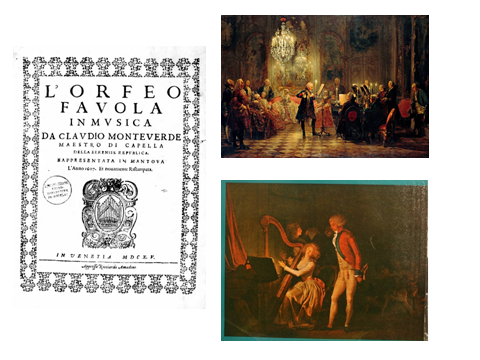
www.historyofemotions.org.au