The First Opera & The Beginning of Baroque

This is a slide-show introduction, based on lecture given to celebrate the 50th anniversary of Theatre Natalya Satz, Moscow (the original home of Peter and the Wolf), following the 45th performance of the theatre’s award-winning production of Anima & Corpo. Nevertheless, this post draws on the latest research findings, and there may be some surprises, even for seasoned baroque fans!


Emilio de Cavalieri's 'Rappresentatione di Anima e di Corpo' (1600) is indeed the 'first opera'. Jacopo Peri, whose 'Euridice' was performed later the same year, acknowledges Cavalieri's role as originator of the style. (Earlier music-dramas by these two composers, notably Peri's 'Dafne', have not survived.) So why would Cavalieri and his contemporaries seek to develop a new theatrical genre of fully-sung plays?
Emilio de Cavalieri’s Rappresentatione di Anima e di Corpo (1600) is indeed the ‘first opera’. Jacopo Peri, whose Euridice was performed later the same year, acknowledges Cavalieri’s role as originator of the style. (Earlier music-dramas by these two composers, notably Peri’s Dafne, have not survived.) So why would Cavalieri and his contemporaries seek to develop a new theatrical genre of fully-sung plays?

What are the three secrets of great performance

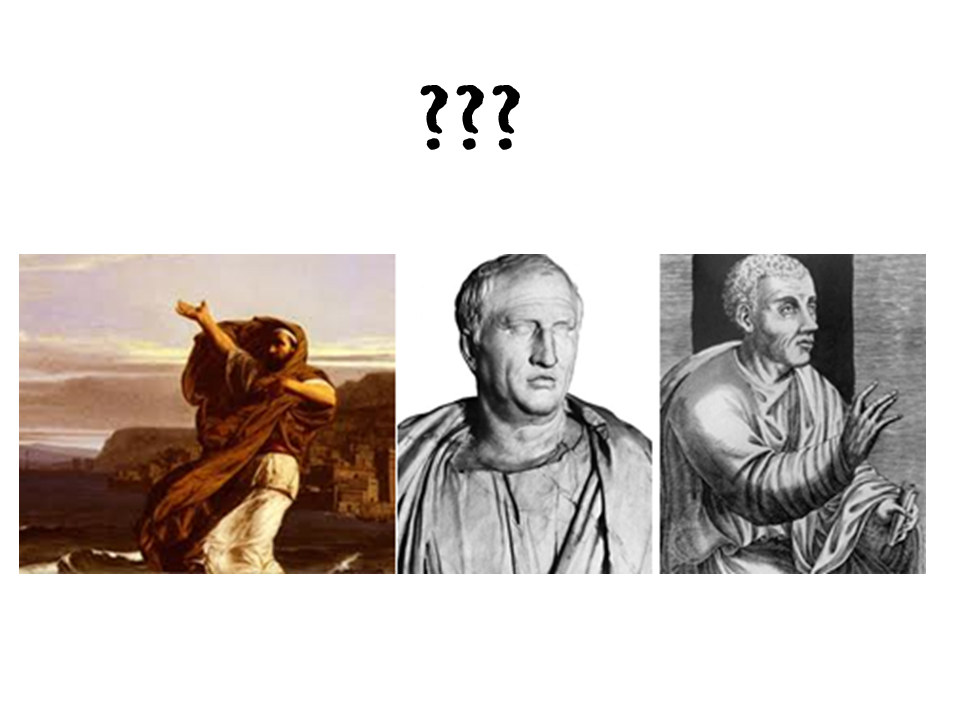
17th-century writers were still re-telling a story going back via Quintilian and Cicero to Demosthenes (4th cent. BC). The question was posed:


What are the three secrets of great performance?
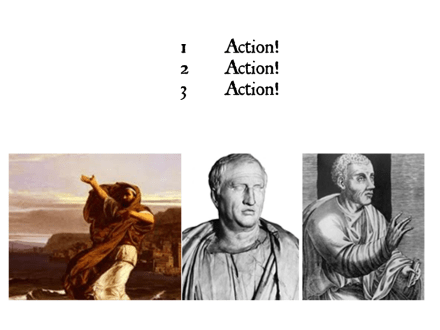
Action Action Action


Demosthenes’ first answer was “Action!”. And his second answer was “Action!”, And his third answer was also “Action”.
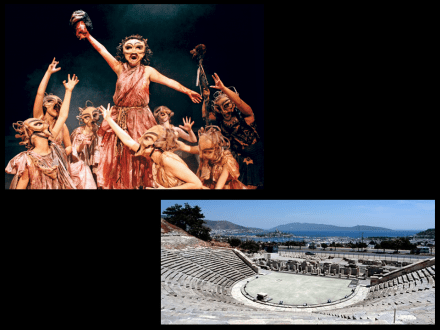
Greek Drama

Meanwhile, in the decades before the year 1600, philosophers of performance were impressed by the emotional power of the ancient Greek and Roman dramas, which (they believed) had been fully sung. So Cavalieri and his colleagues wanted Action in their music, and Music in their dramas: fully-sung music-drama was the epitome of their beliefs in the power of performance.

The modern label 'first opera' encourages us to consider all that came after Cavalieri. But to understand his work, we need to view it in its own historical context. And we should be cautious: even though this is sophisticated, dramatically powerful, fully-sung music-theatre, Cavalieri did not call it 'opera'. It is a 'Rappresentatione', a 'show'. It is not 'primitive', but it certainly is different from our modern expectations.

The modern label ‘first opera’ encourages us to consider all that came after Cavalieri. But to understand his work, we need to view it in its own historical context. And we should be cautious: even though this is sophisticated, dramatically powerful, fully-sung music-theatre, Cavalieri did not call it ‘opera’. It is a Rappresentatione, a ‘show’. It is not ‘primitive’, but it certainly is different from our modern expectations.
Tardis

Not ‘primitive’ but DIFFERENT…

… might well be our motto, as we climb into our time-machine in order to explore Planet Earth, circa 1600.


Architecture and Art

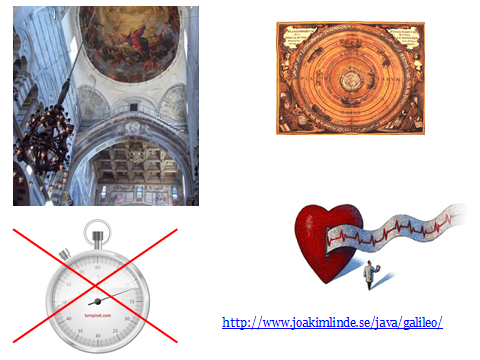
This was an age of impressive architecture: as assistant to Michelangelo, Cavalieri’s father Tommaso was closely involved with the building of St Peter’s Rome. Painting became ever more dramatic, culminating in the chiaroscuro of Caravaggio. Even religious subjects were depicted with theatrical bravura: Tommaso de Cavalieri was the model for Adam in Michelangelo’s frescos for the Sistine Chapel.

Exploration and Science

The exploration of the Americas continued, charted by sophisticated world maps. Galileo trained his telescope on the moons of Jupiter, and also experimented with gravity at the tower of Pisa.
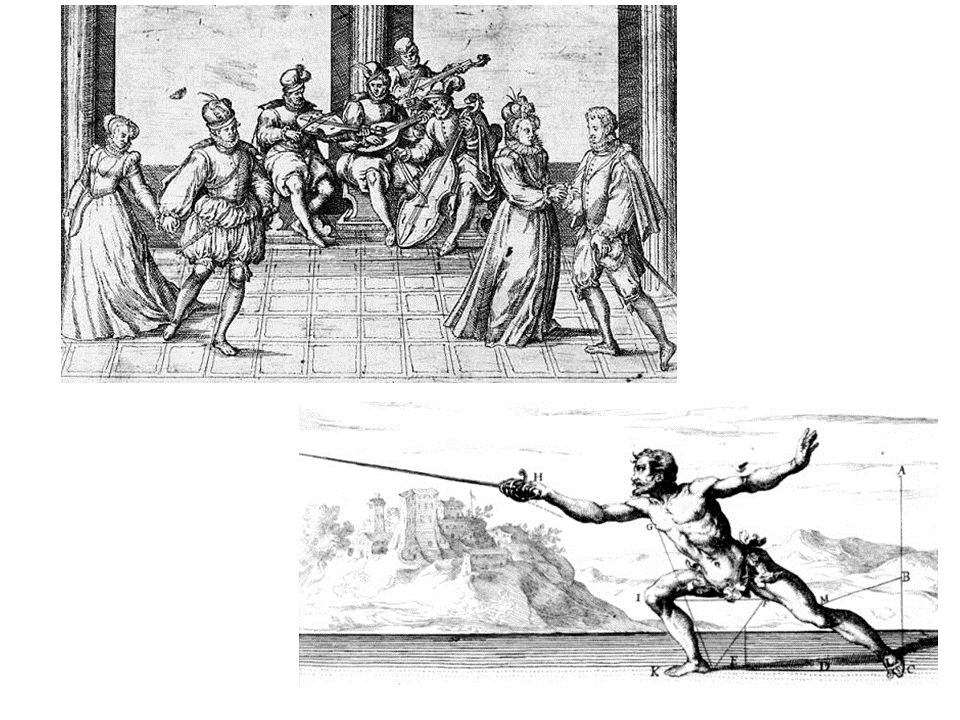
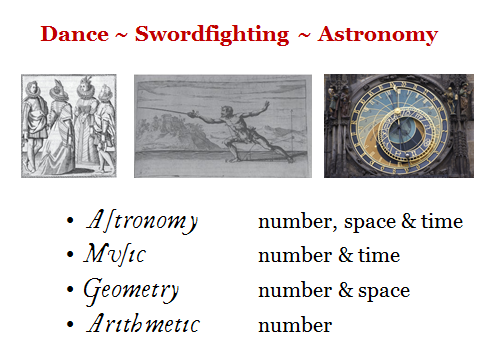
Music Dance Swordsmanship

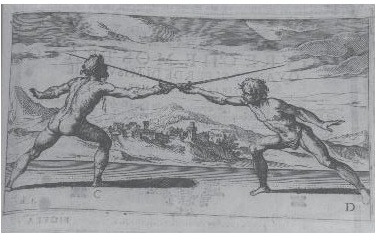
Italian ladies and gentleman at court would spend much of their time making music in madrigal groups or consorts of viols. Several hours each day would be spent learning and performing new social dances. And a couple more hours daily were devoted to practising swordsmanship, with the fashionable rapier, well over 1 metre long, with a needle point and razor-sharp edges.
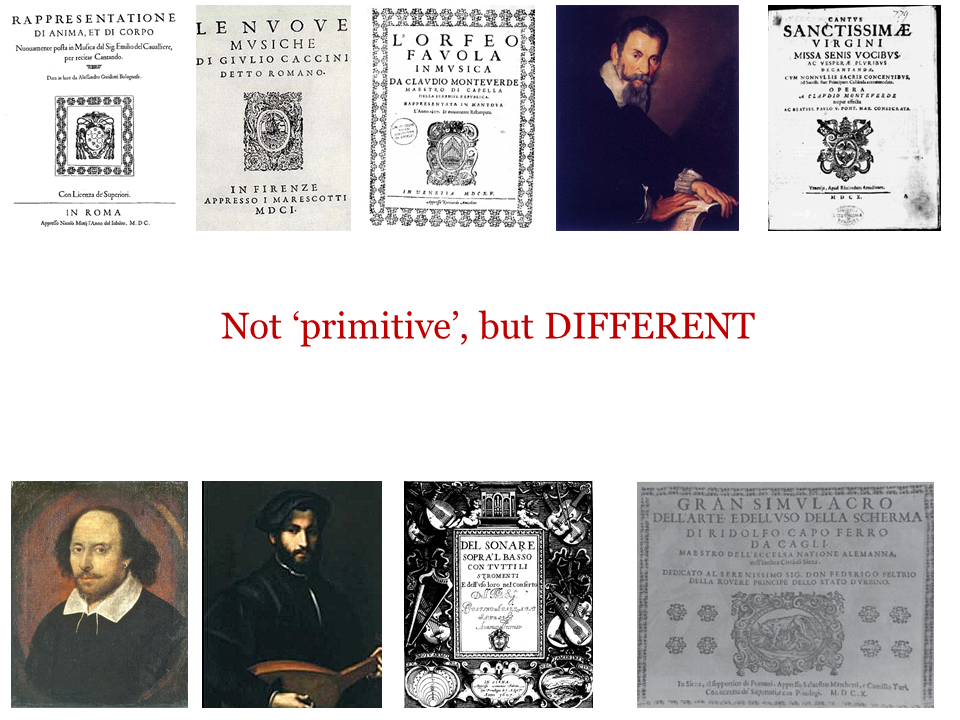
Circa 1600

There was plenty of new music. Cavalieri’s opera was quickly followed by Caccini’s Le nuove musiche (1601/2), the first collection of songs with continuo-bass  accompaniment, which includes the famous Amarilli, mia bella. In 1607, Monteverdi’s ‘story in music’ Orfeo was performed: Aggazzari’s treatise from that year, Del sonare sopra’ l basso explains how many different kinds of instrument could improvise accompaniments from the same continuo-bass notation. In 1610, Monteverdi’s magnificent Vespers mixed old-style polyphony with the new techniques of continuo-song; Capo Ferro’s survey of rapier swordsmanship is from the same year. In England, this was the age of Shakespeare’s plays (full of music, of course) and Dowland’s melancholic lute-music.

Dowland

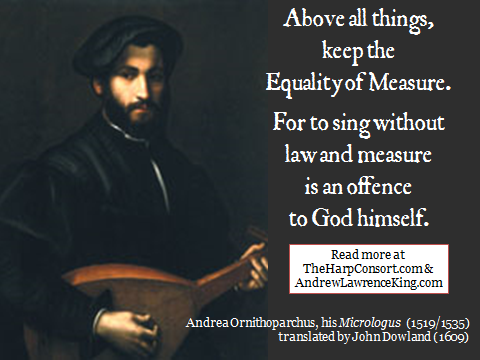
In 1609 Dowland also translated into English an influential book on singing, Ornithoparcus’ Micrologus, in which he emphasises the particular importance of rhythm.


Instruments

Violin family

Violin-family instruments from the late 16th century are still regarded today as the finest ever made. Praetorius’ 1619 diagram shows violin, viola, cello and related instruments, together with a surviving cello by Amati. Nowadays, these wonderful instruments have been altered, by changing the angle of the fingerboard to increase the string tension. But around 1600, violins were held in a relaxed way on the shoulder, were strung more lightly, and were not encumbered by chin-rests, tuning screws and shoulder rests. With its original set-up, the instrument is not as loud as a modern violin, but is more direct and responsive. If a modern violin is like a big, luxurious limousine, then a baroque violin is like a sports-car: lighter, more manoeuvrable, and (I would say), more fun to drive!
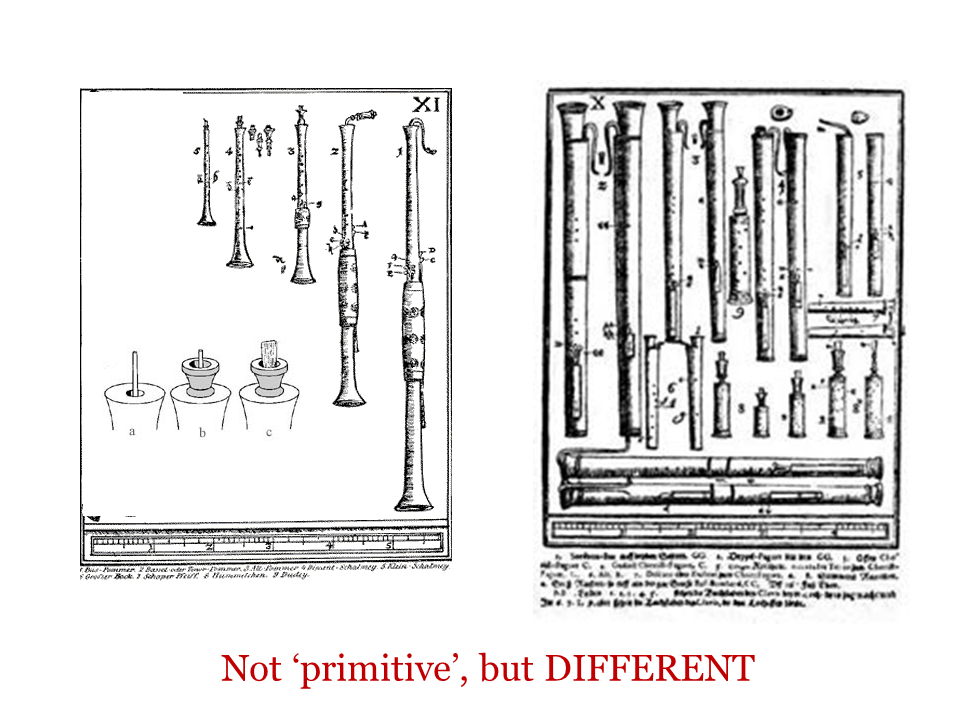
Shawms and Dulcians

The early-17th-century predecessor of the oboe was the Shawm, which was made in various sizes from soprano to bass. The double-reed is surrounded by a wooden ‘pirouette’ to support the player’s lips. The Dulcian is the ancestor of the bassoon, and also came in various sizes from bass to soprano. Whereas nowadays we consider oboes to be the high register and bassoons the low register of a single ‘family’ of instruments, in Cavalieri’s time they were two distinct consorts, each with a complete range from treble to bass.
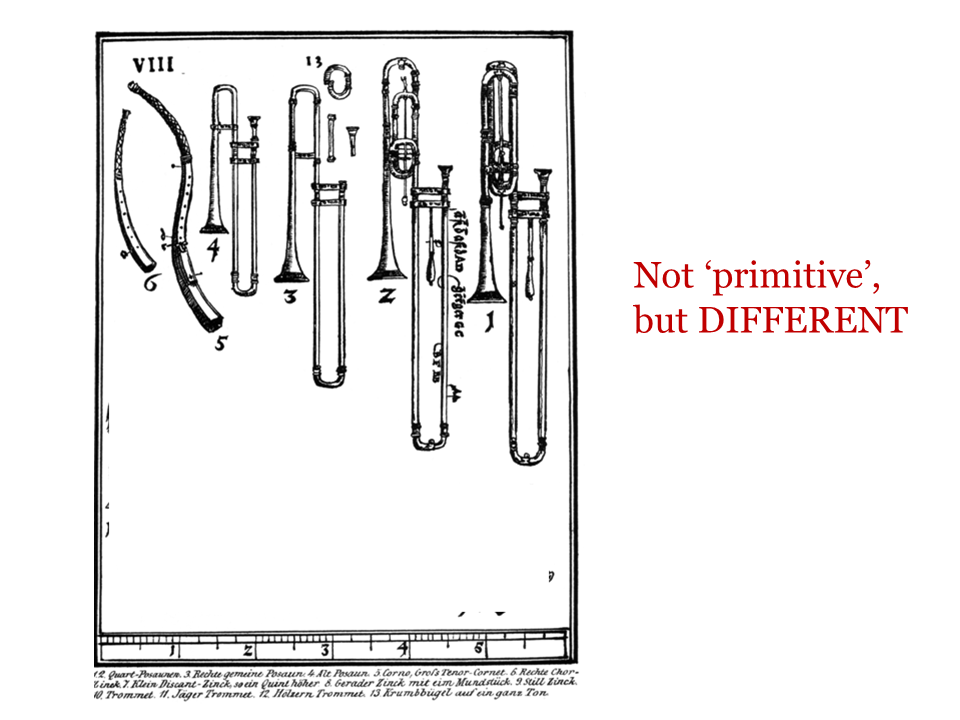
Cornetts and Sackbuts

Baroque trombones, known in English as Sackbuts, have a narrower bore than their modern descendants. Like baroque strings, they are not as loud as modern instruments, but more precise and flexible in their sound. Praetorius shows the trombone family from bass to alto. The upper register of this consort is represented by the Cornetto, made from wood, with leather wrapped around it. It has a wooden mouth-piece similar to a trumpet’s, and finger-holes in the tube similar to a flute. The sound is somewhere in-between a trumpet and a flute, and was considered in this period to be the closest to the sound of the human voice. That gives us a clue to the sound-world of circa-1600 singing: not as loud as modern opera singers, but clear, precise and very flexible.

Trumpets and Drums

Trumpets and drums were originally military instruments, and are still today associated with royalty. Baroque trumpets have no valves; the different pitches, including extreme high notes, are created with sophisticated lip-technique.
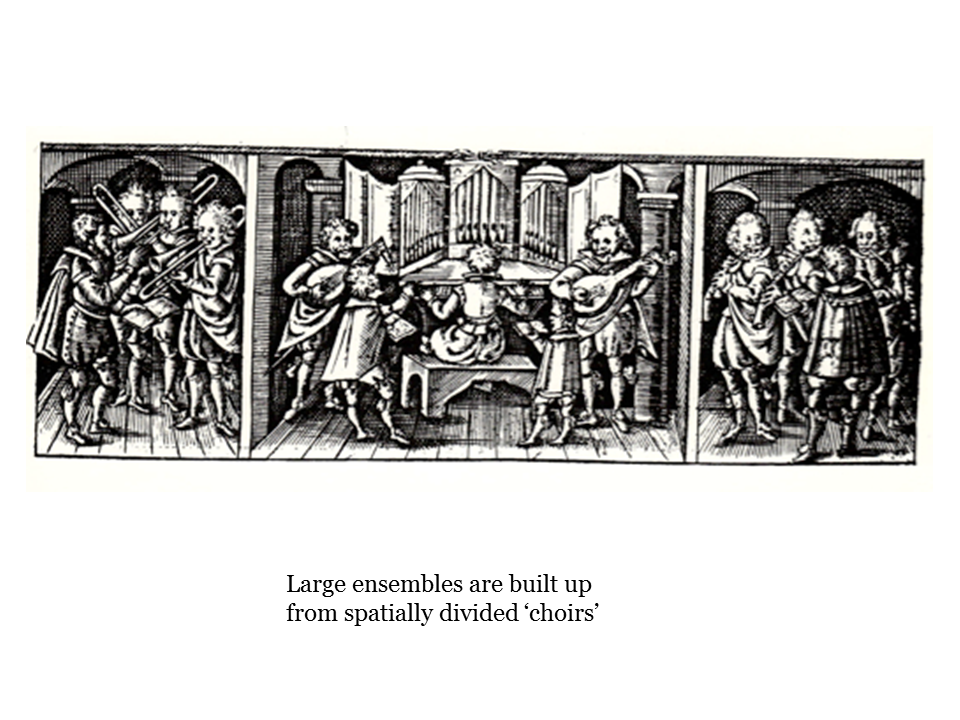
 

Divided Choirs


We can recognise the descendants of these early baroque consorts in the various sections of a modern orchestra. But around 1600, large groups of instruments were not formed into a single ensemble, but were rather distributed around the available space in groups of 4 to 7. Each group was considered to be a ‘choir’, that might mix instruments and voices, or might be homogenous, e.g. contrasting a string ‘choir’ with a wind ‘choir’.


Continuo
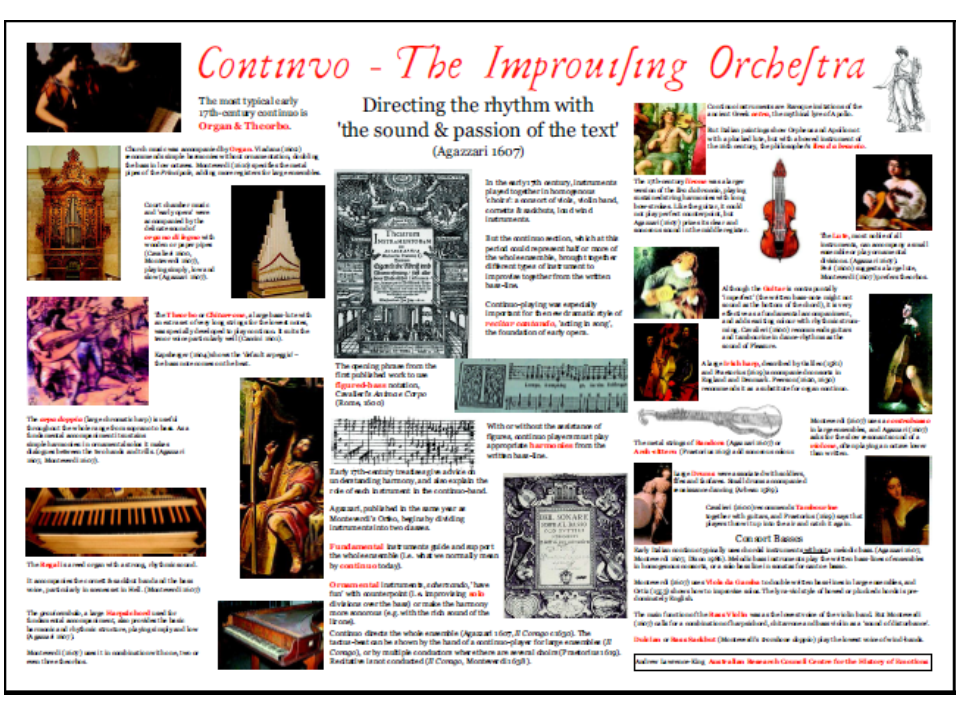
 

Continuo

You can view and download for free a full-size version of this poster here.


The most important instrumental section in the first operas has no equivalent in a modern orchestra. The Continuo section brings together a variety of instruments with the common purpose of providing harmonic support and rhythmic direction, guiding the entire company of instruments and voices. Like the rhythm section of a jazz-band, Continuo-players define the rhythmic structure, respond to the various soloists and add decorative touches of their own. Agazzari’s 1607 treatise Del Sonare sopra’l  basso here explains how each type of instrument contributes to the Continuo.

renaissance organ

The organo di legno, or chamber Organ, has wooden pipes, and plays sustained harmonies in the low register, to support the voices and melodic instruments.

Harpsichord

The Harpsichord has metal strings; when you press a key, a wooden jack rises past the string, so that a small plectrum (shaped from a bird-quill) can pluck the string upwards. As you release the key, the jack descends and a piece of felt is lowered onto the string to stop the sound. The sound is not as loud as a modern piano, but is clear and rhythmically precise. In this style, the Harpsichord also plays simple harmonies in the low register, defining the essential harmonic and rhythmic foundation.
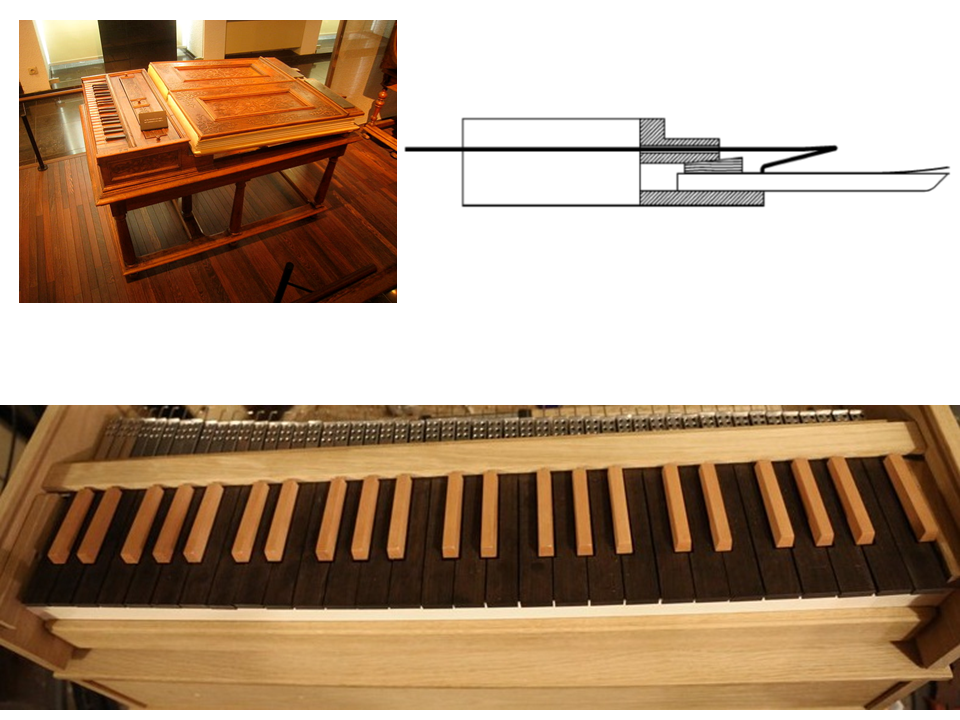
Regal


The Regal, or reed-organ, has metal pipes; when air enters the pipe, a metal tongue vibrates against a metal half-tube, and this vibration is amplified by the metal resonator. The sound is strong and rather nasal. If the wooden Organ suits scenes of heaven, or pastoral idylls on earth, then the Regal is ‘the organ from Hell’!
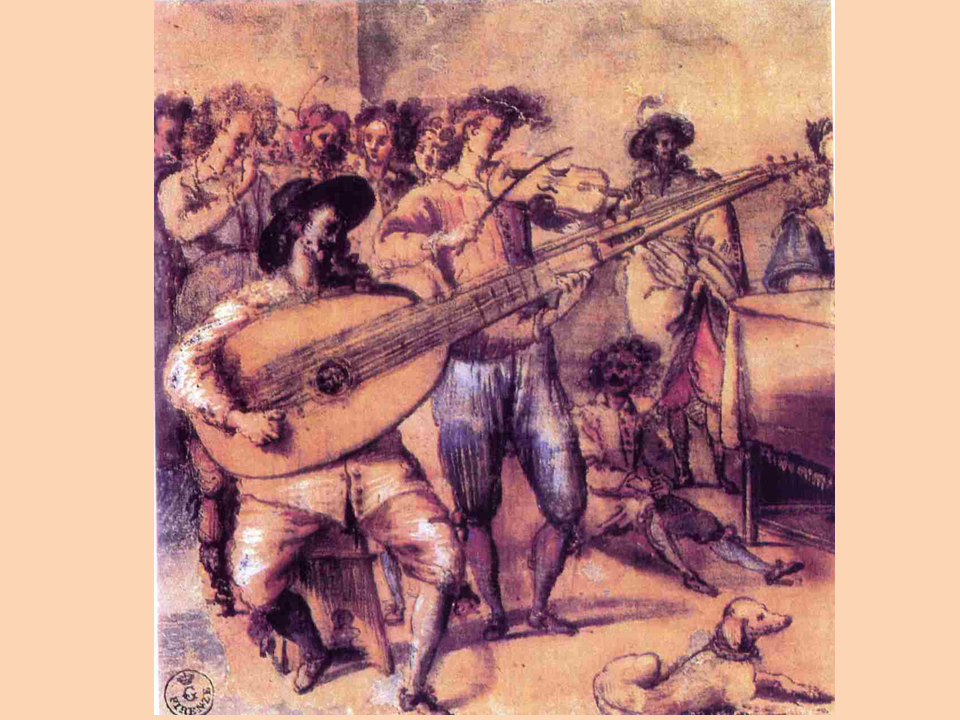
Theorbo

The most essential instrument in an early Italian continuo-section is the Theorbo, also known as Chitarrone. This is the double-bass instrument of the lute family, with two necks. The strings on the first neck run over a fingerboard, and produce a strong melodic bass, with chords in the tenor/alto register. The second neck is much longer, and these strings have no fingerboard; they give another octave of sub-bass notes, that provide a powerful rhythmic impulse and a long sustain that supports the harmonic arpeggio of the upper strings.

Arpa doppia

Around 1600, the harp doubled in size in order to create a strong sub-bass register comparable to the Theorbo’s. The Italian arpa doppia (double harp) has multiple rows of strings, arranged like the black and white notes of a keyboard, so that all harmonies and chromatic changes are available, just as on the harpsichord or organ.

The harp also has a full soprano register, so that it plays a unique role in the continuo section, defining fundamental structure alongside keyboards and theorbo, and also providing decorative touches in the higher register.

Baroque guitar

The baroque guitar has a plucking technique for solo repertoire, but in the Continuo section it usually provides rhythmic energy and decorative colour by strumming.

Read more about Agazzari’s categories of fundamental and decorative instruments here.
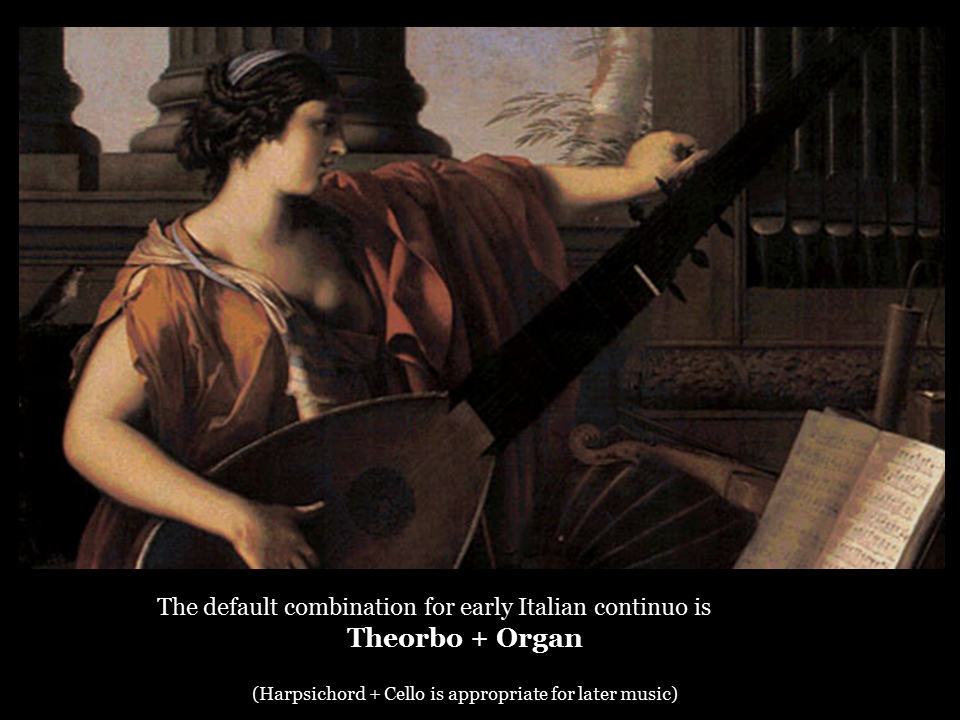
Theorbo + Organ


The combination of harpsichord and cello is typical of 18th-century music. In the early 17th-century, the usual pair is theorbo and organ.
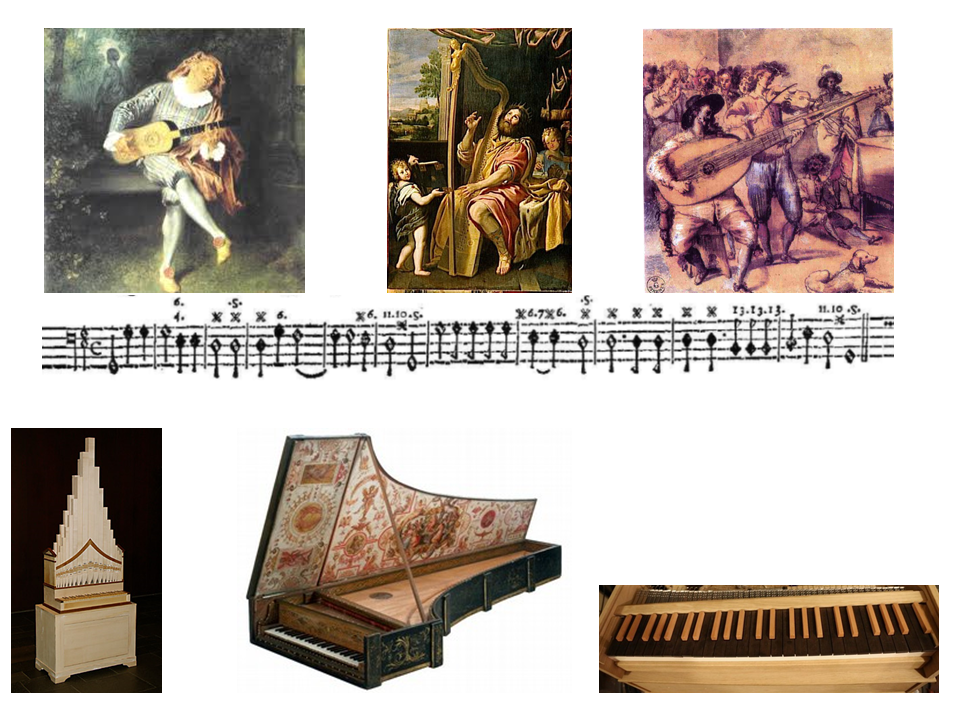
 

Realising the Continuo

All the different instruments of the Continuo section play from the same bass-line, which may (or may not) have additional information about the harmonies indicated by figures above or below each note. But whilst they read from the same part, each player improvises the harmonies and any decorative touches according to the role and capabilities of each instrument: this is referred to as ‘realising’ the continuo.


No conducting!

No Conducting

One prominent figure in modern opera, the conductor who moulds the rhythm and guides the orchestra with his hand or baton, was not seen in the 17th century. Early Music was not conducted. The role of guiding the rhythm belonged to the Continuo section, as Agazzari tells us.

Of course, there would be someone to coordinate the rehearsals and make whatever decisions were needed. This job was done by Il Corago, who was usually the Artistic Director of the entire production, responsible not only for musical coordination, but also for guiding the actors, dancers, scene-builders, lighting technicians (sophisticated lighting effects were obtained from massed candles), and stuntmen (acrobats and sword-fighters). Cavalieri himself was a Corago, with a working knowledge of all of these disciplines, so that he could co-ordinate the contributions of each specialist.

When there was a large musical ensemble, it would be spatially divided into several groups, each of which would have a time-beater to synchronise the rhythm within the group and between one group and the others. The frontispiece of Praetorius’ Theatre of Instruments shows this practice in action, with a large ensemble divided into three ‘choirs’ of instruments and voices. Each choir has its own time-beater, and the three time-beaters watch each other to synchronise the beat.

Priorities
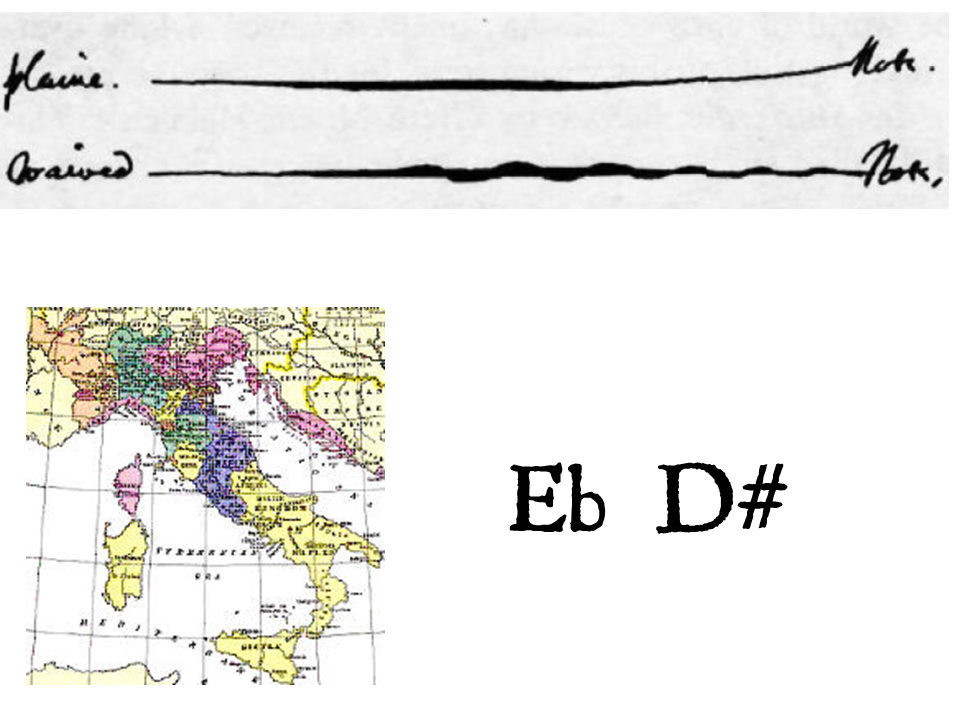
Modern Topics

Today, discussions about Early Music often focus on the question of Vibrato. Period diagrams show the typical shape of long notes: a ‘plain note’ begins softly and then swells out (there is no vibrato); a ‘waved note’ similarly begins softly, and adds vibrato as the sound swells out.

Another topic of modern debate is the question of pitch. Around 1600, in the south of Italy, the pitch was lower than today’s standard of A440; in the north it was higher. In central Italy, it was somewhere in between. Bruce Haynes’ The Story of A here tells the History of Performing Pitch in great detail.

Subtle choices of precisely how to tune each note of a keyboard instrument or harp are studied as Temperament. Whereas on the modern piano, Eb and D# sound the same and are played from the same key, in historical Temperaments these are two subtly different pitches. Some keyboards have double keys for the black notes, baroque harps have extra strings, in order to facilitate this fine distinction. The typical Temperament circa 1600 is known as Quarter-Comma Meantone: it produces beautifully pure major thirds, making consonances sweeter and dissonances sharper.

These are the hot topics amongst many of todays’ Early Music practitioners. But what were the priorities for musicians and singers performing Anima & Corpo in the year 1600? The original print is here, and Caccini’s Le Nuove Musiche tells us how to approach it:
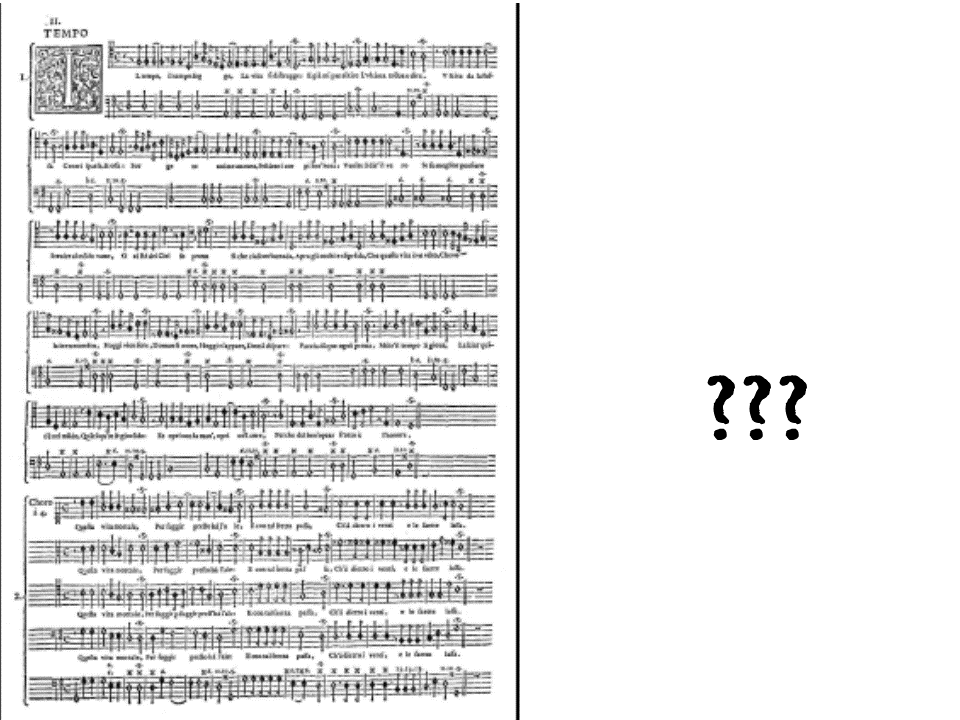
The Interpretation of Early Music

Music is Text + Rhythm, and sound last of all.

“And not the other way around”, Caccini emphasises.
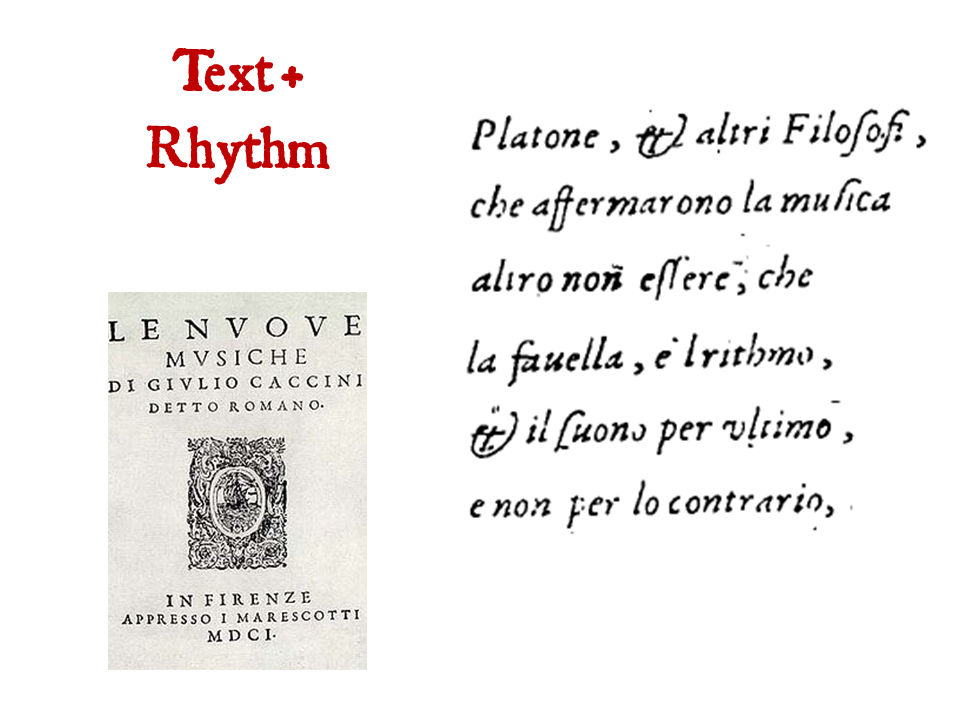
Text and Rhythm

These historical priorities guided my international research program into Text, Rhythm, Action! over the last five years, reported here, and I apply them in all my practical work, training musicians and directing performances for audiences today.

Text
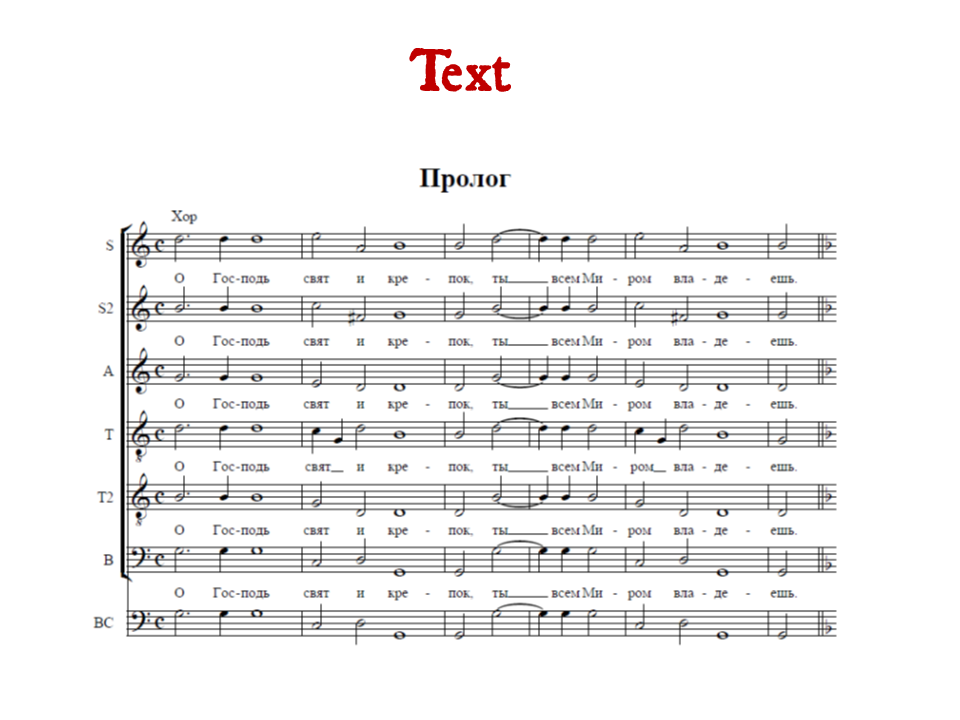
Text

Period sources insist on the importance of communicating the text to the audience, so for the production at Theatre Natalya Satz, we wanted to speak to the audience directly in their own Russian language. Great care was taken to synchronise the translation with the ‘word-painting’ of Cavalieri’s music, in which every single word is individually set to music. Poet Alexey Parin worked together with specialist musicians Ivan Velikanov, Katerina Antonenko and myself, to preserve the close links between text and music.

Word Painting

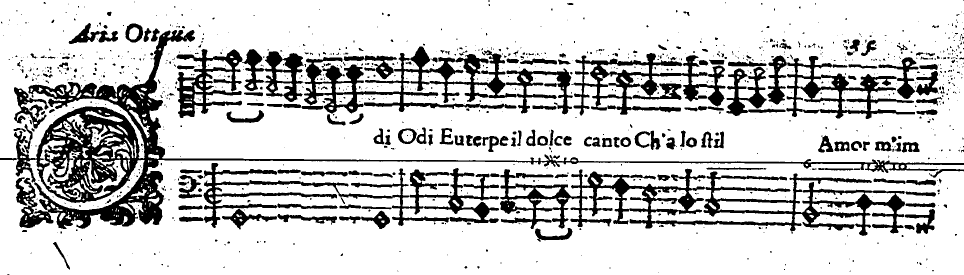
At the beginning of the drama, the first notes are immediately repeated – not because a series of repeated Fs makes a wonderful melody, but in order to repeat the word for emphasis, just as a fine orator would do: “Time… Time”.

In this period, the term Aria has a different meaning; it signifies any repeated structure in words, rhythm, harmony or melody. The metric patterning of the verses Hoggi vien fore, Doman si more, Hoggi n’appare, Doman dispare [Today Life comes forth, tomorrow it dies; today it appears, tomorrow it disappears] is matched by similar patterns in the melodic contours, rhythms and harmonies of Cavalieri’s music. This, in early-17th-century terms, is another Aria, just like the repetition of the single word Tempo, along with its carefully set music.

If the text refers to Heaven above, ciel soprano, the singer will pitch his voice high. If the text mentions a party, festa, the music swings into fast triple-time. Just as an actor in a spoken play will raise his voice to indicate a question, so Cavalieri sets questions on rising pitches.

Text and music are so closely linked that many musical features are not Cavalieri’s compositorial choices, but rather his sensitive responses to the demands of the poetry. Similarly, many performance practices are not the performers’ artistic inspiration, but rather their sensitive responses to the demands of the text and the historical expectations of this musical style.

Treatises

Many explanatory texts survive to inform us of those historical expectations, including a Preface with Cavalieri’s own indications how to perform this kind of music-drama, Agazzari’s treatise on Continuo already mentioned, and the anonymous c1630 guide for a music-theatre’s artistic director, Il Corago.

Rhythm

Rhythm

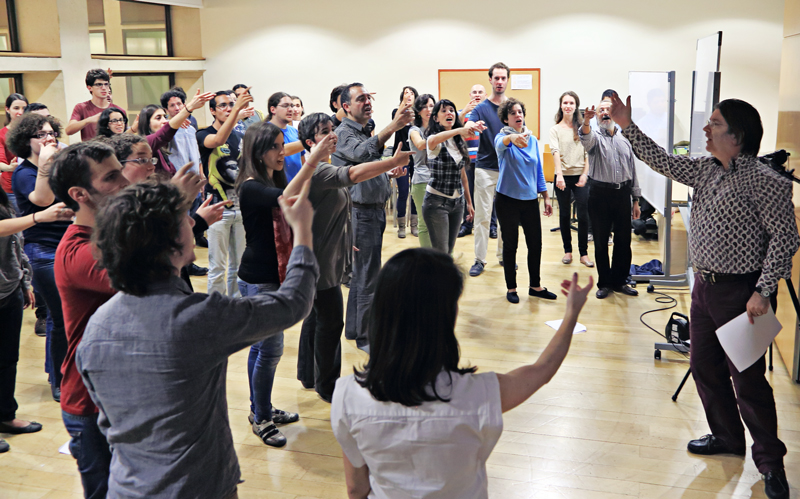
Although there were no conductors in this period, musicians, whether soloists,or in duet, trio and larger ensembles, would beat time with their hand, palm downwards, down for about one second, up for one second. This slow, steady beat was known as the Tactus. Read more about Tactus here.

What is music

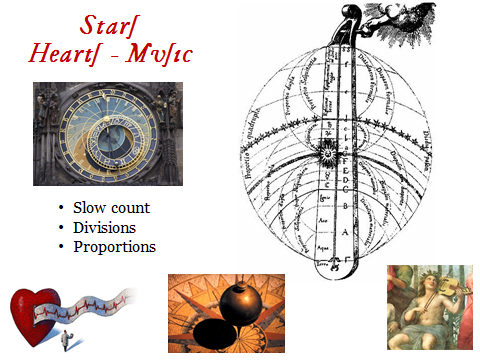
Music itself was understood to be the Music of the Spheres – mysteriously produced by the perfect motion of the stars and planets; the harmonious nature of the human body; and – last of all – actual sounds sung and played on earth. So musical rhythm represents that perfect heavenly movement, rhythm is life itself.


Proportions

Just as clockwork produces various speeds of rotation from one fundamental movement, so 17th-century musicians perceived the different orbits of the planets to be meshed together and turned by the hand of God. This philosophy is imitated in musical Proportions, by which the constant slow Tactus beat is divided into 2, 3 or 6, to create duple, tripla and sestupla metres. A Proportion of 3:2 creates Sesquialtera metre.

What is Time

Time, like Music, was celestial and embodied, measured by the cosmos and the human pulse, better than by clocks. The sun shows the time of day and fixes the moment of noon, the stars show the changes of the seasons. Our pulse measures shorter time-spans, of the order of seconds.

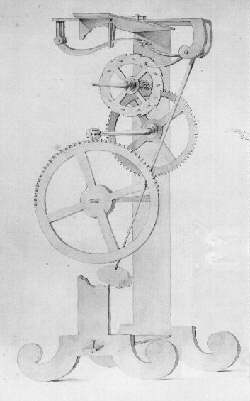
Galileo Pendulum


Galileo discovered the pendulum effect in 1582, observing a chandelier in Pisa cathedral, but the first pendulum clock was not built until 1656. So Galileo’s observations were timed against his own pulse – there was no more accurate clock.

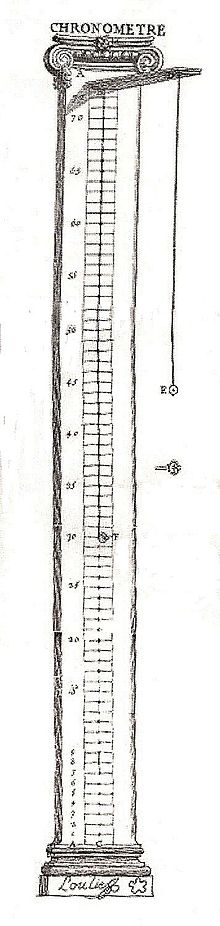
Galileo Inclined Plane

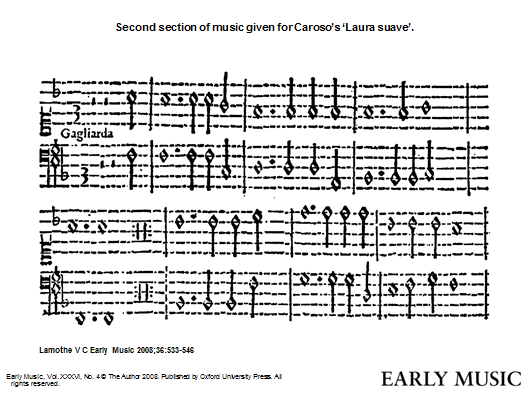
For his experiments on gravity in 1607, Galileo had to time a ball rolling down an inclined plane to an accuracy of fractions of a second. This was far beyond the capabilities of any period clock, and required finer gradations than a pulse-beat. The solution was found in the precision of musical rhythm – if a minim is about one second, then semi-quavers define an eighth of a second.

You can try for yourself an on-line simulation of Galileo’s experiment, precision-timed by lute-music, here.

Newton and Aristotle

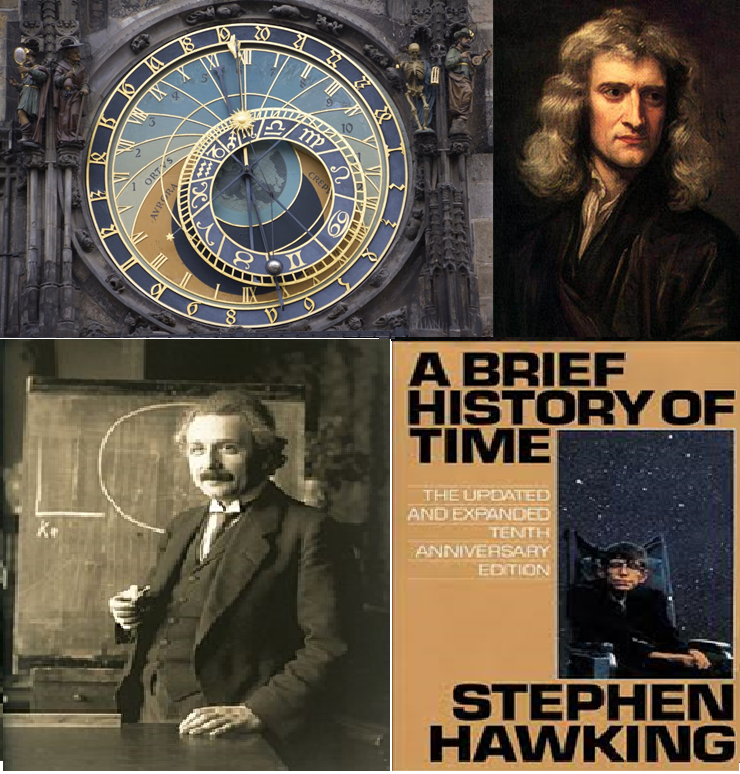
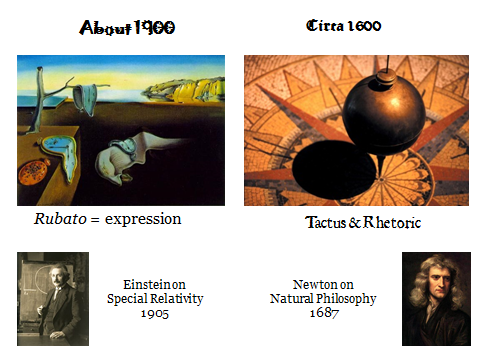
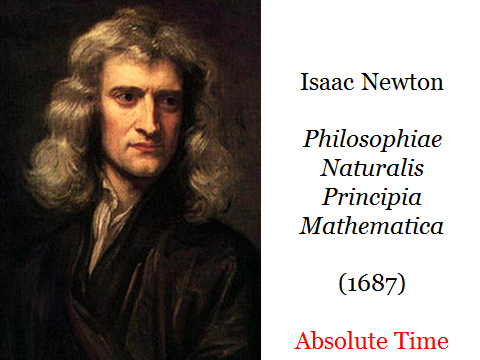
For most of us, our intuitive understanding of Time is based on Newton’s model of Absolute Time: Time itself continues ever-onward, independent of other variables. We we can measure the accuracy of a clock, or the daily changes in the precise time of solar noon, against the fixed scale of Newton’s Time. But Newton published in 1687, and it was many decades before his concepts gained general acceptance. In the year 1600, the accepted model of Time was Aristotle’s:

Time is a number of change/movement, in respect of before and after.

Without an Absolute scale to measure by, without the assurance that Time would march independently onwards, “change/movement” was required to create a “before and after” that would allow Time to be numbered. So musical Time, i.e. rhythm, was not only indicated by the hand-movement of the Tactus, it required such movement (at least as a concept) in order to exist at all. The movement of the cosmos, driven by the hand of God, not only measured time, but created it. Just as the heart-beat sustains life, so the steadiness of the musical Tactus was necessary for human health and indeed, for the preservation of the entire universe.

Read more about the philosophy of Time and musical Rhythm here.

Action!

Plato Kronos Kairos

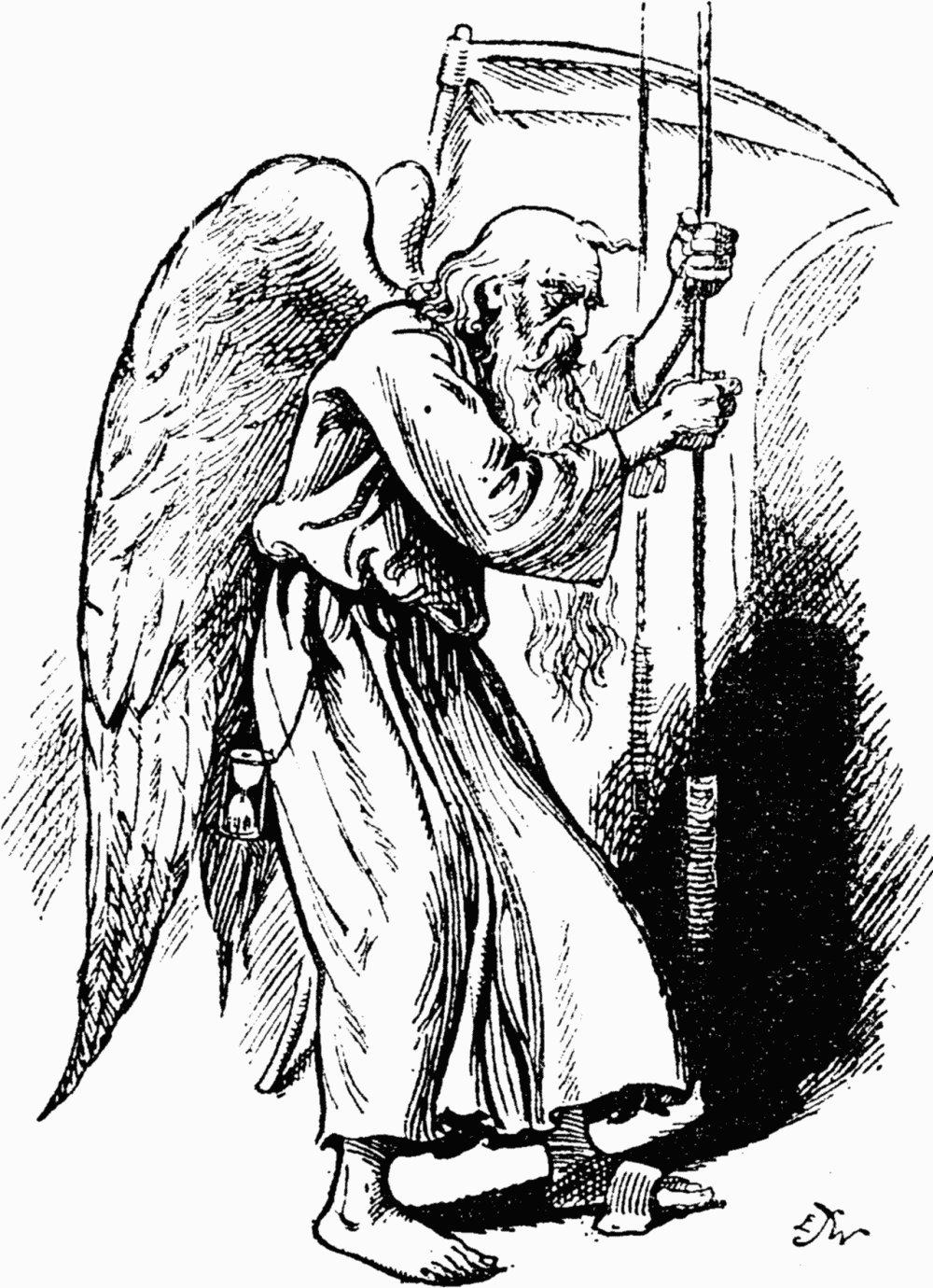
The first character to appear in the first opera is Old Father Time, and his first words (repeated) are Il Tempo. Time is a crucial topic in this drama, understood within Platonic philosophy. The fleeting present moment is a moving image of Eternity, the point of contact between human life and infinite destiny, between earthly actions and the eternal struggle of Good and Evil.

There are two Greek words that we translate as ‘Time’ or in Italian, tempo. Chronological time, clock time, is Greek kronos, whereas kairos signifies the moment of opportunity. For a swordsman, kairos is the crucial instant of time when you must defend yourself to save your life, or when you might safely attack your opponent.
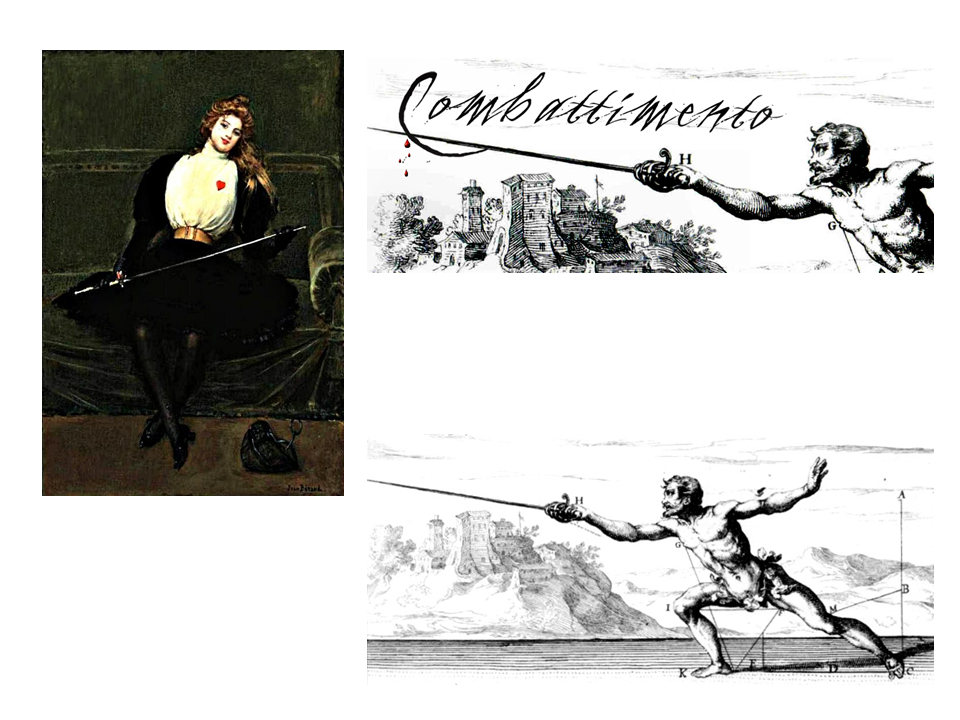
The Art of the Sword


Monteverdi wrote a one-act opera entitled Combattimento, a music-drama of sword-fighting. Opera-singer Julie d’Aubigny, known as La Maupin, was the best duellist of her age. Many dancing-masters were also fencing instructors, and the anonymous sword-master of Bologna declared that swordsmen needed the same precision timing as singers!

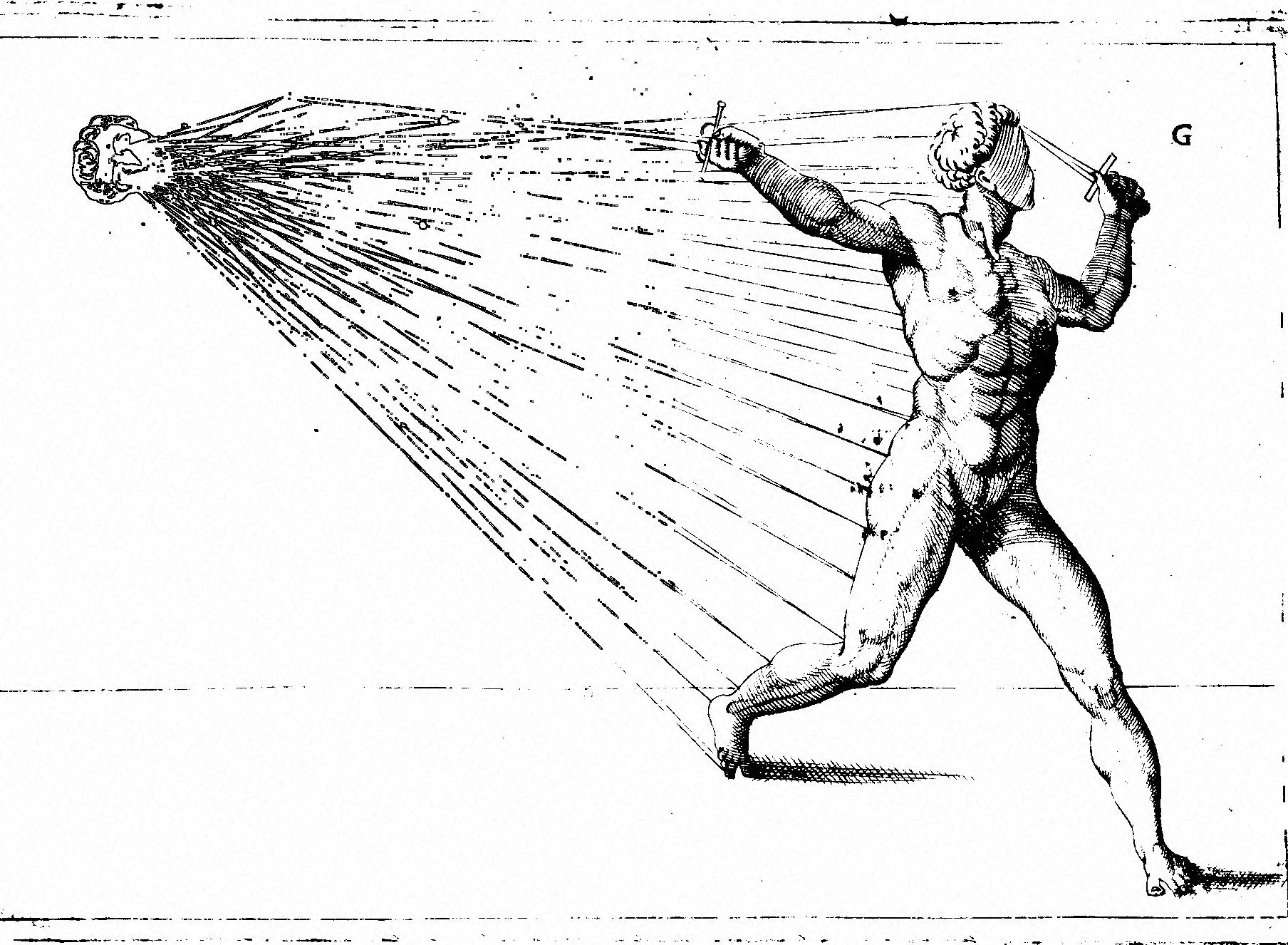
Capo Ferro’s 1610 Gran Simulacrum teaches the Art of the Sword, as applied to the long, needle-point, razor-sharp Italian rapier. If your opponent points his sword at your heart, you turn your (right) sword-hand palm-up and leftwards, so that your sword crosses his and protects you. His likely response is to dip his sword-point underneath your blade, and threaten your right shoulder instead. Now you will have to turn your sword-hand palm down and rightwards, pushing his sword aside so that you can lunge forwards and strike with the point of your sword.

Act with the hand, act with the heart!

Act with the heart, act with the hand


As we are told in the first scene of Anima & Corpo, historical acting linked emotional force to expressive hand-gestures. All the Action is founded on the poetic text, of course, as Shakespeare’s Hamlet instructs the Players:

Suit the Action to the Word
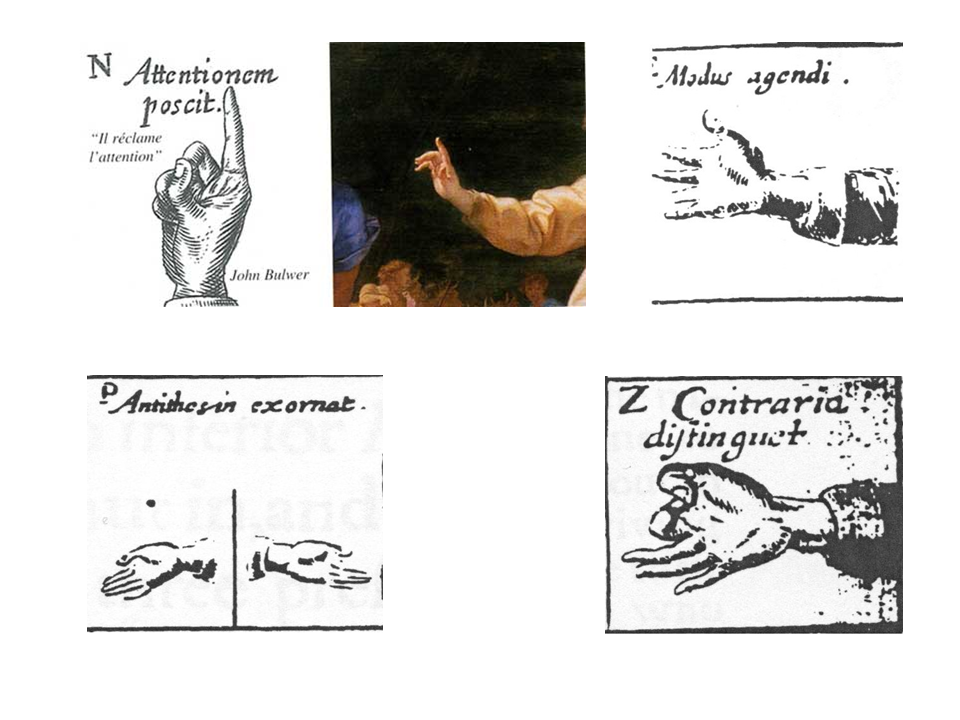
Bulwer Gestures


John Bulwer’s Chironomia (1644) shows gestures for Attention, for stylish Action, and for Antitheses (opposites): ‘on one hand…. on the other hand…’. Another way to Distinguish Contraries rotates the right hand palm-up and leftwards, then palm-down and out to the right.

To be or not to be


We could imagine such gestures being performed in Shakespeare’s most famous line from Hamlet:

To be or not to be, that’s the question

First we Distinguish Contraries  (to be, or not to be), and then we direct the audience’s Attention (the question). So To be (right hand palm-up and leftwards), or not to be (palm-down and out to the right), that’s (with index finger raised and the hand sent forwards, step forward to command the audience’s attention) the question.

If you try it for yourself, this sequence of movements might seem familiar to you: it is very similar to the sequence that we studied as a sword-drill, opposing to the left, turning the hand to close the line on the right, and then lunging forwards to strike.

Sword talk

Both Hamlet and Anima & Corpo are full of the language of sword-play. In Cavalieri’s masterpiece, the Guardian Angel would traditionally carry a sword, and the composer provides suitably martial music with G major harmonies and battle rhythms – the same harmonies and rhythms encountered a quarter-century later in Monteverdi’s Combattimento.

Like Shakespeare’s Hamlet, Cavalieri’s Anima & Corpo explores timeless questions of life and death by means of a fashionable vocabulary of sword-action. The English Play and the Italian Rappresentatione are each monuments of cultural achievement and artistic innovation: certainly not ‘primitive’, but endlessly fascinating and thought-provokingly different.

Anima e Corpo Golden Mask

Please join me on Facebook https://www.facebook.com/andrew.lawrenceking.9 and visit our websites www.TheHarpConsort.com

www.IlCorago.com and www.TheFlow.Zone


Text, Rhythm, Action! Research, Training & Performance

In the field of Early Opera, do you think it might be good to integrate academic research with continuing professional development,  advanced training and international-level performance?

Read more…

Jacopo Peri

PERFORMANCE PRIORITIES

Amongst all the myriad details of performance that have fascinated actors, musicians and audiences over the ages, in the 17th century, the age of Shakespeare, Dowland & Purcell, of Monteverdi and the first Italian operas, what were the highest priorities?
Caccini (1601) defines Music as:

Text and Rhythm, with Sound last of all. And not the other way around!

Text, Rhythm and Sound

Bulwer (1644), via Quintilian and Cicero, cites Demosthenes’ three points of Eloquence:

Action! Action! Action!

Demosthenes Cicero Quintilian

These historical priorities guided Andrew Lawrence-King’s 5-year investigation of Text, Rhythm, Action! at the Australian Research Council’s Centre of Excellence for the History of Emotions and with Il Corago, the production company for historical staging. You can download a full illustrated report from the Il Corago website, here.

In this post, scroll down for Research, Training, Performance, Publications  & (lots of) Links.

A UNIQUE INTERNATIONAL PROGRAM OF RESEARCH, TRAINING & PERFORMANCE

With a unique combination of academic rigour, unified focus, practitioner expertise and international scope, this program applied historical research to the development of new training methods for modern performers in some 2 dozen award-winning staged productions of Early Modern music-dramas and Historical Action worldwide.

AWARDS & PUBLICATIONS

Lawrence-King’s musical direction of the ‘first opera’, Cavalieri’s Anima & Corpo, won Russia’s highest theatrical award, the Golden Mask. During the period of this investigation, he also received the U.S. Grammy, Australian Helpmann and two Spanish Premios de la Música for collaborations with Jordi Savall.

Two documentary-films, a mini-documentary and many video clips have already been released. Research insights are debated on the TRA blog here at http://www.AndrewLawrenceKing.com. Now Professor Lawrence-King has begun to write up his findings formally in book chapters, articles for academic journals and in several forthcoming books.

Golden Mask

RESEARCH

Our initial Question was almost naïve: how can baroque gesture be convincing for modern audiences? This opened up two paths, which both led back to the dramatic Text via investigations of Rhythm (in poetry, music and movement) and of Embodiment (posture, gesture, mind/body interactions). Whereas the romantic tradition glorifies performers’ genius, 17th-century philosophy respects the poetic text (which, nevertheless, is realised with improvised creativity) and privileges the audience.


Musical Rhythm is understood within period concepts of Time itself. As an element of Rhetoric, the Art of Gesture is embedded in the Science of Historical Action. In this ancient, intuitive model of how poetry, music & drama induce psychological and physiological changes amongst performers and audiences, Enargeia (the emotional power of detail) creates imaginary Visions that use the mind-body force of Pneuma to stir up the Four Humours.

Our research Aim is to develop rehearsal methodologies that empower modern-day performers to Use the historical principles of the 17th-century Art of Rhetoric within the framework of period Science. Andrew Lawrence-King’s Method is grounded on close reading of such key historical sources as
Cavalieri & Peri (1600), Bonifacio (1616) & Bulwer (1644), the anonymous Il Corago (c1630). These well-known texts are re-evaluated in the light of period Philosophy, in which Time, Pneuma & Music all exhibit a complex, threefold structure that connects mondana – the heavenly & mysterious, with humana – the human & embodied, and instrumentalis – the practical and interactive.

New understandings were debated in seminars and conferences, applied in workshops and rehearsals, and tested in the real world of live performance with a wide range of modern audiences. Interim Findings – on Pre-Newtonian Time, Musical Tactus, No Conducting!, Medieval music-drama, Commencing Continuo, Redefining Recitative, Pepys’ Shakespeare Speech, Pneuma, Enargeia, Music & Consciousness, 17th-century Hypnosis, Baroque Gesture:
What’s the Point? – have been reported at conferences & public lectures at Cambridge, Oxford, Yale, Vienna, Sydney, Adelaide, Perth, Singapore, Moscow, St Petersburg, Novosibirsk, Barcelona, Copenhagen, Ghent, Basel, Helsinki, Galway, Kilkenny, Budapest, London etc.


Alessandro Turchi 'Bacchus & Ariadne' (c1630). Historical Action is more than just Baroque Gesture.

Alessandro Turchi ‘Bacchus & Ariadne’ (c1630). Historical Action is more than just Baroque Gesture.


TRAINING

17th-century writers present Art as a set of principles, a coherent collection of rules which we can study and apply to today’s Historically Informed Performance. The period concept of Use refers to the nitty-gritty of practical experience: a key element of Andrew Lawrence-King’s work is to devise new
training methodologies that facilitate modern-day performers’ acquiring the skill-sets needed to apply rules of historical Art. The study of profoundly spiritual, cosmic matters beyond the everyday and mundane, the mysterious power of emotions, the magic of the theatre, is the realm of renaissance
Science.

The training focus is historical expertise rather than romantic character analysis or the 20th-century search for motivation: first acquire Thomas Betterton’s (or La Florinda’s) skill-set, then play Hamlet (or Arianna)! Accordingly, we do not rehearse a particular interpretation; rather we teach principles that empower performers to improvise collectively a stylish realisation of text, music & action. Participants do not just memorise a production; we help them develop baroque skills which they can re-apply throughout their careers.

We practice what we preach. The priorities established by historical research are put into effect in professional training: Text – for each hour of rehearsal, 50 minutes are devoted to detailed text-work; Tactus – every performer shares responsibility for maintaining the rhythmic pulse; there is, of course, no conductor; Gesture – supported by period posture and the force of Pneuma; the emotional power of Enargeia – detailed visual description; Visions – mindful attention to the Text creates imagined visions that stir up emotions for performers and spectators; Deictics – the fundamental importance of ‘pointing words’; Ut pictura – how to make historical gesture ‘work’ for modern audiences.

Professional standards – well-structured rehearsals, directorial competence, clarity and consistency of coaching, respect for participants and audiences; state-of-the-art Early Music, Historical Dance and period Swordsmanship; cutting-edge modern understandings of the mind/body interactions of Flow, the Zone, Feldenkrais Method and Neuro-Learning – brain plasticity, myelination, hypnosis; the Structure of Magic – Neuro-linguistic Programming and 17th-century Rhetoric, the modern & historical arts of persuasive language.

Lasciate i monti

PERFORMANCE

Scroll down for Publications  & (lots of) Links.

HISTORICALLY INFORMED STAGED PRODUCTIONS OF EARLY MODERN MUSIC-DRAMAS

Monteverdi Orfeo (1607) ALK (stage & music), SP (movement), JD, KA (assistants); Royal Danish Academy of Music, Copenhagen Christianskerke: Tactus, Art of Gesture. New edition. Handbook on Baroque Gesture. Conference Ghent Orpheus Centre, Full-length documentary film.


Cavalieri Anima & Corpo (1600) GI (modern staging), ALK (music), KA, IV (assistants); Natalya Satz Theatre, Moscow. Word-painting, Tactus, Continuo. New edition (Russian translation AP, KA, ALK). First staged performance in Russia. Golden Mask Award. 42 performances (continues in repertoire). TV and radio interviews.


Purcell Dido & Aeneas (1689) ALK (stage & music), SP (dance), KA (assistant); Concerto Copenhagen, Copenhagen Town Hall. Dance & Gesture, training methodologies. New edition (dances & incidental music)


Landi La Morte d’Orfeo (1619) ALK (stage & music), XDL (music), KA (stage), DV (designer) EMS (dance) AS (swordsmanship); International Baroque Opera Studio, St Petersburg Philharmonic. First staged performance in modern times. Tactus, Art of Gesture, Enargeia, Visions, Historical scenery/lighting, Ut Pictura. New edition. Article Musicologial Journal of Moscow Conservatoire. Radio & TV interviews.


Ludus Danielis (c1200) ALK (stage & music), KA (assistant, gestures); The Harp Consort & Ars Nova Denmark, Copenhagen Marmorkirke: Medieval gesture, conductus (rhythm & improvised polyphony), pitch. New edition. Conference Budapest University, mini-documentary film.


Orgambide Oratorio del Nacimiento ALK (music & stage), KA (designer, stage) The Harp Consort, Ourense Cathedral, Festival Portico de Paraiso. First performance in Spain in modern times. Spanish recitado, Art of Gesture, Tactus, Enargeia. Public lecture by Dr Maria Teresa Ferrer. TV & radio interviews. New edition.


Monteverdi Combattimento (1624) ALK (music & stage), GW (swordsmanship consultant), DR (fight director), SP (dance), KA (stage) Guildhall School of Music & Drama, London Wallace Collection. New edition. Public lectures, post-performance panel discussion with Prof John Sloboda. Conference Cambridge University with Prof John Sloboda. BBC Radio interview.


Ludus Danielis (c1200) ALK (stage & music), KA (designer & stage); The Harp Consort & St Michaels Schola Cantorum, Galway Early Music Festival. Emotions in Action, Medieval Gestures. Public lecture National University of Ireland, full-length documentary film. Radio interviews.


Orgambide Oratorio del Nacimiento ALK (music & stage), KA (designer) Insula Magica, Novosibirsk Philharmonic. First performance in Russia. Spanish recitado, Art of Gesture, Tactus, Enargeia. Public lecture. TV & radio interviews.


Orgambide Oratorio del Nacimiento ALK (music & stage), KA (designer) Guildhall School of Music & Drama, London. Spanish recitado, Art of Gesture, Tactus, Enargeia. Presentation by Dr Anthony Trippett.


Cavalieri Anima & Corpo (1600) ALK (music & stage); Durham University Opera Society, Durham Great Hall. Tactus, Continuo, Enargeia, Visions. New edition.


Purcell King Arthur (1691) ALK (music & stage), Poznan Academy of Music. New edition. Continuo, French violin bowing, Gesture, Speech/Song/Recitative, Ut Pictura. Radio interviews.


Hidalgo Celos aun del aire matan (1660) ALK (music) GI (stage) KA (translation) Moscow, Theatre Natalya Satz Text, Tactus, Spanish Continuo New edition (Russian translation).New edition. TV & radio interviews.


Medieval Kalevala ALK (music, stage, concept) KK (stage, text) The Harp Consort, Montalbane Festival Medieval storytelling & gesture


Carissimi Jeptha ALK (music, stage), MB (vocal coach), KA (assistant). St Petersburg. New edition. TV & radio interviews. Art of Gesture, Tactus.


Peri Euridice (1600) ALK (stage & music), SP (movement), KA (assistant); Guildhall School of Music & Drama, London Lumen Centre. Continuo, Art of Gesture, Posture, Visions. New edition (version for 5 singers). Conference Cambridge University, mini-documentary film

Ourense Angel

Nicole Jordan as the Angel in Orgambide’s ‘Oratorio del Nacimiento’

PERFORMANCES WITH TEXT, RHYTHM, ACTION!


Monteverdi Vespers (1610) ALK (music); Alta Capella, Moscow Lutheran Cathedral. Tactus, Continuo, Visions. Radio broadcast, radio & TV interviews. New synoptic edition. Public Lecture. First performance in Russia.

Gibbons, Dowland, Holborne, Morelli Shakespeare’s Music (17th cent) ALK (stage & music), Alta Capella, Moscow Conservatoire of Music. Text, Tactus, Pepys on Shakespeare.Public lecture. Radio & TV interviews.

Gibbons, Dowland, Lawes The Masque of Time (17th cent) ALK (artistic director, script & concept), EB (music), VN (stage) Guildhall School of Music & Drama, Canterbury St Gregory’s Centre and London. Tactus, Gesture, Dance, Philosophy of Music & Time.


Schutz, Schein In Friede (17th cent) ALK (music & gesture), Royal Danish Academy of Music, Copenhagen Chapel Royal Tactus, Art of Gesture New editions.


Lully, D’Anglebert Choregraphie (1700) ALK (music), KM (dance), The Harp Consort, Edinburgh International Harp Festival Tactus, Dance New editions.


Monteverdi, Peri, Caccini, Cavalieri Favola in Musica (c1600) ALK (artistic director, concept) MB (voice) XLD (continuo) SP (dance) The Harp Consort, St Petersburg Early Music Festival, Feldkirchen Festival, Hamburg Bucerius Kunst Forum The First Operas, Tactus, Continuo Radio interview & broadcast.


Dowland, Purcell The Dark Side (17th cent) ALK (music, stage, concept) SP (movement) The Harp Consort, Graz List Halle Text, Tactus, Art of Gesture


Vite e Voce (Vasari 500th anniversary )ALK (music, concept) Ensemble L’Homme Armé, Florence, Museo Sarto. Baroque gesture & Fine Art


Ars Musicae (Vasari 500th anniversary) ALK (music, concept) Florence, Museo Sarto Design & perspective in Art ~ form & proportion in Music


Hebro with head of Orfeo 2

Anton Varentsov as the River Hebro with the head of Orpheus in Landi’s ‘La morte d’Orfeo’


WORKSHOP PERFORMANCES, STUDY PROJECTS ETC

Monteverdi Lamento di Arianna (1614) (ensemble version) ALK (stage & music). Study project at Helsinki Metropolia. Conference London GSMD.


Monteverdi Lamento di Arianna (1608) (solo version) ALK (stage & music). Study project at Sibelius Academy, Finland. Conference Perth WA. Seminar Melbourne.


Monteverdi Madrigali Guerrieri & Amorosi (1638) ALK (music), Melbourne Early Music Studio. Tactus, Swordsmanship, Visions.


Dowland, Purcell, Morelli The Dark Side (17th cent) ALK (music): Melbourne Early Music Studio Melancholy, Speech/Song/Recitative Conference Sydney University


Malvezzi, Cavalieri, Gabrieli etc Rappresentationi (excerpts from 1589 Florentine Intermedi, etc)  St Petersburg. ALK (stage & music), MB (vocal coach), KA (assistant).


Monteverdi Lettera Amorosa (1619) ALK (stage & music). Study project at Royal Danish Academy of Music, Copenhagen. Paper for Letters2 conference, Lisbon; presentation at Books & Music Conference, Newcastle. Enargeia, gendered Gesture


Purcell Dido & Aeneas (1689) ALK & AM (stage & music); Sydney Conservatorium Redefining Recitative, Art of Gesture


Baroque Gesture: What’s the Point?

Workshop for advanced students and professorial staff at ESMUC, Barcelona

Workshop for theatre researchers, Australasian Association for Theatre, Drama & Performance Studies.
Workshop for movement researchers, Dalcroze Conference, Vienna.
Workshop, Edinburgh International Harp Festival
Workshop, Kilkenny


The Theatre of Dreams: La Musica hypnotises the Heroes

Workshop for advanced students and professorial staff at ESMUC, Barcelona.
Workshop for research students at Guildhall School of Music & Drama, London.


Seminar on Historical Action ALK with Dionysios Kyropoulos at New College, Oxford


Redefining Recitative Workshop at Guildhall School of Music & Drama, London.


Landi La Morte d’Orfeo (1619)

Workshop at Theatre Natalya Satz, Moscow.
Workshop at Rimsky-Korsakov College of Music, St Petersburg


Music & Rhetoric Public Lecture & Workshop, Moscow Conservatoire of Music. Radio/TV.


A Baroque History of Time

Public Lecture, St Petersburg Derzhavin Museum.
Public Lecture, University of Adelaide
Public Lecture, Kilkenny


Modes of Emotion Public Lecture, Kilkenny


Empfindsamkeit Workshop, Moscow Theatre Natalya Satz


Landi Sant’ Alessio (1631) ALK (stage, music), Basel Schola Cantorum, workshop performance. Tactus, Continuo
Etc…

MEET THE DIRECTORIAL TEAM


ALK Andrew Lawrence-King, AM Alan Maddox, AS Anton Semenov, DR Dave Rawlings, DV Danil Verdenikov, EB Emily Baines, EMS Ekaterina Mikhailova-Smolnyakova, GI Georgy Isaakian, GW Guy Windsor, JD Jane Davidson, KA Katerina Antonenko, KK Karoliina Kantolinen, KM Karin Modigh, KZ Klim Zhukov, IV Ivan Velikanov, MB Marco Beasley, SP Steven Player, SG Stephen Grant, VN Victoria Newman, XDL Xavier Diaz-Latorre

Marco Scavazza as the Devil in Orgambide's 'Oratorio del nacimiento'

Marco Scavazza as the Devil in Orgambide’s ‘Oratorio del nacimiento’

PUBLICATIONS & LINKS

Book Chapters by Andrew Lawrence-King:

ALK Il palpitar del core: The Heart-Beat of the “First Opera” in Crispin & Gilmore Artistic Experimentation in Music (2015)


ALK ’Tis Master’s Voice: A Seventeenth-Century Shakespeare Recording? in White Shakespeare and Emotions (2015)

Journal Articles by Andrew Lawrence-King:

ALK (with Antonenko & O’Shea) The Irish Harp: Myths Demistified Celto-Slavica Journal (2015)


ALK The Theatre of Dreams: the Science of Historical Action ADSA (Australasian Association for Theatre, Drama & Performance Studies) Journal (2015)


ALK In vino veritas: wine, women & song in Landi’s ‘La Morte d’Orfeo’ Musicological Journal of Moscow Conservatoire (2015)

Historical Prefaces:

Cavalieri Anima e Corpo (1600)

Peri Euridice (1600)

Caccini Le Nuove Musiche (1601)

Gagliano Dafne (1608)

Frescobaldi Toccate (1615)

Introductions


ALK Video: “What are the Three Secrets of Great Performance?https://www.youtube.com/watch?v=j58nwM3nbpE

Anon. Il Corago (Biblioteca Estense, Modena: MS y.F.11, c1630) edited by Fabbri & Pompilio (1983)


Introduction to ALK’s research: http://www.theharpconsort.com/#!research/c1dp3

Index to ALK’s blog: http://www.theharpconsort.com/#!blog-index/cxm4

What is Music?

Music expresses emotions?

Time & Tactus

A Baroque History of Time: Stars, Hearts and Music


Rhythm – what really counts?


Tempus putationis – Getting back to Monteverdi’s Time

Grant Beating Time and Measuring Music (2015)

Houle Meter in Music 1600-1800 (1987)


ALK Video: “What is Time?

Redefining Recitative

Il Corago on ‘the three ways of acting’, Delle Tre Maniere di Recitare (Fabbri & Pompilio, 40)


The Good, the Bad & the Early Music Phrase


http://www.theharpconsort.com/#!research-findings-recitative/c1nz2

Sternfeld ‘A Note on Stile Recitativo’, RMA (1983-1984)


Continuo
Agazzari Del Sonare sopra’l Basso (1607)


Sparrow-flavoured Soup – or What is Continuo?


ALK Video “What is Continuo?”:


Introduction to Italian Continuo Video:

This is the first of a series of videos, all on the You-Tube channel of The Harp Consort & Il Corago.

Historical Action


www.IlCorago.com


Bonifaccio L’Arte de’ Cenni (1616)

Bulwer Chirologia & Chironomia (1644)


Barnett The Art of Gesture: The Practices and Principles of 18th-century Acting (1987)

Roach The Player’s Passion: Studies in the Science of Acting (1985)


Introduction to Historical Action:

http://www.theharpconsort.com/#!historical-action/c12q3


Flow & The Zone

www.TheFlow.Zone


Flow 2014 – The Cambridge Talks


Flow (Accessing Super-Creativity): Making Connections


Flow (The Oxford papers) Part 1: What’s in a name?


ALK Video: “Accessing Super-Creativity” 


History of Irish Harp

ALK (with Antonenko & O’Shea) The Irish Harp: Myths Demistified Celto-Slavica Journal (2015)


The Researcher’s Otherworld: A Dream of the ancient Irish Harp


Regina Cithararum – the Cloyne, or Dalway Harp


Precision tuning & Early Irish harps


History of Welsh Triple Harp

The Triple, or Modern Welsh Harp

Hypnosis, Rhetoric & Neuro-Linguistic Programming

ALK The Theatre of Dreams: the Science of Historical Action ADSA Journal (2015)


The Theatre of Dreams: La Musica hypnotises the Heroes


Landi La Morte d’Orfeo

ALK In vino veritas: wine, women & song in Landi’s ‘La Morte d’Orfeo’ Musicological Journal of Moscow Conservatoire (2015)


http://www.theharpconsort.com/#!la-morte-dorfeo/c4be

Monteverdi Vespers

The Right Time for a New Vision: Monteverdi’s 1610 Vespers


Laudate Pueri Video:


Dixit Dominus Video:


Harp Technique

Historical technique for Early Irish Harps


The Long Shake (Irish Harp Ornament of the Month #1)

This is the first of a series of articles on this subject, all available on this blog. There is a video to accompany each article, all on the You-Tube channel of The Harp Consort & Il Corago.


Single-Action Harp – making Sensibility of the Méthodes


Introduction to Italian harp Video:

This is the first of a series of 4 videos, all on the You-Tube channel of The Harp Consort & Il Corago.


Introduction to Early Irish harp Video:

This is the first in a series of 4 videos, all on the You-Tube channel of The Harp Consort & Il Corago.


Early Irish harp ornaments Video:

This is the first in a series of 4 videos, all on the You-Tube channel of The Harp Consort & Il Corago.


Monteverdi Orfeo


Documentary Film:


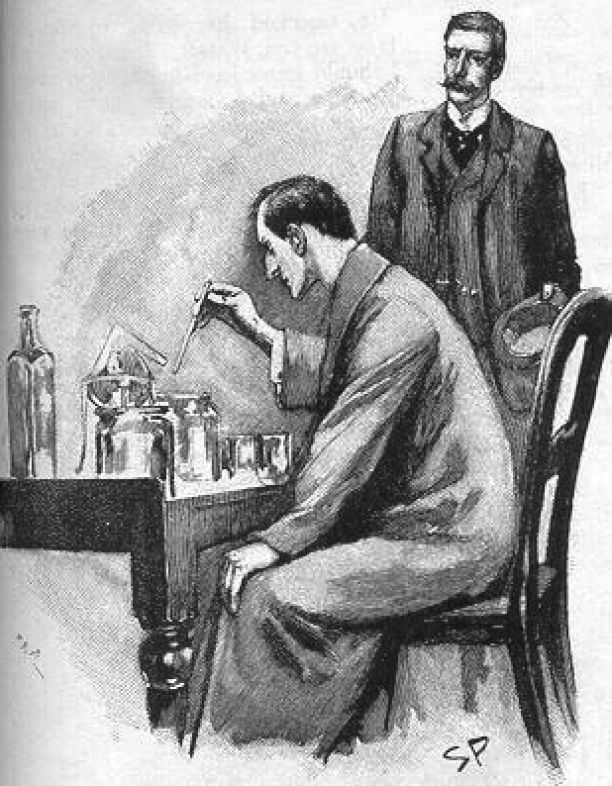
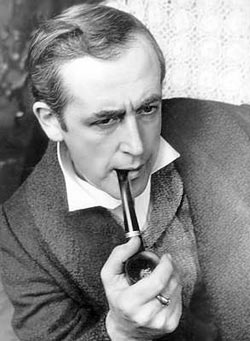
Sherlock Holmes and the Wedding Dance: Tactus & Proportions in Monteverdi’s ‘Lasciate i monti’


Ludus Danielis

Documentary Film:


Peri Euridice

Mini-documentary:


Purcell Dido & Aneas

Dido’s Lament Video:


The Witches Video:


witches-queen

Kristin Mulders as the Sorceress (doubling Dido) and Leif Aruhn-Solén as the Tenor (doubling the Spirit of Mercury) with Leif Meyer (continuo) in Purcell’s ‘Dido & Aneas’


Please join me on Facebook https://www.facebook.com/andrew.lawrenceking.9 and visit our websites www.TheHarpConsort.com

www.IlCorago.com and www.TheFlow.Zone


Opera, orchestra, vocal & ensemble director and early harpist, Andrew Lawrence-King is director of The Harp Consort and of Il Corago. From 2010 to 2015 he was Senior Visiting Research Fellow at the Australian Centre for the History of Emotions.

Monteverdi, Caccini & Jazz

The Rhythm Section by Suzanne Cerny

The Rhythm Section by Suzanne Cerny


Giulio Caccini (1551-1618) would find basic advice for today’s jazz singers rather familiar:

Your jazz singing voice should be a natural extension of your speaking voice.

In Le Nuove Musiche (1601), Caccini asks for una sorte di musica … quasi che in armonia favellare, usando … una certa nobile sprezzatura di canto. [A kind of music, almost like speaking in harmony, using a certain elegantly ‘cool’ vocal production.] Note that, contrary to received opinion, Caccini’s sprezzatura is not to do with rhythm, but with voice-production. See Play it again Sam, the truth about Caccini’s sprezzaturahere.  The complete original text of Le Nuove Musiche is here.

Your aim is to move an audience by conveying the lyrics of a song as if it were a poem.

The aim of music, and all the Rhetorical arts of the 17th century is muovere gli affetti [to move the emotions]. Caccini too searches for the forza di muovere l’affetto dell’animo [the force to move the emotions of the mind], noting that non potevano … muovere l’intelletto senza l’intelligenza delle parole [you can’t move feelings unless the words are understood]. Caccini proclaims la musica altro non essere che la favella e’l ritmo, & il suono per ultimo, e non per lo contrario. [Music is nothing other than Text and Rhythm, with sound last of all. And not the other way around!]

Now sing your song … exactly as it was originally written by the songwriter.

That should prevent you copying a particular interpretation off a recording by an admired artist: rather, you should create your own version of the song. This is very good advice for students of 17th-century song, too. It’s surprising how many interpretative touches have been passed through the Early Music movement, even when they are contradicted by well-known period sources. And all too often, Early Music singers begin introducing random rhythmic changes (in the name of ‘expressiveness’) before learning what the composer actually wrote!

Rhythmic displacement

Nevertheless, the subtle rhythmic displacement that is so important for Jazz is mentioned also by Caccini (but remember, this is not sprezzatura).

The freedom to loosen up the rhythm of a song spontaneously to add intensity is one of the joys of singing jazz. To practise rhythmic displacement, it is a good idea to begin by learning … the song. [Then], start subtly “loosening up” the timing of each phrase. The idea here is to sing the words rather like you might say them. Try shortening and lengthening different notes each time you sing a phrase and notice how playing about with the rhythm changes the emphasis on the words and can help you put your own stamp on a song. Your singing will also sound more like jazz if you leave a short space (about the length of a clap) before launching into every phrase.

For a few bars of one of his three example songs, Caccini applies senza misura [unmeasured, i.e. ‘loosened up’ timing], asking for this particular phrase to be quasi favellando in armonia con la suddetta sprezzatura [almost speaking in harmony with the above-mentioned sprezzatura]. The ‘above-mentioned sprezzatura‘ is a ‘cool’ vocal production.

The jazz citations above are from The Guardian’s online Jazz Singing Advice (2009), full text here, and having dealt with words, the anonymous columnist continues with a paragraph on Swing, paralleling Caccini’s priorities of Text and Rhythm.

Pamelia Phillips similarly mentions Rhythmic Displacement in Singing for Dummies 2nd Edition (2010). [You can read more of Phillips’ Training Requirements for Singing Jazz here.]

Jazz singers … usually change the notes and rhythms from the original music. Jazz singers create their style with rhythmic flexibility, and the singer and pianist don’t always have to be together note for note (called back phrasing).

But this rhythmic flexibility is certainly not anarchic or random. Like Caccini and the Guardian’s jazz expert, Phillips emphasises that

The jazz singer needs a great sense of rhythm.

Just as in renaissance Italy. The Anonymous swordmaster of Bologna writes in L’Arte della Spada [The Art of the Sword, MS Ravenna M-345 & M-346. There is a modern edition by Rubboli & Cesari, who date the treatise to the early 16th century, whilst the consensus view places it c1650] that swordsmen need the same sense of precision rhythm as a good singer!

L'Arte della Spada Anonimo Bolognese

The Hidden Assumption

But the Guardian, Phillips and Caccini all fail to mention (though Phillips hints at it) a vital, hidden assumption. Whilst the singer ‘loosens up the timing’ with rhythmic displacement, rhythmic flexibility or senza misura (whatever you want to call it), the accompaniment maintains a steady swing. We take this for granted in jazz, and the renaissance concept of Tactus similarly requires a steady slow pulse. (For Monteverdi, Caccini etc, evidence suggests a consensus Tactus speed of around minim = 60). The crucial point I’m making is that this concept of Tactus still pertains in the accompaniment, even when the singer is applying Caccini’s senza misura.

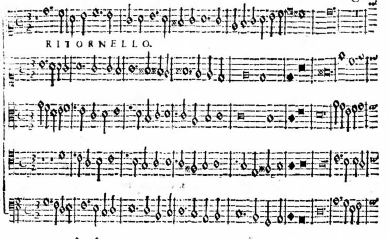
Monteverdi notates this practice, for example in the opening phrase of Orpheus’ aria in the underworld, Possente Spirto, from Act III of Orfeo (1607).

Possente Spirto incipit

Just as Phillips describes for jazz, singer and basso continuo are not always together.

Taking Monteverdi as a model, here is my realisation of Caccini’s example of senza misura from Le Nuove Musiche, showing how the singer might loosen up the timing, whilst the continuo maintain the Tactus.

Aure divine, ch'errate peregrine

Such a realisation fundamentally redefines the role of the continuo. Nowadays, continuo-players are asked to follow even the most random, rhythmically anarchic singers. It feels like that fairground game, where you wait, rifle (or theorbo) in hand, until a little yellow duck (the tenor) waddles into your sights, and then you fire off a chord, and hope to hit him in root position.

Duck shoot

But jazz singing, and Monteverdi’s notation of Caccini’s senza misura, require the accompaniment to maintain the swing, or Tactus. In jazz, those accompanists are called the Rhythm Section. In Monteverdi’s time, the continuo group are

Those who guide and sustain the whole body of singers and instruments of the ensemble.

quei, che guidano e sostengono tutto il corpo delle voci  e stromenti di detto concerto [Agazzari Del suonare sopra ‘l basso (1607)]. There is, of course, no conductor, so the continuo are indeed the Rhythm Section of seicento music.

None of this should be shocking to Early Music readers, except that the familiar role of the continuo as Rhythm Section, maintaining the swing of the Tactus, still pertains, even in what  Caccini calls lo nuovo stile [the new style] of what musicologists call early baroque Monody, and most performers (anachronistically) call Recitative.

[See Redefining Recitative here. Circa 1600, recitare just means ‘to act’, whether in spoken drama, opera, or silent pantomime. Musica recitativa is thus ‘acted music’, i.e. dramatic music. The period term for speech-like declamation over a slow-moving bass is modulazione. 18th-century Recitative is something else. In late 17th-century England, what Samuel Pepys calls ‘Recitative Music’ is rhythmically structured, Caccini-style. See Andrew Lawrence-King, ‘’Tis Master’s Voice: A Seventeenth-Century Shakespeare Recording?’ in R.S. White, Mark Houlahan & Katrina O’Loughlin, eds., Shakespeare and Emotions: Inheritances, Enactments, Legacies (Basingstoke: Palgrave Macmillan, 2015).]

Heavenly Tactus or Hellish Duckshoot?

At the foot of the title page of Agazzari’s treatise, there are two Latin mottos. One shows a diagram of the cosmos, a model of armonia [which in this period means not only harmony, but music in general, in particular well-ordered or ‘goodly’ music].

Armonia comes from movement.

Specifically, well-ordered music comes from the perfect movement of the stars and planets, imitated on earth by the regular swing of the Tactus-beater’s arm, conceptualised as the authority of the Tactus itself.

Ex motu armonia

All this refers to the idea of the Harmony of the Spheres, the notion that earthly music-making, musica instrumentalis, is an imitation of the perfect music of the heavens, musica mondana; both of these symbolise musica humana, the harmonious nature of the human body. Well-ordered music is related to healthy well-being. Steady rhythm is a reflection of cosmic perfection.  Thus Dowland, translating Ornithoparcus’ Micrologus, declares that steady Tactus, “Equality of Measure” is a moral imperative.

Dowland Above all things original

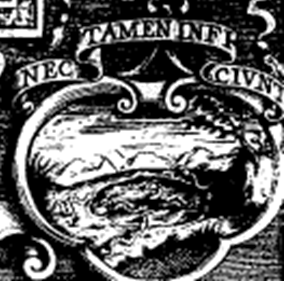
Agazzari’s second motto is placed ‘stage left’, rhetorically the ‘bad’ area in contrast to the cosmos diagram placed in the ‘good’ area. It captions an image of the serpent in the pit of hell, and warns ominously:

And they don’t mess up, either!


Nec tamen inficiunt


If we view Caccini’s invitation for singers to apply senza misura and Agazzari’s description of the continuo ‘guiding the voices’ through the lens of these two mottos, we see a practice that today’s jazz-musicians would recognise: a singer is free to sing before or after the beat, whilst (in the Rhythm Section) the continuo-players maintain the Tactus. “And they don’t mess up, either!”.


Conclusion

Modern advice about jazz cannot prove anything, either way, about Early Music. But the parallels I’ve drawn here show the vital significance of underlying assumptions. Today’s performers approach Caccini and Monteverdi with the anachronistic label ‘Recitative’, which encourages them to abandon the period assumption of steady Tactus. Instead, they assume that the way to ‘express emotions’ is to use 20th-century rubato. But jazz and Caccini are not ‘expressing’ what the performer feels, they seek to move the audience‘s passions. Jazz does this by allowing the singer subtle rhythmic flexibility whilst the Rhythm Section maintains the swing; Monteverdi notates precisely this; I suggest this is what Caccini meant by suggesting senza misura for singers.

The underlying assumptions about music in the early 17th century are that Rhythm is a high priority, that there is a steady Tactus, and that this Tactus is maintained by the continuo.

Agazzari frontispiece

Please join me on Facebook https://www.facebook.com/andrew.lawrenceking.9 and visit our websites www.TheHarpConsort.com

www.IlCorago.com and www.TheFlow.Zone

Opera, orchestra, vocal & ensemble director and early harpist, Andrew Lawrence-King is director of The Harp Consort and of Il Corago. From 2010 to 2015 he was Senior Visiting Research Fellow at the Australian Centre for the History of Emotions.


Flow (The Oxford papers) Part 1: What’s in a name?

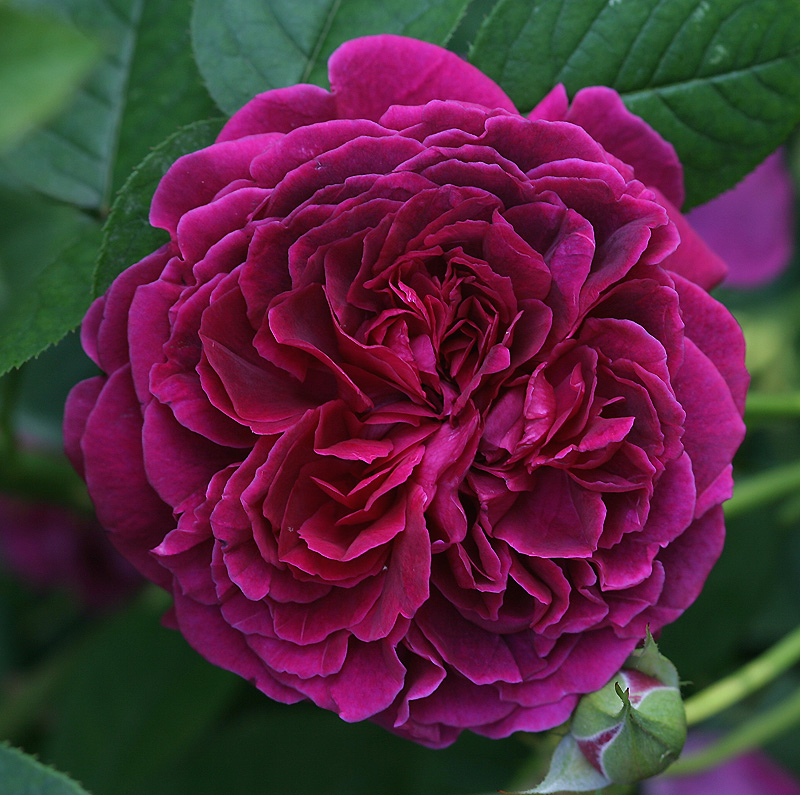
What’s in a name? That which we call a rose
By any other name would smell as sweet.

Shakespeare Romeo and Juliet (1597) Act II Scene ii

The Shakespeare Rose

The Shakespeare Rose


This is the first in a series of posts reporting on the recent Music & Consciousness 2 Conference at Oxford University. Here I present the first part of my own paper. The second part and discussion of other papers will appear in subsequent posts.

Flow, an optimal state for study, training and creativity, is often linked with the concept of The Zone, an ideal state for elite performance. Are these two states identical, or how might they differ?  Does it matter, which name we use? See more at TheFlow.Zone


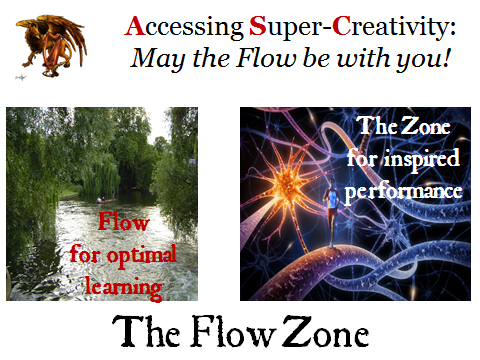
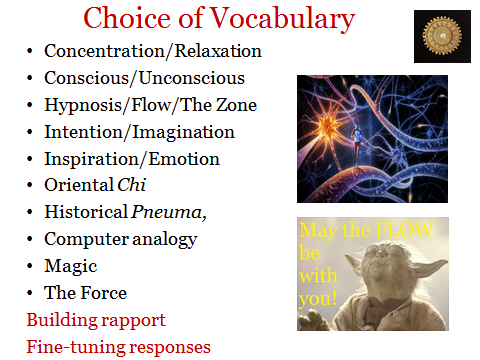
See also May the Flow be with you! here.

ABSTRACT

In this first of two parts, I’m considering the similarities between Flow and The Zone, as two of the many different manifestations of Hypnotic trance. I’m arguing for very careful use of language, but not for the sake of a more rigorous theoretical discussion. The narrow definitions of some terms are highly contentious, so I’m deliberately accepting broad definitions in order to sidestep those theoretical debates. But I suggest that precise choice of terminology is vital, for utterly practical reasons.

As you read this paper, imagine it being presented aloud at a conference, with the words in bold emphasised by subtle changes in vocal tone.

APPROACH

My approach to this subject is Experiential, Phenomenological, individual and practical. I draw on my personal experiences as an international musician, as a professionally qualified sailor (sailing is one of Csikszentmihalyi’s favourite examples of Flow) and as an elementary student of Feldenkrais Method, Tai Chi, modern Epée and historical Rapier. I’m also privileged with many opportunities to compare notes with fellow performers and advanced music students, as well as with highly experienced teachers and some of the world’s most insightful sports trainers and martial artists. The theoretical background to my approach is Joe Griffin’s Expectation Theory of Dreams. Griffin speaks about his theory on video:


I discuss the implications of Griffin’s theory for Flow and for music & drama here.

STATES

For a moment, let’s leave aside the much-debated theoretical question of whether or not Flow can strictly be termed an Altered State of Consciousness, although later I’m going to place great importance on nomenclature for practical reasons. We can agree, can’t we, that sometimes we feel in the mood to work, ready to practise; or we feel the coffee-break coming on, or even “I’m in a right state”;  or we experience that je-ne-sais-quoi as we walk out on stage in front of a packed auditorium, or line-up to compete in a major sports event.

Our expectations and habits, our deliberate preparation and conditioned reflexes, Anchors in NLP-speak, set up mind/body responses which can be positive or negative for desired outcomes in specific situations. Those responses can be optimised through mental and physical training: music lessons, practising and rehearsals; sports training and coaching sessions.

LANGUAGE

Those responses are most effectively optimised through combined mind/body training in which physical processes and neural changes are programmed by specific use of language.

It matters – a lot – what you say in a music-lesson, rehearsal or coaching session. It matters – perhaps even more – what you say to yourself, your inner dialogue, whilst practising. My choice of words as director differs depending on whether I’m rehearsing baroque specialists or a modern chamber orchestra. And each individual has their own inner dialogue and primary sensory modality. “I see what you mean.” (Visual).  “I hear what you’re saying.” (Auditory) “I’ve got a hold on that idea.” (Kinaesthetic) “That feels right.” (Somatic) “Sweet!” (Gustatory).

ASSUMPTIONS

I began my research with two huge assumptions. I won’t call them hypotheses, because they probably can’t be proved. It may well even be impossible to falsify them. But thus far, they are producing meaningful questions and plausible answers.

My first assumption is that this phenomenon of Flow has some essential common features across a wide range of activities: study, creative work, music-making, sports, martial arts, flying aeroplanes etc. Csikszentmihalyi has observed the outward signs of Flow in many different situations, but it remains an unproven assumption that the inner reality is somehow ‘the same’.

The second assumption is that Flow is an ‘altered state of consciousness’ similar to ‘hypnosis’. Just as there is debate about the notion of ‘altered states of consciousness’, there is no universal agreement about what Hypnosis is. The ‘first and perhaps most important’ theme of ‘dialogue and debate’ in the 2008 Oxford Handbook of Hypnosis is of definition: what is Hypnosis? However, the neural correlates of Hypnosis have been identified:

‘Now, numerous experimentally controlled investigations have produced consistent and converging findings demonstrating physiological responses associated with hypnotic conditions … these markers directly reflect the alterations in consciousness that correspond to participant’s subjective experiences of perceptual alteration’ [Barabasz and Watkins 2005].

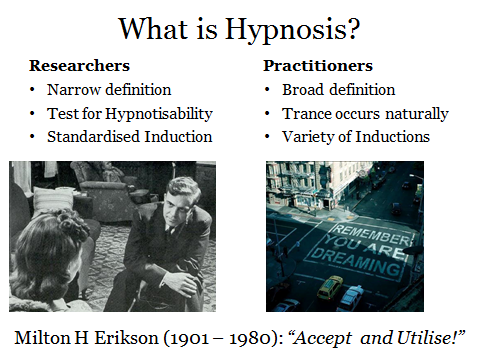
What is Hypnosis?

What is Flow?


HYPNOSIS

Whilst there are many unanswered questions in Hypnosis Research, linking Flow to Hypnosis invites us to consider all the work that has already been done for Hypnosis for possible relevance to Flow. For example, neurological patterns whilst hallucinating a certain action in Hypnosis closely resemble the patterns for that activity when carried out for real. Similarly, we can expect that the brain activity of a musician playing in Flow will resemble that of another musician not in Flow, more than that of Flowing Kung Fu fighter. Any specific neurological markers for Flow are likely to be subtle, but Hypnosis studies might suggest where to look. [There were tentative suggestions of neural correlates for Flow in other papers at the Oxford Conference].

Researchers tend to adopt a narrow definition of Hypnosis, requiring a formal induction and specified tests. Experimental work begins by testing subjects for hypnotisability, using a Standardised Induction.  Most practitioners work with a broad definition, using a great variety of inductions, formal and informal. The guru of modern hypnotism was Milton H Erikson, who viewed trance as a natural phenomenon, a state we all go in and out of several times a day.


What is Hypnosis?

What is Hypnosis?


Have you ever made a familiar journey, and found yourself at your destination with no clear memory of how you got there, because your mind was on something else? You were in a travel trance. Have you ever been in a lecture-room and found yourself off in a little daydream, with no idea what the speaker just said? You were in a conference trance!

Erikson’s mantra was to Accept and Utilise his clients’ reactions. So if you have already drifted off, wonderful! I can get my suggestions over so much more effectively, if you are in trance. Erikson’s approach was client-centred, tailored to each individual, whereas Research pre-supposes that the Hypnotist has his own agenda. There are ethical considerations here. In the Eriksonian understanding of Hypnosis, self-hypnosis is quite possible, and most practioners consider it highly beneficial, teach it, and give Suggestions during sessions of guided hypnosis to facilitate self-hypnosis later.

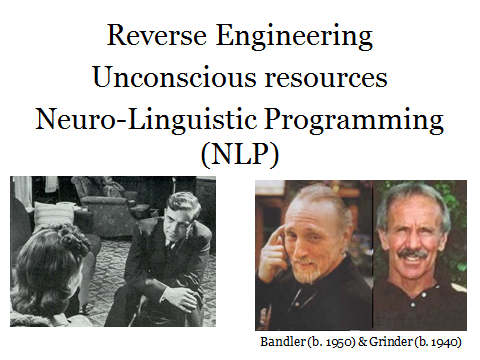
What is NLP?

What is NLP?


Neuro-Linguistic Programming largely derives from Eriksonian Hypnosis, analysing precise use of language to maximise the speed and efficacy of Suggestions. NLP is ‘take no prisoners’ Hypnosis: it does not beat about the bush, but cuts straight to the chase. Consequently, before embarking on any therapeutic procedures, NLP practitioners spend some time establishing whether the client really wants and is ready for the requested change.

Practitioners recognise that individuals respond to Hypnotism in different ways, and that an Induction that works for one person may not work for another. In the Eriksonian approach, the Hypnotist does not try to force through against ‘client resistance’. Rather, one accepts that a certain Induction or Suggestion isn’t working, and one tries to utilise that knowledge to indicate a more promising alternative.

In my favourite Erikson story , the famous therapist was struggling with a difficult case: he couldn’t find an effective therapeutic approach. So he hypnotised the client, and brought him (whilst in trance) forwards in time to a date after the successful conclusion of his treatment. He then asked him what the therapy was, that had succeeded, and having obtained the answer directed the still hypnotised client to forget this conversation. He then brought the client back to the present, re-oriented him out of trance, and applied the therapy as described. It worked a treat.

The point is that the unconscious mind is a rich resource, full of knowledge and skills that may not be available to us in normal consciousness. In music teaching and sports coaching, the 19th and 20th-century trend was towards analysis and scientific teaching of step by step processes. But sometimes it can be more effective to reverse-engineer: focus on the end-result, and let the student’s unconscious figure out the required process. Fencers are taught to imagine the target attracting the point of the sword towards it.

HYPNOTISABILITY?

In principle, NLP does not accept the concept of hypnotisability. If your client cannot be  hypnotised, you are using the wrong induction. Conversely, many people enter Hypnosis without formal induction. If this is true, as most practitioners believe, then some of the most rigorous Hypnosis Research is called into question. Standard practice compares the responses to Suggestions of hypnotised subjects and of a control group who did not receive an Induction and are therefore taken to be in a normal state of consciousness. But in the NLP view, there is no guarantee that the control group are not also in trance, especially if you start making hypnotic Suggestions to them. Indeed, in NLP, the very concept of ‘normal consciousness’ is questioned.

FAQs

One of the most inspiring applications of Hypnosis is for control of pain during surgery, for example for patients who are are allergic to conventional anaesthetics. I’m acquainted with a Hypnotist who provides hypnotic anaesthesia for major dental surgery – if anyone still thinks of Hypnotism as a party-trick or a new-age fad, this clinical application is undeniably the real thing.  Some clinical psychotherapists use Hypnotism alongside other talking therapies.

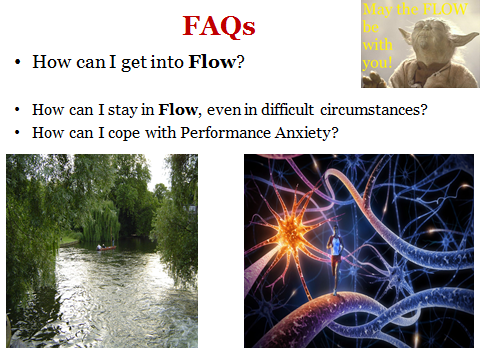
Then there is a huge Hypnotism industry worldwide, offering Hypnosis in face-to-face sessions, on CDs and DVDs, or for download from the internet. Help with losing weight, giving up smoking, relationship problems, phobias and anxiety is much in demand. Alongside these, and also in sports- and music-guru websites, Flow and other performance-enhancing concepts are marketed similarly. In these circles, it is taken for granted that Flow or ‘being in the Zone’ is the secret of elite performance, and that Hypnotism can help you achieve it. The most frequently asked questions are How can I get into Flow? How can I keep Flowing in difficult circumstances? How can I cope with Performance Anxiety?

Flow FAQs

Flow FAQs


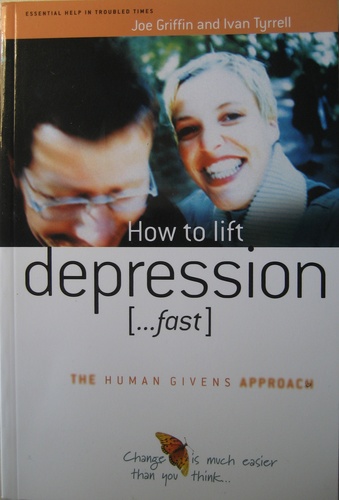
Griffin’s theory of Dreams offers an explanation for the link, often remarked on, between high creativity and susceptibility to mental illness. Recent studies have highlighted the incidence of mental health problems and alcohol dependency amongst professional musicians; performance anxiety afflicts not only students but many established performers. Beta-blockers and other drugs are frequently needed, to say nothing of dangerous levels of caffeine. Mental illness causes untold suffering not only to the patient, but to their families and to society as a whole: the recent airplane crash in the Alps is tragic example. See Griffin & Tyrell How to lift Depression […fast] here.

Many people find that trance itself – for example, in Meditation – is a beneficial experience, even without any deliberate input of therapeutic Suggestions. Flow for music-making, for study, creativity and for life in general, is highly conducive to mental health.

How to lift depression ... Fast

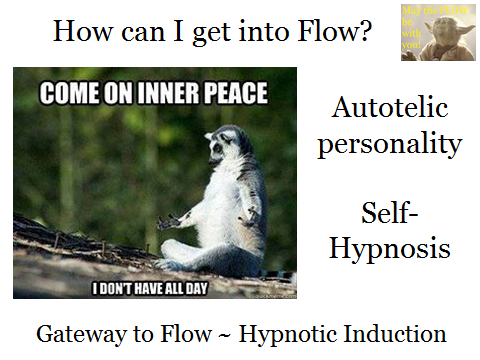
HOW CAN I GET INTO FLOW?

Csikszentmihalyi associated Flow with a particular personality type, the Autotelic, from auto ~ self & telos ~ purpose. Autotelics are strongly self-motivated, ready to do something for its own sake, ‘because it’s there’. If you feel that the task at hand is interesting and worth doing, you are more likely to be in Flow whilst you are doing it. If you can find this motivation for yourself in many activities, you can live much of your life in Flow.

This is all very well, but it does not answer the most frequently asked question: How can I get into Flow, now? Re-building your entire personality might be a long-term project. Can we find a short-cut, a magic portal, a hidden gateway into Flow?


How can I get into Flow?

How can I get into Flow?


The idea I’m putting forward here, that Flow might simply be a phenomenon of Self-Hypnosis, seems to be a new contribution to the field. The implication is that techniques for entering Flow would resemble hypnotic Inductions.

TYPICAL HYPNOSIS SESSION

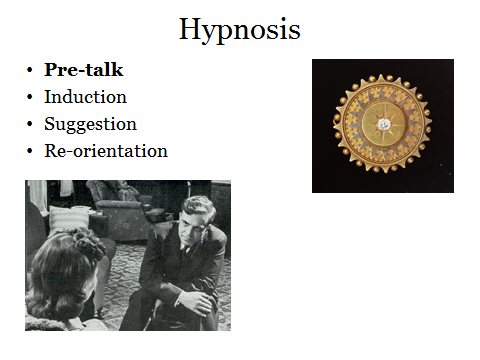
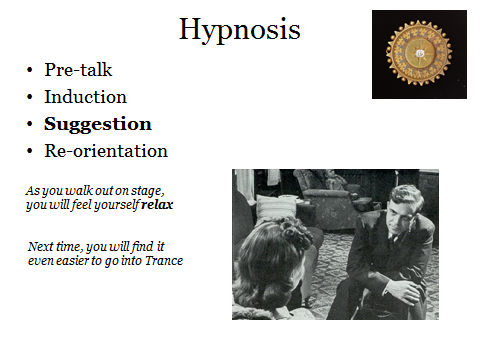
Hypnosis 1: Pre-talk

Hypnosis 1: Pre-talk

So let’s look at a typical experience for a Client who visits a modern Hypnotist. There will be some introductory chat, which the experienced Hypnotist will utilise to build rapport, to find out what’s important to his Client, to explain the procedures of the session and to instill confidence. This phase is called the Pre-Talk, and a fine Hypnotist will be able to do a lot of effective work, before taking the Client into trance. An NLP practitioner might not draw any hard boundary between pre-talk and trance, regarding shifts of state as a natural process that is happening anyway.

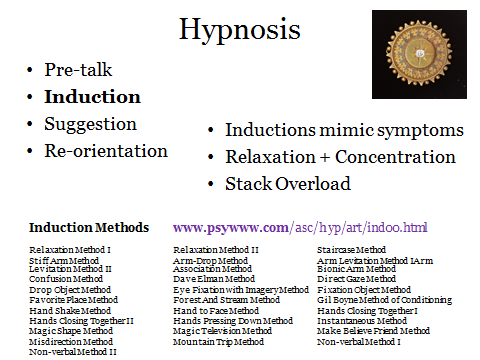
Hypnosis 2: Induction

Hypnosis 2: Induction


There are many possible approaches to Induction (for example, there’s a list of over 30 different Inductions here), but most of them mimic the results of Hypnosis, slow deep breathing, fluttering eyelids, etc. so that the unconscious mind reverse-engineers trance as a cause. Suggestions for relaxation and concentration, whilst seeking an inner focus, are very often employed, using a gentle tone of voice… drifting easily from one suggestion to the next … smoothly avoiding full stops … timing suggestions with the Client’s outbreath…

Alternatively, one can overload the conscious mind with shock, excessively confusing language, or too many simultaneous demands, so that the unconscious is forced to step into the gap. Fencing coaches deliberately employ such Stack Overload, maintaining the complexity of swordplay just beyond the pupil’s comfort zone, in order to keep the unconscious mind positively engaged whilst under the stress of combat.

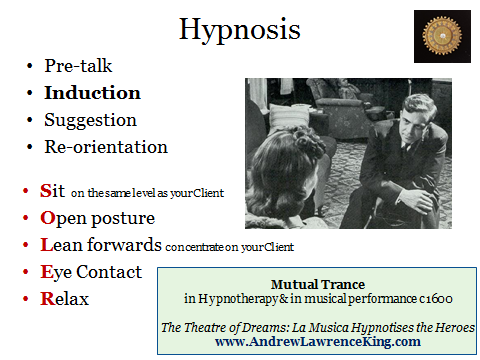
Ericksonian Hypnotists use the mnemonic SOLER for techniques that facilitate rapport:

Erikson's SOLER mnemonic

Erikson’s SOLER mnemonic


  • Sit (be comfortable, and on the same level with your client)
  • Have an Open posture
  • Lean forwards (and concentrate closely on the client)
  • Make Eye contact
  • Relax


With such rapport, and with the Hypnotist also enjoined to sit comfortably, concentrate and relax, it is hardly surprising that one can all too easily end up hypotising oneself. In the NLP view, mutual trance is inevitable and no bad thing: Hypnotist and Client find themselves in complementary states of consciousness, similar but not identical. So too performers and audiences: see The Theatre of Dreams: La Musica hypnotises the Heroes here.


Neuro-Linguistic Programming

Neuro-Linguistic Programming


NLP practitioners use indirect language, so-called Sleight of Mouth, to smuggle suggestions past the conscious mind in order to influence the unconscious. Conjunctions – as, while – can link a truism to a desired response: As you breathe out, you can feel your shoulders relaxing. Whilst you sit in this room, you’re unconscious mind can access new learnings. Clearly, you are sitting in this room and breathing; the implication is that the second half of each sentence is also true. Emphasising certain words allows the Hypnotist to hide an Embedded Command within an apparently innocuous statement: “your Unconscious” sounds like “you’re unconscious”.  Deliberately vague language, Nominalisations in NLP-speak, access new learnings rather than learn something new directs the mind inwards in the search for meaning (a Trans-Derivational Search).

Whilst you sit in this room, you’re unconscious mind can access new learnings.

So it’s no wonder that the abstract, nominalisation-rich language of academia puts people to sleep!

There are many, many more NLP techniques, subtle use of language that works directly on your Unconscious mind, to get the results you want. Read more here.

Hypnosis 3: Suggestion

Hypnosis 3: Suggestion


With the Client in trance, there may be a two-way conversation, or the Hypnotist may ask for non-verbal responses – raise your hand when you’re ready to continue . Typically, the Hypnotist gives Suggestions for desired responses to specific situations in the future. As you walk out on stage, and you take a deep breath, you will feel your shoulders relax, and your whole body feels warm and relaxed. with a pleasant sensation of calm confidence. Suggestions work without trance, especially if you use NLP techniques to aim the Suggestion direct at the Unconscious mind. But Suggestions work better with trance, and best of all with a combination of trance and NLP’s clever use of language.

And of course, your own internal dialogue, the way you talk to yourself (perhaps mostly imagined, sometimes out loud) is a powerful form of Suggestion. It’s worth becoming aware of this ‘self-talk’, and learning to direct it the way you choose to. If your internal dialogue is over-critical, negative and in a harsh tone of voice, you are are imparting powerful negative Suggestions at point-blank range. Adjust the tone-settings, and re-record the announcements with a new script, so that you speak to yourself with gentle encouragement, some firm guidance to follow your chosen path, whatever would help you most. Your internal dialogue is like having a personal trainer whispering in your ear 24 hours a day, 7 days a week. Make sure this “personal trainer” shares your agenda and speaks to you with warm encouragement.

Most people can take charge of their internal dialogue, and improve its quality, with a bit of work. But if you realise that your self-talk is highly negative, and you are unable to change it yourself, then seek help. An NLP or hypno-therapist can fix this for you, easily and quickly. I would recommend a therapist using the Human Givens approach, see here.

A wily Hypnotist will Suggest that next time, the Client will find it easier and quicker to go into trance.

Hypnosis 4: Re-orientation

Hypnosis 4: Re-orientation


Then the Client is gently re-oriented back to normal consciousness: the classic procedure is a 3, 2, 1 countdown, Suggesting a pleasant experience as you emerge from trance.

Learning as a post-hypnotic process


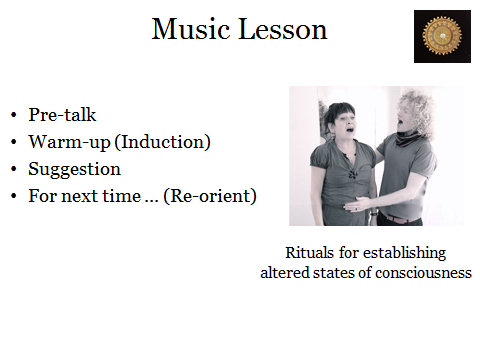
If we now look at a sports coaching session, there are obvious similarities. In the pre-talk, the team are brought together, rapport is established, the program for the session is announced, the vocabulary shifts from everyday to specifics. Warm-up exercises aim for a certain combination of concentration and relaxation, there may even be a formal ritual for achieving the desired state of mind and body (e.g. the New Zealand ruby team’s Haka). With the athletes in the Zone, the coach gives Suggestions to improve performance. The session ends with a warm-down, and a good coach sends everyone home feeling good.

Sports Coaching compared to Hypnosis

Sports Coaching compared to Hypnosis


Similarly, a typical music lesson begins with a pre-talk which establishes rapport, eases the student from everyday life into a suitable state of mind for high-level music-making. A good teacher will calm an agitated student, energise one who is lethargic, and try to find out how best to fit the lesson to the student’s current needs. Many lessons begin with exercises for relaxation, physical and mental ‘centering’, almost a formal ritual for entering the desired state. During the lesson, the teacher offers Suggestions to improve technical execution, or to help the student engage more fully in musical emotions. Finally, the teacher makes Suggestions for the forthcoming performance, and/or for the next week’s practising, and re-orients the student back into everyday life with some concluding chat.

Music Lesson compared to Hypnosis

Music Lesson compared to Hypnosis


The working definition of Hypnosis put forward by Kihlstrom fits Music rather well.


Definition: is this Music, Sports, or Hypnosis?

Definition: is this Music, Sports-coaching, or Hypnosis?


A process in which one person … offers Suggestions to another … for imaginative experiences entailing alterations in perception, memory and action. In the classic case, these experiences are associated with a degree of subjective conviction…and an experienced involuntariness…As such, the phenomena … reflect alterations in consciousness that take place in the context of a social interaction.

Of course, a good teacher will offer Suggestions for imaginative experiences, and will try to improve the student’s perception, memory and action. Good musicians develop a ‘feel’ for the music, a strong sense of subjective conviction:

When I played through the whole piece, it just seemed that this passage had to be loud.

And when you are playing especially well, you can ‘let your fingers do the hard work’:

If you just close your eyes, relax, and focus your intention on that octave leap, your fingers will find their way to the right note all by themselves. 

Music and sports coaching closely resemble hypnosis sessions, especially if they are done well. If there is good rapport, good concentration and the right kind of relaxation, good coaching takes both participants into a special state, in which there is communication and learning via the unconscious mind, facilitating powerful Suggestions for future action.


Mind/Body Awareness

Mind/Body Awareness


Many music conservatoires offer classes in Mindfulness, Yoga, Alexander Technique, Feldenkrais Method. Tai Chi and other disciplines teaching mind/body awareness. These are highly effective in improving concentration and relaxation, and instilling an effortless way to use the body that gradually becomes ‘second nature’, ‘automatic’. These outcomes help students enter the music-making trance more easily, and the teaching methods are also highly hypnotic.

Mindfulness teaches breathing exercises and control of one’s own attention, for example by intense focus on small movements.  Feldenkrais directs the mind inwards with such questions as As you rest your feet on the floor, can you feel more weight on your right foot, or on your left? Or are they the same? Don’t change anything, just notice. This is a well-known technique of hypnotic induction. Feldenkrais also normalises and accepts the student’s experiences, in a similar way to Eriksonian hypnosis: ‘that’s right‘, ‘good‘.  Making small changes to habitual actions calls the unconscious mind to attention:

Clasp your hands and interlace your fingers, then re-clasp them with the other hand on top … very good.

Similarly, Tai Chi and other martial arts use breathing, visualisation exercises, unfamiliar postures and exotic names – Nominalisations – to alter the state of consciousness of the student, in order to maximise the mind/body effectiveness of training. Stand in Wuji stance, with the head suspended from above, hollow the chest, relax the waist, open the Bubbling Spring points at the centre of each foot, let your hands rise of their own volition to hold a ball of green energy at eye level, breathe slowly, feel the Chi descend to the Dan-Tien.

This makes a perfect hypnotic induction, and the best teachers use a gentle, slow tone of voice, and linking conjunctions as recommended in NLP. AS you transfer the weight to the front foot … your right hand moves outward … PENG! See Michael Gilman’s Tai Chi videos, here.

But it’s not all gentle meditation. There is also inner power, the strength of spirit that we look for from a great musician or a dedicated athlete. Good martial arts require that same combination of relaxation and concentration that is induced in hypnosis. See Ian Sinclair’s approach to the Wuji Stance, perfectly characterised by his motto “Relax Harder”,  here.

As all good teachers do, Sinclair uses humour to get across some of his most serious advice. A corny joke makes the lesson more memorable, of course, but it is also a NLP technique for disarming the conscious mind, so that the Suggestion goes direct to your Unconscious mind, where it is even more effective.

There are further connections here. Moshe Feldenkrais was himself a Judo black belt, and one of the first to bring Judo to the West. He contributed several books on Judo, which emphasise the deeper elements on the art, offering mental and spiritual development as well as physical skills. His first book on his Method for teaching Awareness through Movement links Body and Mature Behavior: A Study of Anxiety, Sex, Gravitation and Learning.

Hypnosis-aided Learning

Hypnosis-aided Learning


One of the particular benefits of hypnosis-aided learning is that your Unconscious is given more opportunity to integrate newly acquired skills and knowledge with previous expertise. Relaxation, combined with enhanced access to the unconscious mind, promotes the establishing of new neural connections, and even allows the brain itself to grow, increasing neural capacity for the skill being practised – neural plasticity. Concentration encourages the growth of myelin around those neurones, leading to faster, surer responses.

ETHICS

If the NLP view (shared by many practising Hypnotists and Psychologists in this field) that trance is natural event is accepted, if we even admit the possibility that teaching can be a hypnotic process, then we should consider seriously questions of Ethics. If I’m giving a harp lesson, informed consent to Hypnosis has not been given. Nevertheless, good teaching should change the student’s state and help them access deep levels of the mind-body link. I would argue that good teaching cannot help but be hypnotic. So how can we ethically employ NLP techniques in teaching?

My personal response to this question of ethics could be described as “What does it say on the tin?”. If someone comes for a harp-lesson, I teach them harp-playing. If I’m asked for a lesson on Flow, or on Hypnosis, I’ll work on those topics. If someone comes for a harp-lesson, but it emerges that direct work on finding Flow or managing Performance Anxiety is needed, then I’ll seek agreement before changing the approach of the lesson. I introduce Feldenkrais Method in the same terms of “Awareness through Movement” that are standard vocabulary amongst Feldenkrais practitioners, using pre-recorded lessons prepared by licensed teachers. (I am not myself qualified as a Feldenkrais teacher. More about Feldenkrais Method here)

The Bottles Exercise

But here is an example of a ‘straight’ teaching technique that works by appealing to the student’s unconscious mind. I use this exercise to teach relaxation of the hands for Early Harp playing and also for Baroque Gesture.

water bottles

1. Hold you hands out, palm upwards, and imagine that you are holding two large, 1-litre, plastic bottles, full of water. As the bottles lie horizontally in your hands, wrap your fingers gently around the bottles. Feel the cool touch of the plastic… are there drops of water on it? Use just enough strength to support the bottles.

2. Now pour out half of the water, and then hold the bottles again. Notice how much less effort is needed, now.

3. Now pour out the rest of the water, and hold just the empty bottles. Notice how your hands feel, now.

[Read more about applications of this Bottles Exercise for Early Harps and Baroque Gesture here]

Whenever I use the bottles exercise in routine teaching, I’ll explain that doing it imaginatively, without the actual bottles, is actually more effective, because it requires more concentration and engages the unconscious mind. I’ll use the vocabulary of concentration, relaxation, conscious attention and unconscious mind; but in a regular lesson, I would avoid the word Hypnosis.

How to Practise

I might explain how to practise an ornament slowly, with conscious attention, and then to relax, let go, and let your fingers fly ‘by themselves’. To help the student get the notion of conscious control and fingers that work ‘by themselves’, I often use the image of a little bird learning to fly, closely watched by its attentive parents. At a certain point, the bird just has to jump out of the nest and fly by itself. I help the student change back and forth between conscious control and ‘flying’, by teaching how to change the head-position and gaze, how to use breathing and posture. Sometimes it can help to distract the student’s conscious mind at the moment of ‘take-off’. See How to Practise here.


Baby Owl learning to fly

Baby Owl learning to fly


The interlinked themes of artistic intention, strength of purpose, emotional commitment, physical movement and emotional communication often emerge in music lessons. One needs a vocabulary for discussions of that emotional sensation of a dissonance, that is understood in the mind, felt in the body and mysteriously communicated to the listener; or for analysing the communication of musical effects that cannot actually be created on certain instruments. When you pluck a harp string, the sound then decays, you can’t make a crescendo. But I have to teach students how to make an audience believe there was a crescendo. Although there are technical tricks with sound-quality, timing, articulation and the dynamic relationship to preceding and following notes, the most effective strategy is to imagine the desired crescendo, as vividly as you can, and project that idea with all the force of your powers of imagination.

Similarly, in the Prologue to Henry V, Shakespeare asks the audience to work with their imaginary forces and to Think, when we talk of horses, that you see them / Printing their proud hoofs i’ th’ receiving earth. This entire speech, with its famous opening line O, for a Muse of fire, is a hypnotic induction that entrances the audience, encouraging them to suspend their (conscious) disbelief, to allow the actors to Suggest with their words far more than could ever actually appear on stage, and to receive those words into their Unconscious, in order to heighten their emotional response to the drama that follows.

Imaginary Puissance

Imaginary Puissance


NLP recognises that each individual has their own way of seeing the world, a preferred mode of representation. Erikson was always ready to change his vocabulary to suit his clients’ needs.

I vary my vocabulary, according to the student’s background. One can be scientific, and talk about intention and imagination; arty, with talk of magic and mystery; historical, with the 17th-century concept of Pneuma. Some students appreciate the computer-analogy; you sit at the keyboard, loading sub-routines into the computer, and then you hit RUN and leave the machine to operate at maximum efficiency without further keyboard input. Hungarian Flow-researcher Lazlo Stacho employs the vocabulary of Magic, recalling ancient connections between music and shamanism; there are still folk practices of hypnotism in Eastern Europe today. I find the Stars Wars idea of The Force helps some students find their own way to an understanding of these unconscious processes, that are hard to describe or measure.

Choice of vocabulary affects not only the processes of building rapport and trance induction but also the post-hypnotic end-result. In experiments on the use of Hypnosis for pain reduction, some Subjects were given the Suggestion You will not feel any pain; others were told You will notice the sensation of pain but it will not trouble you. Both Suggestions were effective, but Subjects described the results differently, and neurological measurements showed corresponding activation of different areas of the brain. The unconscious mind is capable of distinguishing between subtly different means of controlling physiological phenomena that are beyond our conscious control.

For this reason, whilst in theoretical discussion I adopt broad definitions of such technical terms as Hypnosis, Altered States of Conscious, Trance, Flow etc., I believe that in practical sessions one should take enormous care with the choice of particular words. It’s vital that teachers adapt their vocabulary to suit their students. In the spirit of Erikson’s Accept and Utilise, one should acknowledge the student’s viewpoint of these topics, and use the corresponding vocabulary. It may be effective to introduce some mysterious word, such as Oriental Chi  or historical Pneuma, which can function as a Nominalisation and facilitate access to the Unconscious. But for teaching purposes, there is nothing to be gained by insisting on your own preferred vocabulary, your model of the whole process, even if (academically or scientifically) it is more correct. In this situation, your aim is to help students find (via the Unconscious mind) their own way into the desired state (whatever they want to call it, however they believe it works), not to engage their conscious minds in a debate over what the best name and most scientific explanation for that state might be.

Choice of Vocabulary matters for practical, not theoretical, reasons.

Choice of Vocabulary matters for practical, not theoretical, reasons.


Chunking and Dissociation


One essential part of the learning process is chunking. For a beginner, playing a single note on baroque harp is a challenge: rest your hand on the harp with the fingers gently curved, relax the elbow, align the structure of your whole body behind and underneath your fingers, place your thumb on (not behind) the string, move your thumb slowly into the hollow of your hand allowing it to slip over the string whilst applying steady firm pressure, keep moving your thumb for the duration of the note. With practice, all of that is chunked-up into “Play a Good note”.


A sequence of Good and Bad notes (Good/Bad is a technical concept in Early Music, derived from accented and unaccented syllables in poetry: read more here) is chunked into a phrase. Phrases are chunked into sections, movements, pieces, entire programs. Effective performance depends on the unconscious mind doing the detailed work inside each chunk, whilst the conscious attention is at a higher-chunked level. You think about the phrase, your fingers play the notes ‘by themselves’.

In Hypnosis studies, this is a phenomenon of Dissociation: the conscious attention is dissociated away from on-going physical processes. Perhaps you’ve had the experience of arriving upstairs, but being unaware of what you came up for….

Dissociation is perhaps the most significant marker of Hypnosis, and can be of two types. With dissociated Control, your conscious mind is unaware of a command given to your fingers, so that they seem to move ‘by themselves’; with dissociated Monitoring, your conscious mind is unaware that your fingers have moved, until you notice that ‘somebody moved them’.  With careful use of language, it should be possible to give Suggestions for the particular type of Dissociation required for a certain application.

There are subtleties in precisely how to apply dissociation at different levels of chunking. It can be utterly disruptive to divert the attention suddenly to a lower level of chunking. This is what happens if a tennis player is serving wonderfully, until you ask them “Exactly how do you throw the ball up in preparation for your serve?”  The balance between conscious and unconscious processes is upset, and the player’s game may collapse entirely. Paralysis by analysis! But contrariwise, it can be very helpful to suggest to a violinist that they engage their mind more with the sensual grain of the experience of drawing the bow across the string. The wrong kind of focus on technique can be counter-productive, the right kind of focus on detailed perception can be inspiring.

A teacher demonstrating often has to dissociate in order for the conscious mind to direct a running commentary on the actions being demonstrated, whilst the actions themselves remain under unconscious control. One learns a lot, by teaching in this way, and it makes an interesting exercise for students to attempt. A similar dissociation allows advanced performers to analyse their own technique with sharp focus but a certain detachment that keeps one relaxed.


Chunking & Dissociation

Chunking & Dissociation


Anchors

The NLP concept of an Anchor is rather like the bell Pavlov rang for his dogs. In training, ideally in hypnosis, the student programs himself for success by linking a certain stimulus to a desired response. As you walk out on stage, you take a deep breath, you feel your shoulders relax, and your whole body feels warm and relaxed, with a pleasant sensation of calm, confidence and concentration. Many performers have warm-up routines and pre-show rituals that function as Anchors to confident performance.

If the response is required only when called for in special situations, you can Anchor it to a highly specific trigger – when you clasp your hands that other way and breathe out slowly, you will relax and go into Flow. If the response is required automatically, you can Anchor it to an unavoidable trigger – as you walk out on stage, you enter The Zone.

NLP has methods for de-activating unhelpful triggers, typically by re-Anchoring them to a better response. It’s very difficult to inhibit an Anchored response, once it has been Triggered, so these methods rely on getting the Trigger to fire the new response first, before the old, unhelpful response can kick in.

Memory itself is an Anchored response, which functions best if the environment at the time of memorising matches the conditions at the time of recall. Hypnotists use small signals to Anchor key words: Flow, Relax, Concentrate. Language-teaching programs using hand signals, and baroque gesture (stylised signs linked to the text) work the same way. For musicians, the score itself (being read or performed from memory) provides a series of Anchors, whether deliberately created for positive results, or unconsciously built through anxiety or mistakes in the practice-room, causing negative responses.

Careful choice of vocabulary (in teaching, and in the self-talk of inner dialogue) ensures that the correct Anchor is Triggered, and unhelpful responses are avoided. If there is a command vocabulary that you associate with a bad response, then avoid using those instructions. For example. sometimes the word “Relax” only makes people more tense!

On the positive side, if you find your way into Flow by imagining the Star Wars ‘Force’, then continue to use ‘The Force’. But if the words ‘Magic’ or ‘Altered State of Consciousness’ work better, use them. Whatever works for you! Set the Anchor you can believe in, and reinforce it with constant repetition in easy circumstances: then it will work for you when you need it the most. The best situation for setting an Anchor is trance. Then use that Anchor, deliberately, even when the circumstances are so undemanding that it’s hardly required: then the Anchor will be strong enough to keep you safe in difficult situations.

To be continued…

In the second part of this paper, I’ll discuss in more detail what Flow is, how to get into it, and how to avoid losing it. You can also read more at TheFlow.Zone, here.

And the next time you read one of my blog posts, you’ll find it even easier to enter Flow.

Coming back to normal consciousness now …. 3: becoming more aware of your surroundings … 2: feeling wonderful …. 1: fully alert, now!

May the FLOW be with you

The Flow Zone


Please join me on Facebook https://www.facebook.com/andrew.lawrenceking.9 and visit our websites www.TheHarpConsort.com

www.IlCorago.com and www.TheFlow.Zone

Opera, orchestra, vocal & ensemble director and early harpist, Andrew Lawrence-King is director of The Harp Consort and of Il Corago, and Senior Visiting Research Fellow at the Australian Research Council Centre for the History of Emotions.

www.historyofemotions.org.au

Tempus putationis – Getting back to Monteverdi’s Time

tempus putationis


Monteverdi fans will recognise this snippet as part of the tenor solo, Nigra sum, from the 1610 Vespers. The text is usually given in English as ‘the time of the singing of birds is come’, translating direct from the original Hebrew of the Song of Solomon. Monteverdi’s setting creates a musical picture of the word tempus (time) with a succession of semibreves.

Cranes flock to Israel in early spring

Cranes in Israel in early spring


Around the year 1600, the semibreve is the note-value where Time as musical notation and Time in the real world meet. That meeting is governed by the Tactus, the physical movement of the hand, down-and-up. Down and up again corresponds to a semibreve, and lasts about 2 seconds. [Read more about how 17th-century notation was calibrated against real time in Quality Time, here]. So Monteverdi’s semibreves for tempus putationis are a musical picture of Time itself.

However, the Latin word putatio actually means ‘pruning’, so Monteverdi’s text actually refers to the early spring pruning of the vines [the Song of Solomon has more to say about the ‘vine with the tender grape’]. That might encourage some pruning of any bird-song ornaments from this phrase! And it inspires me to cut away all the excess foliage to show what I believe to be the essential structure of Time, in Monteverdi’s period.


pruning vines

For this ‘pruned down’ post, instead of arguing from original sources towards my personal conclusions, I’m going to begin by setting out (my take on) the starting assumptions of Monteverdi’s generation. Starting from these period assumptions (very different to those of today’s musicians), we’ll see what kind of music-making might grow, as buds from these particular shoots.


Honoro


This post is also inspired by Bill Hunt’s comments and challenges to my article on Proportions in Monteverdi’s Ballo, here. Thank you, Bill for your thought-provoking remarks: my replies and ripostes are below!

So let’s start at the very beginning, with the ut re mi  of seicento Time. But keep in mind: this is not simply a matter of practical music-making. We are dealing here with renaissance ‘Science’, that is to say the Philosophy of splendid, cosmic, divinely-ordained things, the knowledge of what really counts.


Splendidora explicat

MONTEVERDI’S TIME: PHILOSOPHY

  1. Monteverdi understood Time (as a philosophical concept) in Aristotelian terms, as defined by motus (movement, or change). This is very different from Newton’s concept of Absolute Time (1687) that still today underpins our intuitive grasp of Time.
  2. Time in the real world was defined by the heavenly clock of the cosmos. Each day, the sun reaches its zenith and defines noon.
  3. The best clocks of Monteverdi’s period could indicate the passing seconds, but could not measure seconds accurately. They were only accurate to about 15 minutes a day.
  4. Smaller intervals of time could be measured by the human pulse, the heartbeat. Although the heart-beat varies from person to person, and according to the physical state of the individual, it offered higher precision than the best clocks. But there was no means of calibrating this accurately to clock-time, since clock-time itself was insufficiently precise.
  5. Even smaller intervals of time could be measured by musical rhythm, subdividing to, say, 1/8th of a second. This was the highest precision timing known in this period (renaissance swordfighters wished to emulate singers’ sense of precision timing). Again, there was no means of calibrating this accurately to clock-time, since clocks themselves were inadequate.
  6. There was a strong belief in the existence of a single, divinely ordained, correct Time, defined by the cosmos, e.g. by the noon-day sun.

MONTEVERDI’S TIME: MUSIC

  1. Music itself was cosmic [musica mondana, the Music of the Spheres], and human [musica humana, the harmonious nature of the human body], as well as sound [musica instrumentalis, music sung and played here on earth].
  2. Musical Time was measured by the Aristotelean motus of the perfect movement of the cosmos, of the steady beat of the human heart, by the down-and-up movement of the Tactus hand.
  3. Just as citizens tried to regulate their clocks to run steadily (for practical convenience, and as faithful microcosms of solar time), so musicians tried to keep Time as steadily as humanly possible.  This regulation was at the level of about one second of clock-time; in music, it was at the level of the Tactus beat.
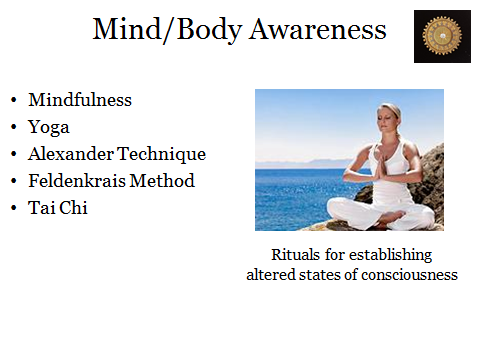
  4. Smaller intervals of Musical Time were measured by sub-dividing the Tactus beat.
  5. Just as citizens tried to calibrate their clocks to agree with each other, and with Solar Time, so musicians tried to agree with each other about Musical Time. The various members of a musical ensemble needed to agree on Time, in order to play together, just as citizens had to agree on a time of day, in order to meet each other. From one day to another, from one place to another, citizens and musicians alike tried to keep a consistent sense of Time. However, they had no means of precise calibration: they could only make their best human estimate. Consistent Time was what felt consistent.
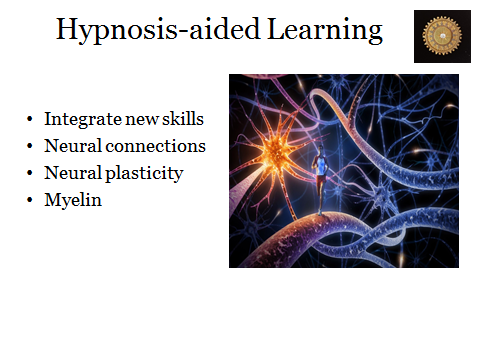
  6. There was a strong assumption of a single, heavenly-inspired, correct Musical Time. A musician’s job was to get it right, not to have a personal clock that ran unsteadily, or differently from everyone else’s.

MONTEVERDI’S TIME: TACTUS

  1. All this philosophy was put into practice using the Tactus, the down-up movement of the hand, which calibrated musical notation to real-world Time. The Tactus could be physically enacted, or just kept in mind as an organising concept: either way, it was compared to the heartbeat.
  2. Under mensuration symbol C, the complete Tactus cycle (down-up) corresponds to a semibreve. Down for a minim; up for a minim.
  3.  In Tripla Proportion, down corresponds to three minims, up to another three minims. The Tactus-beat is maintained without change.
  4. In Sestupla Proportion, down corresponds to six semi-minims (these look like crotchets in 6/4); up to another six semi-minims. The Tactus-beat is maintained without change.
  5. In Sesquialtera Proportion, down corresponds to two semibreves; up to one semibreve. The duration of the complete Tactus-cycle does not change, but now the down is longer than the up, the beat is ‘unequal’.
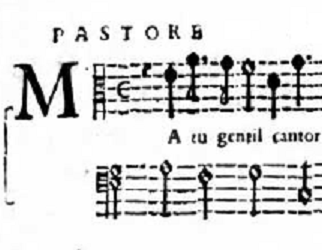
MONTEVERDI’S TIME: QUALITY

  1. Like the Cosmos, like a clock (but better!), like the heartbeat (but slower), the Tactus beats steadily and slowly.
  2. A musician’s job is to get it right, to keep it steady, to make it consistent from day to day and with everyone else’s.
  3. Like the stars in heaven, like a clock at the back of the room, the Tactus (as a concept) existed before the music started, will persist after the music stops, and continues across silences within the music. This Tactus-as-concept directs the music. The Tactus itself is the director, not the human who waves the Tactus-hand.

MONTEVERDI’S TIMES: CALIBRATION

  1. Music was calibrated to the Tactus at the level of semibreve (complete cycle) and minim (down alone, or up alone).
  2. The Tactus shared many vital qualities with the heartbeat, but was not calibrated to it (the heartbeat was generally faster).
  3. The Tactus felt slow and steady, as perceived in the human arm. This sets some limits (a finger could wag faster, the entire body might sway slower), but does not offer precise calibration.
  4. There was no means to calibrate the Tactus accurately to clock-time. The best approximation was about 1 beat (down, or up) per second for minims, i.e. about 2 seconds for the complete down-up cycle, for the semibreve. Tactus was calibrated not by clocks, but by a feeling of consistency.
  5. The Tactus felt the same, whatever the circumstances. We can imagine that in a large resonant building, the Tactus might actually proceed a little slower, in order to get the same feeling as in a small rehearsal room. We can imagine that, at moments of great excitement, or deep, genuine emotion, musicians might feel their Tactus to be consistent with the rehearsal, but this subjective impression would be altered by their human emotions.

MONTEVERDI’S TIME: HUMAN INTERVENTION

  1. Like the Cosmos, like the heartbeat, the Tactus has a conceptual existence and an authority that mere humans should not try to mess with. It is better than any clock, not in the sense of being ‘less mechanical’, but in the quality of being more accurate, more steady.
  2. A musician’s job is to maintain the Tactus steadily, consistently and in agreement with all colleagues.
  3. Within these assumptions, as a daring challenge to the stability of the Cosmos, and at the risk of upsetting one’s own heartbeat, performers began to flirt with the notion that the authority of the Tactus might not be wholly Absolute. In certain, strictly limited, situations, a human musician might intervene to alter (momentarily, minutely, infrequently) the way in which Tactus directs music.
  4. Caccini describes (and Monteverdi notates) a senza misura (out of measure) in which the singer temporarily ignores the Tactus. The Tactus continues as a concept, and in the continuo accompaniment. This is like a jazz singer floating elegantly around a steady beat in the rhythm section. This is a special effect, not to be over-used.
  5. Caccini and Frescobaldi describe (and Frescobaldi links to Monteverdi-type madrigals) ways to guidare il tempo (drive Time), in which the Tactus beats sometimes faster, sometimes slower, and even hesitates (momentarily) on the up-stroke. These changes are between sections (passi, movements), at the boundary of contrasting rhythmic structures and emotional content, not within one section. The alteration is a ‘step-change’, rather than a smooth acceleration/deceleration; it’s like changing gears, rather than using the accelerator/brake; it’s like the way a horse changes pace by changing gait (from walk to trot, canter and gallop), not the smooth acceleration of  jet-plane. This is a special effect, not to be over-used.
  6. When ‘driving the Time’ any change to the Tactus itself is small. The purpose is that the listener should perceive a change of emotion, not simply to turn the speed-dial up or down. When a noticeable change in the speed of the notes is wanted, the composer can notate this with changes in note-values, or changes in Proportion.


Golden Hand

Source references for these period assumptions can be found in many of my previous postings on Tactus, Time and Rhythm (use the Search button and Tags elsewhere on this page) and in Citations and Sources, below. There’ll be more in future posts, too. Tactus and the Philosophy of Time are discussed in great detail in Roger Matthew Grant Beating Time and Measuring Music in the Early Modern Era, hot off the Oxford University Press, and highly recommended, here.

But since this posting is pruned back to the essentials, I’m now going to apply these starting assumptions to Bill Hunt’s excellent list of  questions.

Galileo and the Philosophers

Galileo challenged by the Philosophers


In the discussion that follows, the challenges come from the eminent English viola-player, William Hunt, profile here. Three articles about the Ballo in Monteverdi’s Orfeo are under discussion: Roger Bowers on proportions here, Virginia Lamothe on dance here, ALK on tactus, proportions and dance here.

WH: I’d like to propose a contrary view. Part of the problem with Andrew’s fascinating discussion is that he sets up a number of straw men in order to arrive at his conclusions. Principal amongst these, in referring to the articles by Lamothe and Bowers on L’Orfeo, is the assertion “Their suggested metronome mark of approximately 50/60 as the Tactus Aequalis is certainly highly plausible. And Bowers agrees that the notation implies the same Tactus for the whole opera”. Bowers makes no such claim. 

ALK: (See ‘Citations and Sources’ below). I should first state clearly that I have great respect for Prof Bowers, and I agree with his points of principle. Indeed, I wish to go even further in the same direction of consistency that he recommends. I set up the assumption of  single Tactus for the whole opera, not as a ‘straw man’ to be cast away, but as a strong principle that I thoroughly agree with. Indeed, I believe that a particular notation implies the same Tactus wherever it is encountered in this entire repertoire (to the limits of subjective, human ability to maintain a single Tactus without any clock to confirm it).

For Orfeo, Bowers argues that the original notation conveys precise information that should be respected in performance. I agree. He argues that proportions are mathematically precise, and I agree. I disagree only on the detail of which mathematical ratio applies in certain instances.

In the Ballo, Bowers argues that there is no change in the meaning of note-values between the two triple-metre sections [3/2 and 6/4]. I agree. I go further to argue for equivalence of note-values between all triple-metre sections within the work [3/2 and 6/4 are the only triple-metre ‘time-signatures’ that occur in the whole of Orfeo]. I go further again, and argue for equivalence of note-values between sections in duple-metre too. Therefore, note-values only change, when the Proportion changes between duple and triple.

Bowers notes that all ‘time-signatures’ are governed by C throughout the whole work. He argues for a consistent Tactus from Sinfonia at the end of Act I to the entrance of the Messagiera. I agree, and I go further: I argue for a consistent Tactus throughout the whole work. I see no indication for a great increase of speed at the end of Act I, as the Sinfonia starts (Bowers’ argument requires a three-fold increase in speed at this moment). I see no evidence for doubling the speed (or more) between a “recitative” in C and the ballo also in C.

Bowers seems to be inconsistent about when he applies the principle of constant tactus, and when he does not. He wishes to apply it during the Ballo and through the Act I-Act II sequence, through many changes of ‘time-signature’, coloration etc. I agree. I go futher, I wish to apply it consistently throughout the work. But Bowers rejects the argument for constant tactus in general (see Bowers ‘footnote 33), without careful argument. Does he mean to say “Tactus is constant when I want it to be, and otherwise not”?

I say that Tactus is always constant, with only small and infrequent exceptions. I note Frescobaldi’s and Caccini’s discussions of when and how to change the tactus. They describe very restricted circumstances when tactus may be changed. And those changes should be small – if a composer wants double speed, he writes shorter note-values or switches to C-slash. [Some sources indicate that even C-slash is less than twice as fast as C]. If a composer wants a gear-shift of 3:2 or 3:1, proportional notation is available.

So I conclude that a performer’s personal choice of tempo-change would be within a small speed-range. And this personal choice would be exercised very infrequently. In his example madrigal, Caccini changes the Tactus only once (in response to an obvious cue from the words). Frescobaldi similarly sets specific conditions for change of Tactus: break between sections, change of rhythmic structure, change of affetto. Since they follow the affetto, these changes in tactus exaggerate what the composer has already notated: long note-values (for a sad affetto, say) are played in slower Tactus, short note-values (for a happy affetto) in faster Tactus. The affetto is determined on the short-scale, “line by line, even word by word” [Il Corago, Monteverdi and many other sources], but the Tactus only changes between sections, if at all.

Finally, when one considers the audience – it is after all their ‘affetti‘ we want to ‘muovere‘ – one realises that doubling or halving the speed has no effect. The listener perceives the same pulse, with different levels of activity. But a small increase in speed, in the context of precisely regular Tactus, has a strong emotional effect. It may even entrain the listener’s heartbeat, which was previously aligned with the regular, slow tactus, and increase it. As Renaissance theory of emotions describes, a performer might move the listener’s ‘affetto‘ and even create physiological changes in the body and blood (the doctrine of the Four Humours).

A fine example of this is Led Zeppelin’s “Stairway to Heaven” which accelerates between sections (within the general context, throughout pop music of that period, of steady tactus). There is some fascinating interview material with the performers, where they discuss the general context (“getting faster was absolutely prohibited”) and the emotional effect of a few small, but perceptible changes, in this song. I hear echoes of Caccini and Frescobaldi….


led_zeppelin_stairway_to_heaven


WH: I do firmly believe, as Andrew clearly does, that tactus was an essential structural constant that could unite consecutive and contrasting passages in logically proportionate tempi. On the face of it, the section which Bowers identifies, running from the Sinfonia to Act 2 up to the entrance of Messaggiera, is exactly such an instance, because of the succession of mensural signatures and the absence of intervening double barlines or fermata (the same is not true of the passage from “Lasciate i monti” up to the end of Act 1). Here, if one follows through Bowers’ notational logic, one ends up with a pretty fast tempo for “Vi ricordi boschi ombrosi”, as he says. Personally, I find that persuasive both musically and dramatically, but I have yet to experience it in performance, due to directorial intervention.

ALK: The entire opera (indeed this whole repertoire) offers ‘a succession of mensural signatures’. And I know of no period evidence that a fermata or a double-bar implies a change of Tactus. In Orfeo, Monteverdi sometimes places a fermata in one voice, when simultaneously another voice has no fermata: the fermata sign simply indicates ‘the end of something’, and cannot imply any alteration in the motus of the Tactus. Double-bars are often used to seperate consecutive strains of a single dance-movement, where a change of Tactus would be most implausible.

I don’t accept the argument that the passage from Lasciate i monti up to the end of Act I is somehow ‘different’.. It too has a ‘succession of mensural signatures’. Sure, it has some fermatas and double bar-lines, but so what? If Tactus is ‘an essential structural constant that could unite consecutive and contrasting passages in logically proportionate tempi’ [and it surely is!], then why not for the passage after the Ballo, as well as for the Ballo itself? Why not for the end of Act I, as well as for the bridge from Act I into Act II?

Does WH wish to say that “Tactus is constant when I want it to be, and can be changed when I want”? Or does he know of evidence of a fermata or double-bar as an instruction to change Tactus?

I believe that Tactus is constant, with only small and infrequent changes. Frescobaldi and Caccini list the circumstances in which the Tactus might be changed: neither of them mention fermata or double-bar.

WH: Bowers … analysis of the notation is that … semibreve of the C equates to dotted semibreve of the 3/2.  I suggest a tempo of something like semibreve = 52 for the opening (not a minim tactus, for reasons which I am coming to) becoming dotted semibreve = 52 for the 3/2, and finally bar = 52 (i.e. the ‘new’ semibreve = 52) for the 6/4: in other words a constant tactus.

ALK: I agree with the principle of a pulse that is maintained, and I have no objection to approximately MM52 for that pulse. And this interpretation of the proportions works too, in this place, starting from semibreve = 52 at the beginning of the ballo. But how do we find this tempo at the beginning of the ballo? Semibreve = 52 cannot apply to the whole opera – just try it for the beginning of the opera, for the Toccata or the Ritornello to La Musica or for any recitative: it is about twice as fast as possible. Why pick this fast tempo for this place notated in C, and not for another, also notated in C?

According to modern assumptions, directors can choose their own tempo, whenever there is a reasonable excuse (a fermata, a double-bar, personal inspiration, whatever). But according to period assumptions, the Tactus itself directs the tempo, and that Tactus is as constant as we humans can make it. (Caccini and Frescobaldi list limited circumstances where small and infrequent changes of Tactus might occur). My approach is to take that Tactus (somewhere around minim = 60), apply it at the beginning of the work, and maintain it, as best I can, until the end. And I’ll try to establish and maintain the same Tactus tomorrow, to the limits of my subjective perceptions of musical tempo.

The movement of the hand in beating Tactus is specified in period sources: in C, down for a minim, up for a minim. I find semibreve = MM52, i.e. minim = MM104 inconveniently fast for this mode of time-beating. I also find the resultant motus incompatible with the qualities of slow, steadiness that are associated with Tactus. I’m more convinced by the motus of minim around 60.

My approach starts from a broad principle, of a constant tactus. I apply this general principle first, before I look for solutions to particular problems of Proportions. I then apply the same solution to parallel situations. Following the Ballo under discussion, the next Proportional change in Orfeo is between the recitative (C) Ma se il nostro goir and the Ritornello (3/2), which moves in dotted semibreves and minims. My solution to the Ballo is  C: minim = 60 leads to 3/2: dotted semibreve = 60. My solution to the following, parallel situation is the same.

Bill’s solution to the Ballo [C: semibreve = 52 leads to 3/2: dotted semibreve = 52] does work there. But it does not work for the parallel situation of Recitative & Ritornello. Either the 52 pulse or the proportional relationship (or both) have to be abandoned. Is it Bill’s argument that although the notation is parallel, the second situation allows a personal choice, whereas the first situation indicates the composer’s tempo intentions? Why?

My belief is that the entire concept of personal choice of tempo is foreign to this period and its repertoire. Mensural notation indicates the composer’s intentions.

WH. … treating the central section of the first “Lasciate” as not being repeated. (No repeat is marked, of course, but a second verse of text is underlayed. I subscribe to Andrew Parrott’s view that this is a printer’s error, and that the second text should have been printed in the second “Lasciate”, instead of the repeated underlay of “Qui miri il sole”. This would result in an ABC form for each chorus, though, as Andrew (LK rather than P) points out, the uninformed listener would hear it as AABCC, because of the written-out repeats in the outer sections. This has a perfectly satisfactory symmetry. What is hard to believe is the format as it is printed).

ALK: I agree that the sequence of movements in the Orfeo Ballo is ambiguous – Lamothe has much to say on this. Andrew Parrot’s suggestion of a printing error in the 1609 edition is plausible, though one might have expected the editor of the 1615 edition to have fixed the problem, since much smaller errors were corrected (albeit at the cost of introducing some new errors too!). Lamothe makes a good point that the opening section (with the associated choreography of reverences and passi gravi, slow steps on the ground) would not be repeated in a court social dance. My point is that a similar opening section (which is not danced) is repeated in Cavalieri’s theatrical ballo for Anima & Corpo. We do not know which sections of the Orfeo ballo were danced, though it is sure that the singers themselves could not have danced a galliard, with all its jumps, whilst singing. Consideration of the repeat scheme for the Orfeo ballo has include all these points, together with scholarship on the total number of singers (between 7 and 9), the possibility that dancing masters might have participated (as is specified by Cavalieri), and the prohibition against women acting on stage, still in force in Mantua in 1607.

Good arguments can be made to support several possible solutions.

WH: Having read many of the linked sites here with great interest, particularly the one on “Text, Rhythm, Action / Rhythm: what really counts?”, I am curious to know what Andrew thinks about the semibreve, which so many theorists describe as the fundamental unit of time. There is so much emphasis throughout all his articles on the minim and the fixing to it of a constant tempo, viz “Around 1600, typically the Tactus will be on minims (half-notes), somewhere around MM60. Down for one second, Up for the next second”

Leaving aside the massive nature of this generalisation (is this really supposed to be typical of all music around 1600?), what about the concepts of Thesis and Arsis? It seems to me that these are essential to an understanding of musical structure in this period, especially the setting of text. Unless the semibreve is the unit on which one is principally focussed, not the minim, a whole vocabulary of subtlety is missed, to my mind. But that is a huge subject for another occasion!

ALK: Bill is absolutely right to draw attention to the fundamental significance of the semibreve. The complete Tactus-cycle (down-up) corresponds to a semibreve. I could equally well, perhaps better, express my view as “The Tactus-cycle will last for a semibreve, approximately two seconds, i.e. somewhere around MM30 for the complete down-up.” In duple time, this results in the same “Down for one second, Up for the next second”.

But an advantage of the focus on the semibreve is that it allows you to negotiate the tricky change into Sesquialtera more easily. The complete Tactus-cycle (down-up) still lasts  two seconds, but the Down lasts longer than the Up. This is why triple time is described as ‘unequal’ in this period. I agree with Bill that there are interesting and beautiful subtleties to be found in a heightened focus on the semibreve.

However, period sources specify that the mode of beating time for Tactus is that the semibreve corresponds to the complete down-up cycle. There is no suggestion of beating Down for one semibreve, Up for the next: the Down and Up are on successive minims.  Thus a heightened focus on the semibreve implies a heightened focus on the complete cycle, as opposed to the individual down/up movements: it does not imply a different mode of beating time. The concept of Thesis and Arsis (Down and Up) is therefore located in the alternation of minims (under mensural sign C). See my discussion of ‘The Hobbit problem’ in Quality Time, here.

Of course, there are duple (or other) symmetries at semibreve and longer durations too. It’s very good to be aware of these.

THE MASSIVE GENERALISATION

Returning to the fundamental assumptions with which I began, I agree that it is a massive generalisation to state that musical tempo was consistent throughout the whole repertoire in circa-1600 Italy, to the limits of human perception. It is a generalisation that is hard for us post-Romantics to comprehend. But it fits well with the evidence, not only of musical treatises, but of period philosophy in general. And we can observe the gradual change through the later 17th and 18th centuries; the persistence of notions of tempo giusto or tempo ordinario as late as Beethoven; the developing presumption of personal choice that comes to characterise the 19th-century; the glorification of Rubato circa 1910 that is taken by some today as a musical absolute. Those changes in musical practice follow changes in the scientific and philosophical understanding of Time itself, from Aristotle and Plato via Galileo and then Newton to Einstein and then Hawking.

It helps to keep in mind the 17th-century identification of musical tempo with Time itself, alluded to in Monteverdi’s setting of the word tempus at the beginning of this post. The ideal is to keep Time. A musician does not seek to develop a personal opinion about tempo, just as he does not seek to acquire a clock that runs differently from everyone else’s.

The difficulty is that we tend to read historical treatises on Music in the light of our modern assumptions of Science and Philosophy. If we start by assuming period philosophy, musical treatises reveal new, quite surprising details. To do this, we must be ready to abandon some modern assumptions so familiar that we hardly even notice them.

Most modern directors assume they have the right to choose their own tempo, movement by movement, through a baroque opera:  most of those directors fail even to notice the anachronism of conducting, as a means of imposing those choices. But period sources tell us that music is directed by Tactus itself: not by the whim of a Tactus-beater!. And Il Corago tells us that operas are not conducted.


No conducting


CITATIONS & SOURCES

At the opening of my article on the Orfeo Ballo, I tacitly linked up citations of Bowers and Lamothe with my own assumptions. So here are the individual elements:

Lamothe quotes Bowers on MM 50/60 (but identifies this with the semibreve, which  would not work for the whole opera. I  identify this sort of pulse with the minim). Bowers states that the notation implies the same Tactus for the lengthy excerpt from the end of Act I until the entrance of the Messaggiera halfway through Act II. Bowers remarks that the notation is the same throughout the rest of the opera too. I take the logical step that the same Tactus is implied for the whole opera.

George Houle’s (brief) discussion of constant tactus throughout the repertoire is on pages 3-5 of ‘Metre in Music’, citing Heyden, Mersenne and secondary sources. On page 2, Houle mentions (all too briefly) ‘degrees of change intermediate to those determined by diminution or proportion.’

Constant Tactus for the whole repertoire is supported by Il Corago, page 47 (see future postings on this blog).

Houle cites Dowland’s explanation of Tactus and Semi-Tactus on page 4. This is the ‘Hobbit Question’, aka ‘there and back again’: the semibreve corresponds to the complete down-up cycle. See Quality Time here.

Bowers cites Banchieri’s ‘Conclusioni’ chapter 14 “when there is no numerical sign”, in support of his Sesquialtera interpretation of proportional change. Of course, in Orfeo, there are numerical signs [3/2 and 6/4]. Banchieri addresses this situation in chapter 15, at the end of which he describes the Tripla interpretation that I propose.

I admit that Banchieri describes two interpretations, and does not discuss how to decide between them. But my general point is that we can approach such decisions by requiring consistency, not only of interpretations of Proportional relationships, but also in constancy of the underlying Tactus. If we consistently interpret the same notation the same way, if we apply a consistent tactus (perhaps allowing SMALL changes, but not doubling/halving the speed), we can rule out certain interpretations as impossible. [I try to distinguish carefully between ‘unfamiliar’ and ‘impossible’]. When – as in Orfeo and the Vespers – we have many proportions at work, the accumulated constraints of ‘impossibilities’ gradually reduce the number of possible solutions – ideally to a single answer.


Galileo Pendulum


Please join me on Facebook https://www.facebook.com/andrew.lawrenceking.9 and visit our website www.TheHarpConsort.com . Further details of original sources are on the website, click on “New Priorities in Historically Informed Performance”

Opera, orchestra, vocal & ensemble director and early harpist, Andrew Lawrence-King is director of The Harp Consort and of Il Corago, and Senior Visiting Research Fellow at the Australian Research Council Centre for the History of Emotions.

www.historyofemotions.org.au

Quality Time: how does it feel?

During a workshop on 18th-century music that I taught in Moscow recently, there was what diplomats call ‘a frank exchange of views’ [i.e. a heated argument]. I stated that mid-18th century musicians did not use mechanical clocks to measure musical time. A historian there objected strongly: suitably high-precision clocks had been invented in the 17th century already. I managed to restore peace, on the basis that we were both correct.

TIME AS A NUMBER OF MOTION


Galileo Pendulum

According to the Galileo Project [directed by Prof Albert Van Helden at Rice University] here, Galileo observed this chandelier in Pisa cathedral in 1582, and made notes on the pendulum effect in 1588. His serious experiments on the subject were begun in 1602. Around 1641, he designed a pendulum clock, but it was not built. The best clocks during the first half of the 17th-century marked the seconds, but did not measure them accurately: their best accuracy was plus/minus 15 minutes per day.

Galileo Pendulum Clock

Around 1636, Mersenne and Descartes further investigated the pendulum effect. Mersenne defined the Tactus as one beat per second, and in 1644 he  measured the length of a 1-second pendulum as a little less than 1 metre. Christian Huygens was the first actually to build a pendulum clock, in 1656. The accuracy of the best clocks was greatly improved, to within about 15 seconds per day.

Huygens first pendulum clock

In 1696, Etienne Loulié published Élements in which he described his chronomètre, which was essentially a variable-length pendulum combined with a ruler for measuring the pendulum-length, gradated in inches. The machine was 72 inches (almost 2 metres) tall, giving a slowest possible beat around 44 beats per minute. The middle of its range (i.e.  a pendulum length a little less than 1m) was about 60 beats per minute (corresponding to Mersenne’s one-second Tactus).

Loulie Chronometre 1696

18th-century devices were also very large, measuring slow beats in the range 40-60 beats per minute. The more compact, double-weighted metronome was invented by Winkel and first manufactured by Maezel in 1816.

So during the 18th century, mechanical devices for measuring musical time did exist, and were reasonably precise – good enough for all practical purposes, one would think. Their inconveniently large size is evidence of the importance of a slow count (Tactus) throughout this period. The one-second pendulum, i.e. 60 beats per minute, had a particular significance, in scientific studies.

Nevertheless, in spite of the availability of precision machines for measuring time, 18th-century musicians did not make much use of this technology. They continued to describe Tactus in the old ways. For example, Quantz  Versuch einer Anweisung die Flöte traversiere zu spielen (1752) here mentions Loulié and his chronomètre, but says (XVII -vii – 46) that nobody uses it, in spite of its reliability and precision. Instead (47), he describes musical Tempi in terms of the human Pulse, and for each different type of movement (Allegro, Adagio etc) relates this Pulse to a particular note-value.

So it seems that increasing precision about Time itself did not tell baroque musicians what they needed to know about musical Time. Musicians were not so interested in the absolute Quantitative measurement of Time, they were concerned with the subjective Qualitative nature of musical Time. Their question was not, “how fast does it go?”, but rather:

What is the Quality of Time? How does it feel?


This question places the investigation of Time within the study of the History of Emotions. [Read more about the Australian Research Council’s Centre for the History of Emotions, here.]

The Galileo Project characterises the slow change in concepts of Time from Aristotle via Galileo and Newton to the modern era as the shift from the ‘qualitative and verbal’ to the ‘quantitative and mathematical’. You can read more about Philosophies of Time, ancient, baroque, our own everyday assumptions, Einstein’s 20th-century revolution and Hawking’s 21st-century paradoxes, in A Baroque History of Time here, where I too emphasise the continuing importance circa 1600 of Aristotle’s idea of Time as ‘a number of motion’ [some translations have ‘a number of change’] circa 1600.

You can also watch a video discussion of What is Time? here 

For the Metaphysics of Quality, be sure to read Robert M Pirsig Zen and the Art of Motorcycle Maintenance (1974).

Quality (Zen and the Art of Motorcycle Maintenance)

QUALITY TIME

In this post, I’d like to consider how historical philosophy affects practical music-making, in terms of Quality. What was the Quality of baroque Time? How did it feel?

In Ars Cantandi (1696), Carissimi makes it clear that 17th-century musicians appreciated the difference between Quantity and Quality of Time.

The triple-metres all agree with regard to quantity, division and proportion, as is easily understood, but in the slow or fast quality, known by the Italians as tempo and by the French as mouvement, they are utterly different.

So in the various triple-metres, the relationships between note-values agree: a semi-breve in 3/1 has the same duration as a semi-breve in 3/2.  Whatever the proportion sign, a semibreve can be divided into two minims, a minim can be divided into two semi-minims. As Carissimi says, the Quantities all agree.

But the Quality, how it feels, is very different, depending on whether the music proceeds as Sesquialtera (feeling groups of three semibreves); as Tripla 3/2 (feeling groups of three minims); or as Sestupla 6/4 (feeling groups of two dotted minims). Sesquialtera feels slow, Tripla feels medium-fast, Sestupla feels fast, even though the Quantities agree, each note-value has its true, consistent worth, the same value in all three triple-metres.

We can acquire a feeling for the Quality of early 17th-century musical Time by reminding ourselves what Music itself is, in this period. As we read in many sources, for example Dowland’s Micrologus (1609) here [translating probably the 1535 edition of Ornithoparcus: the almost-indentical 1519 edition is here], what we think of today as “music”, music as sound, practical music-making, was the least important meaning. [Read more about What is Music? here]

  1. Music is firstly Mondana, Dowland’s ‘musicke of the world’, the heavenly Music of the Spheres created by ‘the very wheeling of the Orbes.. the motion of the starres and the violence of the Spheares’.
  2. Next, music is Humana, Dowland’s ‘humane musicke’, the harmonious nature of the human body, ‘by which the spirituall nature is ioyned with the body…that Musicke which euery man that descends into himselfe finds in himselfe’
  3. In third place, music is Instrumentalis, Dowland;s ‘instrumentall musicke’, the actual music that we play and sing here on earth.

Three kinds of Music

Music was also divided into Practical (what Dowland calls Active or Pracktick) and Theoretical or Inspective:


Inspectiue Musicke, is a knowledge censuring and pondering the Sounds formed with naturall instruments, not by the eares, whose iudgement is dull, but by wit and reason.
 Such Speculative Music included many kinds of intellectual investigations, for example such contrapuntal brain-teasers as the Puzzle Canons that were popular in the 16th century.
So we end up with four types of music. The three types placed higher in the hierarchy can tell us a lot about the Quality of Time for the lowest-placed type, that is to say, for actual practical music played or sung here on earth.
What is Time
Like Music itself, the Quality of Time is Cosmic. It is a slow beat, reliable, perfect (think of the circular orbits that period science insisted upon), it is divinely-ordered. Mere mortals should not trifle with it.
The Quality of Time is like the human Heartbeat. It has a double-beat, it is live-giving, essential, not to be stopped. It may in certain circumstances beat faster or slower. It is very scary to suspend it even for a tiny moment.
The Quality of Time is seen Instrumentally by beating time with your hand, tapping your foot, waving the end of your theorbo, walking, or with a long (1 to 2 metres) pendulum. This beat is known as Tactus, Dowland’s ‘Tact’.
Tact is a successiue motion in singing, directing the equalitie of the measure: Or it is a certaine motion, made by the hand of the chiefe singer, according to the nature of the marks, which directs a Song according to Measure.
Notice that Tactus is ‘motion’ [recalling Aristotle’s definition of Time as a ‘number of motion’, discussed here], that Tactus ‘directs’, that Tactus maintains ‘equalitie’ ‘according to Measure’. Tactus is not just a tool with which a performer controls time, according to his own arbitrary conceit; Tactus itself maintains the equality of measure. Dowland again:
Above all things, keep the equality of measure!
Dowland Above all things


TACTUS


[See also Rhythm: what really counts here.]
Tactus is vitally important for us practising musicians – it is the practical means by which musical time operates. Tactus is “How to Do Rhythm” for Early Music. To employ a modern conductor, or to add rubato and other modern means of managing time, is a gross anachronism, like putting a modern piano into the Monteverdi Vespers. You can do it, of course, but if you do, you can’t pretend that it’s HIP.
Tactus, the visible sign of musical Time, brings together the same set of hierarchical categories as Music itself – heavenly & human, practical & theoretical. Tactus is the Divine Hand that turns the cosmos, Tactus is the Human Hand that keeps earthly musica instrumentalis in equality of measure, Tactus is related to the heart-beat. Considering musica speculativa, Tactus is where real Time for practical music (cosmic, human and actual sound) intersects with the theory of musical Time (as written in musical notation). Specifically, around the year 1600, Tactus calibrates the notational system against real time at the level of the semibreve.
Beating Tactus in duple metre, the semibreve is divided, down-up, into two minims. This is perhaps a good moment to consider what one might call the ‘Hobbit Question’,  aka ‘There and Back Again’.
The Hobbit or There and Back Again
The Tactus Hand goes ‘there and back again’, down and up. Similarly, a pendulum goes to and fro, and a semibreve is divided into two minims. When today’s musicians think about a metronome beat, they think of the click in each direction. But when mathematicians and physicists consider a pendulum, they define the Period as the time taken to swing there and back again. Strictly, we ought to use Tactus to mean a semibreve, the movement of the hand down and up again; each beat (down only, or up only) is properly called ‘semi-tactus’. But today, and also in 17th-century sources, musicians tend to use the word Tactus more generally to mean “the beat”, without always being specific about whether a minim (down only, or up only) or a semibreve (down and back up again) is meant.
So in my discussion above (and in many discussions by modern historians and musicologists), the pendulum ‘beat’ refers to the movement in one direction only, the same way musicians define a metronome beat today. In this sense, a 1-metre pendulum gives a beat of approximately MM 60 – this is Mersenne’s ‘one- second pendulum’, and he equates this 1 second to the minim. Strictly, this should be called semi-tactus.
Strictly speaking, the modern scientific definition of the Period of a pendulum, and the academic definition of Tactus around the year 1600 refer to “there and back again”. Mersenne’s approximately-one-metre pendulum goes there and back again in 2 seconds, which he would equate to the semibreve. Dowland agrees, clarifying the concept of ‘there and back again’ as ‘reciprocal motion’:
The greater [Tactus] is a Measure made by a slow, and as it were reciprocall motion. The writers call this Tact the whole, or totall Tact. And, because it is the true Tact of all Songs, it comprehends in his motion a Semibreefe.
Ornithoparcus, Dowland’s source from almost a century earlier, has an academic’s scorn for the habit amongst practical musicians of framing discussions in terms of Semi-Tactus:
The lesser Tact, is the halfe of the greater, which they call a Semitact. Because it measures by it motion a Semibreefe, diminished in a duple [i.e. a minim]: this is allowed of onely by the vnlearned.
Well, plenty of learnéd 17th-century musicians did discuss rhythm in terms of minim and semitactus! The insistence on the semibreve is already old-fashioned and theoretical, by Dowland’s time. For practical purposes today, it is a sufficient challenge for most conservatoire-trained musicians to get used to thinking in the slow beat of minim = approx 60. They (and many early music specialists too!) might find it very hard to work with the ultra-slow beat of semibreve = approx 30. Nevertheless, it’s worth keeping in mind that there is plenty of evidence to suggest that 17th-century musicians did indeed manage to work with this long beat, the whole Tactus. Certainly, an awareness of the very big, ultra-slow, count of semibreve = approx 30 is a big help when it comes to Sesquialtera proportion.
[More about Proportions – in search of a practical theory here, with discussion of proportions for the ballo in Monteverdi’s Orfeo here]
Another source of confusion is that some earlier 16th-century music was counted with a semibreve to each beat, and a breve to the complete Tactus. Some of this music remained in the repertoire of cathedral choirs etc. Theorists, and choir-singers performing a mix of old and current repertoire, had to reconcile these two different systems in theory and in practice.

For the rest of this post, I will continue as I started, with the more practical, less ‘learnéd’ nomenclature, discussing what is strictly called Semi-Tactus, a minim beat (down only, or up only; not there and back again).

TACTUS AS QUANTITY

Stopwatch

So, having dealt with the Hobbit Question, we can now consider how to calibrate our Tactus: to line-up the musical notation of note-values against Time in the real world of early 17th-century Italian music.   We have plenty of sources to put us ‘in the right ball-park’. The double heart-beat of the Tactus semibreve is divided into two minims, down-up, with each beat at minim = approximately 60, i.e. one minim beat per second. And around the year 1600, this was as accurate as they could get, they had no way to measure it more exactly.
Try to estimate a second, without looking at any kind of modern watch, clock, mobile phone etc. To help, try imagining a 1-metre pendulum, or think about your relaxed heart-beat. Did you make your estimate? That’s how long a minim is.
In Quantitative terms, circa 1600, we cannot know any more exactly. The minim was somewhere around one second, whatever you feel one second to be. It could be slower, for practical reasons, in certain circumstance, e.g. when there is lots of complex ornamentation. (In his 1610 Vespers, Monteverdi specifies a slower Tactus for Et exultavit, because the tenors have lots of fast notes. He also warns performers not to take his Ballo Tirsi & Clori  too fast, because the ensemble music is complex). How music feels depends on the size of the ensemble and the acoustic of the venue. To get the same feeling in a more resonant acoustic, it’s plausible that you might count your seconds a bit slower.
This calibration of a notated minim as a real Time second is inevitably subjective. Although a minim, or a second, are in principle fixed units, individuals will differ in how they estimate them. I remember being told as a child to estimate an English yard (a bit less than a metre, about the length of a one-second pendulum) as the distance from the tip of my nose to the end of my arm, and realised even then that not everyone’s arms are the same length (not to mention noses!). Of course, highly trained musicians could be expected to remember the duration of a minim better than the average person, just as some musicians today can remember the pitch of a tuning fork, or of the organ in a particular church. But, in the absence of a precision measurement of time, it’s your memory against mine. And if I trained with a maestro di capella who had a slower idea of one second than your teacher, we would probably continue that difference into our adult careers. So each individual will perceive Tactus slightly differently.
Tactus is also subjective in that it depends on one’s emotional state. Although I fondly imagine that I am keeping the ‘equalitie of measure’ , my sense of a one-second beat might well be a little faster when I am under stress, excited or angry; a little slower when I am especially relaxed or even drowsy.
Note that these subjective differences are not individual choices. Nor are they expressive interpretation. It’s just that my best, humanly fallible guess of the duration of one second  might be different from your guess, and might also vary according to my emotional state. Long training and repeated experience of the ‘equalitie of measure’ would have helped 17th-century musicians make consistent estimates.

TACTUS AS QUALITY

Since performers’ emotional state can alter their perception of an ‘equal measure’, a singing-actor representing a character’s strong passions might act out the affetto in dramatic music (in genere rappresentativo) by letting that passion alter the speed slightly. Of course, this only works, if the audience don’t notice the trick: if they become aware that you are just going faster, the illusion is gone.

In the early 17th century, such writers as Caccini and Frescobaldi suggest subtle changes to the Tactus, according to the affetto of the sung text. Frescobaldi suggests imitating this vocal practice (which he derives from dramatic madrigals) even in instrumental music, with subtly different tempi for the various movements of a Toccata. Early violin sonatas have markings of tarde and velociter etc to show such subtle changes of Tactus, corresponding to changes in affetto. We can understand this as a performer acting out a change of Passion, as if his own heart began to beat slower or faster, in response to a poetic text, or to the affetti of such poetry imitated in instrumental music.
With such changes, the desired result is that the audience’s passions are moved. The audience should notice a change of affetto, in fact they should feel that emotional change themselves. If they simply notice a change of speed, the performance has failed. With such changes, the alteration in Tactus is small. If the composer wants double-speed, he can show that with shorter note-values. If he wants one-third faster, he can show that with Sesquialtera proportion. As George Houle writes in Metre in Music 1600-1800 (1987):
 In the early seventeenth century, tarde, velociter, adagio and presto distinguished between fast and slow, that is degrees of change intermediate to those determined by diminution (2:1) or proportion (usually 2:1, 3:1 or 3:2).
(My added emphasis)
So these changes for the sake of the affetto are subtle changes. In particular, a gross change to double-speed may not be perceived at all by your audience. They will still feel the same Tactus, and just assume that the note-values have been halved.
Jazz suggests a good model for the Quality of these subtle changes. Whatever the actual, Quantitative tempo, jazz musicians recognise that one can play “on the front” of the tempo or “laid back”. What is essentially the same Quantitative speed can feel different, more urgent or more languid; its Quality can be varied.
In early 17th-century music, a change of Tactus according to the affetto will tend to reinforce whatever changes of note-values the composer has written. If the affetto is urgent, the composer will write short note-values. And then the performer takes a slightly faster Tactus, making those short notes even quicker. And the converse for languid affetti.
Another important point is that these changes are not gradual acceleration or rallentando, but a step-change in time. In what Frescobaldi calls ‘driving the time’, guidare il tempo, you don’t use the accelerator and the brakes, you use the gear-shift! Such gear-changes, even when by subtle amounts, are very strong medicine, all the more so in the context of ‘equality of measure’ throughout the rest of the performance.
Finally, even when the Tactus changes, there is still Tactus. Frescobaldi explains that although Tactus no longer rules absolutely in his toccatas, the performance is still facilitated by means of Tactus, a Tactus which now can be slightly faster or slower, changing at the intersection between movements and according to the affetto. I will discuss Caccini’s, Peri’s and Frescobaldi’s specific comments about Tactus in future posts.
Perhaps the most important Quality of early 17th-century musical time is that musicians are striving to make it as constant and consistent as they can. Although its precise Quantity is subjective, and might even be deliberately adjusted to take account of particular circumstances, or to create a subtle illusion for the audience, time is supposed to be stable, otherwise the heavens will fall. If your heart stops beating, the music also dies.
The myth of Phaeton tells of an ill-fated attempt to ‘drive time’. Phaeton grabbed the reins of Apollo’s sun-chariot, but could not control the time-horses, He crashed and burned.
Sun Chariot


THE QUALITIES OF DANCES

In the second half of the 17th century, in France, the quality of Time was linked to how it felt to perform the movements of a particular dance. Each dance had its own vrai mouvement (as Muffat calls it, in Florilegium 1698) – ‘true movement’. This deceptively simple phrase has many meanings: the particular steps of each dance, a speed-range within which those steps ‘feel right’, a particular metre (duple or triple), and also what a modern musician might call a particular ‘groove’, a regular pattern of Good and Bad beats, a tendency towards certain characteristic rhythms. Time itself ‘moves’ truly, but differently, for each dance. And of course, each dance-type is associated with a certain range of emotions. In short, each dance-type has its own feeling, its own Quality.

Modern musicologists and dance historians have worked hard to understand the precise Quantity, the actual speed for each dance-type. Commonly encountered speeds around 84 beats per minute for some dances look rather like a proportion of the earlier Italian Tactus =  a bit less than 60. But perhaps too much focus on Quantity is again the wrong approach to the whole question. We might better seek to understand the Quality of each mouvement, learn how it feels. We can find a typical range of feelings, in the sense of emotions, affetti, by examining texts sung to each dance-type. We can try to discover the right groove within the Tactus, the appropriate swing of inégalité in the shorter notes,  and – most importantly – we can learn how it feels, physically, to dance its characteristic steps.

When I first started playing the harp, I studied renaissance and baroque dance and spent a lot of time playing for dancers. I count this a most valuable part of my Early Music education. I quickly discovered that dancers are very sensitive to the precise speed of each dance, so as a dutiful young professional musician, I would measure their ideal speed in rehearsal with a metronome, and then use a silent metronome to reproduce this speed in performance. This was Quantitatively accurate, but it didn’t work at all.  Dancers’ appreciation of speed is highly subjective – it depends on the nature of the floor surface, on the size and shape of the available floor area, on their physical condition and mood at the moment of performance. It’s not a question to be answered with a metronome; it’s a matter of How does it feel?

My solution, as an instrumentalist playing for dancers, was to learn the dance-steps so that I could watch whilst playing and allow the dancer to set the tempo in the opening bars. Of course, the ‘ball-park’ tempo was known from rehearsal, but the ‘fine-tuning’ of speed was left to the performer, in the moment. Once set, this speed, the rhythmic ‘groove’, the inégal swing, the complete vrai mouvement  is maintained until the very end of the dance, just as Muffat says.

Because each dance has its own vrai mouvement, its own Time, the Quality of musical time in late 17th-century France is complex and multifarious. Time is still cosmic and divine. Indeed, dance itself is a metaphor for the perfect movement of the heavens, as well as for a perfectly organised society with Louis XIV himself as the divinely appointed principal dancer around whom everyone else must orbit. Melody, harmony and vrai mouvement (in all its meanings) work together as the head, heart and soul  of the human body. Tactus is still shown by an up and down movement of the hand, or of the big stick that led to Lully’s death. Muffat recommends that dance-musicians should tap their feet in Tactus (on the downbeat of each bar). Meanwhile, the dancers’ feet strike out faster-moving beats within the Tactus, moving with the groove of the music as they step, rise and sink, turn and balance.

French dance-Time still has the Quality of being ‘true’, rather than arbitrarily chosen according to the whim of performers. But now there are many truths, as many different types of vrai mouvement as their are types of dance. The significance of individual dance-steps within the slow count of the Tactus encouraged French musicians to think more about the ‘equalitie of measure’ beat-by-beat in crotchets. The actual speed was determined according to the Quality of each dance, rather than by the Quantity of mathematical proportions. As Houle observed in 1987, these different ways of thinking were essentially incompatible, and the attempts to reconcile them make for confusing reading in late 17th-century sources.

Logical extensions of mensural principles were sometimes in conflict.

Just as the 17th century saw opposed national styles of Music (French and Italian), so each national style had its own approach to questions of musical Time. When the musical tastes were re-united, gradually and not always completely, during the 18th century, so attitudes to Time were also gradually brought closer into alignment.

Tomlinson dance a 2


THE QUALITY OF A PENDULUM

Today, when we think about beating time, we may be reminded of the Qualities of a metronome, or of a modern conductor. Experiments we carried out at Scoil na gCláirseach (2013) and at the Royal Danish Academy of Music (2014) demonstrated that a long, slow-beating pendulum (about one metre long, at a Tactus speed of around one beat per second in each direction) has quite different Qualities.

A metronome gives a sharp click, and conductors are taught to make the precise moment of the beat as sharply defined as possible. But a pendulum slows down and stops momentarily as it turns, so that the actual moment is not sharply defined. This allows a musician to ‘place’ the beat subtly, communicating the particular feeling of this note, this harmony, the quality of this moment of time, letting the audience enjoy the moment of ‘smelling the roses’ as they walk steadily along the path of the music.

Valentini’s Trattato della battuta musicale (1643) allows the downward movement of the Tactus hand to last one quaver (approximately 1/4 sec) after which the hand remains down for three quavers (3/4 sec); similarly for the upward movement. Try this for yourself: it looks very different from modern conducting, and (like a pendulum) leaves the subtle ‘placing’ to the musician, within limits of the order of magnitude of a 1/4 sec.

Within the steady Tactus, shorter note-values need not be precisely equal. Descriptions of the ‘intrinsic’ hierarchy of Good and Bad notes (buone & cattive) remind us that the concept of a ‘half’ in this period does not necessarily imply precisely 50%.  Muffat (Florilegium 1698) explains that

Good notes are those that seem naturally to give the ear a little repose. Such notes are longer, those that come on the beat or essential subdivisions of measures.

It is not easy to put this difference in Quality between Good and Bad notes into words. Rameau in his Traité de l’harmonie (1722) asks for a certain je ne sais quoi on the Good beats, which he contrasts with a ‘slight leaning’ (appuyer un peu) on the Bad beats.

To get a feeling for the Quality of Good and Bad sub-divisions of the Tactus, first establish steady one-second Tactus. Then try saying simple words like piano, forte, dolce, arpa, pasta, pizza in your best Italian accent, one syllable on the down-position, the next on the up-position of your steady Tactus. [Don’t ‘bang’ the initial consonants, savour the vowels]. Can you reconcile the result of this tactus-beating with Valentini’s instructions above?

This subtle difference between Good and Bad (not loud and soft, but something of Long and Short) on the principal divisions of the Tactus (the ‘groove’ of a dance-movement)  is not to be confused with the stylised inégalité on shorter note-values (the ‘swing’ of short notes in French music).  Read more about The Good, The Bad, & the Early Music Phrase here. Watch a video about Good & Bad notes here.

Whereas a modern conductor might struggle to control a wayward soloist, or a modern accompanist might struggle to follow, a pendulum just swings to and fro, maintaining the ‘equalitie of measure’ calmly and gently. This quality of calm steadiness is a vital skill for a baroque accompanist to acquire. As Agazzari writes in Del Sonare (1607), the continuo’s role is to ‘guide and support the entire ensemble’: the continuo maintain the Tactus, even if a soloist chooses to place a certain note before or after the beat. But this is not an aggressive power-struggle, the continuo can remain as calm as a perfect slow-swinging pendulum.

A jazz-band provides a good model for baroque continuo, with the rhythm section keeping a steady groove, whilst the soloists syncopate or drift elegantly around the beat, depending on the affetto. 

Like a pendulum or the classic swinging pocket-watch, the calm, slow, steady beat of Tactus can be powerfully hypnotic, taking musicians and audiences into a shared trance, a dream-world where the cosmic and the human are mysteriously connected, a magical space where emotions are felt more intensely, where music unites performers and audience in a shared spiritual experience.

Did Dowland perhaps refer to the inner focus of trance in his description of musica humana as ‘that Musicke which euery man that descends into himselfe finds in himselfe’? This spiritual quality of time is enhanced by calm steadiness – any random alteration would jar. One strand of my research investigates how ‘early opera’ made deliberate use of these hypnotic qualities in the first decades of the 17th century. Read more here.


swinging watch


THE QUALITY OF BAROQUE TIME

The essential Quality of baroque Time emerges from the fact that 18th-century musicians did not use machines to determine time accurately, even when such machines became available. No matter how closely we investigate period sources, we cannot know the precise Quantity of baroque Time. And actually, we don’t want to, because to ask the question of Quantity doesn’t give us a useful answer. The objectively “right” metronome speed will still “feel wrong” if the subjective situation changes.

So we want Quality Time. Time that is calm, steady and deeply significant, like the movement of the heavens or the beating of our hearts. And we must work hard to maintain it. Here is my personal take on baroque Quality time:

If the Tactus breaks, the heavens will fall. If your pulse stops, the music also dies.

As we begin to appreciate the subtle Quality of baroque time, we can appreciate how period writers struggled to explain its mysteries, to define the ineffable. Here is my anonymous hero, Il Corago circa 1630:

Per lo che in quanto alla tardita e velocita de’ movimenti, o vogliamo dire brevita o lunghezza di tempo nel quale si pronunziano i suoni o voci musicali, i moderni reducono e et essaminano il tutto ad una certa misura, come a suo proprio paragone, la quale essi chiamano battuta et e quel tempo che si mette nell’ abbassare et elevato la mano o piede o altra cosa che sia in una determinata velocita che d’alcuni et in alcuni casi piu prestamente di altri et in particolari occasioni meno velocimente si muove, ma pero dentro una certa latitudine o determinazione di tempo, come piu l’esperienza s’impara che chiaramente si possa esporre con lo scrivere.

Concerning the slowness and speed of movements, or we might say brevity or length of time in which musical sounds, notes or words are pronounced, modern [i.e. early 17th-century] musicians examine the whole question and reduce it all to a certain measure, as if to its own bench-mark, which is called battuta [Tactus, or ‘beat’] and which is that time which is put into the lowering and raising of the hand, or foot, or other object, which should be at a specific speed which for some people and in some situations goes faster than others, and in certain circumstances less rapidly, but however within a certain latitude or precision of time, which experience teaches more clearly than can be explained in writing.

Tactus is the seicento musician’s paragone, defined in Florio’s 1611 dictionary as ‘paragon (i.e. model/example of excellence), a touch-stone to try gold, or to distinguish good from bad.’ Tactus is the Champion of Time. Tactus is the ideal or bench-mark of Time, the gold standard.

Tactus is Quality Time.

Golden Hand 

Please join me on Facebook https://www.facebook.com/andrew.lawrenceking.9 and visit our website www.TheHarpConsort.com . Further details of original sources are on the website, click on “New Priorities in Historically Informed Performance”


A Baroque History of Time: Stars, Hearts and Music

A Baroque History of Time

The past is a foreign country,

they do things differently there.

L. P. Hartley The Go-Between (1953)

The past is a foreign country;

there is very little we can say about it until we have learned its language

and understood its assumptions.

Michael Howard The Lessons of History (1991)

One of the challenges of Historically Informed Performance is to try to catch a glimpse of our own assumptions, to notice where something seems so ‘obvious’ and ‘absolute’ that we  don’t even question it. The worst decisions in Early Music are the decisions that we don’t even realise we are making, because we don’t even notice there is a question to be addressed. But as soon as we become aware of an assumption, we can look for evidence of whether the same assumption held good in the past, or if attitudes might have changed with the centuries.

In this post, I’m exploring the subject of musical Rhythm by examining period concepts of Time: historical belief-systems at both cosmic and human levels; the grand philosophy and naive assumptions that underpin pragmatic performance decisions; the changing views of science; and the various practices of artists as they performed their passions. The assumption that I’m challenging is that we today understand Time itself in the same way that Monteverdi and Shakespeare did.


1900 and 1600

The question I’m posing to Renaissance Man, in order to understand his ways of thought, is the same question we can pose to ourselves, in order reveal the assumptions of our own age:

What is Time?

Modern Time

Now, it’s almost a century since the London newspaper, the Times, declared that Newton’s ideas had been ‘overthrown’ by Einstein (7th November, 1919). One might say that this ‘Revolution in Science’  which led to a ‘New Theory of the Universe’ began with a paper written by an official in the French Bureau of Longitude, mathematician Henri Poincaré. In The Measure of Time (1898), he asked two deep questions:

1. Is it meaningful to say that one second today is equal to one second tomorrow?

2. Is it meaningful to say that two events which are separated in space occurred at the same time?


A century later, the answers are: (1) we still don’t know, and (2) No. That resounding “No” came  from the work of Albert Einstein, who in his annus mirabilis of 1905 published four papers, on the Photoelectric Effect (establishing the Quantum nature of light), on Brownian Motion (addressing the methodology of statistical physics that Quantum Theory would come to rely on), on Special Relativity (overthrowing Newton’s concept of Absolute Time) and on Matter-Energy Equivalence (formulating that most famous equation, E=mc2). He also submitted his PhD thesis.

Perhaps relativistic effects helped him get so much done in just one year!


Poincaré and Einstein

The predicted and observed effects of all this new science still seem ‘paradoxical’ to most of us. Schrodinger’s Cat is neither alive nor dead, until the act of observation collapses the quantum dynamical waveform one way or another. There’s no certain answer, only statistical Probability.

Schrodingers Cat


Even Einstein himself didn’t want to believe that ‘God plays dice with the universe’ like that. Whatever the science told him, Einstein’s own assumptions were inevitably conditioned by the thinking of previous generations. Before the 20th century, religious beliefs and traditional assumptions led most people to expect Cosmic Power to control the everyday scale. Like Einstein, many of us find it hard to grasp that tiny particles might dictate the fate of the universe.

20th-century Science presents many more paradoxes. Heisenberg’s Principle means that we are forced to balance knowledge with uncertainty in pairs of values, for example mass and momentum. The more precisely we establish Time, the less we can know about Energy. Einstein’s Theory of Relativity predicts that a man who travels to Mars and back will return slightly younger than his twin brother, who waits for him on Earth.

Time itself might be reversed, if the arrow of entropy changes, in some future contracting state of the universe. Meanwhile, Quantum effects in the brain allow our nervous system to respond to stimuli measurably before the stimulus is received. The mathematics of Quantum Theory predict the existence of Wormholes, opening up the possibility of travel through time. This raises the question of what might happen if you went back in time and killed your Grandfather, forestalling your own birth. The Bootstrap Paradox refers to creating something out of nothing by complex loops of time-travel, like pulling yourself up by your own bootstraps.


Tardis

In Heinlein’s novel All you Zombies, kidnapping, love-affairs and gender-change surgery leave us with a time-travelling character who is his own mother, father, son, daughter, long-lost lover and kidnapper. Scientists are struggling too: Quantum Theory and Relativity do not mesh well, so that a Grand Unified Theory of Life, the Universe and Everything is currently out of reach.

But for most of us, the paradoxes of Einstein’s science, let alone more recent findings, do not affect our daily lives. We find Relativity counter-intuitive, because we do not see it at work in the everyday world. For us, Newton’s Philosophiae Naturalis Principia Mathematica (1687) works just fine. If I drop an apple it will hit the ground more or less when I expect. Our intuitive assumptions about Time are more than 300 years behind the cutting edge of scientific theory.

Newton Principia 1687


We are very comfortable with Newton’s concept of Absolute Time, with its one direction ‘like an ever-rolling stream’, Time that exists independent of any other quantities. We are very accustomed to measuring the accuracy of a clock, the movement of a star, or the beating of a heart, against the absolute scale of Newton’s Time. So accustomed are we,  that as well as ignoring what we know from Stephen Hawking about post-Einsteinian Time, we also overlook the fact that Peri and Monteverdi did not know about Newton’s Time.

Early baroque musicians, around the year 1600, did not feel about Time the same way we do. They could not have had the same assumptions. Even after Newton’s 1687 publication, it would have taken some years for his ideas to gain acceptance amongst fellow-specialists, and many decades for those ideas to become part of the instinctive assumptions of the population at large.

Monteverdi’s Time

The Early Modern philosophy of Time was founded on Aristotle and Plato. Aristotle’s Physics characterises Time as

A Number of Motion in respect of Before and After

Time is only meaningful in the context of Motion or Stillness, of observable Change before/after.

In the year 1610, this was no mere philosophising: swordfighters bet their lives on it. Capo Ferro describes a swordfighting tempo as ‘measuring the Motion of my opponent by the Stillness of my sword’. Such a tempo could be long and slow, when the duellers were far apart and reluctant to come to close combat, or terrifyingly fast, as the sword-master parries and ripostes in a single lightning-strike of tempo, driving his rapier through his opponent’s left eye.

 Capo Ferro Plate 7

Viggiani’s sword treatise specifically refers to Aristotle. Agrippa’s fighting manual shows the period theory of Light, beams that come from your eyes, as he demonstrates how to save your life with a timely turn, the scanso della vita.

Agrippa rays of light

Tasso, whose poetry Monteverdi set as  the Combattimento di Tancredi e Clorinda, owned a copy of Agrippa’s book, and that music-drama is full of swordsmanship jargon: schivar (deceiving the blade), parar (parry), ritrarse (step back), destrezza (sword-skills).

Cavalieri’s musical morality play, Anima e Corpo (the earliest surviving ‘opera’, the first oratorio; Rome, 1600) presents Plato’s philosophy of Time. Past and Future are divided by the moving point of the Present, which is an instantaneous image of all Eternity. As Soul and Body battle against worldly temptations, this libretto too is full of swordsmanship jargon, but the first character to sing is Il Tempo, Old Father Time.

Old Father Time

Cavalieri tells us that Time flies, does not last, wears us away, measures us, that Time is short. We are told to do good works – act with the hand, act with the heart –there is a clear parallel to an actor’s performance, linking baroque gestures and heartfelt emotions.

But 17th-century texts use the word Time (in Italian, tempo) to translate from Greek two different words, conveying two distinct concepts. Kronos is Aristotle’s numbered Time of Before and After: kairos is a timely opportunity. In Rhetoric, kairos is when the time is ripe to press home logical arguments – I hope that as you read these words, there is kairos now.

For a swordfighter, tempo  is not only motion and stillness, but also the moment of opportunity, the crucial instant in which you must strike to defend yourself and wound your opponent.

In the Christian New Testament, the Messiah comes in the fullness of time – at the moment of kairos. And the Apostle Paul frequently exhorts his followers to seize the chance of their own instant of kairos.

In life, in debate, in a fight, or on stage, kairos is the moment to act. The anonymous 16th-century Bologna sword-master said that swordsmen need the same skills of timing as a fine singer: this gives an idea of the level of sharp rhythmic precision singers must have had back then. As one voice-student said to me ruefully of today’s early music singers: ‘we’d all be dead!’.

Hierarchy of Disciplines


Since Aristotle links Time to Number and to motion in Space, the Renaissance recognised an intellectual hierarchy relating Arithmetic (the study of Number), Geometry (Number and Space) and Music (Number and Time). At the top of this hierarchy is Astronomy (Number, Time and Space), the study of the heavens. That lofty position is shared by Dancing and Sword-fighting, which (in contrast to today’s devaluing of ballet, let alone martial arts) outrank absolute music.

Both philosophically and practically, sword-fighting and renaissance dancing are related, and ballets of the stars are a 17th-century cliché. In Monteverdi’s Orfeo, Nymphs ‘leave the mountains, leave the fountains’ to dance a ballo ‘even more beautiful than those danced to the moon on a dark night by the heavenly stars’. The first opera from the New World, Torrejón’s La púrpura de la rosa (Lima, Peru 1701) begins with Urania, the Muse of Astronomy, sighting a new planet.

So here are the Stars of my sub-title. For period musicians, swordsmen, even for baroque sailors, Time is a matter of Astronomy. Around 1600, it is defined by the stars and planets (on the largest, cosmic scale) and followed here on earth (on a smaller, human scale).

Three kinds of Music

Time & Music

Continuing to examine the assumptions of the past, what about practical music-making? For Cavalieri, Peri and Monteverdi, what is Music? Again, period thought was based on ancient authorities, and there is a consistent view that differs from modern assumptions.

The most significant type of music was musica mondana, the Music of the Spheres, the perfect music (inaudible to human ears) created by the heavenly  dance of the stars and planets. Musica humana is the harmonious nature of the human body, the divine image incarnate, the Word that was ‘in the beginning’ set to the soul-music of embodied Creation. Musica instrumentalis is what we mean by the word ‘Music’ today, the actual sounds we make with our voices and instruments.

These then are the three categories of my subtitle: music of the stars, of human hearts, and music as performed by 17th-century musicians. The structure of the cosmos, the beating of the human heart and musical rhythm are also the interlinked ideas that illustrate the period concept of Time. They are interconnected in philosophical theory and also in practical use.

What is Time

Slow Time (years, months, days and hours) is measured by Celestial movement. A brief moment is measured by the heartbeat, which is both a symbol and a practical measurement of musical rhythm.

Galileo discovered the pendulum effect in the late 16th century, but the first pendulum clock was not built until the 1630s. In this period, the most accurate clocks could just about count the seconds. This begs the question, how did Galileo measure the pendulum effect?

The most accurate clock available to him was his own, human pulse. This was sufficiently reliable to establish the constancy of period, around 7 seconds, for a chandelier hung on a very long cable from the roof of Pisa cathedral.


Galileo Pendulum


But Galileo also did high-precision experiments to determine the acceleration due to gravity, which required split-second timing. How could he do this? Circa-1600 clocks were hopelessly imprecise. His pulse (about one per second, when relaxed) was better, but still insufficient for such high-precision work.

History of Science researcher Stillman Drake realised that the Galilei family’s expertise in music would have solved the problem. Musical rhythm provides a reliable way to divide a one-second pulse into eight equal parts: in period notation, this is the equivalent of dividing a minim (half note) into semiquavers (sixteenth notes).

Joakim Linde has created an online simulation that allows you to repeat Galileo’s experiment with gravity and music, here.

What we need to understand today, is that Galileo was using Music to measure Time. Music was more precise than the very best clocks of his period. Music had the regular, heavenly equality of measure, that Time itself did not yet possess, since Newton’s idea of absolute time had not yet been formulated.


Measurement of Time


Hierarchy of Time

There is a definite hierarchy in this philosophy, in this period Science of Time. Celestial Time is the ideal, imitated on earth. As we look up to the heavens, to the musical spheres, the highest sphere is the primum mobile. It is God’s hand that winds the Clock of the Cosmos. This is imitated on earth, in that musical rhythm is determined by a long, slow count; in that we divide up those slow, long notes into faster notes (by division, or diminution); in that these faster notes must fit inside the rhythm pre-determined by the slow count; and in that we divide up the slow count in various proportions, in precise, whole-number ratios.


Hierarchy of Time


Ha, ha, keep time! How sour sweet music is/ when time is broke and no proportion kept!

warns Richard II.

Clocks had religious significance. Just as Protestants and Catholics argued about calendar reform, so musical rhythm is a moral imperative. As Dowland thunders in 1609 (translating Ornithoparcus from 1535) “above all things… “ (the language itself is hierarchical) …

Above all things, keep the equality of measure, lest you offend God himself!

To attempt to change Time (the modern practices of rubato, rallentando, accelerando; even the 19th-century concept that the performer can decide the tempo of a particular movement) is to risk the stability of the cosmos, to threaten your own bodily health.

When Phaeton seized the reins of Apollo’s sun-chariot, he could not control the movement of the sun through the heavens. He crashed and burned.

Sun Chariot


If your pulse stops, the music also dies.

 The take-home message from all of this period Philosophy, or History of Science, is that Newton’s 1687 concept of Absolute Time did not apply around the year 1600. Time does not measure music, because there is no Absolute Scale of Time.

It’s the other way around: Music measures Time. Time is determined by divine, cosmic forces that we see also at work in the human body and in music itself.

This helps us understand what seem to be needlessly complicated statements about musical notation, like Carissimi’s here:

The triple-metres all agree with regard to quantity, division and proportion, as is easily understood, but in the slow or fast quality, known by the Italians as tempo and by the French as mouvement, they are utterly different.

Carissimi lacks the vocabulary and the very concept of Newton’s Absolute time, and he flounders as he tries to explain something we can today express more clearly, more simply.

The triple-metres all agree with regard to the quantity, the duration of musical note-values in absolute time [a semibreve lasts 0.66 seconds, a minim 0.33 seconds, etc].

This is easily understood [but it is different from 19th-century practice, where the performer can choose the speed of a piece of music].

In the slow or fast quality [how it feels to the listener] the triple-metres are utterly different [3/1 feels slow, 3/2  feels medium fast, 6/4 feels very fast].

‘What the Italians call tempo’ can mean Time itself, or the subjective feeling of how fast a piece of music is going. Carissimi has no vocabulary to separate these concepts, except for his idea of Absolute quantity and subjective quality.

The difficulty for Carissimi’s generation is that they do not have a concept, or a vocabulary for Absolute Time. Their best measure of Time is Music. So it’s extremely difficult for them to explain how different pieces of music can have consistent note-values, yet still produce such different subjective impressions of speed.

The French language is  bit more helpful: Mouvement for a piece of music helps us appreciate that music can seem to ‘move’ faster or slower, whilst we measure time steadily. But in the 17th-century they still measure Time with Music (so one can’t establish an objective description of how music moves in time), and (looking back to Aristotle) Time itself needs movement (i.e. change) in order to be measured. Without Newton’s concept of Absolute Time, it is very difficult to talk about the subjective speed of music!

Towards the modern assumptions of Time


As the 17th century progresses, the idea of an Absolute measurement of Time emerges. Clocks become more accurate, and the clock itself becomes a metaphor of time, and of music.

Thus Playford can advise music students to learn rhythm by listening to the tick-tock of a clock. Musicians’ modifying words, such as tarde, velociter, adagio, presto function like subtle adjustments to a clock, so that it ticks somewhat slower or faster. Similarly, Frescobaldi, Caccini and others allow the Tactus beat to go faster or slower according to the affetto, just as the human heart beats faster or slower under the influence of differing emotions. Gradually, music becomes a clock that can be adjusted by emotions to count Time faster or slower.

Nevertheless, this is still far removed from Newton’s concept of Absolute Time, and from our modern ideas that music can move freely whilst time itself is regular.

We need to think carefully, we need to understand the language and assumptions of the 17th century, before we rush to conclusions about rhythmic freedom. Rather than starting from the modern assumption of Absolute Time and musical rubato, we would do better to start from the period assumption that steady time is a religious imperative; that the heavens, our hearts and our music are inter-connected.


If the rhythm breaks, the cosmos will collapse!

If your heart stops, the music also dies.


 No rubato, no conducting


Please join me on Facebook https://www.facebook.com/andrew.lawrenceking.9 and visit our website www.TheHarpConsort.com . Further details of original sources are on the website, click on “New Priorities in Historically Informed Performance”

Opera, orchestra, vocal & ensemble director and early harpist, Andrew Lawrence-King is director of The Harp Consort and of Il Corago, and Senior Visiting Research Fellow at the Australian Research Council Centre for the History of Emotions.

www.historyofemotions.org.au

Sherlock Holmes and the Wedding Dance: Tactus & Proportions in Monteverdi’s ‘Lasciate i monti’

Sherlock Holmes

“We must look for consistency. Where there is a want of it we must suspect deception.”


In a fine article, Dancing at a Wedding (Early Music magazine 2008 here) Virginia Christy Lamothe offers “some thoughts on performance issues in Monteverdi’s ‘Lasciate i monti’ (Orfeo, 1607) from her particular viewpoint as a musicologist and dancer. In a chapter for the multi-authored book edited by Timothy Watkins, Performance Practice: Issues and Approaches (Ann Arbor, 2009) she applies her expertise to Monteverdi’s Ballo delle Ingrate.

Lamothe examines these staged dances in the light of Roger Bowers’ theories of highly conservative, ‘medieval’ notation of Proportions (Bowers on Proportions in Orfeo here). Her own contribution is to place these dances in the context of period manuals for social dancing, Caroso Il Ballarino (1581) here  and Negri Le Gratie d’Amore (1600) and Nuovi Inventioni di Balli (1604) here.

There is certainly much to be learnt from Lamothe’s approach, to which we should add information specifically about theatrical dancing, in particular the Preface to Cavalieri Anima e Corpo (1600) here  and the anonymous c1630 treatise Il Corago (edited by Fabbri & Pompilio here). Both recommend that a ballo should be choreographed by an expert dancing-master, both mention specific dance-steps, continenze, gagliarda, canario that we see also in choregraphies for social dancing.

Il corago

Theatrical Dances

Cavalieri identifies slow steps such as riverenze, continenze and other passi gravi which are performed by the whole company con gravita. He suggests that singers might dance with instruments in their hands, and reminds us of his famous all-singing, all-dancing finale to the 1589 Florentine Intermedi, the Ballo del Gran Duca. But he distinguishes these slow, walking steps from the kind of ballo saltato (jumping steps) with gagliarda, canario, capriole (capers) etc, that would be performed by dance soloists (either two or four, depending on the size of the stage) without singing.

Listen to a duet version of Cavalieri’s Ballo del Gran Duca with Andrew Lawrence-King & Xavier Diaz Latorre here:


Monteverdi’s Balletto (Orfeo)


Lasciate i Monti scoring


The stage directions in the original print of Monteverdi’s Orfeo describe Lasciate i Monti as a balletto (diminuitive), and indeed it is small-scale compared to Cavalieri’s 1589 spectacular. It is shorter than many choregraphies for social dances. But nevertheless, the ensemble is larger than for Monteverdi’s Tirsi & Clori, designated a ballo.  Here, in Orfeo, we have 5 voices and 13 instruments. I will write about the instrumental ensemble in another post.

This balletto has three sections, in three time-signatures: C, 3/2, and 6/4.

Lasciate C

C: Lasciate i monti


Lasciate 3.2

3/2 Qui miri il Sole


Lasciate 6.4

6/4 Ritornello


Lamothe equates these with three movements commonly encountered in social dances: a opening section of riverenze, continenze and other passi gravi; a central gagliarda; a final salterello (jumping dance). The dotted rhythms of the final section of Lasciate i monti strongly suggest one particularly vigorous dance, the canario.

Galliard?

I agree with these identifications of the first and third sections. But I am not convinced that the central section is a gagliarda. It’s not a problem that the first phrase starts with an upbeat qui | miri il sole – Lamothe’s gagliarda example from Caroso does this.

Caroso gagliarda

Caroso gagliarda


But Monteverdi chose to make every phrase start this way, even when the word-accents suggest something different vos- | tre carole. In contrast, galliard phrases normally start on the first beat of the bar, even if the second note takes the word accent.

My thoughts are winged incipit

Dowland Galliard: My thoughts are winged with hopes, my hopes with love,


As Lamothe writes, “Specific types of dances followed particular rhythmic patterns.”. “Each galliard step requires six counts”, including gettati in aria, throwing yourself into the air, on the fourth count.

But the phrasing of qui miri il sole consistently contradicts the phrasing of the galliard step. If Monteverdi had wanted a galliard here, he could have written it like this.

Qui miri galliard

How ‘Qui miri il Sole’ could have been a galliard


Not everything in 3/2 is a galliard. Many of Negri and Caroso’s social dances include movements in 3/2 that are not galliards. Cavalieri tells us that theatrical galliards are danced without singing.  I conclude that Monteverdi’s sung 3/2 movement, Qui miri il sole, is not a galliard.

Monteverdi’s balletto and Cavalieri’s ballo

As we try to identify the three sections of Monteverdi’s 1607 balletto, there is an excellent match with Cavalieri’s 1600 ballo, the grand finale of Anima e Corpo, This is a larger-scale piece, with six strophes and many singers (Cavalieri asks the whole cast, whether on or off-stage, to sing). But the essential structure is the same: C (sung, major mode); 3/2 (sung, minor mode); jumping dance (major mode, instrumental). The texts of both link the movement of celestial bodies to earthly dancing. Cavalieri’s central movement also begins before the beat, in this case with two upbeats – it too, is not a galliard.

Cavalieri’s galliard comes as the jumping dance at the end of the first strophe, with perfectly regular phrases beginning on the beat, and obvious galliard rhythm. And – just as we read in his Preface – after the second strophe, the final dance is varied: now it’s a canario, with dotted rhythms in 6/4, and beginning (like Monteverdi’s canario) after the downbeat. The even-numbered strophes of Cavalieri’s ballo exactly match Monteverdi’s balletto:

  1. C (sung, major mode, could be danced by singers, riverenze, continenze etc) This section is con gravita.
  2. 3/2 (sung, minor mode, starts with upbeat, could be danced by singers but not with jumping steps, definitely not a galliard)
  3. 6/4 (instrumental, major mode, starts after the downbeat, canario, vigorous dance for the dancing-masters)

Cavalieri’s ballo has six strophes, so this particular sequence of three movements comes three times. Monteverdi’s balletto seems also to come three times: the sequence is two iterations of the balletto , some dialogue, and a final reprise of the balletto.

Repeats?

One of the challenges in reconstructing choreographies of this period is figuring out the precise repeat schemes. Lamothe problematises the repeats of the various sections of Monteverdi’s balletto. The music of the C section is written out twice, with a new text the second time;  the 3/2 has the music written out only once, with two strophes of text underlayed; the 6/4 is written out twice, but when the whole ballo is reprised a few minutes later, the repeat of the final section is indicated by repeat marks.

Whilst period choreographies show many different repeat schemes for different dances, the ABC ABC form usually adopted for modern performances of  Lasciate is not typical of Negri and Caroso’s social dances. However, we’ve seen that Monteverdi’s balletto is closer to Cavalieri’s staged ballo than to social dances.

I agree with Lamothe that the question of repeats is problematic. There is much to be said for her suggestion of ABB*C.   (B* means the B music with a new text). The effect for the listener is logical, since Monteverdi’s music has writtten-out repeats for A and C sections, but not for B. So the listener (unaware of how the music was notated) would hear an effect of AA*BB*CC. (The C section is untexted, of course). If one agrees with this logic, then the reprise of the ballo (a few minutes later) could be taken the same way.

I recommend this solution. But I do not rule out (as Lamothe does) the ABC AB*C …. ABC that we hear in many performances today. Her example of a social dance by Caroso is an arrangement of Cavalieri’s Ballo del Gran Duca (1589). Tellingly, the original theatrical ballo and the social dance arrangement have different repeat schemes. Theatrical and social dances were related, but not identical.

Galliard tempi

Lamothe draws attention to particular features of the Galliard movement in social dances, in particular that it is often specifically marked as gagliarda. She suggests that this implies the tempo of the galliard could be specific to that dance (i.e. not in proportion), or variable. Certainly it is true that the physical demands of this jumping dance require that the dancing master has just the tempo he needs. In The Harp Consort, our standard operating procedure for galliards (when performed as a single item, i.e. not as part of a larger ballo ) is to allow the dancer to set the tempo.

Contrary to what one might at first suppose, a slow galliard is physically more demanding than a fast one. At a slow tempo, the dancer must remain in the air longer – this allows more time for capriole, leg-beats in the air – which inevitably requires a higher jump. So slow galliards are more ornamented (just as with musical ornamentation in madrigali passegiati, where a slower Tactus may be taken). And slower, ornamental galliards with their extreme physicality were particularly for men.

Lamothe cites Yvonne Kendall, a scholar of early dance and music, who “reminds us that … the rhythm associated with a particular dance may not be tied to a particular metre signature.” Monteverdi notates galliard sometimes in 3/2 minims (which I take to be tripla, i.e.   three minims to one tactus at about MM60). This is a fast tempo, and we find it for example in Ballo delle Ingrate, which was danced not by singers, nor by the dancing-masters, but by the aristocratic ladies of the court.

Ballo delle Ingrate gagliarda

Ballo delle Ingrate gagliarda


But in the ballo ‘De la bellezza le dovute lodi’ the galliard is in 3/2 semibreves (which I take to be sesquialtera, i.e. three semibreves to two tactus beats). This is a slow tempo, and is set to the words Ben fallo Alcide il forte referring to that mythical strongman, Hercules.

De la bellezza galliard (bass)

De la bellezza galliard (bass)


The agreement of fast/slow tempi with the physicality of fast/slow galliards and with texts associated with women/men seems to support my interpretation of proportions, in which the note-values (minims or semibreves) give us the information we need, to choose between tripla and sesquialtera proportions.

De la bellezza galliard (cantus 1)

De la bellezza galliard (cantus 1)


By the way,  in the cantus primus part for ‘De la bellezza’, there is no time-signature for that same galliard at Ben fallo Alcide. According to Roger Bowers’ theory, this would be a fatal error, a singer would not be able to interpret the notation. According to my theory, the absence of a time-signature is a minor problem; the time signature doesn’t tell the singer anything they didn’t already know.

"What do you make of it, Holmes?" "It is obviously an attempt to convey secret information."

“What do you make of it, Holmes?” “It is obviously an attempt to convey secret information.” “But what is the use of a cipher message without the cipher?”


Since dance movements in 3/2 may or may not be galliards, I suggest that the marking gagliarda in Caroso and Negri indicates not so much the tempo of the movement but rather the particular rhythmic pattern, the characteristic  ‘groove’ of this specific dance. Lamothe again: “specific types of dances followed particular rhythmic patterns.”

We see the same idea with her example from Caroso’s social dance, where the final jumping dance is specifically identified as a salterello. The fast tempo and dotted rhythms might otherwise have suggested a canario (although there are other rhythmic clues in Caroso’s salterello that would contradict an initial diagnosis of canario). 

Caroso saltarello

Caroso saltarello

Who were the dancers?

We should move away from the conventions of Grand Opera in the Romantic period, away from the modern categories of soloists, chorus and corps de ballet. The first ‘operas’ were performed with small casts, who doubled several roles. Soloists often sang as the chorus, too. Chorus members, even soloists might dance.

Lamothe takes into account Tim Carter’s calculations of a company of 9 or 10 singers, a typical size for early ‘opera’, that could have performed Orfeo. But there is strong argument that the first performance in 1607 involved only 8 singers, SSATTBB plus Francesco Rasi as Orfeo. Either way, the singers for the balletto will be mostly, if not entirely, one-to-a-part.

It is possible that singers might sing one-to-a-part and simultaneously dance. This was done by the three female soloists in the 1589 Ballo del Gran Duca – they even played instruments too! But castrato Giovanni Gualberto Magli, who sang three roles (plus chorus parts) in Orfeo, arrived in Mantua eight days before the performance, knowing only the Prologue, and much concerned about ‘so many notes’ that he had to learn. I find it implausible that he would have learnt a dance too, although period commentators report that he performed well when it came to the show.

Certainly, singers could not have sung Qui miri il Sole one-to-a-part and simultaneously danced a galliard, with its combination of three low jumps and one high jump every two seconds. (Try it for yourself!) At most, they could have done some passi gravi during this section. This supports my argument that this section is not a galliard. 

In Mantua in 1607, female courtiers were not allowed to appear on stage – that is why castrato Magli had to be brought in from Pisa. I assume that this prohibition would apply to dancing just as much as to singing. The courtly ladies who danced the Ballo delle Ingrate in 1608 (that year saw a change of policy, which also allowed La Florinda to sing the title role in Arianna), could not have represented the ninfe who are invited to leave the mountains and dance the balletto in 1607.

The most likely explanation is that the dancers were the court dancing-masters. On the model of social dances, they could have danced all three sections. Or ,on the model of Cavalieri’s theatrical ballo, the singers could have done simple movements (riverenze, continenze etc) in the slow C movement, and other passi gravi  in the sung 3/2 (but not a jumping galliard). The instrumental Ritornello then featured a jumping dance, almost certainly a canario, performed by the (male) court dancing masters. Maybe four, or perhaps just two of them, since the performing space for Orfeo was small, and there are already 13 musicians and 5 singers on stage.

One of the court castrati, Issachino Massarini, was also a dancing-master (though he was elderly by 1607). Lamothe speculates that this singer might have sung the role of Euridice, and also danced the balletto. In this interpretation, Rasi as Orfeo would also have to dance the balletto. I haven’t found anything about Rasi’s dancing skills (he was a singer, theorbo player and composer), but I’m sceptical that he would find dancing a vigorous canario the ideal preparation for his great song, Rosa del Ciel, which comes about half a minute afterwards, even if he was not needed for the chorus parts of the balletto. I also find it hard to believe that old Issachino would have managed the sequence of ballo choruses, galliard dancing, and Euridice’s recitative, followed by more chorus-singing, another galliard and the chorus Vieni Imeneo, all in the space of a few minutes.

Nevertheless, Lamothe’s suggestion reminds us that a male dancing master might have danced this balletto as a female character, just as the castrati singers sang female roles.

Another possibility is that some of the 13 on-stage instrumentalists could have danced and played – more plausibly in the passi gravi of the first two movements, than in the canario. But since Stephen Player of The Harp Consort has often played guitar whilst simultaneously dancing a canario, perhaps there was a dancing-master or two amongst Monteverdi’s players. Perhaps not the bass-violinist, harpsichordists or the harpist, but what about the three chitarrone-players? We do have period images of dancers with lutes and long-necked instruments.

Eighteenth-century Engraving of Commedia dell'arte Actors on Stage


Riciulina and Metzetin


Consistency

Part of Lamothe’s argument is that Proportions might not apply to dancers. Dancers (and many conductors) are sometimes reluctant to struggle with the intellectual and practical challenges of Proportions, but period philosophy and historical musicology combine to emphasise that they are essential.

Ha, ha, keep time! How sour sweet music is / When time is broke and no proportion kept!

William Shakespeare Richard II (c1595) Act V scene v

To support the argument for inconsistency, Lamothe cites musicologist Jeffrey Kurtzman, who is certainly correct to draw attention to the complexity of evidence from period theorists. Working within the scholastic method, theorists had to reconcile the new practices of the 17th century – Monteverdi’s seconda prattica,  the novelty of continuo-notation and (I argue) a simplified use of proportional notation – with the conservative traditions of previous generations. As George Houle observes in Meter in Music 1600-1800, changing usages were fundamentally incompatible with older notation systems, and the theorists’ attempts to unite the irreconcilable were confused, confusing, and in vain.

I do not see that inconsistent realisations could work, in a period when there was often no rehearsal at all. And I do not agree with Bowers’ position, that musicians of Monteverdi’s generation were still putting into practice highly conservative, ‘medieval’ systems – Bowers’ theories are too complicated to work in real time, when sight-reading. Yes, something of the old ways was conserved in the notation, and period theorists struggled to make sense of this. But the actual Use had moved on, and (as just continuo notation replaced intabulated accompaniments) the practice (as opposed to the theory) of Proportions had been simplified, made more practical.

We can be sure that practising musicians found pragmatic solutions that worked, that provided consistent and unambiguous realisations of proportions for ensembles sight-reading together. For, unlike opera, most 17th-century ensemble performances had very little or no rehearsal. I argue:

Practical musicians must have found workable, consistent solutions.

You can examine my theory of proportions here.

Holmes theories

“The theories which I have expressed there, and which appear to you to be so chimerical, are really extremely practical — so practical that I depend upon them for my bread and cheese.”


In addition to arguing that period musicians realised Proportions consistently, I also reject the suggestion that 17th-century dancers had a different way of thinking. Such a divergence may happen today, but the familiar concept of the Renaissance Man reminds us that historically there was an aesthetic unity across many artistic disciplines, guided by high philosophy, i.e. period Science.

In Mantua, Massarini danced and sang; Rasi composed, sang and played theorbo; Monteverdi sang, composed and played the viol. Elsewhere we know of dancer/swordsmen, swordsman/vihuelists, and many dancing violinists, and continuo-playing singers.

It’s clear that there must have been a consistent approach across all these disciplines. We must therefore synthesise all the available information.

It is a capital mistake to theorize before one has data. Insensibly one begins to twist facts to suit theories, instead of theories to suit facts.

“It is a capital mistake to theorize before one has data. Insensibly one begins to twist facts to suit theories, instead of theories to suit facts.”


I suggest that the missing links in Lamothe’s and Bowers’ arguments about Lasciate i Monti are the links: the link from the previous speech, the link to the next speech. Their suggested metronome mark of approximately 50/60 as  the Tactus Aequalis is certainly highly plausible. And Bowers agrees that the notation implies the same Tactus for the whole opera:

There thus appears to be every indication of the prevalence of a single tempo for the entirety of these pages, the fundamental durations of the unblackened semibreve, minim and semiminim remaining constant throughout.

Houle goes further, showing  considerable evidence of the same Tactus for the entire repertory, within this period.

But this ‘single tempo for the entirety’ must be minim = approx 60, not semibreve.

The confusion here is one that we find in period sources too, between Tactus (which strictly means the complete down-up movement) and Semi-Tactus (which is the proper name for the down-movement alone, or the up-movement alone). Many sources use the word Tactus for both, which leads to some theoretical confusion.

But in practice, there is no confusion. Just try the recitative Ma tu gentil cantor  that follows the first part of the balletto,  

Minim = 60? Maybe. Semibreve = 60? Impossible!

Minim = 60? Maybe.
Semibreve = 60? Impossible!


or Euridice’s speech Io non diro qual sia before the reprise,

Minim = 60? Maybe. Semibreve = 60? Impossible!

Minim = 60? Maybe.
Semibreve = 60? Impossible!


or the chorus afterwards, Vieni Imeneo.

Minim = 60? Maybe. Semibreve = 60? Impossible!

Minim = 60? Maybe.
Semibreve = 60? Impossible!


All work well at around minim = 60, none could be imagined at semibreve = 60!


Chain Missing Link Question

When considering Proportions, Tactus supplies the missing link


So, according to the well-agreed principle that the whole work has a unified Tactus, around MM 60,  I’m convinced that the C section of  Lasciate goes at approximately minim = 60. This is slower than many modern performances, but corresponds to the period description of this kind of movement as con gravita, with passi gravi.

Combining Tactus & Proportions

And here is perhaps the most powerful tool for the scholar of Proportions. If we combine the period principle of Proportions with the period principle of Tactus, we can eliminate many theoretical options as impossible. Starting with minim ~ 60 for Lasciate i monti (unfamiliar to our modern ears but certainly possible), the big question is what proportional relationship to apply at Qui miri il sole.

Eliminating the impossible I – Sesquialtera

If we follow Bowers’ theory and apply Sesquialtera to Qui miri il Sole, we would have dotted semibreve (three minims) = 30, i.e. minim = 90. I find this too slow for Qui miri, but not necessarily impossible.  (Bowers himself arrives at a faster tempo, by applying Sesquialtera, but starting impossibly fast in the previous C section). But what about the Ritornello after the balletto reprise?

Minim = 90? Impossible!

Minim = 90? Impossible!


Or (killer example) the final Moresca at minim = 90? Impossible!

Moresca from Orfeo

Minim = 90? Impossible!


Eliminating the impossible II – Sextupla

Alternatively, if we apply the very fast (Sextupla) proportion to 3/2 Qui miri il Sole, we would get dotted semibreve (three minims) = 120..  I find this too fast, but not necessarily impossible. But now the 6/4 canario would be dotted minim (three crotchets) = 240. Impossible!

Dotted minim = 240? Impossible!

Dotted minim = 240? Impossible!


What remains?

My practical theory of proportions (here again) indicates Tripla, dotted semibreve = 60 for Qui miri il Sole. (This would work as a fast galliard tempo, but I don’t think this is relevant, since the movement is not a galliard.) Then the canario comes out at dotted minim = 120 (i.e. the same dotted semibreve = 60 as in the previous movement). This (as Latrophe agrees) is a good canario tempo.

As Sherlock Holmes said:

When you have eliminated the impossible, whatever remains, however improbable, must be the truth.

[Sir Arthur Conan Doyle, The Sign of the Four (1890), page 111]

Livanov as Holmes

Holmes never said, “Elementary, my dear Watson”


I find this balletto an interesting and significant test-case, for which my theory of Proportions provides a plausible solution.

But I’m certainly not so arrogant as to insist that anyone else should accept my theory. And I’m just having some fun by quoting Conan Doyle, even if investigating period performance practice can be something like Holmes’ Detective Science. However, I do suggest that you might apply my methods to test your own theory of Proportions. A good theory should be consistent, unambiguous, and easily applied for quick decisions in the real world of practical music-making.

So, as Sherlock Holmes said on the next page of The Sign of the Four:

You know my methods, apply them!


Please join me on Facebook https://www.facebook.com/andrew.lawrenceking.9 and visit our website www.TheHarpConsort.com . Further details of original sources are on the website, click on “New Priorities in Historically Informed Performance”

Opera, orchestra, vocal & ensemble director and early harpist, Andrew Lawrence-King is director of The Harp Consort and of Il Corago, and Senior Visiting Research Fellow at the Australian Research Council Centre for the History of Emotions.

www.historyofemotions.org.au


Proportions – in search of a practical theory

Lantern_gear_-_Turret_clock_from_1608


It’s well-known that in music from around the year 1600, changes of metre are associated with Proportional notation. But how does this work in practice?

Proportions are like gear wheels – whilst the Tactus turns at a steady, slow pace (about one beat per second, as we will see), Proportional changes create fast notes: three times as fast, six times as fast, one and half times as fast. But how does the original notation show us how to select the correct gear?

George Houle’s Meter in Music 1600-1800 (Indiana, 1987) brings together evidence from many primary sources. The 17th century is a period of change, and there are differences between different decades, different countries. There are also contradictions between different writers within the same period and country. Part of the difficulty is that musicians were trying to reconcile contemporary usage with older authorities.

Nowadays, there is considerable debate about proportions amongst musicologists, with Roger Bowers (Emeritus Professor of Music at Cambridge) leading the arguments for a very conservative (almost ‘medieval’) interpretation of Monteverdi’s proportional notation.  In Bowers’ view, Monteverdi’s “time-signatures” give detailed information which can be decoded to reveal the intended proportion, applying rules that go back at least into the previous century.

Given the lack of consensus, most musicologists would agree that we do not have a complete understanding of proportions today. But I suggest that the situation is comparable to that of high-energy physics. We do not have a complete understanding, a Grand Unified Theory that brings together quantum mechanics and general relativity, uniting the various fundamental forces. But we do have a good idea of what such a theory would look like.

Grand Unified Theory

In this post, I’ll suggest what a practical understanding of Proportions should look like, and propose some tests that you can use to examine your theories. And yes, I’ll set out my own theory and explain why, with great respect, I disagree with Professor Bowers. That disagreement probably reflects the difference between my practical approach and his theoretical viewpoint, a difference that we see also in period sources.

But, just as with basso continuo, Proportions are not only theory, they are crucially necessary for practical music-making. So let’s begin our search for a ‘practical theory’.

einstein-relativity1


GUIDING PRINCIPLES

I suggest that a practical theory of proportions should satisfy certain principles.

  • Proportions should be consistent, so that the same input produces the same result in whatever circumstances.

Of course, there are limits: for one composer, or for a certain period/place, perhaps as narrow as “within this one piece”. But even that most limited version of the Consistency principle is broken in many modern editions and performances (e.g. Monteverdi Vespers or Orfeo).

  • Proportions should be unambiguous, so that different people can reach the same answer.

Remember that most music circa 1600 was performed from part-books (not score), without conductor, and with minimal (if any) rehearsal. Each performer had to reach their own decision about each proportional change, and would not know what other parts were doing, until they heard the result.

  • Proportions should be simple, so that performers can reach an instantaneous decision

Since most music circa 1600 had minimal (if any) rehearsal, sight-reading performers should be able to turn a page, see a proportional change, and make an instantaneous decision. This is a comparable situation to continuo-playing, where performers similarly have to make instantaneous decisions of which harmony to play.

  • Proportions should be consistent with dance-types

Monteverdi’s balli, including the ballo and moresca within Orfeo, provide good examples. It’s worth remembering that Monteverdi recommended just 30 minutes of rehearsal for the Ballo di Tirsi & Clori. It’s a difficult piece, as he admits – most pieces would not have even this much rehearsal, whatever proportional challenges they might contain.

  • Proportions should be consistent with Tactus

Here musicologists have additional information, not taken into account by many of today’s performers. There is a very strong historical argument for assuming a consistent Tactus, around one beat per second, throughout a large-scale work, and indeed, across the entire repertoire in this period. The model is the pendulum swing, the limit of precision is human memory. This Tactus beat corresponds to a minim in C time. (Read more about Tactus here.)

  • Proportions should be consistent with the affetto of the text.

Such large-scale pieces as Monteverdi’s Vespers and Orfeo are good testing-grounds for any theory, since they provide a large number of cases, in full score, partial score, and part-books. In particular, the Magnificat from the Vespers has one set of proportional signs in the voice partbooks and a different set in the basso continuo book – obviously the result has to match between the two sets of notations. This hard case can test many a promising theory to destruction! There are many Proportional changes to consider in the Sonata, including one very hard case of black notation, discussed by Bowers here (and yes, once again I have to disagree. I’ll present my arguments in a later post).

The large-scale madrigals Altri canti di Marte and Altri canti d’Amor also provide challenging examples to consider.

One warning: be aware of the notation that creates triple-metre rhythms under a C time-signature, as in the first aria of Orfeo Act II: Ecco pur a voi ritorno (see below for the original notation). The minims here go at the same speed as in the preceding madrigal, Ecco Orfeo. 

And another warning: even supposedly reputable editions sometimes change original time-signatures without informing you. If you are not looking at the original notation, you are liable to be misled.

So at this point, I encourage you to consider your own theory of Proportions, and to test it against the principles and examples I’ve listed.

Grand unified theory 2

ALK’s PRACTICAL THEORY

For anyone interested, here is my personal theory, which I have applied successfully across a wide selection of repertoire around the year 1600. You are welcome to use this, all the more so if you are polite enough to credit me for it in your writings or program notes. And if you disagree, I’d love to hear your counter-arguments, and to examine your theory in the light of my principles and test-pieces!

In common time, minims go with the Tactus, approx minim = 60.

In triple metre under a common time sign, there is no proportion, no change of speed, crotchet = crotchet. Dotted minim works out as ~ 40, but you still count the regular tactus  of minim = 60, even though the word-accents will not always coincide with the Tactus count. (This is rather like modern dancers, who count a Waltz in eight: ONE two three FOUR five six SEVEN eight one TWO three four… etc)

For proportional changes, you don’t have to worry about the time-signatures, which I consider to be obsolete remnants of an ancient system, now lost, and soon (i.e. in the second half of the 17th century) to be abandoned altogether. (Here is the crux of my disagreement with Bowers, who interprets proportional signs according to medieval principles). My approach is simple: just look at the note-values, whether in white or black notation.

In triple time,

minims represent Tripla, three minims to the Tactus, i.e. dotted semibreve = 60.

semibreves represent Sesquialtera, three semibreves to two Tactus, i.e. dotted breve = 30. Notice that dotted semibreve = 60 again, and minims have the same value as in tripla.

semi-minims (looking like crotchets) go very quickly, six to the Tactus. The default grouping is three groups of two, i.e. Tripla. Under a 6/4 mark, or with 3 marked over small groups of notes, the grouping becomes two groups of three (i.e. compound duple). Notice that minims, dotted minims, semibreves and dotted semibreves have consistent in any triple time notation.

This simple consistency ensures that different voices fit together in all situations, as well as allowing quick and unambiguous solving of proportion puzzles.

BLACK NOTATION

In triple time, semibreves can be white  or black. In certain circumstances (beyond the scope of this post, but the wiki article on mensural notation here  is a good introduction), white semibreves get “perfected” to contain three minims. What we regard today as the dot of prolongation (a dotted semibreve is worth three minims), the 17th century saw as the dot of perfection. Black semibreves do not get perfected.

Similarly, breves can be white or black.

In practice, black notation either shows a switch to triple proportion (easily noticeable, since in common time all semibreves and breves are white) or draws attention to a syncopation within triple proportion. (e.g. the rhythm short-long, rather than the customary long-short).

Minims can also be white or black. The problem is that a black minim (triple proportion, black notation) looks identical to a crotchet (common time). It also looks like a semi-minim (triple proportion, white notation). A black semi-minim (triple proportion, black notation) looks like a quaver (common time). We also see white semi-minims (triple proportion, white notation), which look strange to us, like white quavers.

But don’t worry too much. In most situations, it’s abundantly clear whether or not you are in triple proportion, and if the notation is generally white or black.

Changes in colouration draw attention to changes of metre and/or of short-time rhythm.

THE THEORY IN PRACTICE

We end up with these five possible speeds of triple time (three different proportions, and two non-proportional notations):

Non-proportional triple metre

Very Slow & Steady: Three beats in 3 seconds (not proportional, minims under common-time sign)


Sesquialtera

Slow proportion: three beats in 2 seconds (semibreves in proportional notation, Sesquialtera)


Non-proportional triple metre 2

Medium Steady:  Three beats in 1.5 seconds, crotchets under duple-time sign


Tripla

Medium proportion: three beats in 1 second (minims in proportional notation, Tripla)


In principle, there could be a fast steady notation, with groups of three quavers under common-time sign (non-proportional). These would go at three beats in three-quarters of a second. But I can’t think of an example from this period. Can anyone provide an example?


6 4 proportion

Fast proportion: compound duple, counting six beats in 1 second This example from “Altri canti d’amor” sets the text “le battaglie audaci” (‘daring battles’, hence the very fast declamation)


In any triple proportion, a semibreve lasts about two-thirds of a second. A minim lasts one-third of a second. A semi-minim lasts one-sixth of a second.

But whilst the notation, the metre and the short-term rhythms change, the Tactus remains constant.

Whatever the notation says, you maintain the same Tactus beat (around MM 60, i.e. one beat per second). But before a change into Sesquialtera, it helps to focus only on the Down-stroke of the Tactus (i.e. thinking semibreve = 30 rather than minim = 60), so that you can mentally subdivide the Down-strokes into three as the change to slow triple proportion takes effect.

Some period sources discuss this in terms of Tactus (semibreve = 30) and Semitactus (minim = 60), but most use Tactus interchangeably for the full Down-Up, or just for the Down stroke.

Of course, you need to avoid anachronistic rallentando as you approach a proportional change. Don’t use the brake and accelerator, just use the gears!

In a later post, I’ll discuss the application of this theory to balli in operas, in particular Anima e Corpo and Orfeo.

But one last thought… My theory is that the “time signatures” don’t matter, you can see everything from the note values. Roger Bowers believes the opposite is true, i.e. that the vital information is conveyed by Proportional signs. So what about the moresca that ends Monteverdi’s Orfeo? It is printed under a “time signature” of C. But clearly it must be proportional notation, you couldn’t continue in common time with minim = 60.

Obviously, this was a printer’s error, and the proportional signs were omitted. But – and here’s my point – if this error were highly significant (as for Professor Bowers’ theory, it would be), surely the printers would have restored the missing signs, perhaps during the print run (other errors were fixed along the way, as can be seen by comparing different copies of the 1609 edition), and certainly for the second edition (which fixes many errors, and introduces many new readings, some erroneous) of 1615.

But they didn’t fix it, not in 1609, not in 1615. I suggest that no-one (then or now) is confused by the lack of proportional signs, and there is broad agreement today that this lively dance goes at three minims to the Tactus. QED.

Moresca from Orfeo


PS Don’t forget to add this last killer example to the challenge tests for your own alternative theory!

Robot wars

Competing Theories of Historical Performance Practice?


Please join me on Facebook https://www.facebook.com/andrew.lawrenceking.9 and visit our website www.TheHarpConsort.com .

Opera, orchestra, vocal & ensemble director and early harpist, Andrew Lawrence-King is director of The Harp Consort and of Il Corago, and Senior Visiting Research Fellow at the Australian Research Council Centre for the History of Emotions.


Flow 2014 – The Cambridge Talks

Cambridge bridge of sighs

Csikszentmihalyi defined Flow, being ‘in the zone’, that ‘Zen feeling’, you’re relaxed, but wonderfully concentrated, quietly confident, feel calmly exhilarated at the challenge in front of you. [Read ALK’s introduction to Flow, Accessing Super-Creativity: May the Flow be with you!  here.]

This posting summarises and comments on papers and discussions related to Flow at the recent CMPCP conference at Cambridge University. [More about the Centre for Musical Performance as Creative Practice here.]

SELF-REGULATED PRACTICE PROCEDURES AND FLOW STATES

Marcus Araújó, who investigates Performance Studies and Psychology of Music & Education at the Department of Communication and Art at the University of Aveiro, is interested in Flow, the cognitive processes underlying performance and practice of music, musical expertise, and expert musicians’ preparation for performance.

Abstract

The aim of his study is to explore self-regulatory practice behaviours and Flow in highly-skilled musicians. A sample of 212 musicians answered a developed questionnaire about practice behaviours and Flow state. Results show that the skilled musicians were highly self-regulated. Most of the Flow characteristics were experienced whilst practising, but ‘action-awareness merging’ and ‘sense of control’ were less reported. Self-regulated behaviours, ‘metacognitive awareness’ and ‘self-efficacy’ were correlated with Flow dimensions, suggesting that these may contribute to the Flow experience whilst practising. ‘Goal setting’ negatively correlated with the ‘action-awareness merging’ dimension of Flow. No positive associations were found between the ‘action-awareness merging’ dimension and any or the self-regulated behaviours.

ALK summary 

Marcus is looking at the relationship between Flow and efficient practising. In particular, he has devised a questionnaire to measure various aspects of musicians’ experience. He has taken well-agreed indicators of Flow (from Csikszentmihalyi  and others):

  • a good balance between challenge/skills
  • clear goals
  • clear feedback
  • intense concentration
  • loss of self-consciousness
  • merging of action and awareness
  • sense of control and agency
  • losing track of the passing of time
  • a sense of deep satisfaction

Flow improves creativity and combats performance anxiety. But there is a lack of research on positive experiences whilst practising. This is why Marcus is looking at positive experiences, and at experiences during practising (as opposed to performance).

The experience of the ‘Merging of action and awareness’ is the Flow-indicator that is most beneficial for musicians.

Self-regulation and the optimal use of one’s own personal resources is the key to finding Flow and practising efficiently.

Marcus’ results show a negative correlation between Practice Organisation and Merging. Practice Organisation may inhibit Flow.

ALK comments

Marcus’ advance title was more ambitious “Entering into Flow-state through self-regulated behaviour: an explanatory study”. This is of course what we are all looking for, reliable ways to enter Flow  that we can use for ourselves, that don’t require the presence of a teacher. I can understand that with his revised title, Marcus wanted to avoid claiming more than he could deliver, but his study is already on a good path towards identifying possible gateways into Flow. And he has also noticed along the way some potential blocks to be avoided.  

The particular importance of Marcus’ work is that he is measuring experience. It is very useful to have data on, as well as descriptions of, Flow. Of course, there are limitations inherent in his methodology. Participants are reporting their own experiences, after the practice-session is over. There might perhaps be a tendency for self-reporting to be over-optimistic, but the strength of Marcus’ questionnaire is that it asks about many different aspects of experience. We don’t have to make any judgement about how successful or not these musicians were at entering Flow, rather (as Marcus has done) we can examine correlations between those different elements.

There might well be differences between how a practice-session feels whilst it is going on, and how one feels about it just afterwards – obviously, questionnaires cannot give real-time data on the on-going experience. Indeed, Csikszentmihalyi has already shown that the satisfaction associated with Flow is not felt during the process (which may require hard work,    Csikszentmihalyi  gives the example of rock-climbers making a difficult ascent), but afterwards, when one looks back on the completed task. And it seems to me that, since Flow is associated with an absence of self-consciousness, real-time testing carries a strong risk of Observer Effect (the process of measuring will change the activity that is being measured), even of disrupting Flow entirely. It is very difficult to devise real-time testing that would be ‘invisible’ to the participant.

Marcus is measuring subjective experience. This positions him somewhere in-between those of us who are investigating experience qualitatively (i.e. phenomenology) , and the ‘hard science’ approach of measuring objective variables. Such an in-between position might be particularly advantageous for establishing connections between subjective experience and more objective measurements from neuroscience and other disciplines.

Questionnaires are low-tech, low-budget and easy to administer. Collating the data is also straightforward. These are all significant advantages.

For all these reasons, I think Marcus’ approach has much to commend it. Other studies are producing descriptive material, but lack measured data. It would be very useful if other researchers could take up Marcus’ questionnaire and apply it to their own studies, so that large data-sets could be built up for comparative studies and meta-analysis.

From his data, Marcus pulls out some interesting ideas. I agree that the Merging of Action and Awareness is a key benefit of being in Flow, not only for musicians but also for sportsmen. It’s not the only such benefit, and in a future posting I will argue that it is not the most important one for elite performance. However, Marcus is looking at practising, and my next post will present my hypothesis that performance-Flow and practice-Flow are significantly different.

Marcus observed that goal-setting and practice organisation correlated negatively with Flow.  Can this be explained as conscious, Left-Brain processes interfering with subconscious Right-Brain Flow?  Or does referring back (during the practice session) to goals and practice-plans (established before the session started) disrupt the focus on the present moment, the Mindfulness that is needed for Flow? These are important questions, because Ericsson’s concept of Deliberate Practice suggests that conscious organisation of practice-sessions is highly beneficial. How can we organise practice efficiently without disrupting Flow?

My own investigation examines Flow within the Griffin model of the REM-state, and in connection with Ericsson’s Deliberate Practice and Ericksonian Hypnosis. [Read more here] Learning (in lessons or in self-regulated practising) is regarded as a Post-Hypnotic process, guided by Suggestions which can come from the teacher or from one’s own self-regulation. In a future posting, I’ll discuss how established knowledge from Hypnosis might contribute to our understanding of gateways into Flow and of how to manage blocks that prevent or disrupt Flow. Marcus observes that Self-Regulation is a key factor: I will propose that Self-Hypnosis could be a highly effective gateway into Flow.


Cambridge river flowing

 THE ABILITY OF REAL-TIME NAVIGATION IN THE MUSICAL FLOW: THEORY AND PEDAGOGY

László Stachó is a musicologist, psychologist and musician working as senior lecturer at the Liszt Academy of Music in Budapest ad at the University of Szeged. He is a CMPCP Visiting Fellow. His research focuses on Bartok analysis, 20th-century performance practice, emotional communication in musical performance and enhancement of attention skills involved in music performance.

Abstract

Laszlo argues that a true sign of musical giftedness is the ability to uncover meanings from musical materials – grounded in feelings – and to position into them in the act of performing with full concentration. Full concentration is fostered through the ability to navigate cognitively in the musical Flow, i.e. the ability to ‘be’ in  (i.e. to position into) the future, in the past and in the present – phenomenologically very often at the same moment.

In a forthcoming book, he presents the outline of a new, detailed pedagogical methodology for enhancing in musicians (regardless of their instrument and including singers) the ability of real-time navigating in the musical Flow, including the sub-abilities to imagine the upcoming structural units (i.e. to estimate by feeling their durations through forming a mental image of them), to form a clear mental image of the past musical units to which the upcoming ones are to be measured, and to feel deeply the present moment.

ALK summary 

Laszlo contrasted two viewpoints: technical, logical, looking for the end-result and content-centred, emotional,  focussed on the on-going process. In Music, these viewpoints can be contrasted as  Mathesis (i.e. science/learning/mathematics) versus Emotions. Today’s conservatoire methodologies are strongly rooted in 19th-century attitudes to technique. However, Emotion and Mathesis need not be mutually exclusive.

What is missing in theories of musical ability is the consideration of Affekt, and Time. What is missing in pedagogy is teaching how or what to feel, teaching how music happens in real time (as opposed to detached analysis).

Laszlo showed videos of master-classes with elite performer-teachers. Teaching how to play Chopin in 1961, Alfred Cortot said that the performers interpretation “should be transposed to the plan of a kind of intimate reverie”. “You need to dream the piece, not play”. Flow is compared to dreaming.  In another master-class, Maria Peres said “We have to believe that miracles can happen, and then they happen more and more often”.

Lazlo argues that imagery is strongly connected to feeling. Mindfulness is also important: Laszlo sees it as a short-term phenomenon, linked to particularly significant musical moments.

Laszlo drew attention to the performer-teacher’s Gaze. A certain characteristic direction and focus of the eyes reveals the cognitive process of reflection.

Another video showed high-tech analysis of Gaze, contrasting two footballers, an elite international (Ronaldo, popularly dubbed “the phenomenon”, and considered by experts and fans to be one of the greatest football players of all time) and a competent amateur. Analysis showed Ronaldo’s very precise direction of his eyes, switching very rapidly and precisely from the ball to opponent’s feet, hips (for predicting the opponent’s next movement), looking for empty space to move into.

For musicians, Laszlo recommends that the mental image should appear in your mind just before you play. This ability is a core ability, appearing in sports as well.

Three skills must be operated simultaneously:

  • Goal setting – being in the future
  • Mindfulness – being in the present
  • Reflection – being in the past

The quality of performance depends on thoughts and feelings in your mind during performance.

Real-time navigation of musical flow requires learning “how to let go”. We learn this by visualisation exercises involving imagined movement (e.g. the trajectory of a thrown ball).

ALK comments

This was a fascinating paper, even if Laszlo’s detailed methodology for entering into Flow was not presented here. We’ll have to wait for his forthcoming book (in Hungarian!).

It could be very productive for Laszlo and Marcus to collaborate, since Laszlo has methods for helping musicians enter Flow, and Marcus can measure the experience they have as a result.

Ericsson’s concept of Deliberate Practice argues against the idea of inherited talent. I would re-phrase Laszlo’s opening claim to avoid the notion of “giftedness” and re-prioritise for the audience rather than for the performer: a true sign of musical success is the ability to reveal meanings to the audience. The performer must extract those meanings from musical materials – grounded in feelings – concentrate on them fully during the act of performing.

Laszlo is grappling with a difficult but vital concept as he tries to help performers ‘be in’ the Past, Present and Future, all at once. Perhaps this happens in different ways on different time-scales. As we speak (whether formally or in casual conversation) we are able to link the words we just said, the word we are pronouncing now, and the words that will follow immediately afterwards, in order to create a sentence. Whilst we remain more-or-less aware of our previous sentences, and of the sentence we are saying now, we might or might not have a conscious intention concerning the next sentence. Only an experienced speaker can maintain a coherent structure for an entire speech or lecture, navigating sentence by sentence through the current paragraph, whilst keeping in mind what was said in previous paragraphs and what must be said in subsequent paragraphs. Most people would memorise or write down some kind of plan (an outline, or an entire script) for such a speech. All of these examples are shorter-term than and different from Laszlo’s triad of Goal Setting, Mindfulness, and Reflection.

In Early Music, we can side-step these complications by equating Music with Rhetorical Speech. Past-Present-Future relationships in Music can then be linked to similar progressions through Time in prose or poetry (as I just did, above). I’m strongly convinced that such a Metaphorical understanding of the Past-Present-Future relationships is more useful in the practical situation than abstract theorising. Other Metaphors are also valid (walking, dancing, visual imagery) and indeed Laszlo recommends visual imaging as a practical way to manage Past-Present-Future awareness.

In Early Music, we can think about Passions (affetti) that change across measured Time. Time is measured with a slower beat (Tactus, read more here), affetti change more frequently, than in later music.  This results in a different experience of passions/time, that may be more effective in facilitating Flow. My own research into Enargeia links changing affetti to the emotional power of detailed visual imagery. (More about Enargeia: Visions in Performance here).  Positive imaging is frequently used in sports training and in Hypnotherapy.

Early Musicians are very aware of the bias of Conservatoires towards 19th-century models of performance and pedagogy. One aspect of this bias is the conventional divide between Technique and Interpretation. Historically Informed Performance (HIP) does not accept this binary, but follows earlier models in which technical means are more closely interconnected with musical ends (e.g. keyboard fingering and phrasing). Nevertheless, the most recent research relates HIP to Emotions Studies, so that performance, passion and the audience’s perception are also all interconnected. [Read more about How did it feel? here.]

I suggest that Laszlo is seeing from his pedagogical and Flow-oriented viewpoint similar limitations of the standard Conservatoire approach that we see also from the HIP viewpoint. Certainly most Conservatoires are uncertain how to teach Emotions in music, whether in standard repertoire or in HIP. There are programs that address the problem of performance anxiety, but (as Marcus observed in the context of practising) there is less teaching of precisely how to work positively with emotions.

Laszlo’s plea for a holistic approach that unifies interpretation, technique, and emotions should be heeded. This is the same triad that we see in the historical concept of Music as Musica Mondana (the Music of the Spheres, that Otherworld of magic, myth and mystery that makes a musical interpretation deeply meaningful, somehow spiritual), Musica Humana (the harmonious nature of humanity, unifying body, mind, spirit and emotions) and Musica Instrumentalis (actual music, i.e. techique, whether instrumental or vocal).

My first reaction to the videos of master-classes was to remind myself that a master-class is a very asymmetric situation, in which everything favours the teacher. The student is not only processing new information & new instructions, and changing their whole performance, but they are doing all this in full view of the audience. It is highly likely that the student will not be in Flow. At worst, a master-class can become a vehicle for the teacher to demonstrate their own superiority, their own Flow, at the expense of the student. But these problems for the student in a master-class are advantages for the researcher studying Flow, since we can expect to observe crucial differences between the master in Flow and the student not in Flow.

Cortot’s idea of a performance with Flow as similar to dreaming relates to the theoretical underpinning of my own research into Flow within Joe Griffin’s theory of Dreams. (more about Griffin’s theory, such stuff as Dreams are made on: Representing Emotions in Metaphor here).

As soon as I saw Cortot’s face, with the characteristic Gaze to which Laszlo drew attention, I recognised a look that can be found in many historical paintings of musicians. The eyes are directed forwards, upwards and into the remote distance.

Zampieri eyes

This Gaze is associated in Neuro-Linguistic Programming with inner focus (accessing visual memory or invented imagery). In Hypnosis this eye movement is part of a standard test, and is considered to be a reliable sole indicator of a hypnotic trance. In Historical Action, it is associated with the hand gestures for Awe or Wonder: the complete set of Awe/Wonder indicators are seen in many religious paintings (saints receiving visions, calling forth or witnessing a miracle).


Admiror

In 2013, I made a case-study of John Bulwer’s 17th-century gesture of awe-struck worship for performances of the earliest surviving Spanish Oratorio, which tells the Christmas story of the Shepherds witnessing the appearance of the Angel and worshipping the Christ-child in the Bethlehem stable. Another, highly detailed case-study of medieval Awe by Javier Diaz-Vera of the University of Castille La Mancha was reported at the recent CHE conference on “Languages of Emotion”. I observed a startling strong connection between this Gaze and Flow in a class at Scoil na gCláirseach, the summer school of the Historical Harp Society of Ireland, in August 2014.

The Feldenkrais Method advises re-setting ones habitual Gaze by placing the head lower, and lifting the eyes. This releases neck vertebrae, with beneficial effects for wellbeing, confidence and voice-production. Similar adjustments are recommended in Alexander Technique.  I am experimenting with Gaze and Self-Hypnosis in my own investigations of Flow.

Gaze and historical performance are related in the study of Enargeia and baroque gesture – you point at what you see, which can be far off in the distance, within your imagined vision of the words you are singing. 17th-century texts frequently evoke distant mountains or the heavens.

Laszlo identifies Gaze as an indicator of Flow. I hypothesise that control of Gaze can facilitate access into Flow. In discussions at Cambridge, some delegates were concerned that such a Gaze might just be created deliberately: I don’t think this is a problem. “Fake it till you make it” applies – imitating the outward appearance of the Flow-Gaze can be expected to produce the genuine Flow-state within.

Peres’ comment “We have to believe that miracles can happen, and then they happen more and more often” can be appreciated in the context of Hypnotic Suggestion for confidence, suggesting that the ‘miracle’ of Flow happens more frequently as one gains confidence in it. The comment also makes sense in the context of Deliberate Practice: the harder you practice, the luckier you get. Flow can lift you to the very peak of your ability, but it cannot create abilities you do not have.

The Gaze analysis of footballers supports a finding in Matthew Syed’s Bounce [here] that elite sports performance is not necessarily associated with fast physical reactions, but rather with very fast subconscious processing of information coming in from visual observation. That visual observation is facilitated by rapid, accurate, but subconsciously directed eye movements. All this fits perfectly within the Griffin model of dreaming and the REM-state (Rapid Eye Movement). Eye Movement is another route into hypnotic trance (see Richard Nongard’s “butterfly” rapid induction here). I hypothesise that REM is not only an indicator of Flow in elite performance, but could be a gateway into such Flow 

Laszlo talks about “letting go” in order to enter the Flow-state for performance. I think this is a crucial building block for a better understanding of how Flow differs between training/practice and performance. At Scoil 2014 I deliberately asked students to ‘change gear’, to ‘let go’ as they transitioned from establishing technical skills with detailed slow practice into full-speed trials of the new skill. I combined this with deliberate re-direction of Gaze, in order to enter a particular Flow-state for the full-speed trial. I used the imagery of a young bird learning to fly: flap the wings slowly, learn how they work; then jump off and fly. In this context, Yoda’s advice also holds good:

Yoda do or do not

Conscious doubt of whether or not one can succeed is a strong inhibitor of the subconscious Flow needed for that success.

I like Laszlo’s formulation that “The quality of performance depends on thoughts and feelings in your mind during performance.” When I was a student at the London Early Music Centre, tenor Edgar Fleet taught me that “Early Music is transparent. The audience can see through to what you are thinking about. If you are thinking about fish-and-chips, that’s what they’ll get. If you are thinking of something more meaningful, they’ll get that instead”. If we think about technique, audiences may appreciate our skill, but their passions will not be moved.

As Laszlo said in his opening remarks, we need to focus on Content and Meaning. I would add that such focus does not ‘distract us from our technique’, rather it helps us ‘let go’, and enter Flow. Let your subconscious handle technique, give your conscious mind something more interesting to think about, communicate better with your audience and also enter Flow. Win-win-win-win!

In private conversations, conference delegates reported to me that Laszlo’s coaching musicians to enter Flow has wonderful effects. I’m sure this is true, and I’m looking forward to reading his book (yep, it’s time to study Hungarian!) And what is the significance of Hungary’s position as a world-leader in pedagogy for Music (Kodaly method) and Fencing?

Other conversations dwelt on Laszlo’s personal conviction that discussion of Flow should include the language of magic. This was resisted by scientifically-minded delegates at the Cambridge conference, and it might not play well for Laszlo in academia generally. But here are my reasons for supporting Laszlo’s position. Flow is not a modern phenomenon, even though it has been named only recently. Our ancestors, right back to the first cave-painters experienced Flow, even if they did not name or analyse what they were experiencing. [More on the REM-state and evolution here] Flow and Hypnotism are clearly related to ancient traditions of folk-magic and shamanism.

Meanwhile, modern practitioners of Hypnosis recognise that different clients require different types of language. The word ‘sleep’ is used less today in Clinical Hypnosis, though it is still highly effective in Rapid Inductions. ‘Hypnosis’ or ‘Trance’ can be used with clients who are confident and comfortable with the idea of being hypnotised. For other clients, it’s better to invite them to a ‘resource state’ or ‘your own special state’. When I work with students on Flow, I take my cue from Ericksonian Hypnosis and adapt my vocabulary to match the student’s preferred language.  For an Early Music fan, I’ll talk about musica mondana and musica humana; for a new-age enthusiast, I’ll rephrase this in terms of Cosmic Harmony. For the nerd (yes, there are some Early Music nerds!), the Star Wars ‘Force’ may be the best metaphor. The Celtic Otherworld or Shamanism could be very powerful metaphors for someone who responds to such imagery. For someone with a science background, the metaphor of a computer, with its memory banks, operating system, keyboard inputs and background functions can be helpful.

From an Ericksonian perspective, it is the client/student, not the therapist/teacher, who chooses the vocabulary. From a historical perspective, ancient beliefs in music and magic are indeed related to the modern experience of music and Flow.  From my own, practical point of view, I’d recommend widening the vocabulary as much as possible, so as to offer Flow to students from all kinds of backgrounds. “Accept and utilise” is the Ericksonian mantra.

Thinking of the Historical priority that privileges the audience over the performer (in contrast to the 19th-century glorification of the ‘artistic genius’ and ‘expressive performer’), I raised the question at the Cambridge conference: is there any correlation between the Performer being in Flow, and audience members having a Strong Experience (shivers down your spine, the tingle factor, those powerfully emotional reactions to music)? The research project I’ve now begun on The Theatre of Dreams: Operatic Performance as an Early-Modern REM-state Activator assumes that around the year 1600 there was such a correlation, and draws on Ericksonian Hypnotism as an explanation. [More here]


Cambridge Mathematicians Bridge

WHAT COULD BE UNIVERSAL ABOUT MUSICAL IMPROVISATION? SITUATING THE COGNITIVE APPROACH

Andrew Goldman is a PhD student at the Centre for Music and Science, University of Cambridge. In addition to his scholarly research, he is a pianist and composer. Recently, his musical entitled Science! The Musical was premiered in Cambridge.

Abstract

Andrew Goldman reviewed trends in ethnomusicological and critical research on improvisation, showing how they challenge cognitive-scientific approaches and also how they share certain motivations (such as exploring performers’ creative processes). With specific reference to his own experimental research paradigms working with jazz musicians, he shows how such sensitivity can be an important check on the universalising tendency of scientific theorising, but also a way to demonstrate the broader validity of such scientific theories. This is accomplished through exploring modes of performance in terms of cognitive-scientific theoretical frameworks – such as motor theories of perception – in order to expand the explanatory scope of scientific conclusions beyond a particular musical tradition.

ALK summary

Andrew Goldman showed how daunting a task the serious, cognitive-scientific researcher faces, in attempting to establish solid,  reliable data for such richly complex activities as music-making and improvisation. His carefully designed and executed experiment established that time-delayed Feedback disrupted the performance of jazz pianists significantly more when they were improvising. From this, we can deduce that improvising (whatever that means: for this experiment the pianists were just instructed to improvise, and the results were accepted) is indeed different, and that the difference is somehow related to Feedback and to Time.

ALK comments

I admired this paper precisely because Andrew G’s conclusion was so carefully limited, precise in what it did not attempt to claim. Painstaking and sustained effort was needed to reach even this modest conclusion. This encourages great respect for those who are investigating complex phenomenon within the ‘hard’ scientific disciplines. We do need this check and balance on the tendency to universalise individual experience to general theory. Even if we can discover more, more quickly, through an experiential, phenomenological approach, we must constantly test the assumption that such experiences have any more general significance. A rounded view of complex phenomenon is likely to come about from a multi-disciplinary combination of various approaches, both “hard” and “soft”. [Andrew G tells me that he doesn’t like these labels, but I use them as a convenient shorthand, and with proper respect for both sides].

This paper was not about Flow. But I was interested in the topic of Improvisation anyway. I improvise a lot (in HIP styles) in performance; I direct The Harp Consort, an ensemble renowned for its HIP-improvisation; I’m a teacher of HIP-improvisation and I’m personally convinced that Improvisation is a valuable skill for any musician. Andrew Goldman gives us solid evidence that “improvising” [whatever that means] is “different”.

I suspect that scientific investigation of precisely how Improvisation is “different” will run into similar difficulties as scientific investigation of  Hypnosis, which has a much longer history. Neuroscientific observations of Hypnosis identify the characteristics of the activity happening (hallucinated or suggested under Hypnosis, or actually happening in a normal conscious state) rather than particular characteristics of Hypnosis itself. I suspect we will find the same is true for Flow. But in the face of this serious difficulty, Andrew G has established one clear difference, relating Improvisation [whatever that means] to Feedback. And we know from Csikszentmihalyi that Feedback is related to Flow. I have hypothesised that Improvisation may be related to Flow, and that Improvisation may be a gateway into Flow.

One possible explanation could be that Improvisation requires an Altered State of Consciousness, an inner focus that facilitates the calling up of material either from the memory, or from the imagination, or from the imaginative re-combination of memorised and imagined fragments. In ensemble improvisation, this inner focus must be combined with the processing of external information, the material improvised by other musicians. In any improvisation, this inner focus must be combined with the processing of the sound of the music one is creating, i.e. with Feedback. Improvising may self-induce a trance. In trance states, Suggestions can have particularly powerful effect. When improvising, it is the sound of this note that Suggests what note might follow. If that Feedback/Suggestion process is disrupted, the effect would be stronger in trance than in normal consciousness.

In one way, that explanation of mine is useless. It replaces one word we can’t define, Improvisation, with another word we can’t define, Hypnosis. In spite of all the years of investigation, there is still no accepted definition of Hypnosis, and no accepted scientific indicator of trance. Just as with Flow, there is a list of typical indicators: if someone experiences enough of these indicators, they are probably in that state. But the benefit of linking Improvisation, Flow and Hypnosis (no doubt there are distinctions to be made, alongside those links) would be that we could take the knowledge of Hypnosis acquired through many decades of practical investigation and scientific study, and quickly apply that knowledge (mutatis  mutandis) to Flow and/or Improvisation.  

Certainly, we should not be ashamed that we don’t really know what Improvisation or Flow is, in the strict scientific sense. In that sense, we don’t yet know what Hypnosis is, but we do know that it works, and that in certain circumstances, it can work magic, wreak miracles. An phenomenological approach might open up ways to extend good experiences of Hypnosis, Improvisation and Flow to the benefit of more people, more often. A ‘hard’ scientific approach can provide necessary balance by searching out chinks in the links, establishing how these related phenomena differ from each other. Ericksonian Hypnosis emphasises how one person’s experience can differ from another’s, and searches for ways to accept and utilise those differences. Can hard science establish what is universal, beyond such individual differences?

water drops

In the meantime, my own experiential investigations into the phenomenology of Flow and the Theatre of Dreams continue. More posts on these subjects soon. In particular, I will propose that Time Distortion effects (much studied in Hypnosis) are crucial to the understanding of two different kinds of Flow, in practice and in performance.

May the FLOW be with you

Please join me on Facebook https://www.facebook.com/andrew.lawrenceking.9 and visit our website www.TheHarpConsort.com .

Opera, orchestra, vocal & ensemble director and early harpist, Andrew Lawrence-King is director of The Harp Consort and of Il Corago, and Senior Visiting Research Fellow at the Australian Research Council Centre for the History of Emotions.