Inexplicable Dumb-Shows & Noise? Languages of Emotion in Early Opera

These representations in music, a spectacle truly of princes and moreover most pleasing to all, as that in which is united every noble delight, such as the invention and disposition of the tale;

sententiousness, style, sweetness of rhyme;

art of music, concertos of voices and instruments, exquisiteness of song;

grace of dance and of gesture.

Landi "La Morte d'Orfeo" (1619) First Staged Production i Modern Times International Baroque Opera Studio (2013)

Landi “La Morte d’Orfeo” (1619) First Staged Production i Modern Times International Baroque Opera Studio (2013)

This paper was presented at a recent Collaboratory “Languages of Emotion”, organised by the Australian Research Council’s Centre for the History of Emotions. More about CHE here.

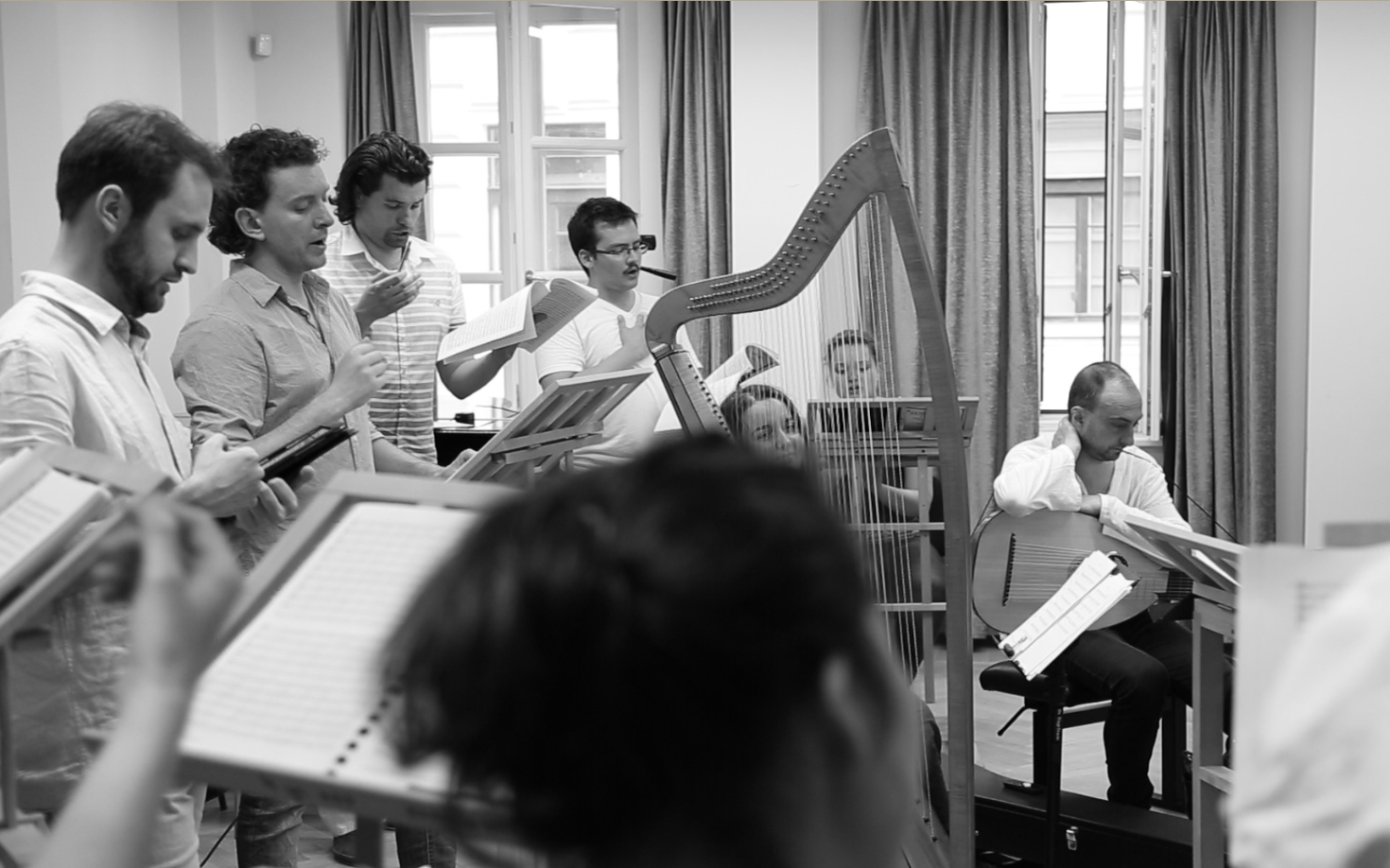
The earliest-surviving opera, Cavalieri’s Anima & Corpo (1600) has just notched up three seasons in repertoire at the Theatre Natalya Satz, Moscow (the original home of Peter and the Wolf) in Georgy Isaakian’s modern yet highly sympathetic production, which won the 2013 Golden Mask, Russia’s most prestigious music-theatre award. Over the years, new singers, musicians and continuo-players, even the Theatre’s brand-new Chorus have joined the show, so we have been constantly in rehearsal, continuously developing the performance.

Georgy Isaakian on Opera

Georgy Isaakian: Three “texts” to be delivered

 In a rehearsal break last year, Georgy commented to me that in opera, the libretto, the music and the stage production are each “texts” for the performers to deliver, each of which tells its own story. In the context of modern opera direction he is absolutely right. And we might paraphrase his comment for the purposes of this discussion, to claim that Text, Music and Action are each “languages of emotion”, “languages of performance”.

Il corago

But that 17th-century theatre director, Il Corago, would fundamentally disagree with the second part of Georgy’s remark, that Text, Music and Action each tell their own story. In the 17th-century productions, the same story was told simultaneously in all the languages of performance. Rather than any particular detail of historical accuracy, I would argue that it is this unity, this telling of the same story, that should today distinguish a historical production from a ‘modern’ one, and it is that simultaneity which will make a historical production a good one, in the sense of being effective for the audience.

 The imitation … must take into consideration only the present, not the past or the future, and consequently must emphasise the word, not the sense of the phrase.

Monteverdi Letter to Striggio 7 May 1627


Thus all the languages of emotion are aligned and synchronised in performance, like the co-ordinated pulse of a laser-beam, to move the passions muovere gli affetti of the audience. As composer, Monteverdi is praised for


adapting in such a way the musical notes to the words and to the passions that he who sings must laugh, weep, grow angry and grow pitying, and do all the rest that they command, with the listener no less led to the same impulse in the variety and force of the same pertubations.

Anon Argomento to Le Nozze d’Enea in Lavinia (c1640) cited in Tim Carter Monteverdi’s Musical Theatre

Note that it is the words, or perhaps even more fundamentally, the passions, that ‘command’. And notice the connection between ‘variety’ i.e. dramatic contrast and the emotional ‘force’ of the performance. In the Preface to Anima e Corpo, Cavalieri is particularly insistent on such variety, a crucial difference to the 19th-century approach of intensifying one particular emotion until the cathartic moment is reached.

It’s obvious that in good poetry, each particular image should create an appropriate metaphor for the underlying message. But the sound of the words too should be appropriate, as Dante observed as he descended into the last circle of Hell:

 If I had rhymes both rough and stridulous,

As were appropriate to the dismal hole

Down upon which thrust all the other rocks,

 I would press out the juice of my conception

More fully; but because I have them not,

Not without fear I bring myself to speak;


Actually, Dante manages quite well to find suitably “rough and stridulous”sounds, such as occe and uco:


S’io avessi le rime aspre e chiocce,

come si converrebbe al tristo buco

sovra ‘l qual pontan tutte l’altre rocce,

 io premerei di mio concetto il suco

più pienamente; ma perch’io non l’abbo,

non sanza tema a dicer mi conduco;

Dante Inferno 32

Dante Divine Comedy

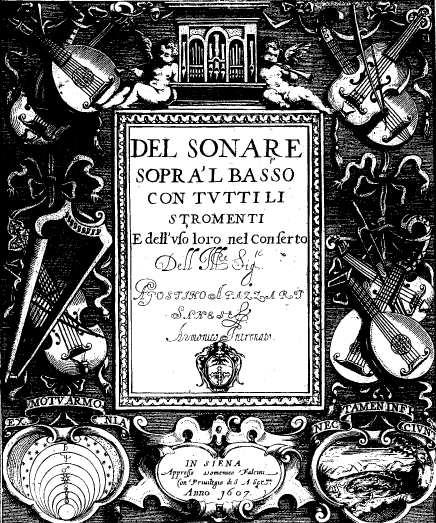
Even in instrumental music, Agazzari requires instruments to imitate the emotion and semblance of words, imitatione dell’affetto e semiglianza delle parole. (More on Agazzari’s continuo treatise Del Sonare sopra’l  basso (1607) here).

Meanwhile, a singer’s acting also has to match the emotions:

 When she speaks of war she will have to imitate war; when of peace, peace; when of death, death; and so forth. And since the transformations take place in the shortest possible time, and the imitations as well – then whoever has to play this leading role, which moves us to laughter and to compassion, must be a woman capable of leaving aside all other imitations except the immediate one, which the word she utters will suggest to her.

 Monteverdi, ibid.

 As Shakespeare has Hamlet tell the Players, “Suit the Action to the Word”. And this will be matched in the music:

 [She must] be fearful and bold by turns, mastering completely her own gestures without fear or timidity, because I am aiming to have lively imitations of the music, gestures, and tempi represented behind the scene; … the shifts from vigorous, noisy harmonies to soft, sweet ones will take place quickly, so that the words will stand out very well.

 Monteverdi, Letter to Striggio 10 July 1627

 Text, Music and Action must be united:

 They make the steps and gestures/actions in the way that the speech expresses, nothing more nor less, observing these diligently in the timing, hits and steps, & the instrumentalists [observe] the aggressive and soft sounds; and the Text [observes] the words in time, pronounced in a manner that the three actions [fight, music, text] come to meet each other in a unified representation.

 Monteverdi, Preface to Combattimento 1636

 All of this proceeds from the Rhetorical principle of Decorum, that every element should be suitable, appropriate to its rhetorical purpose. As we already observed, the starting point is the emotions embedded in the Text. In a 17th-century opera house, there is a single artistic director, Il Corago, who has “universal command” over every aspect of production, but is ‘subject to the text’. The anonymous c1630 book Il Corago therefore devotes considerable attention to the requirements for a good libretto. Advising how to put on a good music-drama, Cavalieri’s Preface to Anima e Corpo similarly concentrates on the libretto, and we saw how Monteverdi carefully negotiates with his librettist, Striggio, in order to get a libretto that will give him the dramatic and musical opportunities he needs.

With the madrigalism, or ‘word-painting’ so typical of this period, composers ‘paint’ the emotion of a particular word, synchronising the musical effect with the text. This was one of the toughest challenges, as we translated the libretto of Anima e Corpo into Russian: we had to preserve the word-order of the original Italian, so that Cavalieri’s musical effects would still coincide with the correct word.
Caccini & Quintilian

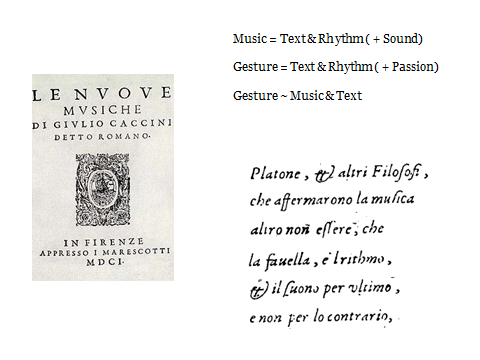
I’ve written here  and here  about the importance of rhythm in 17th-century music. As Caccini writes in Le Nuove Musiche (1601), music consists of “Text and Rhythm, with Sound last of all.” But rhythm is also crucial for period gesture.

The thunderbolts of Demosthenes would not have such force but for the rhythm with which they are whirled and sped upon their way.

Quintilian, citing Cicero

 The motions of the body also have their own appropriate rhythms

Quintilian
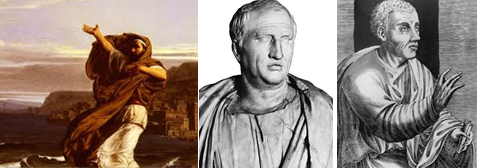
 Demonsthenes, Cicero, Quintilian

Demonsthenes, Cicero, Quintilian

This rhythm is synchronised also with the words, and with the emotions themselves:

 The movement of the hand should begin and end with the thought that is expressed. Otherwise the gesture will anticipate or lag behind the voice, both of which produce an unpleasing effect.

Quintilian

 Action, Music and Text are not only unified, but also synchronised.

 Every gesture and every step should fall on the beat of the sound [i.e. music] and of the song [i.e. text].

Marco da Gagliano Preface to Dafne 1608

LANGUAGES OF EMOTION?

It’s tempting to go along with the idea that music is a language, “nature’s voice, through all the moving wood of creatures understood, the universal tongue to none of all its race unknown”, as Purcell’s St Cecilia Ode (1692) proclaims. Music does have a kind of grammar, with certain Parallels of fifths and octaves to be avoided, Cadences that function rather like punctuation, and Ordered Chunking of Preparation-Dissonance-Resolution that could be compared to sentence-order of subject-verb-object.  We can discern some meaning in the emotional contrasts of music, and particularly in the word-painting of 17th-century madrigalism, but we cannot translate precisely between music and text in the way we can between English and Italian.

In 1644, John Bulwer makes extravagant claims that gesture is a language. “This naturall language of the Hand” does have a “significant varietie of important motions” but it’s hard to find here any grammar, unless one counts the rule of avoiding the left hand (or at least favouring the right), in all but highly negative gestures. In L’arte dei Cenni (1616) Giovanni Bonifaccio similarly claims that the “visible speech” or “mute eloquence” of gestures (here not limited to the hand, but extended to the whole body from head to toe, not omitting “gestures of the genitalia” – you’ll have to read it for yourselves!) is a universal language.

Bulwer & Bonifaccio


The meanings of gesture are supposedly clear and universal, but in practice gestures are often incomprehensible – you might not recognise the gesture that “explains more subtill things” or another that “inculcates Logick, as with a horn” – or local. The street-theatre players with whom I appeared in a medieval show on tour around Greece found out the hard way that the friendly thumbs-up gesture with which they saluted the audience has a local meaning corresponding to the middle finger in other countries, or the V-sign in England.

3 Bulwer gestures

Even in their own period, Bulwer’s and Bonifaccio’s claims obviously fail. Yet there are so many close parallels in their work, that we might consider accepting the idea of a ‘universal language’, if we confine their ‘universe’ to the narrower domain of the Western European, Christian, educated, middle and upper social classes of their readership, who shared a common background of Biblical and Classical literature, whether they were English or Italian. After all, any language is only a language for those that understand it, otherwise it is just meaningless noise. And a meaningful word in one language may be just noise, or have a different, even an obscene meaning, in another. My favourite modern example is the Vauxhall car, the Nova, which sold very badly in Spain. In Spanish, no va, means “it doesn’t go”.

So, since we have seen that Music and Gesture are closely aligned with performed Texts, in particular with the Emotions of those Texts, let’s side-step any debate over “what is a language” and look at each of these ‘languages of performance” to see what they can say about Emotions in early opera. Can we ‘translate’ between them, perhaps not in quite the same way we can translate between English and Italian, but with sufficient precision to extract emotional meaning? As many CHE researchers have commented, Emotions studies are necessarily “messy”, and inherently holistic. We have already seen that Text, Music and Action are complexly interconnected. So performers must try to isolate particular elements that they can work on in rehearsal, and prioritise amongst all the possible options.

TEXT

  1. From the Text performers can extract factual information: Io la Musica son, I am Music. Da mio Permesso amato a voi ne vengo, I come to you from Permesso. Incliti eroi, sangue gentil de regi, the audience is honoured as famous heroes, noble blood of kings.
  2. The Text also gives cues for specific emotions: tranquillo calm, turbato agitated, nobil ira righteous anger, amore love, infiammar fired up, gelati menti frozen minds– all these in one four-line stanza.
  3. Text also shows the character of the speaker: “with this golden harp I’m accustomed to charm mortal ears, but with the heavenly lyre I can even involve your souls.” All these examples come from the Prologue to Monteverdi’s Orfeo (1607).

Information, Emotion and Character are the Rhetorical divisions of Logos, Pathos and Ethos, which correspond also to three 17th-century performance options.

  1. A text may be read appropriately, but without personal involvement, as a modern newsreader would adopt a suitable tone for a serious report, whilst preserving a proper professional detachment.
  2. A performer can invest more emotion in the delivery, in the manner of a fine poetry-reading, but without identifying themselves with the subject of the piece. So a woman might read a poem in the male voice, or a vocal ensemble perform an amorous madrigal.
  3. But around 1600 in both Italy and England, there is a fascination with the genere rappresentativo, with embodying a character in dramatic music, with what Shakespeare’s contemporaries called Personation.

But in whichever mode the performer communicates a Text, the movement of the passions that concerns us is from the text to the audience. It is not about performers expressing their own emotions – this is an essential difference from the romantic tradition – even if performers, like audiences, get swept along by the passions that are constantly on the move.

MUSIC

Music as Caccini tells us is Text, Rhythm and Sound. This sets the first priority as

  1. Articulation, the clear enunciation of the words by a singer who should

seek to chisel out the syllables so as to make the words well understood, and this is always the chief aim of the singer in every occasion of song, especially in reciting.  And be persuaded that the true delight arises from the understanding of the words.

 Marco da Gagliano, Preface to Dafne 1608

For an instrumentalist, Articulation means creating speech-like patterning by means of keyboard, harp or lute fingering; bowing on violins or viols; and tonguing on wind instruments. This creates Agazzari’s ‘semblance of words’, giving opportunity for the passions of the words to be imitated too.

2.  Rhythm in this period is structured around regular Tactus and mathematically precise Proportions, inside which the accented and unaccented syllables of renaissance poetry can be pronounced Long and Short. (These syllables are often referred to as Good/Bad, but Caccini and others refer to them as Long/Short. In spoken Italian, Good syllables are usually lengthened anyway).

3.  Period writers discuss the Sound of early opera as Harmony, in particular processes of dissonance and resolution, and Modulazione, the imitation of speech contours as the ‘melody’ for recitatives. In the Preface to Euridice, composer, harpist and tenor Jacopo Peri praises the emotional effectiveness of these speech-like elements, as opposed to the old-fashioned style of beautiful singing and elaborate ornamentation, as championed by soprano Vittoria Archilei.

Vibrato – the topic that dominates many discussions today – is simply not on the agenda of serious aesthetic debate: there are simple rules for applying it, just as there are for other types of ornament. At the end of a long Good note. That’s it, basta, The End.
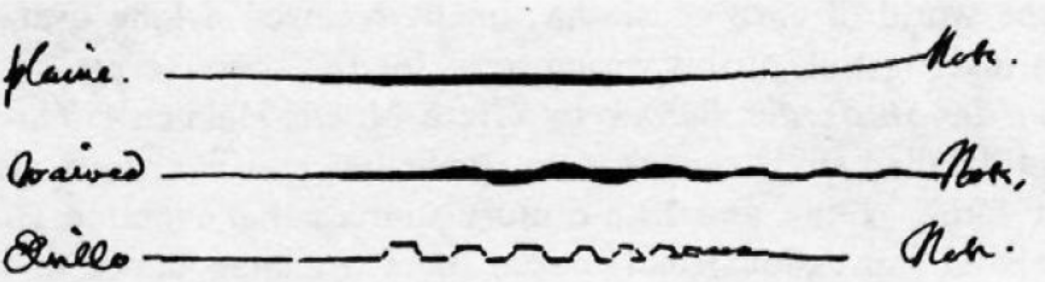
Plain note (with messa da voce),  Waived note (with messa da voice and late-arriving vibrato) Trillo (with accelerating trill and diminuendo) Roger North (1695) cited in Greta Moens-Hanen  "Das Vibrato in der Musick des Barock"

Plain note (with messa da voce),
Waived note (with messa da voice and late-arriving vibrato)
Trillo (with accelerating trill and diminuendo)
Roger North (1695)
cited in Greta Moens-Hanen
Das Vibrato in der Musick des Barock

ACTION

We could similarly classify Action, perhaps from small to large, from

  1. what Bonifaccio calls cenni – outward and visible signs of inner passion, i.e. gestures, facial expressions, small movements;
  2. large-scale postures and movements of the whole body – positioning on stage, walking onto stage or around the stage, dance, sword-fighting, costumes; and
  3. stage sets, backdrops, lighting.

We’ve just presented Monteverdi’s 1610 Vespers, in a version strongly influenced by CHE research, and as the first-ever performance in Russia, and this brought to my attention that 17th-century religious liturgy also includes Action of all these classes.
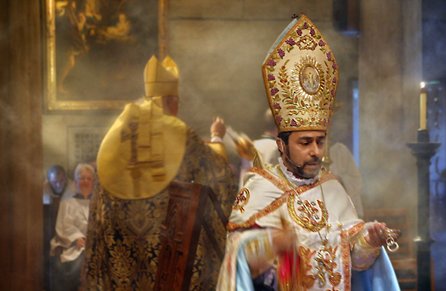
Solemn Vespers


RHETORIC

Passions are Nature’s never-failing Rhetorick, and the only Orators that can master our Affections.

 The English Theophrastus (1708)

 As languages of performance, Text, Music and Action are governed by the canons of Rhetoric. As we consider the communication from performer to audience we are concerned not so much with Invention (even if performers in this period often improvised) and Arrangement, rather with Style, Memory and especially Delivery. From the perspective of a History of Emotions, we are less concerned with what is said, than with how you say it. After all, the meaning of bare words is only the tip of the emotional iceberg: “I just asked her what time dinner would be ready, and she flew into a rage”.

Simply moving the word accent, fundamentally changes the subtext:

“What are you doing?” [neutral] “What are you doing?” [you, not me] “What are you doing?” [don’t just think about it] “What are you doing?” [disbelief] “What are you doing?” [exasperation]. A musical setting might underline one or other choice. Thus in the opening speech of Act I of Orfeo, “in questo lieto e fortunato giorno“, Monteverdi underlines the emotional words ‘happy’ and ‘lucky’, rather than the neutral fact of ‘this day’.

In questo lieto

Gesture also underlines particular words and clarifies meaning. Alan Boegehold’s When a Gesture was expected provides “a selection of examples from Archaic and Classical Greek literature” of when a gap in the Text would have been filled by a Gesture. In seicento opera, Gesture is expected on many often-encountered words, especially on Deictics, pointing words. The frequent use of the most powerful deictics – Here! Now! Me! – in early opera points to the frequent and emotionally powerful use of Gesture, and suggests immediacy.

DEICTICS - pointing words "Here!" "Now!" "Me!" Pointing gestures: To show, indicates, refers to self

DEICTICS – pointing words “Here!” “Now!” “Me!”
Pointing gestures:
To show, indicates, refers to self


Other Gestures that might seem optional or unfamiliar to us would fit almost automatically into a 17th-century hand. “To be, or not to be, that’s the question” – the famous Words suit the Actions (less well-known today) of Bulwer’s “distinguish between contraries” and “pay attention”. To any gentleman of Shakespeare’s time, these movements are utterly familiar to the hand as a rapier swordsman’s disengage from quarta (Mercutio’s punto reverso) to  to seconda, followed by an attack in terza (Mercutio’s stoccata) – “a hit, a very papable hit”!
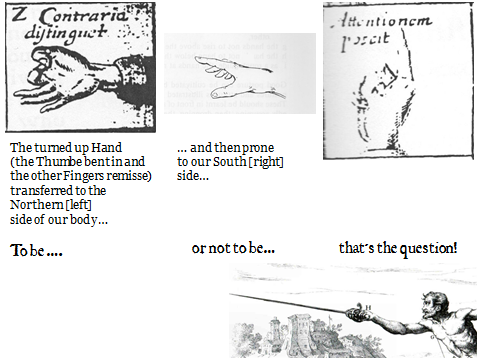
To be or not to be gestures

Traditionally, historical musicology has used Text to explain the Music set to it. Insights gleaned from such studies have informed today’s performers. In contrast, it has been widely assumed that we don’t know enough to attempt to reconstruct period Action, and/or that the attempt would be meaningless for a modern audience. I strongly disagree. We have lots of information, albeit as a series of stills. But study of period dance, and more recently of historical swordsmanship, can help us “join the dots”. But the difficulty is that putting your hand in the right place is not sufficient. Good gesture requires exquisite timing and powerful intention: otherwise the audience accurately read the performer’s real intention “to put my hand into the right place”. What is often missing from modern productions with ‘baroque gesture’ is the rich network of interconnections between gesture, music and text: audiences are therefore left unmoved by the emotions that should flow through those networked connections. What matters is not what you do with your hand, it’s what your hand “means to say”.

LANGUAGES OF EMOTIONS IN RECITATIVE

One particular result of my ‘Text, Rhythm, Action’ investigation within CHE’s Performance program has been to suggest a re-defining of Recitative, the musica recitativa of the first operas, not as ‘the boring bit in between the nice tunes’ but according to its literal meaning in Italian as “acted music”. (Read more here) In this new dramatic style, an  innovation around the year 1600, the composer uses musical notation to recreate the dramatic timing, rhythmic patterns and pitch contours of theatrical speech. Peri explains how to do this:

 I know similarly that in our speaking some tones are pitched in such a way that they could create music, and in the course of narration many other [tones] pass by, which are not pitched, until one returns to another [tone] suitable for movement of a new harmony …. And I made the Bass … according to the emotions, and kept it unmoving through the dissonances and through the correct consonances, until the tone of the speaker running through various notes, arrives at one which in ordinary speaking would be pitched, [this] opens the way to a new harmony;

Peri Preface to Euridice (1600)


This is just what we see in Monteverdi’s setting of in questo lieto e fortunato giorno.

 Il Corago emphasises that singers should vary their tone-colour, so that recitative sounds just like the speech of a fine actor, which – as Shakespeare agrees – was learnt by rote: “Speak the speech, I pray you, as I pronounced it to you”. Cavalieri and Il Corago emphasise variations in speech patterns, variations of pitch and syllabic lengths, just as we see in Cavalieri’s, Peri’s and Monteverdi’s notation of recitative. In Gibbons’ Cries of London, too, variety of pitch and syllable lengths in the persuasive calls of street sellers is contrasted with the dreary monotone of that 17th-century news-announcer, the Town Crier. Shakespeare similarly contrasts his ideal of declamation, speech rhythms that dance  “trippingly on the tongue” – with the Town Cryer’s habit to ‘mouth it’.

But within this essentially aural tradition of acting, there were strong conventions allowing less freedom than one might expect in the delivery of a particular line:

 In recitative… there is but one proper way of discoursing and giving the accents.

Samuel Pepys
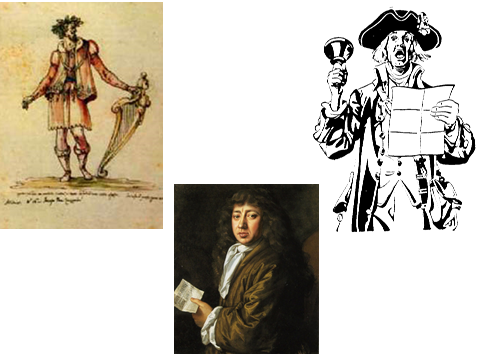
Jacopo Peri, Samuel Pepys & the Town Crier

Jacopo Peri, Samuel Pepys & the Town Crier

Perhaps you remember James Alexander Gordon reading the classified football results “The best way to do it is to get the inflection right. If Arsenal have lost, I’m sorry for them. If Manchester have won, I’m happy for them. So it would go something like this: Arsenal 1, Manchester United 2. And so on, and so forth.” (See a video interview with JAG here).

If  baroque actors declaimed particular lines in a consistent manner, we should therefore expect corresponding consistency in 17th-century musical settings, and as part of my new CHE investigation into musical imagery, “Enargeia: Visions in Performance”, Katerina Antonenko and I have already begun to find supporting evidence.

For example, Monteverdi sets the word “Signor” with the same upward inflection, a rising minor third, as pronounced both by Poppea and (in Orfeo) by Proserpina. We can easily imagine that this follows a conventional speech pattern of courtly etiquette: “My Lord?” Signor?

Signor


It’s well known that the word sospiro (a sigh) is almost invariably associated with a short rest in the music. Less well known is that in 17th-century Italian, such short silences are not called pausa (this is the term for longer silences) but sospiro. Still less well-known is that 17th-century lovers sighed on the in-breath, Ah! not Ha! And Katerina has noticed that many sighs in Orfeo are associated with  the same pitch, around low F#.


When for you (Ah!) I sighed You (Ah!) sighed crying (Ah!) and sighing After a deep sigh (Ah!) she expired in my arms

When for you (Ah!) I sighed
You (Ah!) sighed
crying (Ah!) and sighing
After a deep sigh (Ah!) she expired in my arms

Note the link between inspiring the breath of emotion as Orfeo sighs for love, and expiring the breath of life, as Euridice dies. This breath is Pneuma, the renaissance spirit of passion. It is very likely that 17th-century actors (and singers) sighed (on the in-breath) audibly at such moments, though this is seldom done today.

EXCLAMATIONS: EMOTIONS WITHOUT TEXT

Exclamations – Ah! Oh! – are pure emotion, essentially without text. Around the year 1600, the exclamatione was a novel vocal technique, following the fashion for more emotional delivery. Caccini gives three ways to start a phrase: intonazione, messa da voce and most up to date and emotional, exclamatione.
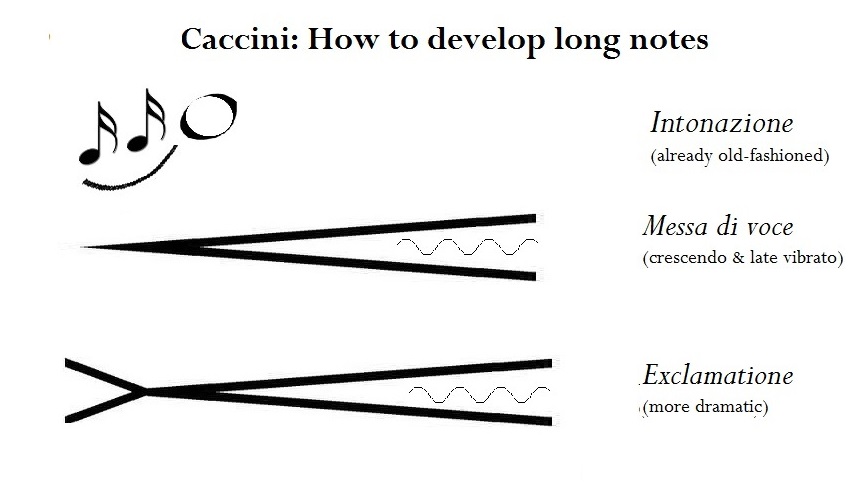
Intonazione, Messa di voce, Exclamatione

Consistently, Monteverdi sets exclamatione to medium-high notes, D or E.

Tancredi in "Combattimento" Messaggiera in "Orfeo"

Tancredi in Combattimento
Messaggiera in Orfeo


Orfeo (2 examples) Euridice & Messaggiera in "Orfeo" Orfeo (3 examples) ALL from "Orfeo"

Orfeo (2 examples)
Euridice & Messaggiera
Orfeo (3 examples)
ALL from Orfeo


Another exclamation, ohime!  frequently combines medium high pitch, around D, with a falling  inflection, and dissonant harmony.

And Orfeo’s delivery of the word lasso (Alas, wretched me!) is similar to the Messagiera’s pronunciation of the feminine equivalent lassa.

Note that when several exclamations follow one another, the pitch of the note follows the rules of rhetoric, either building upwards, or (for three iterations) high, low, higher. The rhythm is syncopated, off the beat, showing that something is wrong. A bass-note from the continuo defines that beat…

Ohi… BASS-NOTE … me!

which might be reinforced by the actor changing his stance, even stamping his foot on that beat.

And pitch contour and rhythm combine perfectly with the appropriate gesture, throwing out the hand high, above the head for Ohi… and then returning it to the chest (perhaps even striking the chest audibly) at …me!
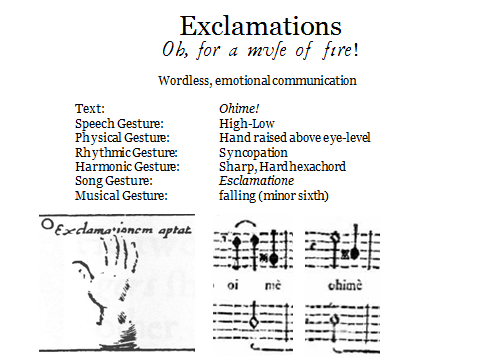
Exclamations


As Il Corago tells us, pitch contours communicate emotion very effectively. This is true even without words – think of mother/baby talk, or the BBC children’s series the Clangers, in which characters ‘spoke’ only with inflected whistling sounds, performed by leading comedic actors of the day, on swanee-whistles. (If you don’t know the Clangers, you can hear them here).

Quintilian agrees:

 The second essential is variety of tone, and it is in this tone that delivery really consists… Take as an example the opening of Cicero’s magnificent speech… Is it not clear that the orator has to change his tone almost at every stop?

GESTURE: EMOTIONS WITHOUT WORDS

Bulwer and Bonifaccio consider gestures to be wordless expressions of emotion:

Gesture, whereby the body, instructed by Nature, can emphatically vent, and communicate a thought, and in the propriety of its utterance expresse the silent agitations of the mind

Bulwer

And in Elizabethan times there was a fashion for silent pantomime, or Dumb Show. [See Dieter Mehl The Elizabethan Dumb Show: The History of a Dramatic Convention (1965)]. Some of Bulwer’s gestures can be confusingly similar:

"Munero" I give money to you "Demonstro non habere" I show I have nothing

“Munero” I give money
“Demonstro non habere” I show I have nothing


And Elizabethan Dumb Shows were, if not inexplicable, certainly hard to understand. So after the pantomime, the actors might re-enter, whilst someone explains what it all had meant:

 Sir John, once more bid your dumb-shows come in,

That, as they pass, I may explain them all.

 Munday’s Downfall of Robert, Earl of Huntington

So also in Shakespeare’s Hamlet, where after watching the Dumb Show, Ophelia asks: “What means this, my Lord”, and when the Prologue enters, she asks again: “Will he tell us what this show meant?”

SINFONIA: PICTURES WITHOUT TEXT

In Recitative, music imitates the declamatory rhythms and pitch-contours of dramatic speech. And in all kinds of music, composers used the technique of madrigalism to ‘paint the words’, so that the music creates a detailed sound-picture of the text. Ut pictura musica – music is like a picture. This extends even to instrumental music, labelled sinfonia or ritornello in early operas. Just as with spoken declamation, there were strong conventions at work.

One of the first conferences presented by CHE was on the Power of Music, which was a highly significant topic around the year 1600. Many of the early operas explore the Orpheus myth, in which the protagonist has the power to influence nature with his music (birds, animals even trees come to listen, stones weep), to persuade Hell, even to conquer death. This cosmic, super-natural, super-human power is related to the three-fold identity of Music as

  1. Musica Mondana – the Harmony of the Spheres, the perfect music created by the slow dance of the stars and planets
  2. Musica Humana – the harmonious nature of the human body
  3. Musica Instrumentalis  – actual music, played or sung

Three kinds of Music

Many philosophical concepts are depicted in musical ‘paintings’ of the Power of Music. Orpheus’ lyre (or his father, Apollo’s) is represented by an ensemble of bowed strings. The stability of the cosmos is reflected in root-position chords and simple harmonies – corresponding to the fundamental mathematical ratios that structure music itself, and were believed to describe the circular orbits of heavenly bodies. The ‘universal string’ is tuned of course to Gamut, low G, the lowest note of renaissance music theory (even if in actual practice, lower notes were frequently used). The benevolence of heaven is heard in the gentler sounds of the Soft Hexachord, of B-molle, i.e. G minor. The perfect movement of the heavens is a slow, formal dance. And ascending and descending scales represent in music the mathematical relationships between one Sphere and the next.

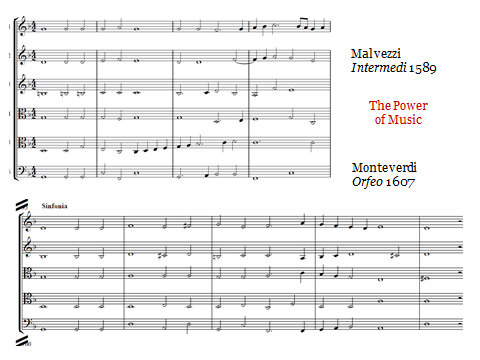
Two of the most famous soundscapes of the Power of Music, Malvezzi’s Sinfonia representing the Music of the Spheres in the first of the Florentine Intermedi (1589), and Monteverdi’s Sinfonia representing the power of Orpheus’ lyre to persuade Hell (the same Sinfonia is heard again in the last Act, when Apollo descends from heaven to rescue Orfeo from despair), show all these features:

  • string ensemble
  • root-position chords
  • G with a ‘key-signature’ of Bb
  • pavan rhythm
  • scales moving through the texture

Power of Music

UNITING THE LANGUAGES OF EMOTION

In spite of the possibilities of ambiguity in Dumb Shows, in Peindre et dire les passions (2007) Rouillé has convincingly used Gesture to identify the precise words, and hence the emotions, depicted in baroque paintings. She shows consistency of baroque Gesture between John Bulwer’s English diagrams and French paintings, e.g. the gesture for “Pay attention!”We can see similar matches between Bulwer’s English gestures and Bonifaccio’s Italian cenni, e.g. the sign to an audience for “Silence, I intend to speak”.
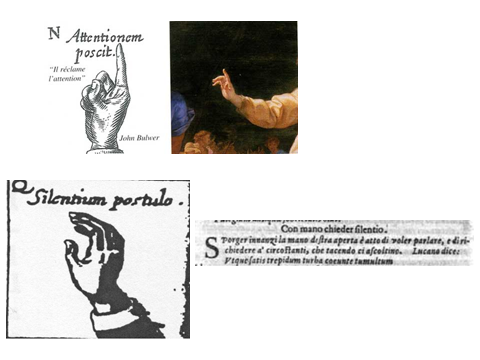
Gestures united

Musicologist Louise Stein has drawn attention to a strongly consistent dramatic style in Spanish theatrical laments. The heroine (such laments are always given to a female role, even though male roles were also acted by female actors) exclaiming on high notes, calls upon all nature to rescue her, and dividing the entire cosmos into related sets:

 Sovereign spheres, powerful gods; heaven, sun, moon, stars; rivers, streams, seas; mountains, peaks, cliffs; trees, flowers, plants; birds, fish and beasts; sympathise with me, have mercy on me… air, water, fire and earth!

 Calderón/Hidalgo Celos aun del aire matan (1660)

 We are currently working on a Russian translation of Celos for a production in Moscow, and with recent CHE findings fresh in my mind, I suddenly realised one more reason why this model of lament would be emotionally effective on stage – the conventions call for actors to point at what they speak about. So the actress exclaims and laments with many thrilling high notes and dramatic changes of register as the music ‘paints the words’, and simultaneously her gestures are equally powerful: hands sometimes raised high above the head, then swept dramatically downwards. Spanish Laments represent visual as well as musical exclamations.

Lament of Aura (Celos)

The only practical difficulty is that a few lines earlier, the goddess Diana (who is about to execute our heroine) has commanded: “Tie her to a tree trunk, with her hands behind her”. This would prevent the actress from gesturing at all. But as the Lament begins, the command has not yet been executed, as the Text reveals: “Tie her up, what are you waiting for”.  As any theatre producer knows, the spoken (or sung) text provides many details of Stage Directions.

This convention, that actors point at what they speak about, extends to poetic imagery which might be realised in stage scenery, or simply imagined by the actor. “To the hills and the vales, to the rocks and the mountains, to the musical groves, and the cool shady fountains” sing the Chorus in Purcell’s Dido & Aeneas. Singers would point out each feature, whether it is actually visible in the theatre or not, so that the audience ‘see it’, either in the ‘reality’ represented on stage or imagined, in the mind’s eye. In many early operas, poetic imagery in the libretto matches the real-life surroundings of the theatre, so that actors point outwards towards what they imagine, and the audience already knows, is actually there, outside in the real world.

BACK & FORTH

If we accept that Action and Music have at least some characteristics of language, then meaning must flow not only from, but also back to, the performed Text. ‘Suit the Action to the Word, and the Word to the Action.’  Meaning also flows to and fro between Music and Action, Music and Text.

Historically Informed performers usually work from the Text and seek to move the passions of their audiences. At first glance, problematising the language of historical Emotions threatens to saw off the branch we are sitting on. If we question the meanings of historical words of emotion, how can we understand the music attached to those word? But given the reversible flow of meaning between Text and Performance, perhaps Music and Action can contribute to the linguistic debate.

 FROM MUSIC BACK TO TEXT AND PASSION

In early music, well-understood historical principles of harmony (dissonance/resolution) and melody (hard/soft hexachords) allow us to assess objectively the intensity and character of an affective turn of phrase. If such an accento can be consistently linked to a passionate Word, we can reach a better understanding of that Word’s Emotional significance.

B natural, any sharps, and harmonies on the sharp side are associated with the Hard Hexachord, and therefore with hard emotions – dry Humours, Melancholic or Choleric. B flat, any flats, and harmonies on the flat side are associated with the Soft Hexachord, and therefore with soft emotions – wet Humours, Sanguine or Phlegmatic. So in his (Italian) Lament, Orfeo alternates between sadness in soft G minor and anger in hard A major. The most acute contrast of opposites comes at the words “on my troubles have pity”, moving from hard G# on mal to soft Bb on pietate, with an unsettling chromatic twist that matches the turn of the emotional screw.

S'hai del mio mal pietate

Investigation of musical emotions in standard repertoire has sometimes focussed on moments of particular intensity, thrilling, spine-chilling moments, the ‘tingle factor’. We have informally collected audience reports of such moments in early opera, and many of them are linked to a particular turn of harmony towards the soft hexachord. This corresponds to an emotional truism, that it’s not the hardest moments that make you cry, but the moment when amidst the toughness, you are offered a hint of sympathy. It’s the easing of the emotional pressure, the change of affetto, the move to the wet Humour that allows the tears to flow.

Particularly strong examples we’ve observed in 36 performances so far of Anima & Corpo are Anima’s last words (moving from hard G major to soft C minor), and the chorus at Corpo’s final exit (the body ages and dies, even though the soul is eternal), which moves even further from hard A major to the same soft C minor. This moment regularly reduces audiences and many of the company too to tears.

canti la lingua e le risponda il core

canti la lingua e le risponda il core

At this moment of emotion, the meaning of the words (shown here in the Russian edition and original Italian) is highly significant: “the tongue sings, and the heart responds”.

Another tear-jerker is the final scene of Monteverdi’s Combattimento: Clorinda’s dying words move from hard E major to soft D minor. “Heaven opens, I go… -that’s the moment – in peace”.


Heaven opens I go  [in peace]

Heaven opens, I go
[in peace]

At the conclusion of the CHE-supported performance in London there was a very extended silence, broken only by the sound of an audience member crying.

Musicologists have a good understanding of the relative intensity of particular harmonies, according to 17th-century conventions. So as we look at the harmonies a composer assigns to particular words of the text, we have a reliable impression of the emotional intensity, moment by moment, word by word. Analysing the harmonies of Cesare Morelli’s setting for Samuel Pepys of To be or not to be on a simple scale of 1-5 allows us to chart the emotional intensity during this famous speech. Morelli’s setting is thought to have been inspired by the declamation of Thomas Betterton.

Harmonic Tension in To be or not to be

Whilst it would be unrealistic to expect a perfect mapping of meaning, or even the kind of translations we can make between say Italian and English ,the transforming ‘languages’ of historically informed Performance might help shape a modern understanding of the Emotional Meaning of historical Words.

In future investigations, it would be interesting to study contrafacta, where a new text is set to existing music. What are the emotional parallels between the original and new texts? How do these ‘emotional synonyms’ translate the music’s language of emotion?

FROM GESTURE BACK TO PASSION

Gesture is both cause and result of emotion, creating a spiral of intensity.

These motions of the body cannot be done, unlesse the inward motions of the mind precede,

the same thing again being made externally visible,

that interiour invisible which caused them is increased,

and by this the affection of the heart, which preceded as the cause before the effect…. doth increase.

Bulwer

Gestures are preceded by emotion, and make that emotion outwardly visible. But that physical movement then increases the inward emotion. Modern scientific studies support the traditional belief of actors that Emotions work not only from inside outwards, from the performer’s intention to exterior display, but also ‘from outside inwards’. Paul Ekman has shown that accurately reproducing the changes in facial musculature associated with a particular emotion calls up that very emotion, without any other stimulus. If the hypothesis of ‘mirror neurons’ is believed, then here is a mechanism that might explains one mode by which audiences themselves feel the same emotions portrayed by the performers they are watching.

At a recent workshop on the Feldenkrais Method, I witnessed a very telling demonstration that physical processes (in this case, the precise position of one particular neck vertebra), vocal production and emotion are closely intertwined. After the therapist had showed the singer how to reposition her head over her spine, she sang again the song she had sung moments before: the sound was utterly different. The singer was shocked, re-started, and then burst into tears. The voice was resonating freely, the emotions were flowing freely. And an audience member commented that the phrase sung after physical repositioning also  communicated more emotion to listeners.

All of this fits perfectly with the renaissance theory of Pneuma, which links the mysterious Spirit of Passion (communicating emotion from performer to audience) with a flow of mystic energy in the body (rather like Oriental Chi) that promotes proprioception and relaxed movement. The same Pneuma is also associated with the divine energy of creation, the breath of life itself. The three-fold nature of Pneuma parallels the three kinds of Music.

006 3 kinds of Pneuma and of Music

We might therefore experiment with using historically informed Action, suited to a period Word, to re-create physical sensations, to re-embody and (in some way) ‘experience’ a historical Emotion.

DICTIONARIES OF LANGUAGES OF EMOTION

This brings me to the idea of Emotional Dictionaries, charts of Meanings between one discipline to another, an idea that regularly emerges in CHE discussions. For Historically Informed Performance, I think we need to compile dictionaries that function in the opposite direction to the historical sources: not from Gesture to Word (as Bulwer and Bonifaccio inform us), but from Word, or better still, from Passion to Gesture. This is the approach I’ve taken in my work-in-progress guide to Historical Action, which we continue to test and develop in CHE performance projects around the word.

Cross-connection dictionaries would be interesting too: from Gesture to Harmony, from Scenery to Heaxchord, and (for instrumentalists) from Music to Words. As you will remember, high D- low F# means “Ohime!”.

CONCLUSION

Below the tip of the Text iceberg lies the emotional subtext – this is what really concerns performers and – even more importantly – their audiences. It’s not what you say, it’s how you say it. It’s not the notated words and notes, but how you deliver them, with posture, gesture, and with variety of vocal colour. It’s not about where you put your hand, it’s what you mean to say with your gesture. It’s not about the sound, it’s about the pictures. It’s not about singing at the audience, but about telling them a story.

It’s about uniting and synchronising all the languages of emotion, putting Text and Music into Action. As Bulwer writes, quoting Quintilian quoting Cicero quoting Demosthenes:

 What are the three secrets of great delivery?

Action, Action, Action!

ALK TRA


Please join me on Facebook https://www.facebook.com/andrew.lawrenceking.9 and visit our website www.TheHarpConsort.com .

Opera, orchestra, vocal & ensemble director and early harpist, Andrew Lawrence-King is director of The Harp Consort and of Il Corago, and Senior Visiting Research Fellow at the Australian Research Council Centre for the History of Emotions.


The Right Time for a New Vision: Monteverdi’s 1610 Vespers

Monteverdi vespers image

Claudio Monteverdi’s most famous work, the 1610 Vespers of the Blessed Virgin Mary, evokes all the glory of the Italian seicento, combining plainchant melodies, exquisite polyphony and the drama of the newly invented operatic style. This Vespers has been linked with the cathedrals of St Peter, Rome and St Mark, Venice, but the inclusion of the Gonzaga family fanfare (also featured in Monteverdi’s 1607 opera, Orfeo) confirms a stronger link to the church of St Barbara, Mantua.

Mantua by night

The publication of the Vespers in 1610 places this collection of religious music in the context of the first operas – Cavalieri’s Anima & Corpo, Peri’s and Caccini’s Euridice all in the year 1600 – and Shakespeare’s plays (e.g. Hamlet c1600); of Caccini’s secular songs Le Nuove Musiche and Viadana’s sacred Concerti Ecclesiastici, both 1602); of Monteverdi’s own operas Orfeo (1607) and Arianna (1608); of Agazzari’s continuo treatise Di suonare sopra’l basso (1607); and of the publications of Orfeo (1609) and of Capo Ferro’s famous swordfighting treatise, Gran Simulacro (1610).

Context

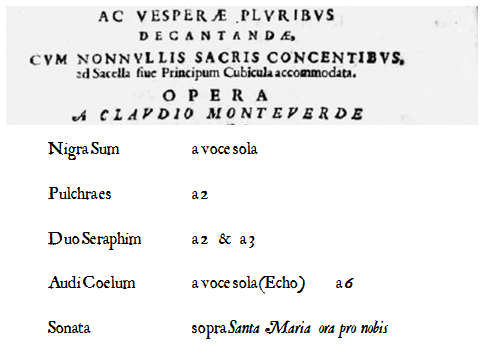
The title-page of the collection refers to some Sacred Concertos ‘suitable for the Chapel or a Princely chamber’. Musicologists debate whether these pieces are substitutes for the plainchant Antiphons specified in the liturgy of Vespers, or independent, non-liturgical additions. Either way, they alternate with the Vespers Psalms to create a fascinatingly varied publication, or indeed a modern concert. The size of the ensemble and the complexity of the music increases from one piece to the next. Meanwhile, the term ‘sacred concertos’ recalls Viadana’s publication for voices and continuo, suggesting that Viadana’s technical advice might be applied also to Monteverdi’s music. That advice emphasises the subtlety and delicacy of the ‘sacred concerto’ style, to be performed with solo voices. Viadana also gives detailed instructions for realising the continuo.

Sacred Concertos

The ‘sacred concerti’ most obviously demonstrate Monteverdi’s modern style, his secunda prattica, but even if the psalm settings are more conservative, with plainchant cantus fermus throughout and exquisite polyphony, they too are full of variety. Each Psalm exploits different techniques. Dixit Dominus weaves the plainchant into rich prima prattica polyphony, and also into fashionable soprano or tenor duets. Choral recitation on a single note might be heard as highly conservative and derived from liturgical chant, but it also suggests the most up-to-date styles of operatic recitative and dramatic madrigals, for example the choral recitation in Monteverdi’s Sfogava con le stelle. Instrumental ritornelli add another fashionable touch to this Psalm.

Laudate Pueri explicitly calls for eight solo voices (not a large choir), which Monteverdi combines in many ways: as a single ensemble, as two four-voice choirs, and in pairs of equal voices. Laetatus is unified by its catchy walking-bass, another modern touch. Nisi Dominus and Lauda Jerusalem might appear similar, both for double choir, but are quite different. The block contrasts of Nisi remind us of the first metaphor of the text, God as the heavenly builder, whereas in Lauda the alternations of the two choirs come faster and faster, until the voices overlap.

Psalms

It is not known if the 1610 Vespers was ever performed in the composer’s lifetime – perhaps its constituent parts were assembled only as an attractive package for publication – but it has become a world-wide baroque hit, a tour-de-force of early baroque vocal, instrumental and ensemble skills, and an icon of seicento style.

07 Claudio Monteverdi

The original print has 8 part-books. Additional parts (voices or instruments) are included here and there amongst those books, but the combined parts are carefully layed out, with page-turns synchronised so that the books could well have been used in actual performance. If they were, then the combination of voices, or voice and instrument, in a single book, gives interesting information about the spatial positioning of the performers. It is noticeable that Monteverdi does not write Echos into a different partbook, even when an additional performer and an additional partbook are available: there is no change of performer or partbook when the music changes from a duet of equals to echo effects.

Part books

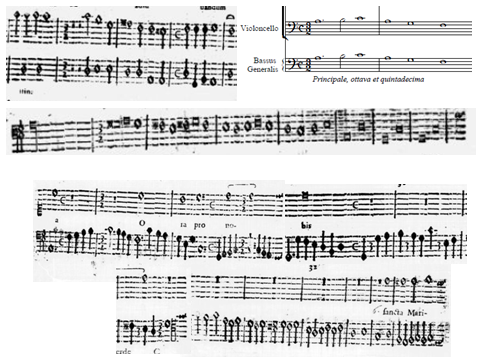
The Bassus Generalis partbook has a short score, since the entire performance would be guided by the continuo (as Agazzari tells us in 1607). But otherwise, no original score exists, only the individual partbooks. And there are significant differences between the Bassus Generalis and the other partbooks.

Deus in adjutorium meum

On 1st June 2014, the Cathedral of St Peter & Paul, Moscow, was filled to capacity for a landmark concert, the first-ever performance in Russia of the Monteverdi Vespers, which I had the honour to direct. Amongst many musicians and early music fans in the audience, distinguished guests included prominent Russian opera directors & international conductors, leading arts journalists, representatives of several Christian confessions, even the great-grandson of Giuseppe Verdi.  The concert was the flagship event of the festival La Renaissance (artistic director Ivan Velikanov), produced by the Moscow Conservatoire and supported by the French Cultural Institute. The performance was recorded and broadcast by Russia’s largest classical music station, Radio Orphee.

Vocal and instrumental soloists were brought together from Moscow, St Petersburg, Ukraine, Lithuania, Colombia, France, Germany and UK. Many of the team have worked together with me in previous baroque projects in Russia, including the first baroque opera –  Cavalieri’s Anima e Corpo (1600), soon to begin its fourth season in repertoire at the Natalya Satz Theatre Moscow in Georgy Isaakian’s Golden Mask-winning staging; the first staged production in modern times of Stefano Landi’s La Morte d’Orfeo (1619)  – with the International Baroque Opera Studio and Il Corago at the St Petersburg Philharmonia last December; and the compilation I made of Shakespeare’s Musicke at Festival La Renaissance 2013.

Rehearsal

Even though there are many fine modern performing editions available, I made a new edition for this project. The new edition re-examines some questions, but does not make too many startling new choices. Rather, it presents all the information- including the variants in the Bassus Generalis book – at a glance, so that performers can make their own choices. Continuo players had (my transcription of) the original Bassus Generalis partbook to play from. At first they found this disconcerting, since it is not a complete score, but we gradually discovered the benefits of not having a full score. The original notation encourages continuo-players to play simply, structurally, and to lead in steady rhythm, rather than trying to follow the singers.

BG part book

Some singers also experimented with singing from facsimile of the original partbooks – they are clearly printed, and have very few mistakes, apart from the usual miscounting of rests. (That is to say, the original printers miscounted the rests, not our singers!).  

Solemn Vespers

The Moscow concert reflected state-of-the-art Historically Informed Performance practice.  Solo voices (rather than a large choir) offered the listeners direct, personal communication of the text, whilst still creating impressively sonorous tuttis in the clear but generous acoustic of the Cathedral (a large building, but on the scale of St Barbara, Mantua rather than the enormous spaces of St Marks Venice or St Peter’s Rome). The chiavetti notation of the final Psalm and Magnificat was respected, so that these movements were transposed downwards to the standard renaissance vocal line-up, with high tenors (not falsettists) on the Altus parts. Cornetts, sackbuts and strings played only where called for by Monteverdi, creating dramatic contrasts by their appearances, and a more intimate atmosphere when they were silent. As the original part-books require, the famous Echos were sung and played from the same positions as the principal solos, with echo-performers turning away from the listeners to allow the acoustic to create a natural echo effect (rather than trekking off to some remote location).

And of course, we used quarter-comma meantone: there was certainly no thought of introducing the anachronism of the modern early music scene’s “one size fits all” Vallotti temperament (from the year 1779).


ALK title page Score


Most significant, and immediately visible to the audience, was the absence of a conductor. The entire performance was guided (just as period sources describe) by the instrumentalists of the continuo section (organ, regal, theorbos and harps), with each singer taking individual responsibility for maintaining the steady beat of the baroque “Tactus”.

Continuo

It is well known that music was not conducted in this period, but nevertheless even specialist Early Music ensembles often introduce the gross anachronism of a modern conductor.

No conducting


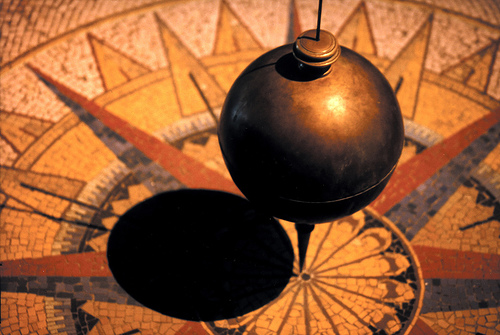
The project also benefitted from the latest research findings of my Text, Rhythm, Action!investigations for the Performance program of the Australian Research Council’s Centre for the History of Emotions. In Monteverdi’s Rhythm, the steady beat of the Tactus represents the perfect clock of the cosmos, the Music of the heavenly Spheres. Just a couple of decades after Galileo’s discovery of the pendulum effect, seicento music itself is still the most precise clock available on earth, with duple and triple metres alternating in regular Proportions. The Tactus is a rhythmic heartbeat, maintained throughout the whole work (except for certain movements where Monteverdi specifically indicates a more relaxed speed). With no anachronistic conductor, there are also no arbitrary changes of tempo. As a result, the composer’s notated contrasts of activity are more effective. (See Rhythm: What Really Counts here and also The Times they are a-changin’ here )

Galileo Pendulum

Proportions

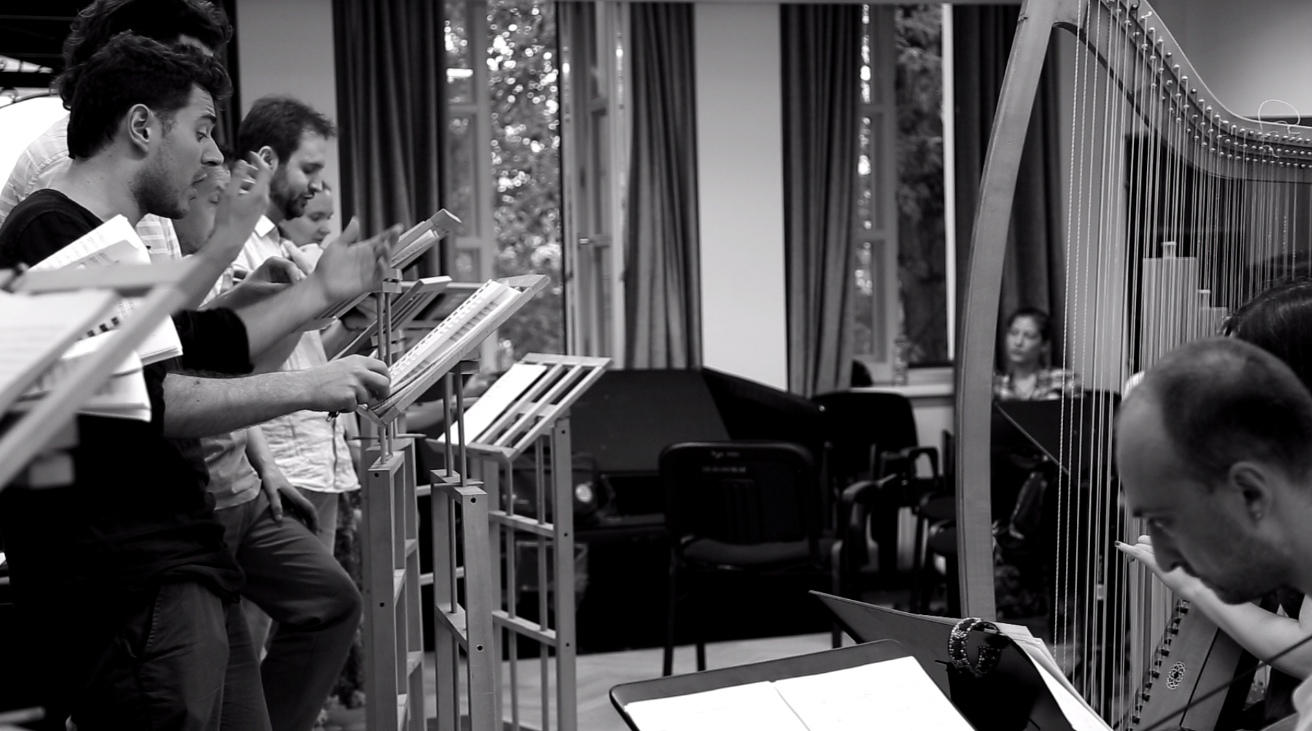
All this ancient philosophy was put to practical use in rehearsals, with a lot of time spent working on Text and Rhythm. With no conductor at the front, all the singers took on the role of “conductor”, beating time in seventeenth-century style, with a slow, constant down-up movement of the hand, like a pendulum moving for one second in each direction. When the music changes into triple metre, the fast Proportion of Tripla is counted down-two-three, up-two-three. But the Proportion of Sesquialtera counts a slow three against the two movements, down-up, of the hand. This slow Proportion is less familiar to today’s baroque musicians, but it occurs much more often in the Vespers than in secular works.

Hand Tactus in rehearsal

In another rehearsal exercise, we asked the singers to use their hands to show the accented syllable of each Latin word, the so-called Good syllable. Sometimes these word-accents coincide with the Tactus, sometimes they are syncopated against it. This exercise helped bring out the lively rhythms and syncopations of Monteverdi’s writing. Using the hand to show the Tactus kept the ensemble together and made the music safe: showing the Good syllables emphasised contrasts and made the music interesting.

Tactus and word-accent

In a development of the Good syllable exercise, we varied the hand-movement to make it long and sustained or quicker, depending on the length of the Good note. This helps to bring out the contrasts in Monteverdi’s notated note-lengths, and the long, sustained accents create a thrilling, emotionally committed sound, especially when one particular voice has long accents where others do not.

Hand Accents in rehearsal

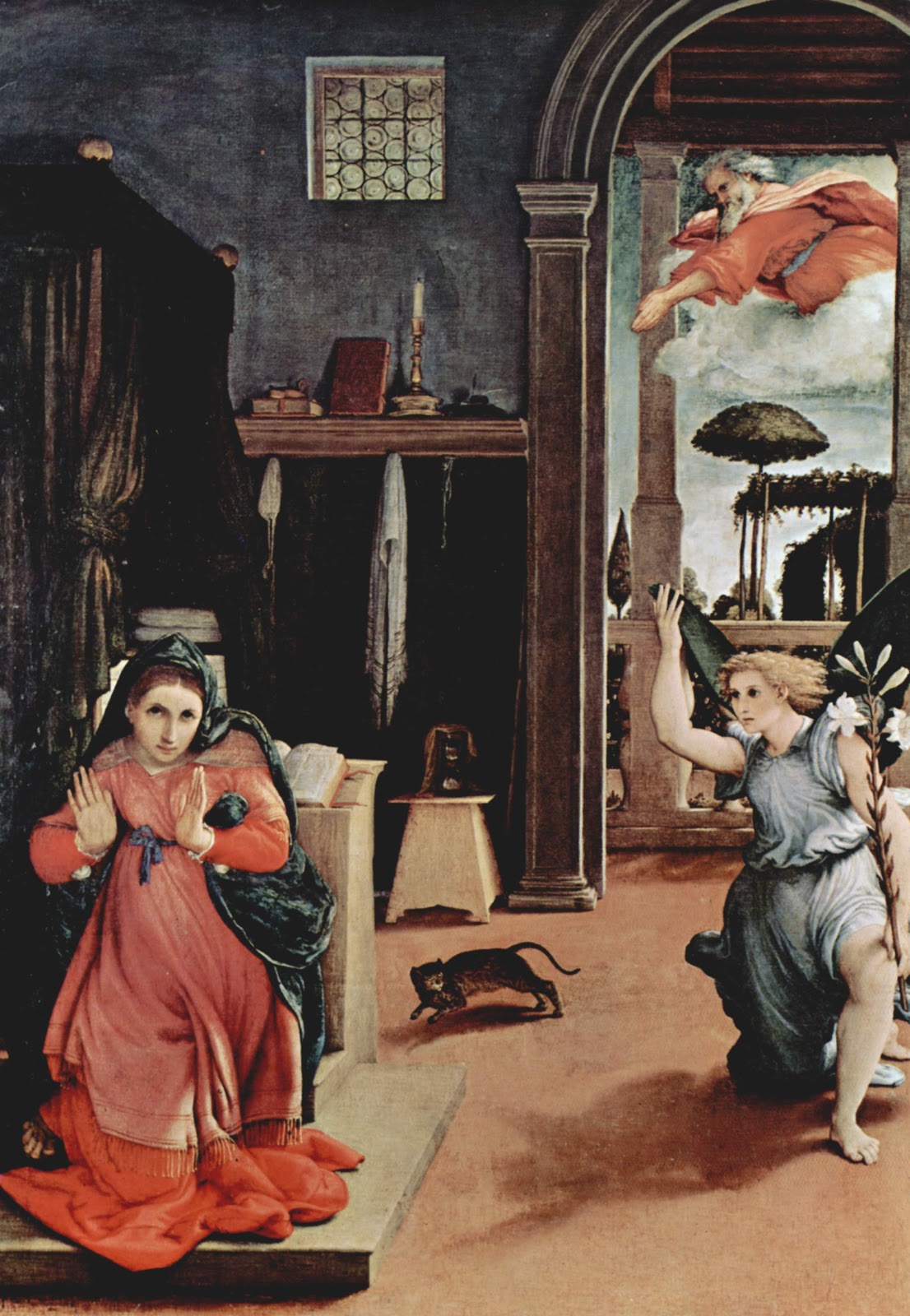
But the highest priority in early baroque music is the Text. As a madrigalist and opera composer, Monteverdi responds passionately to the poetic imagery and dramatic Action of the Vespers texts. His music for the Magnificat verse Quia respexit sets the Annunciation scene with high wind instruments (played ‘with as much force as possible’) representing the Spirit of God. Pairs of quiet instruments suggest the dialogue between the Angel Gabriel (sackbut) and Mary (flute), before the whole ensemble plays again for omnes generationes: ‘all generations shall call me blessed’.

Annunciation

In rehearsal, we discussed in detail the meaning of each verse, and what significance the texts would have for seventeenth-century listeners. Although this was not a theatre project, we did explore in rehearsal the baroque gestures that would be used for similar words on stage, as a way to experience the emotional force of particular words. Even in performance, hand gestures were used, but with appropriate decorum, suited to liturgical music in the sacred space of the church. But the most useful rehearsal exercise was to combine a hand-gesture on the Good syllable (this optimises the sound of the text) with simultaneous concentration on the meaning of that particular word (this synchronises the emotions of the text).

ALK in rehearsal


Rehearsing the text in this way revealed to us how Monteverdi cast particular voices in certain roles, just as one would find in a baroque opera. A duet for two tenors is a favourite seicento device, and obviously suits a text about two angels, Duo Seraphim. When the second part of the text begins Tres sunt (there are three), the appearance of a third tenor transforms the musical texture into something rich and strange, appropriate not only to the simple number three, but even to the divine mystery of the Trinity which the text continues to expound.

In the Psalm, Laudate Pueri, a tenor duet at the words excelsus super omnes gentes is again a conventional choice. But here the plainchant cantus firmus is given, rather unusually, to high soprano, vividly illustrating the text “in the highest heaven, above all the people”. In that same Psalm, a bass duet is a most unusual choice – there are very few duets for basses in the entire repertoire. But here, and again in the Magnificat, this combination (deep sounds, and the super-human effect of two powerful voices at once) represents God himself: Quis sicut Dominus Deus noster? (Who is like the Lord our God?) and sanctum nomen eius (Holy is his name).

Barocci_Annunciation

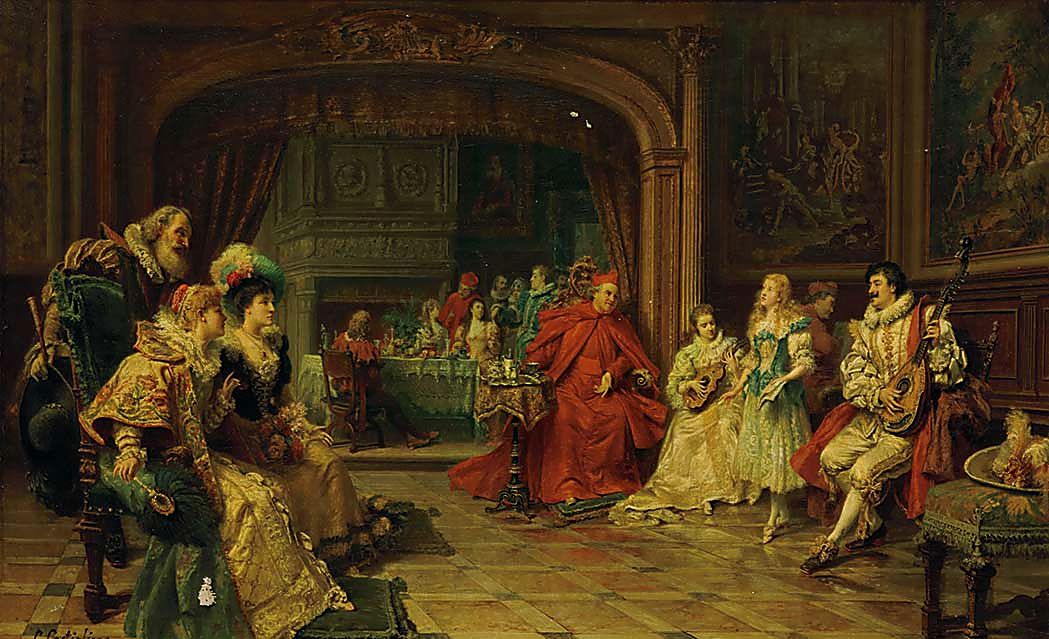
In the verse et de stercore erigens pauperem , low voices paint the picture of the mire out of which God (slow triple metre) lifts up (a rising sequence) the poor man (a solo tenor). Just as in some of his polyphonic madrigals, here Monteverdi seems to cast the solo tenor as if personifying the protagonist’s role. So this singer is featured again,reciting on a single note (is this plainchant or operatic recitative?) amidst the eight-voice tutti at the words ut collocet eum cum principibus populi sui – placing him amidst the princes of God’s people. It is surely the deliberate touch of an opera composer to cast this tenor as the poor man, so that the audience – or liturgically, the congregation – sees this same man literally placed amongst the princes as he sings his solo amidst the choir, clergy, cardinals (princes of the church) and other nobility in the courtly chapel or chamber.

Giuseppe Castiglione


Just as earthly music was considered to be an imitation of the perfect, heavenly Music of the Spheres, so actual dancing was an earthly imitation of the divine dance of the stars in their orbits. This explains why there are so many slow, Sesquialtera Proportions in the Vespers, whereas Monteverdi’s opera Orfeo more often has fast Tripla. Of course, the slower movement of Sesquilatera sounds better in a church acoustic, whereas fast Tripla sounds good in a less resonant theatre. But more significantly, the sacred spheres were thought to rotate more slowly than the sublunary sphere of the earth, so a slow triple Proportion was the ideal musical emblem for the divine Trinity.

Harmony of the Spheres Fludd

Fast, we might even say ‘secular’, Tripla dance-rhythms in the Vespers paint texts that call for divine assistance down here, on earth: Domine ad adjuvandum me festina (O Lord, make haste to help us) and Sancta Maria, ora pro nobis (Holy Mary, pray for us). And another Tripla depicts the speed of arrows in the hand of a giant sicut sagittae in manu potentis.

Archery

It is this passion for visual detail, even in a musical setting, that – according to renaissance philosophy and period medical science – conveys the emotions from the text to the listeners, in order to move their passions, muovere gli affetti. This intense, emotional visualisation by composers, performers and audiences is the focus of one of my current research strands: Enargeia: Visions in Performance.

Enargeia

During the project, we explored in great detail questions of Proportions and Frescobaldi’s advice for Driving the Time – guidare il tempo. These discussions helped shaped the arguments in a later blog post on the Frescobaldi Rules here, and I’ll return to the subject in future postings.

For the coming season, further Early Music productions are planned in Moscow, St Petersburg and around the country: the first Russian performance of the earliest Spanish opera, Calderón and Hidalgo’s Celos aun del aire matan (1660); the production team Il Corago with the medieval Ludus Danielis; and another historical production from the International Baroque Opera Studio.

Please join me on Facebook https://www.facebook.com/andrew.lawrenceking.9 and visit our website www.TheHarpConsort.com .

Opera, orchestra, vocal & ensemble director and early harpist, Andrew Lawrence-King is director of The Harp Consort and of Il Corago. From 2011-2015 he was Senior Visiting Research Fellow at the Australian Research Council Centre for the History of Emotions.


How to Practise

  • As with any training, practise little and often. 15 minutes, 3 times a week is better than 3 hours once a week.
  •  3 minutes concentrated,  disciplined work will advance you further than 3 hours of unfocussed playing.
  •  Unfoccused practising is not only wasted time, it creates bad habits which are hard to get out of later.
  •  If you are not in the mood for hard-working practice, play through your music for pleasure, but without stopping!

 THERE ARE 2 GOOD WAYS TO PRACTISE:

1. Get it right

Play several times through a small section (as small as it needs to be, to be sure of getting it right), at a slow tempo (as slow as it needs to be, to be sure of getting it right).

Get it right! Get it right 10 times consecutively.

Every time you get it right, you create a good memory, a good habit. (And every time you get it wrong, you create a bad memory, a wrong habit – so get it right!) Go slow enough, stay focussed and concentrated so that you get it right.

Get it right!

2. Don’t stop

Play through a medium or long section without stopping.

Don’t stop! Even if you make a mistake, don’t stop.

By continuing, you develop your feeling for steady rhythm, and for a smooth flowing performance. (But if you stop, you develop the habit of stopping, which is hard to break, so don’t stop!). Stay focussed and concentrated so that you don’t stop.

Don’t stop!

THERE IS ONE, MUCH-USED,  BAD WAY TO PRACTISE:

 Start off playing, make a mistake, and stop temporarily

Now correct the note you are on, and continue until the next mistake

You have just rehearsed “making an error and stopping”. Next time, you are very likely to make the same error, and stop again. You have not properly fixed the error, or practised getting it right.

You have practised “getting it wrong”.

And your practice will probably be “successful”: you will get it wrong next time too!

SUMMARY

Either “Get it Right” or “Don’t Stop”.

Know which kind of practice you are doing.

Don’t fool yourself – bad practice does not help you. Actually, it sets you back. Because practice does not make perfect… practice makes permanent. Bad practice makes it permanently bad!

Practice makes Permanent

Please join me on Facebook https://www.facebook.com/andrew.lawrenceking.9 and visit our website www.TheHarpConsort.com .

Opera, orchestra, vocal & ensemble director and early harpist, Andrew Lawrence-King is director of The Harp Consort and of Il Corago, and Senior Visiting Research Fellow at the Australian Research Council Centre for the History of Emotions.
The Triple, or Modern Welsh Harp

The Welsh Triple Harp is a national symbol, an icon of patriotic pride in the principality’s rich cultural heritage, associated with legends of the ancient druids and bards, and (from 1742 to the present day) with traditional Welsh music. But how Welsh are its origins?

In London, there seems to have been a burst of harp-related activity in the 1730s. Handel’s 1724 opera Giulio Cesare was revived in 1730 and 1732 with a new version of the harp Sinfonia, featuring higher, faster passage-work. The scene is highly dramatic:

S’apre il Parnasso, e vedesi in trono la Virtù, assistita dalle nove Muse

Cesare: Giulio, che miri? e quando
con abisso di luce
scesero i Numi in terra?

Parnassus opens to reveal Virtue enthroned, attended by the nine Muses.

Caesar: Julius, what do you see? And when
with a downpour of light
did the Gods descend to earth?

Handel’s masque Haman and Mordecai, first performed in 1718 and 1720 (probably at the Duke of Chandos’ house, Cannons), was revived in London in 1731 and reworked in the oratorio Esther in 1732; it too has a fast, high harp solo. The Israelites are first encouraged to “Tune your harps to cheerful strains”, and then to

Praise the Lord with cheerful noise,
Wake my glory, wake my lyre!
Praise the Lord each mortal voice,
Praise the Lord, ye heavenly choir!
Zion now her head shall raise:
Tune your harps to songs of praise.

According to Jeremy Barlow here, the 1732 performance was played by a Welsh harpist.

In 1732 and 1733, William Hogarth was painting the series A Rake’s Progress, which was engraved and widely published in print form a couple of years later, in 1735. The second scene shows the protagonist, Tom Rakewell together with masters of all the fashionable 18th-century arts: a dancing-master, a fencing-master, a quarter-staff instructor, a gardener, a soldier, a huntsman, a jockey and Handel himself at the harpsichord. But in the next image, the location has shifted downmarket to a notorious brothel, the Rose Tavern in Covent Garden. In the shadowy background, a harper is playing; his instrument boasts a spectacular carving, supposedly of King David playing the harp, at the top of the pillar.

Image

[By the way, this is the earliest image of a ‘Welsh Triple Harp’ that I know of. Can anyone suggest an earlier one?]

The earliest surviving instrument of this type is at London’s Victoria & Albert Museum. A label inside was ‘recently discovered’ in 1968. From this, we know the harp to be the work of “David Evans Instrument Maker, In Rose Court, near Rose Street, Covent Garden, London 1736”. According to the V&A catalogue entry (1998) for “this unusually splendid triple harp”:

The finial is now missing. The neck is richly carved and gilt. The belly is decorated with gilt scrollwork that is drawn with great freedom and charm… The post is japanned black with gilt chinoiserie subjects, now largely worn away.

Image

Since Evans’ workshop was so close to the Rose Tavern, it’s tempting to speculate that Hogarth’s painting shows an earlier example of his work. And might it even give us a clue to the finial that would originally have adorned the V&A harp?

It has been plausibly suggested that Evans’ ‘unusually splendid’ harp was built for William Powell, appointed harper to the Prince of Wales in 1736. In the same year, Powell played Handel’s Bb Major Concerto for Harp, Lute, Lyrachord and other instruments in the premiere of Alexander’s Feast. The concerto shows the ‘Power of Music’, championed by the character Timotheus, bard to Alexander the Great.

Timotheus placed on high
Amid the tuneful quire
With flying fingers touch’d the lyre:
The trembling notes ascend the sky
And heavenly joys inspire. 

Just as the sound of Timotheus’ ‘lyre’ did ‘ascend the sky’, Handel’s writing for harp shows high, fast figuration in the outer movements, and extreme high notes in the slow movement.

Alexander’s Feast was revived in 1739, which year also saw the premiere of  Handel’s Saul. In this dramatic and richly orchestrated score, David’s music soothes King Saul’s anger:

Fell rage and black despair possess’d
With horrid sway the monarch’s breast;
When David with celestial fire
Struck the sweet persuasive lyre:
Soft gliding down his ravish’d ears,
The healing sounds dispel his cares;
Despair and rage at once are gone,
And peace and hope resume the throne.

David’s ‘lyre’ is represented by a solo for unaccompanied harp. The music is slow, but once again in the high register.

Image

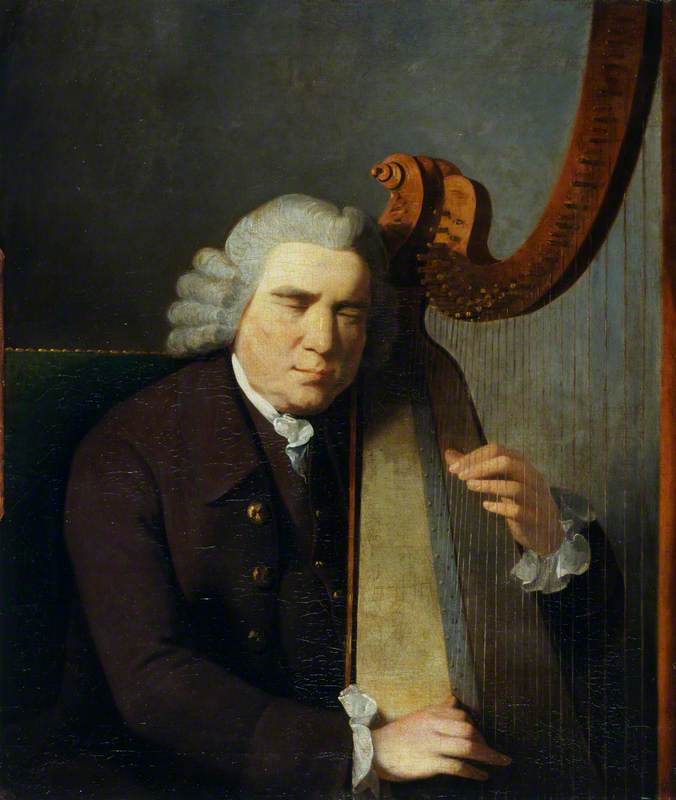
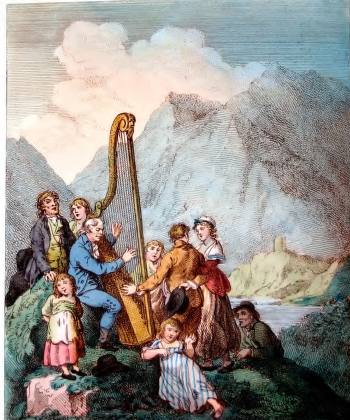
[John Parry, painted by his son William Parry c1770; harp by John Richards]

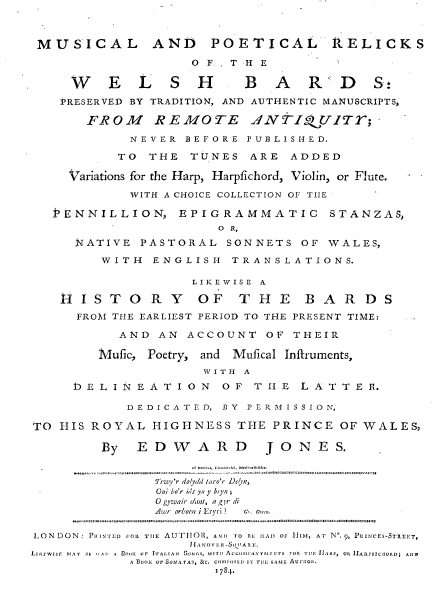
Half a century later, Edward Jones’ historical, literary and musical survey of the Relicks of the Welsh Bards (1784) characterises the type of instrument built by Evans and by John Richards (born in 1711, and thought to have studied with Evans) as the triple or modern Welsh harp. Its shape is distinctive: where the instrument rests against the player’s shoulder, it is relatively low (much lower than Italian triple harps of the previous century). This facilitates access to the highest strings, as needed for the virtuoso style of high, fast passage-work. But at the top of the pillar, the neck swoops upwards to the characteristic ‘high head’, providing long strings for a powerful bass. The frame and ribbed back are hardwood, the belly of soft pine or deal.

Image

The strings are arranged in three rows, divided like the black and white keys of a keyboard instrument. The two outside rows have the diatonic (white) notes, duplicated on each side for left and right hands. This duplication allows certain special effects, which became a cliché of Welsh harp variations. In between, the central row has the chromatic (black) notes. The player inserts a finger between two diatonic strings to reach the chromatic string in the central row.

Jones associates medieval literature and historical documents of bardic practices with the late-18th-century triple harp, although he admits that “some of its present appendages were probably the additions of the latter centuries”. An illustration on page 41 of Relicks and the frontispiece of Jones’ second volume, The Bardic Museum (1802), depict just such ‘modern Welsh’ harps, but the 1784 frontispiece shows quite a different instrument, an older form that is much more plausible as truly Welsh, and as a genuine Relick of previous centuries.

Image

[Welsh Triple, 1802]

Image

[Welsh Triple 1784]

Image

[Old Welsh harp, frontispiece to Relicks of the Welsh Bards]

At the end of the seventeenth century, a Cambridge professor, James Talbot, made extensive manuscript notes about various types of musical instruments, including Triple harps and old Welsh harps. He describes a single-row proper Welch harp with a box carved from a single piece of holly, and an oak back. He states that these old Welsh harps have brays or cogs, wooden pins at the belly, that touch the vibrating strings to make a nasal, buzzing sound. Strings fastened at the Belly by Brays instead of round Buttons which give it a jarry sound. Such bray pins were a typical feature of renaissance harps throughout Europe.

Somewhat confusingly, Talbot calls this Welch or Bray Harp the true English harp. But I suggest that we can understand this in a similar sense to harpist John Parry’s calling his 1742 compilation of Welsh airs Antient British music… retained by the Cambro-Britons (more particularly in North Wales). Talbot’s Bray Harp is a genuine relic, an ‘antient British’ harp retained particularly in Wales. Talbot’s nomenclature also serves to distinguish this old Welsh instrument from the wire-strung Irish harp, which he also describes. He also distinguishes between the jarring Welsh Bray Harp with its single-piece holly sound-box and a lute harp without brays, constructed in the newer English form with a ribbed back and soft-wood belly.

Still today, some writers suggest that the old Welsh Bray Harp ‘cross-bred’ with the 17th-century Italian triple harp (which certainly came to London) to produce the 18th-century Welsh triple harp. But there is no trace, no DNA of the old Welsh harp in Jones’ modern triple. No bray pins, no holly sound-box, no oak back, no carved sound-box. Expert opinion therefore accepts that the Triple Harp came to Britain in its Italian form, and was imported into Wales during the eighteenth century, where (thanks in part to Jones’ alluring mix of myth and history) it then became established as the national instrument.

It would indeed be a bitter pill to swallow for anyone with Welsh blood in their veins, if the national instrument were just a foreign import, with no true connection to earlier Welsh culture, let alone to the ancient Britons. But the 18th-century Welsh triple harp does show significant differences from 17th-century Italian harps, in particular its high-head shape and soft-wood belly.

These crucial changes are already in place at the end of the 17th century, and are detailed in Talbot’s descriptions (made with the help of a Mr Lewis) of Triple Harps. Talbot describes the three rows of brass tuning pins, with as many buttons in Belly (the corresponding string pegs at the soundboard). He specifies Air-wood (high-quality maple) for the ribbed back and Cullen cleft (deal) for the sound-board. In one table, he gives precise measurements for both high- and low-headed harps

For high headed Harp      

best length of Belly 3 ft 7 inches 4 lignes

Bow with head 6ft 3 inches

Length of Belly low head 3ft 2 inches

Bow with head 5ft 0 inches           

This gives ratios of the height of the top of the pillar (bow with head) to the length of the sound-board (Belly) of approximately 1.75 (high-headed) and > 1.5 (low-headed). A higher ratio means that the harp is higher-headed, that the instrument is comparatively lower at the player’s shoulder. A high ratio makes the high notes easier to play.

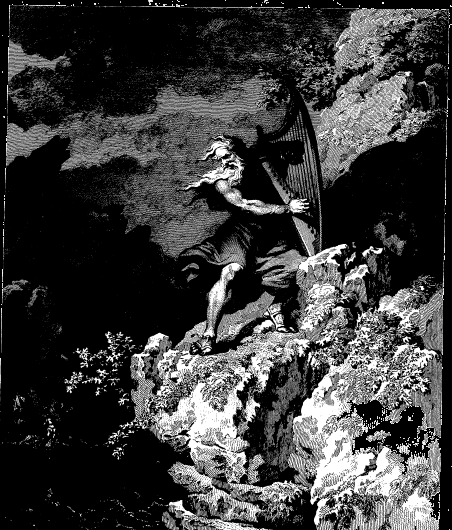
Note that even Talbot’s ‘low-headed’ harp, is definitely higher ratio than early 17th-century Italian harps. I estimate the ratio for the harp depicted by Zampieri as approximately 1.25. And the harp shown by Jones in 1802 is very high-headed indeed, with a ratio close to 2.

Image

[Domenico “Domenichino” Zampieri: King David playing the harp]

~ 1.25 Italian early 17th (Zampieri)
>1.5 English circa 1700 ‘low headed’ (Talbot’)
~1.75 English circa 1700 ‘high-headed’ (Talbot)
~1.9 Welsh 1802 ‘modern triple’ (Jones)

On the authority of Lewis, Talbot states that what he calls the English Triple Harp is seldom used in Consort, though capable of Thorough Bass; and (in another paragraph) that the Triple Harp is seldom used in Consort but generally alone. This is consistent with the change of shape: the earlier Italian triple is optimised for continuo-playing, whereas Talbot’s English Triple is lower at the shoulder, making it more suitable for solos with soprano-register melodies. As the repertoire tends more and more towards high, fast passage-work, even higher-headed shapes become more and more preferable.

Does all this spell disaster for the Welsh patriot? Was the instrument imported into Wales during the 18th century an English Triple Harp?

As we have already seen, it is difficult to disentangle English and Welch in Talbot’s manuscript notes. For him, the genuinely ancient proper Welch bray harp is also the true English harp. But he clearly distinguishes the old, single-strung holly and oak Welch instrument from the single-strung English or lute harp with maple ribs and a softwood soundboard. The three paragraphs on Triple, English Triple and Triple harps do not mention anything ‘Welsh’, or ‘Italian’. The three paragraphs on Welch, Welch or Bray and Welch harps do not mention triple stringing. And according to Rimmer’s commentary on Talbot here, no Welsh source mentions a triple harp in Wales, until the 18th century.

But both before and after Talbot’s time, many prominent harpists playing in London are Welsh. For the 17th century, Peter Holman has traced here a line of court harpists, showing a clear change from Irish to Welsh names. Before the Commonwealth, they play Irish harps, but at the Restoration in 1660 Charles Evans (a good Welsh surname) is appointed his Majesty’s harper for the Italian harp. The flurry of harp-related activity in the 1730s is linked to Welsh harpers (in particular, William Powell) and to the Welsh luthier David Evans. Around this time, Welsh nobility are enthusiastic patrons of music, notably the newly- created Duke of Chandos (James Brydges, until 1719 he was styled the Earl of Caernafon), Sir Watkin Williams-Wynn (patron of John Parry from 1734), and Frederick, Prince of Wales (who employed Powell from 1736 onwards).

[Duke of Chandos]

File:Sir Watkin Williams Wynn, 3rd Bt by Michael Dahl.jpg

[Sir Watkin Williams-Wynn]

[Frederick, Prince of Wales, at the cello]

To conclude, there was indeed a proper old Welch harp, but it had brays, was constructed in a different form and from other types of wood, and it was not triple. Jones’ (1784) modern Welsh harp had both similarities to, and differences from early 17th-century Italian triple harps. Crucial design changes were made during the late 17th century, so that for Talbot, the triple harp had been naturalised as English. Such triple harps made, played and funded by Welshmen came to new prominence in London in the 1730s.

In Britain, the 18th-century triple harp is certainly associated with 18th-century Welshmen. But before the mid-18th century, the triple harp was not particularly associated with older Welsh culture. It is not organologically related to the old Welsh bray harp. Its repertoire was in the fashionable Italian style championed by Handel himself. In his operas and oratorios, the triple harp represents Alexander the Great’s lyre, an Israelite harp, the Psalmist’s lyre or a vision of the Muses, but never anything Welsh.

The first printed publication of Welsh airs for the harp is Parry’s in 1742. Jones’ great flood of enthusiasm for Welsh culture and antiquarianism, attempting to link his modern triple harp to ancient bardic traditions, comes only in 1784.

So much for the instrument itself – more on its players and repertoires in a future posting.

[A painting by William Parry, from the collection of Sir Watkin Williams Wynn. John Parry plays the harp, his other son David holds a copy of Handel’s coronation anthem Zadok the Priest]

Please join me on Facebook https://www.facebook.com/andrew.lawrenceking.9 and visit our website www.TheHarpConsort.com .

Opera, orchestra, vocal & ensemble director and early harpist, Andrew Lawrence-King is director of The Harp Consort and of Il Corago, and Senior Visiting Research Fellow at the Australian Research Council Centre for the History of Emotions.
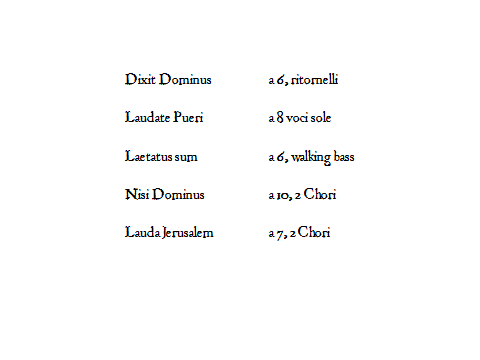
The times they are a-changin’

We think that water has no taste, because we were born with it in our mouths.

Most performers of art-music, even many Early Music specialists, believe that the subtle manipulation of rhythm for expressive effect – so-called tempo rubato – is an essential element of fundamental musicianship. To play in strict time is derided as mechanical, the work of “a poor block-head who hammers away in strict time without … artistic expression”. Teachers are advised that “a Metronome is apt to kill the finer Time-sense implied by Rubato”. “Variations of Tempo, the ritardando, accelerando, and tempo rubato, are all legitimate aids demanded by Expression. […] use is determined by sound judgment and correct musicianly taste”. Control of Rubato lies with the conductor, or in chamber music, with the soloist. It is expected that the accompaniment will yield to the melody.

Image

But is Rubato really an Absolute, a fundamental quality of good musicianship that has never changed over the years? Scientific scepticism would encourage us to doubt this: after all, historical pitch standards, temperaments, tempi, and musical notation itself all show significant differences from current mainstream practice. Why should we expect Rubato alone not to have changed over the years?

Happily, solid evidence is available, from detailed analysis of historical gramophone recordings by elite performers throughout the 20th century. Much of our present knowledge comes from the wonderfully-named CHARM project in the UK (the Centre for the History and Analysis of Recorded Music, lots of materials available here), and Dorottya Fabian’s investigations into rhythm perception, expressiveness and emotion in music, and the Early Music movement & Bach performance, at the University of New South Wales in Australia.

[By the way, the current assumption that expressiveness is connected with Rubato is so strong, that I have suggested that researchers avoid the word ‘expressive’ in their questionnaires to listeners, since it will probably elicit responses about Rubato. A more searching set of questions might ask if the performance showed ‘signs of emotions’, whether the listener had detected the use of particular techniques (e.g. vibrato, rubato, tonal or dynamic contrasts) and (most tellingly) whether listeners themselves felt they had been touched by those emotions?]

Commenting on some results from the CHARM investigations at a recent conference of the Australian Centre for the History of Emotions, Nicholas Cook, 1684 Professor of Music at Cambridge University, described a significant change in the use of Rubato around the middle of the 20th century. Before the Second World War, performers followed what Prof Cook calls the ‘tent-pole’ model: the tempo slows down as the music approaches the important point, and speeds up again afterwards, just as the canvas of a tent rises to the point where the pole supports it, and then falls away again.

In the post-War period, a different model emerges, which I have christened the ‘tube-train’. Each phrase begins slowly, accelerates to the middle, and then slows again towards the end. The tracks for London’s Underground Railway, the ‘Tube’, descend out of each station, and ascend again to the next, to help trains accelerate away and slow down again.

There are some famous international Early Music ensembles that apply this Tube-Train Rubato to renaissance and baroque music. I speculate that this approach might be particularly favoured by directors whose formative years of high-level music education were in the 1950s.

Early Music ensembles with younger directors show other models of Rubato. The “Go-To” model, much in vogue amongst baroque orchestras in Germany and elsewhere is almost the opposite of the ‘Tent Pole’: the tempo accelerates towards the important point and dwells on this one note somewhat. This approach is associated with directorial comments and group discussion about ‘where does this phrase go to?’.

Another approach, which I’ve seen at work in renaissance polyphony, is what I call the “Smoothie”. Notated contrasts in note-values are reduced: long notes are cut short, short notes are taken more slowly. Or if the composer writes notes of equal length, the music generally slows down (from moderate tempo) or speeds up (from slow tempo, because the long notes are shortened). The Smoothie is sometimes the result of laziness in observing the written rhythms, or of sloppy bowing from string-players. But at higher levels, it is associated with performers who make sound-quality, fine tone-production, a high priority. Such performers elongate short notes, to make sure that even the little notes have the best possible sound quality.

Other genres of music favour different approaches. Most fans would agree that the emotional power of Heavy Rock is not lessened by that music’s strong rhythm in strict tempo. Mainstream jazz allows a degree of rhythmic flexibility (swing) within a steady underlying beat. In this style, soloists may float freely over a regular accompaniment in the rhythm section.

Such ‘cool rhythm’ might remind us of 19th-century descriptions of Chopin’s Rubato as “timeless melody over a timed bass”, which I shorten to TLM/TB. (I avoid terms like Chopinesque, since TLM/TB clearly pre-dates Chopin). In his book Stolen Time: The History of Rubato (Oxford 1996 details here) Richard Hudson “identifies and traces the development of two main types of rubato: an earlier one in which note values in a melody are altered while the accompaniment keeps strict time, and a later, more familiar, one in which the tempo of the entire musical substance fluctuates.”

Hudson’s book very usefully charts the recent history of Rubato, though his terminology of “Early Rubato” and “Late Rubato” has been criticised. I don’t claim that my own terminology is perfect, but to clarify my intentions, I will use the term ‘TLM/TB’ for melodic freedom controlled by a regular bass, keeping ‘Tempo Rubato’ for entirely Stolen Time. Notice Hudson’s characterisation of the ‘fluctuation of the entire musical substance’ in Tempo Rubato as ‘familiar’.

But what are the artistic and emotional results of this ‘fluctuation’ of musical Time? Assuming it is done deliberately and skillfully, what is its purpose? 

Tempo rubato softens the sharpness of lines, blunts the structural angles… idealises the rhythm…. It converts energy into languor, crispness into elasticity, steadiness into capriciousness.

Wait a moment! Shouldn’t this ring alarm-bells for Early Music performers? Surely baroque music should have clear lines, strong structures, energy and crispness!! Why should we want to soften, blunt, make rubbery, unsteady and capricious a Bach fugue, a Lully overture or a Palestrina mass??? Perhaps things might have been different, before the year 1800…

The past is a foreign country, they do things differently there.

L. P. Hartley The Go-Between (1953)

 At the very least, the blind assumption that Rubato is an unchanging, fundamental absolute is demonstrably unsound. Since we now know that our ‘familiar’ Tempo Rubato has a history of change across the 19th and 20th centuries, we should begin to enquire what approaches were taken to Tempo and Rhythm before 1800. But I’ll come to this Another Time.

Galileo and the Philosophers

.

PS

The three quotations in the first paragraph are from Constantin von Sternberg Tempo Rubato and other essays (c. 1920) available here; Tobias Matthay Musical interpretation: its laws and principles, and their application in teaching and performing (c. 1913) details here ; and W.E. Haslam Style in Singig (1911) here. The remarks that Tempo Rubato softens, blunts etc were made by Paderewski c. 1909, published here. All these are cited – together with the general opinions summarised by my first paragraph – in the Wikipedia article on Tempo Rubato here.

I present Wikipedia not as an academic authority, but as a reliable indication of the consensus view amongst its self-selecting editorial group. Wikipedia is also a powerful influence on students seeking basic information.

My claim is that Wikipedia’s presentation of Tempo Rubato,  with its bundle of early-20th-century citations (most of them pre-World War I), not only demonstrates the consensus view, but shows that consensus to be lacking in historical perspective (there is no suggestion that use of Rubato may be a changeable element of Period Performance Practice) and somewhat closed-minded (Chopin’s use of TLM/TB, also heard in 20th-century jazz, is rejected, even ridiculed).  Yet in ‘the free encyclopedia anyone can edit’ that consensus view remains unchallenged. The article has not changed significantly over the last three years (accessed March 2011 and February 2014). Elsewhere in Wikipedia, debates rage between standard repertoire musicians and Early Music specialists, articles are aggressively edited back and forth between opposing camps, and moderators are kept busy damping down the flame-wars.

But Tempo Rubato circa 1910 is accepted as a universal truth. No-one even cares enough to debate it, even though the arguments are fierce over a few Herz up and down in historical pitch, or even for a few cents this way or that in historical temperaments. Get the flavour from the FaceBook Anti-Vallotti page here.

All this supports my claim that most musicians, even many HIP specialists, consider Rubato to be an essential element of basic musicianship, in spite of clear evidence that it is a historical and cultural variable.

But I urge readers of this Blog NOT to go and edit Wiki’s Tempo Rubato. Let’s leave it there, as a gloriously fossilised dinosaur, and (more seriously) as an indicator of the consensus view, so that we can see if there is any change over the next three years!

fossil dinosaur

Please join me on Facebook https://www.facebook.com/andrew.lawrenceking.9 and visit our website www.TheHarpConsort.com .

Opera, orchestra, vocal & ensemble director and early harpist, Andrew Lawrence-King is director of The Harp Consort and of Il Corago, and Senior Visiting Research Fellow at the Australian Research Council Centre for the History of Emotions.


Where are YOU? Martial arts, self-awareness and Historically Informed Performance

Descartes

In a second-hand bookshop, I found a copy of Moshe Feldenkrais’ Higher Judo: Groundwork (1952) as a gift for a friend. But (of course) I couldn’t resist having a quick look inside for myself, before giving it away! [You can read the whole book for yourself here]

Nowadays this author is best known as the founder of the Feldenkrais Method, which teaches healthy use of the body not through prescriptive instructions or strenuous exercise, but by developing your own sub-conscious self-awareness as well as your active proprioception. A typical “Awareness through Movement” session has you repeat simple, slow movements without undue effort, but with mindful attention. There is plenty of time between movements, not so much to rest, as to give your somatic nervous system time to ‘learn’ new connections. There is careful attention to breathing. Most participants find the sessions relaxing and undemanding (except of their attention), and are amazed at the positive effects they observe at the end. Typically, ease of movement, range of movement, balance and flow are greatly increased, with a strong accompanying sense of mental and spiritual well-being. I strongly recommend it. [Read more about the Feldenkrais Method here]

But Feldenkrais was also one of the first Western practioners of Judo, and he was held in high regard by Japanese masters of the Art. Gunji Koizumi, who brought Judo to the UK, wrote the preface to Feldenkrais’ book:

Dr M Feldenkrais has made a serious study of the subject, himself attaining Black Belt efficiency. He has studied and analysed Judo as a scientist in the light of the laws of physics, physiology and psychology, and he reports the results in this book which is enlightening and satisfying to the scientific mind of our age. Such a study has been long awaited and is a very valuable contribution to the fuller understanding and appreciation of the merits of Judo…

Dr Feldenkrais, with his learned mind, keen observation and masterly command of words, clarifies the interrelation and the intermingled working of gravitation, body, bones, muscles, nerves, consciousness, subconscious and un-consciousness and opens the way for better understanding.

As we might expect from a thinker who invented his own Method of Awareness through Movement, Feldenkrais’ idea of Groundwork goes far beyond the technicalities of holds, locks and other moves for fighting on the ground. His concept of Higher Judo applies a holistic approach with benefits for mind and spirit, as well as for the body.

Judo is the art of using all parts of the body to promote general well-being, and might be considered as a basic culture of the body. It creates a sense of rhythm of movement and co-ordination of mind and body. Soon after commencing practice, the novice often becomes aware of an improvement in his own occupation or sport, due to a sharpening of his senses.

As part of this sharpening of the senses, Feldenkrais considers a question that equally concerns actors, opera-singers and indeed any performer: how do you perceive your own location in space, where are YOU? According to E. Claparède Notes sur la localisation du Moi (Archives de la Psychologie XIX 1924 p172)

We generally localise the ego at the base of the forehead, between the eyes.


I stumbled on this question as a teenager, and my own observations then confirmed Claparède’s findings. And before reading on, you might like to consider, perhaps even experiment with your own sense of where YOU are. If you lift your hand above your head, it is definitely above YOU, your feet are probably below YOU. Can you close in those limits to home-in on your personal sense of where YOU are located?

Shiva ascetic

As Feldenkrais writes, “the localisation of the ego is not an anatomical fact, but is based on subjective accounts, and is, therefore, one of those things which has little significance unless other phenomena or facts can be aligned with it. It is certainly true that most people feel the ego, i.e. the point which feels more like “I”, at the base of the forehead between the eyes. But it is not exclusively so. With the advancement towards fuller maturity of the spatial and gravitational functions, the subjective feeling is that the ego gradually descends to be finally located somewhat below the navel.”

With fuller maturity, as acheived by Judo training, and by some people by their own means, subjects have no hesitation in finding the localisation in the lower abdomen.

When I mentioned this to a couple of experts in European Historical Swordsmanship, they too had no hesitation in agreeing with Feldenkrais’ location of the self. Stage performers similarly seek a sense of being “centred” or “grounded”.

For many years, I have practiced and taught a technique of ‘grounding’ for historical harp, counter-balancing the tendency for the action to be all ‘at the end of your fingertips’ and connecting-in the whole body, with a sense of centre and a pathway to the ground. And I rediscovered the importance of such ‘groundwork’ when I began research and practical investigation into baroque gesture.

But we know all too well the opposite feeling: instead of a calm centre, there are ‘butterflies in the stomach’, your ‘heart is in your mouth’, ‘the rug is taken out from under your feet’. The opposite of being centred and grounded is to be nervous and off-balance.

Feldenkrais again: “It may be interesting to note that nervous people are very undecided as to where they feel their “I” to be. Sometimes they declare it to be placed in accordance with Clarapède and sometimes they just cannot tell. In acute states of emotional disorder the sensation is that ego shifts between the two extreme localisations mentioned. When we are in good form, the lower localisation is more frequent, and is exclusively so with the higher exponents of Judo. The reader is warned that these observations must be considered critically, though we can demonstrate that we are better co-ordinated when we have no hesitation, and feel distinctly that our ego is located in the lower abdomen.”

Western Historical Martial Arts expert and author of several books on Historical Swordsmanship, Guy Windsor (principal of the School of European Swordsmanship in Helsinki) added the observation that, after a day spent researching and writing, he is aware of the sensation of being  ‘too much in his head’, and welcomes the change of his own sense of location-of-self when he turns to training practice.

So we artists, whether performing or martial, are better co-ordinated, confident and in good form when we can ‘ground’ or ‘centre’ ourselves around the centre of gravity of the body. Depression, nervousness and other disturbances to our spiritual and mental balance, even too much intellectualising, all these can destabilise that centred feeling, but it can be re-established through training and practice.

Nevertheless, a question remains for those of us working in Historically Informed Performance. Whilst we expect an Oriental martial artist to be meditating on his breathing, mindful of the balance of his spirit, and contemplating a sense of self in his own navel (my gentle teasing is accompanied by the serious respect that this person probably knows 100 ways to kill me with minimal effort on his part); whilst we see that such holistic techniques can be very effective in modern theatre, in alternative medicine, in elite sport or in promoting mental health; whilst we may well see undeniable practical benefits in our own disciplines, is there any academic justification for introducing such ‘mumbo-jumbo’ into Historically Informed Performance? Where is the Western renaissance evidence to support concepts that we tend to associate with the Orient and with the 1960s?

According to period medical science, varying mental or spiritual states are reflected in the body as changes in the balance of the Four Humours, body liquids that produce visible signs and physical sensations of emotion. Excess of any Humour is unhealthy, but when we are in good form, we are inclined somewhat to the Sanguine Humour. Red blood warmed by the heart floods through the body to give us a healthy glow, a feeling of confidence and warm generosity, an appreciation of the pleasures of the belly (good food and red wine) as well as of the delights of music and dancing. Blood flows to the extremities so that we have good proprioception and muscles are warm, ready for action. In contrast, excess of the Melancholic Humour brings all the negative factors described above, and more: too much intellectualising, nervousness, depression, cold muscles, lack of sensitivity in the nerve-endings. The Melancholy person is ‘in their head’, the Sanguine person is ‘in their body’.

Modern experts in Alexander Technique and Feldenkrais Method, sports coaches and dancers, anyone with advanced understanding of physical movement can spot the ‘centred’ pose of a practitioner who is ‘relaxed and ready’, ‘grounded’ yet free to move. They can also spot the ability of a trained performer to structure their posture and movement so as to direct maximum efficacy into the desired result, with minimum effort. Renaissance paintings of dancers, swordsmen, even of passionate speakers or angel musicians show the same use of the body, the same relaxed movement and effortless strength that produce grazia of action and sprezzatura in performance, the very qualities so prized in a renaissance courtier. (See Il Libro del Cortegiano, The Book of the Courtier, here).   

It is reasonable to assume that in a culture where people rode horses rather than driving cars, and danced or practised swordsmanship rather than playing computer games, Renaissance Man was not only fitter, but also more ‘centred’ than his modern counterpoint. Horse-riding, walking and running, dancing and swordfighting all promote proprioception, sense of balance and control of movement. Indeed, we might even assume that ‘centredness’ was the default state for a healthy person in that period – this would explain why period sources discuss the phenomenon mostly when it is pathologically absent.

Around the year 160q0, Italian sources frequently use the word  vita (life) to mean also ‘the part of the body around the centre of gravity’. Dance-teacher Cesare Negri refers in Le Gratie d’Amore (1602) to walking well ‘sopra la vita‘  an effortlessly relaxed walk, with the body elegantly balanced over the centre of gravity. He also gives hilarious examples of how not to do it. “There are many different ways to walk, as we see every day on the street: some have the feet wide apart, and when they put a foot forwards, they fall from their centre of gravity onto this foot; others have the legs spread and the feet pointing outwards; others, when they put their feet forwards, wobble their belly backwards and forwards; others take lots of tiny fast steps with the points of toes outwards, as if they are on important business; others walk with their feet apart and their knees knocking together. All this offends the eyes of the onlookers. But to walk well, balanced on your core, with the best grace and ability, so that you give honour to others, is to walk well…

Colleagues of mine who are experts in Feldenkrais Method and Alexander Technique similarly recognise how mis-use of the body is reflected in the peculiarities of people’s gait.

One of the most dramatic moves in circa-1600 rapier fighting is the ‘scanso della vita‘, in which a fast, well-balanced turn removes the entire body from where your opponent was just about to stab you. This ‘voiding of the body-centre’ is accompanied by a counter-attack with the sword-hand in quarta.

inquartata

This use of the word vita assures us that the seicento sense of a ‘body-centre’ was strong. But in that pre-Cartesian culture, there was no simple duality of mind and body. We might rather think of the Mind as centred Claparède-style between the eyes; the Spirits of Passion (higher emotions) centred at the heart; ‘gut-feelings’, posture and movement at the centre of gravity. All of these centres are linked by the ‘mystic breath’ of pneuma, the European renaissance’s analogue to oriental chi. 

In this period, Music had a threefold identity: the divinely ordered movement of the stars and planets, musica mondana, the harmonious nature of the human body, musica humana, and actual music as performed on earth, musica instrumentalis (whether played or sung). Similarly, pneuma, the mystical Spirit of Passion, has a parallel three-fold nature as the divine breath of creation, the flow of breath/energy within the human body, and the communicative exchange between performer and audience. For a Historically Informed Performer, being ‘centred’ not only optimises your own physical co-ordination in performance and combats nervousness, but also empowers emotional communication to your audience, and puts both performer and audience in touch with the ineffable, mystical spark of artistic inspiration.

As Feldenkrais’ book title reminds us, in so many disciplines and in so many ways, Groundwork and the Higher Art are inextricably linked.

006 3 kinds of Pneuma and of Music

Please join me on Facebook https://www.facebook.com/andrew.lawrenceking.9 and visit our website www.TheHarpConsort.com .

Opera, orchestra, vocal & ensemble director and early harpist, Andrew Lawrence-King is director of The Harp Consort and of Il Corago, and Senior Visiting Research Fellow at the Australian Research Council Centre for the History of Emotions.

Sparrow-flavoured Soup – or What is Continuo?

Image

There are many possible routes towards an understanding of basso continuo. As an academic discipline, it’s often associated with the study of musical grammar, harmony and voice-leading: ‘Harmonise this chorale melody in the style of Johann Sebastian Bach’.

Some performers might – like me – have begun their study with the printed realisations in modern editions: thinning out rich, mid-20th-century piano parts; enriching minimalist sketches; adding some improvisatory touches and trying to filter out what is stylistically inappropriate.

Often the harpsichord is assumed to be the epitome of historical style, and the combination of cello and harpsichord to be the ideal mix of melodic bass and chordal harmony, perhaps with a double-bass to add gravity.

There is a strong modern tendency to think in terms of an ideal realisation, with the ‘correct’ harmonies. In this view, a perfect (in every way!) cadence should be figured 53 64 54 73 over the dominant – other options are seen as variants of this ‘standard’ harmonisation.

But a moment’s reflection will suggest that over some two centuries of the basso continuo age, the ideal of a ‘perfect’ realisation must have changed. Like any other aspect of performance practice, the aesthetics of Continuo must differ according to period and national style. C.P.E. Bach’s admirably detailed instructions do not apply to Peri, Johann Sebastian’s wonderful harmonies are no guide to Caccini, Rameau’s  aesthetic is not the same as Monteverdi’s.

And in Continuo studies as in any historical investigation, we must beware of teleology, of the dangers of ‘looking backwards into the past’. It is all too easy to approach the beginnings of Continuo via Bach, and to view both Bach and Monteverdi through the distorting lens of modern assumptions (whether in ‘common practice’ or ‘early music’).

So I suggest that it’s well worthwhile to start at the very beginning, and consider the earliest sources for Continuo. Those first treatises should be our guide for the early 17th century, and they should also be our starting point from which to follow a chronological path towards Corelli, Lully, Bach and beyond.

One of the most interesting early sources is Agostino’s Agazzari’s 1607 Del Sonare sopra’l basso con tutti li stromenti e dell’ uso loro nel Conserto (About playing from the basso part with all instruments, and about their use in ensemble). See my posting What is Music here for links to a facsimile, translations and commentaries.

The reference to uso shows that Agazzari’s intent is thoroughly practical. His treatise is not lost in the clouds of metaphysical speculation (Science), nor concerned about theoretical principles governing the Art of Music. And he doesn’t waste time expounding lots of rules for playing from unfigured bass, since composers often create surprising harmonies as they imitate the passions of particular words. Agazzari prefers to write in the figures as necessary, though he emphasises that all cadences, intermediate or final, end on a major chord. His focus is consistently on the practicalities of playing from a new notation (the basso, whether figured or not, now regarded as the best guide to the structure of the whole piece, rather than a score or intabulation).

Agazzari discusses in detail what each kind of instrument should do, and categorises his material in various different ways. He distinguishes between wind and string instruments.  Other than the organ, winds are excluded from delicate ensembles because they do not blend, though the trombone can serve as a low bass when only a small (4-foot) organ is available. Other wind instruments might be acceptable, if played expertly and dolce.

Amongst string instruments, he mentions those which are capable of perfetta armonia di parti (perfect structure of counterpoint – the word armonia means well-structured organisation, not just ‘harmony’): Organ, gravicembalo (large harpsichord with low basses), Lute and arpa doppia etc.

Other instruments can play harmonies (in the modern sense), but not fully correct counterpoint (not all the armonia, in the period sense): cittern, lirone, guitar. A third group of instruments offers fewer chordal (let alone contrapuntal) possibilities: Viola da gamba, violin, pandora etc.

Players are expected to have three separate but complementary skill-sets: a knowledge of armonia (counterpoint, rhythm and proportions, all the clefs, dissonance and resolution, when to play major/minor thirds or sixths etc); total familiarity with their instrument and with playing from score or intabulation; excellent aural skills and awareness of the movement of individual polyphonic voices.

Agazzari champions the practice of playing from the basso as useful in three ways: for the new style of singing dramatic music, lo stile moderno di cantar recitativo; as easier than reading, especially sight-reading, from a score or intabulation; and as a very concise and compact notational system.

But the most significant binary distinction he makes , one that he repeats several times within this short treatise, is to categorise what is played ‘on the basso’ as either Structure – fondamento ( a word that occurs 9 times) – or Decoration – ornamento (4 times). Meanwhile, we should note that the word continuo does not occur anywhere in this document.

Agazzari frames his entire discussion in these terms – Structure versus Decoration – introducing these two ordini (categories) at the very beginning of his argument. We should therefore be very careful to link each piece of advice to the relevant category. We should think too about how the various bi- and tri-partite categorisations mentioned above intersect with those most significant ordini of Structure and Decoration. And how does the concept of Continuo fit with all this?

Simply to pose this question points us towards the answer. The essential function of Continuo is fondamento: Structure (organ, harpsichord, theorbo, harp).

Meanwhile, the function of Decoration, ornamento, is condire – to spice up the ensemble with delicious tone-colours (lirone, cittern, guitar etc) or clever division-playing, scherzando e contrapontegiando (having fun and playing counterpoint, on lute, violin etc). Agazzari includes division-playing here for highly practical reasons: divisions can now be improvised whilst reading from the basso part, rather than from a score or intabulation.

Looking backwards into the past, we might be tempted to conflate these two functions, to imagine that Agazzari was writing about ‘two ways to play Continuo’. But his book is not called ‘How to play Continuo’, it’s ‘about playing from the basso’.

Moving chronologically forwards with Agazzari from the late 16th into the early 17th century, we can see that he is linking the uso moderno, a new use of notation (playing now from a basso, rather than a score or intabulation) to two distinct practices: structural accompaniment and fun decoration – scherzi. And he is very careful to keep the two practices distinct.

The structural foundation – Agazzari’s fondamento -is what we now call Continuo (organ, harpsichord, theorbo, harp).

Some instruments with interesting tone-colours (lirone, cittern, guitar etc) can play a chordal accompaniment (which we might well today call Continuo), but Agazzari does not class these as fondamento because they cannot play the actual basso. Nevertheless, we have clear evidence from other sources that such instruments were sometimes used as the sole accompaniment.

Otherwise, Decoration – ornamento – consists of division-playing. This ‘spice’ should of course be flavoursome and tasteful. And advanced division-playing even includes the invention of additional counterpoint. But it’s not Continuo.

Image

As Bernhard Lang (2003) comments here, Agazzari’s advice on ornamento-playing can be seen in the context of earlier division manuals by Ganassi (1535), Ortiz (1553) and dalla Casa (1584). Agazzari’s contribution is to compare the different division-playing styles of particular instruments, inviting them all, even violinists, to improvise whilst reading from the basso part.

The other job, Continuo-playing, is described in the other part of Del Sonare sopra’l basso, in the paragraphs referring to Structure, fondamento. As Agazzari reminds us, we should not confuse the two roles –

hanno diverso ufficio, e diversamente s’adoperano (they have different jobs, and are managed differently).

But all too often today, we hear Continuo-bands playing divisions, playing divisions simultaneously (but not quite together!) on several instruments, and playing divisions on fondamento instruments. We even hear Continuo competing with the singers or solo instruments in the treble register – precisely the zuppa e confusione, cosa dispiacevole (soup and confusion, a displeasing thing) that Agazzari warns against!

Even in division-playing, whenever several instruments play together, Agazzari tells us that they should take turns to add ornamento, one at a time. They should not compete ‘like sparrows, all at the same time: and let’s see who can shout the loudest’!

Lang also comments on the seicento trend for the fondamento to be less contrapuntal, more chordal, assembled vertically over the basso. And Agazzari leaves us in no doubt that in general, too much polyphonic complexity, too much concentration on contrapuntal imitation, is contrary to the new aesthetic:

By the rules of counterpoint these might be good compositions, but nevertheless by the rules of good and true Music they are vitiose –  vicious, faulty, sinful, defective, imperfect, false, corrupted, blemished, full of vice, unsound, crazy, and worm-eaten (according to Florio’s 1611 dictionary).

And that comes from not understanding the purpose and the job, from forever wanting merely to observe counterpoint and imitations of notes, rather than of the affetto (passion) and semblance of the words.

So with that stern warning and the condemnation of sparrow-flavoured soup ringing in your ears, I invite you to compare Agazzari’s point by point instructions for fondamento with what you hear, listening to Continuo in concerts and recordings today. Continuo-players, keyboardists especially, might like to compare Agazzari’s recipes with their own playing in early seicento repertoire.

  • The Continuo are those which guide and support the whole body of voices and instruments in the ensemble.
  • They are Organ, gravicembalo etc (and for smaller ensembles) Lute, Theorbo, Harp etc

The job of ‘guiding’ or ‘directing’ – guidare – reminds us of the crucial importance of rhythmic Structure. Rhythm is a significant element of 17th-century armonia, and Caccini makes it a priority, along with the Text.

Agazzari links ‘support’ to grave resonance and low-octave basses (see below).

  • When playing Continuo, you have to play very judiciously, watching out for the entire ensemble…
  • Playing the piece as straight and accurately as possible, not making passages or divisions, but helping with some low-octave bass notes, and avoiding the high register.

Many of the earliest figured-basses show exactly where the harmonies change over a sustained bass, by writing the rhythms of the harmony changes into the basso itself. (The repeated bass notes are then tied together, to show that they are not re-struck). Such precise notation, combined with Agazzari’s instruction not to ‘break’ a bass-note and with the growing seicento tendency to think vertically over the bass (rather than horizontally in counterpoint), suggests that Continuo-players should as far as possible avoid in their realisation any activity (especially harmony changes) that is faster-moving than the basso itself.

So if the basso moves in minims, say, your realisation should also move in minims, not in crotchets and quavers. In general, we expect the entire fondamento to reflect the rhythms of the basso, and typically to be less active than the composed contrapuntal parts.

  • Don’t double the soprano, don’t play divisions and ornaments in the high register…
  • But it’s good to play with great restraint (or perhaps, very compactly), and grave (low, weighty, serious: Florio  gives ‘grave, solemn, important).

Grave is also used to characterise the violone, which plays ‘as much as possible on the thick strings, often with low-octave basses’. The re-entrant tuning of the theorbo and the triple-stringing of Italian baroque harp allow compact chords, with a lot of supportive resonance all packed into the grave register: both instruments have low-octave basses, as does the gravicembalo (literally, grave-harpsichord).

Note Agazzari’s emphasis that the fondamento should play ‘very judiciously’, ‘with great restraint’. No chirping sparrows!

  • The Continuo holds the tenor – the underlying harmonic/rhythmic sequence, for example a ground bass (see Ortiz) and the armonia –the complete structure, both harmony and rhythm – ferma – firm, steady, fixed, sure (Florio).

In large ensembles, certain instruments have well-defined roles. When, for example, harpsichord and theorbo play together, it is the theorbo that should make some divisions (on the bass strings), whilst the harpsichord provides a fondamento grave. Agazzari’s advice is confirmed by the allocation of particular instruments to alternative bass-lines in scores by Landi, Veracini etc. The more complex basso is for lute, theorbo, or harp: the simplified part is the fondamento for harpsichord.

The role of the keyboard, whether organ or gravicembalo is entirely Structural. (Small spinetti might provide Decoration). Today, this custom is more honoured in the breach than in the observance !

Nowadays a lot of zuppa e confusione is created by inappropriately applying to Continuo-playing Agazzari’s suggestions for ornamento, whilst ignoring his warnings against chirping like competing sparrows. But his advice on fondamento is repeated in many other period sources, especially for musica recitativa, where it’s generally agreed the accompanist should play grave and not add ornaments.

Image

The frontispiece to Del sonare sopra’l basso illustrates tutti li stromenti, with the organ, Agazzari’s own instrument, enthroned above. In the Academy of the Intronati, Agazzari’s nickname was L’Armonico intronato (well-structured musical organisation, enthroned). Below two shields show the heavenly orbits, with the caption ex motu armonia (cosmic movement produces armonia) and what might be the infernal pit, with the caption nec tamen inficiunt (and, however, they don’t create chaos – literally ‘un-make’). 

So I give Agostino the last word:

 Just take this as it is, and forgive me for the lack of time to write more.

Please join me on Facebook https://www.facebook.com/andrew.lawrenceking.9 and visit our website www.TheHarpConsort.com . Further details of original sources are on the website, click on “New Priorities in Historically Informed Performance”

Opera, orchestra, vocal & ensemble director and early harpist, Andrew Lawrence-King is director of The Harp Consort and of Il Corago, and Senior Visiting Research Fellow at the Australian Research Council Centre for the History of Emotions.

www.historyofemotions.org.au

The Good, the Bad & the Early Music Phrase

The Good & the Bad

We all know what a musical phrase is. It corresponds to a sentence of prose, or a line of verse, and we see phrases marked with long, elegantly curved lines in beautifully engraved 19th & 20th-century editions. The phrase is arched, long, sustained, and essentially legato. It curves upwards to the middle, and then descends. We talk of “phrasing towards” a certain note, so that the phrase “moves”, and has a “goal” along the way. And when we come to the last phrase, the final note of a piece often represents a triumphant arrival, perhaps returning emphatically to the tonic, after explorations of other tonalities.

All this is taught in elementary music lessons, so that it becomes part of what we assume to be basic, ‘instinctive’ musicality. But …

The past is a foreign country – they do things differently there.

L.P. Hartley, The Go-Between, (1953)

Although the guiding principle of Early Music is awareness of various different historical aesthetics according to period and country, there are some general trends that distinguish the Rhetorical age (pre-18th century) from the Romantic and Modernist periods. For example, the relation between Rhythm and Emotion changes particularly sharply in the decades after 1800. Read more about this in Richard Hudson Stolen Time: The history of tempo rubato (1997).

The 19th/20th-century aesthetic encourages evenness, homogeneity, continuity during a long phrase. Consistently rich tone, even volume of sound, and continuous vibrato indicate depth of emotion, in the sense of a sustained level of intensity. The most powerful moments are the culmination of a gradual intensification of one particular emotion, to the point of cathartic release.

In that aesthetic, high artistry and nobility of purpose are indicated by bending the rhythm. Lively and steady rhythm is seen as ‘popular’, but inscrutable manipulation of rhythm casts the performer as a ‘Romantic genius’, expressing emotions beyond the understanding of the common herd. 

The Early Music phrase is different

The pre-18th century aesthetic encourages short-term contrasts within short phrases. Quality & volume of sound, vibrato and articulations, the passions themselves change from note to note. Emotion is conveyed by changing (not maintaining) passions (affetti). 

High artistry and nobility of purpose are indicated by the ability and determination to frame these passions within reliable rhythm. Musical polyphony and linguistic complexity are the main indicators along the spectrum from ‘popular’ to ‘high art’ music: composers and performers are equally at home anywhere along that spectrum. Reliable rhythm is one of the fundamental skills by which a performer speaks clearly and persuasively to an audience who are at the same, or higher, social level.

In this aesthetic, the musical phrase is an imitation of the human voice, speaking rhetorically in short sense-groups of a few words. Musical phrases are broken up into short ‘mini-phrases’, like an inspiring leader delivering a passionate speech to a large audience in a big hall, without microphone. In music, as in public speaking, the primary duty of the performer is to deliver the text clearly. Clear and varied articulations of vowels and consonants produce short-term contrasts and a mix of legato and staccato.

In rehearsals and lessons, many of today’s Early Musicians talk about phrases (or shorter musical figures) “going towards” a certain note. In performance, this is often associated with a subtle rubato that accelerates towards the phrase-middle, and then slows up. Some Early Music directors deliberately coach this particular rubato technique. (I have christened it ‘Tube-train rubato’ after the London Underground, where the tracks descend away from one station and ascend again to the next, in order to help trains accelerate and slow down as required).

But I see no evidence of the language of ‘going towards’ in period texts that analyse or teach music and poetry. Rather, there are frequent reminders to maintain the tempo without change. And Cambridge University’s recently completed CHARM project has shown by analysis of elite historic recordings that ‘Tube-train rubato’ emerges in the 1950s, replacing what Prof Nicholas Cook calls early-20th-century ‘Tent-pole rubato’, (slowing towards a meaningful note, then accelerating again, in the way that the canvas of a tent curves up towards the point where the tent–pole supports it, suspends there, and then falls away again).

So if historical sources do not discuss ‘going towards’ significant notes, ‘moving through’ the phrase, and other such indicators of rubato, what do they talk about? If musical time is regular, what else are we encouraged to vary during the phrase, to avoid monotony, and for the sake of expressive subtlety?

Good & Bad

A fundamental period assumption is that music is Rhetorical: it imitates the structures and devices of persuasive speech, in order to muovere gli affetti – to move the passions of the listeners. And if music is like speaking, then the structure of the musical phrase can be compared to contemporary poetry. Accented and unaccented notes correspond to the accented and unaccented syllables of verse: actually, in period sources, notes and syllables are referred to as Good & Bad, or Long & Short.

The regular metre of pre-1800 poetry is the underlying structure that corresponds to the regular Tactus pulse of period music. (See Andrew Lawrence-King Rhythm – what really counts? here). In poetry, Good syllables generally coincide with the underlying metrical structure, for example, in the iambic pentameter of Shakespeare’s (1609) sonnet:

When I do count the clock that tells the time.

But, as Patsy Rodenburg observes in Speaking Shakespeare (2002), ‘the pure regularity of such a line is relatively rare’. From line to line, word-accents and poetic metre sometimes coincide, but sometimes are in tension against each other, and this is what makes the difference between doggerel and fine poetry. Notice the subtle interplay of word-accents (underlined) and metre (bold) in Richard Barnfield’s line from The Passionate Pilgrim (1599)

 If Music and sweet Poetry agree.

Similarly in period music: individual word-accents may, or may not coincide with the underlying Tactus measure.

So monotony is avoided, the regularity of rhythm is varied, not with rubato, but with varying placement of Good and Bad notes, within a steady measure of time. Read more about the distinction between metre and accent in George Houle Metre in Music (2000).

Principal Accent

The metre of period poetry typically alternates Good and Bad syllables, with the most significant Good syllable (referred to in metrical analysis as the Principal Accent) at the end of the line, where the rhyme might occur. However, this Principal Accent is usually not the last syllable: typically the line ends with a Bad syllable.

To be or not to be, * that’s the Question.

Shakespeare Hamlet

Nel mezzo del cammin di nostra Vita

Dante Inferno

Even in these short examples, we see again that not every metrically ‘strong’ syllable necessarily has a Good word-accent. Metre and accent work together in independent counterpoint.

We also see that each language has its own patterns. English uses many monosyllables, Italian has many two-syllable words Good-Bad: piano, forte, mezzo, nostra, vita etc. [Cammin is a poetic shortening of cammino, which shares a typical tri-syllable pattern Bad-Good-Bad with allegro, adagio, sonata etc]

So now we can assemble the structure of a typical Early-Music phrase:

  • The Tactus is maintained with a slow, steady pulse
  • Individual notes contrast with one another in articulation, colour, volume & meaning.
  • Passions change rapidly – for example with dissonance/resolution.
  • Individual notes are Good or Bad, typically alternating Good/Bad and joined Good-to-Bad.
  • The Principal Accent is the last Good note.
  • Phrases typically end with a Bad note.
  • Complete phrases are separated into short ‘mini-phrases’.
  • Unity through the phrase comes from consistent Tactus and sustained thought, not from legato sound.

And in place of that long, elegantly curved phrase-line in thick steady black, we could envisage something more speech-like: fragmentary, multi-coloured, alternating, with its high point on the penultimate note.

 Early Music Phrase


The past is a foreign country; there is very little we can say about it until we have learned its language and understood its assumptions.

 Michael Howard ‘The lessons of history’ 1991

In my opening paragraph, I blithely assumed that a phrase corresponds to a sentence. But in period literature, a sentence (terminated by a full stop .) is often the length of a modern paragraph, containing a long succession of clauses punctuated by semi-colons ;. In spoken delivery, within each clause, a good orator would make gaps between each sense-group of a few words:

Speak the speech, * I pray you, * as I pronounced it to you, * trippingly on the tongue: * but * if you mouth it, * as many of your players do, * I had as lief * the town-crier spoke my lines.

Shakespeare Hamlet The Advice to the Players

So in Early Music we might expect to find that short ‘phrases’ corresponding not to sentences, but to short sense-groups, linked together by steady rhythm and continuity of thought into medium-length clauses. Clauses are then separated by cadences (which correspond to semicolons, rather than to full stops). Like semi-colons in period texts, cadences occur very frequently in 17th-century music, but they punctuate, rather than stopping the flow. Steady Tactus drives us over the momentary lull of each cadence, until we reach a full stop, which corresponds to the end of a section.

These are the hierarchical, Rhetorical structures of sentence construction and musical design which are carefully matched to each other in 17th-century madrigals, mass-settings and recitatives. The link between punctuation and musical construction is made explicit in a 17th-century poem in praise of composer Henry Lawes:

No pointing Comma, Colon, half so well

Renders the Breath of Sense; they cannot tell

The just Proportion how each word should go

To rise or fall, run swiftly or march slow.

Thou shew’st ‘tis Musick only must do this…

Henry Lawes

Please join me on Facebook https://www.facebook.com/andrew.lawrenceking.9 and visit our website http://www.TheHarpConsort.com .

Opera, orchestra, vocal & ensemble director and early harpist, Andrew Lawrence-King is director of The Harp Consort and of Il Corago, and Senior Visiting Research Fellow at the Australian Research Council Centre for the History of Emotions.
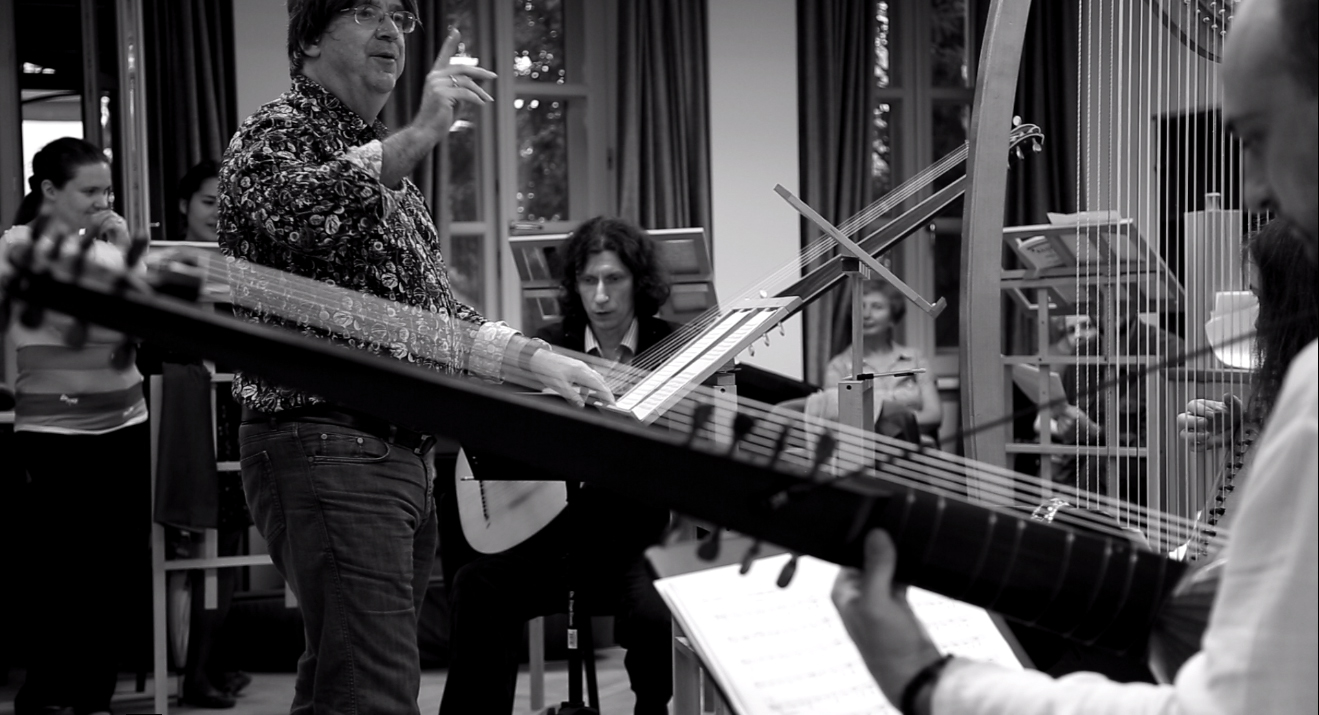
http://www.historyofemotions.org.au

Single-Action Harp – making Sensibility of the Méthodes

diderot 1769

The late 18th century tends to be where modern harpists and Early Music first connect. But how did the original players of the single-action harp think and feel about this new instrument and the fashionable music they played on it? Of course, the instrument itself is different from its modern descendant – smaller, more lightly strung, and with different chromatic possibilities – so we can expect differences in technique and interpretation too.

But how appropriate is that modern dialectic of ‘technique’ and ‘interpretation’ anyway? Rather than looking backwards into the past, can we find a way to view the instrument in the context of its own time? Can we share the original players’ contemporary perspective, the musical heritage of the 17th century, and the new developments of the mid-18th?

Mike Parker’s Child of Pure Harmony (2006) is a concise, but very useful introduction, looking back over the development of the instrument. His survey of technique covers the playing position, left-hand ‘bracing’ (where non-playing fingers rest on the strings to support the hand),  and certain harp-specific special effects: harmonics, sons étouffés and the use of the swell pedal. Mary Oleskiewicz’s Preface to her (2008) edition of the CPE Bach Sonata sets the scene in Berlin in 1762, where the new French pedal harp co-existed alongside the older Italian triple-harp. The present brief essay explores modes of thought during the first golden age of the pedal harp, from the 1760s to the French Revolution, focussing on France itself.

Les goûts réunis

To ensure that our gaze follows the arrow of time in the right direction, let’s approach the 18th century from the late 17th, via the music of Corelli, Lully, Purcell and the young Johann Sebastian Bach. The aesthetics of the 17th century were discussed in terms of differing, even opposing, national styles: Italian and French. Italian violin-playing was dramatic, virtuosic, characterised by slow, sonorous bow-strokes in long notes and rapid passage-work in allegros. French violin-music danced lightly and elegantly, with a lot of ornamentation, but in strict rhythm, vrai mouvement. In this airy style, the very short French bow skips like a dancer’s feet, often lifting of the string, but always landing gently.

The poet John Dryden described Henry Purcell’s music as structured on the Italian model counterpoint, ‘which is its best Master’, but played in the French style, ‘to give it somewhat more of gaiety and fashion’. Bach wrote an Italian Concerto and French Suites, but was most at home in the highly conservative, intensely polyphonic German style. In Hamburg, Georg Philipp Telemann (who described himself as le grand partisan de la musique Française) was at the cutting edge of musical fashion with his music ‘for a mixed taste’, combining elements of French and Italian styles within the same work.

The concept of ‘re-uniting the tastes’ became the cornerstone of the three great mid-18th-century Essays, each dedicated to the ‘true art of playing’ a particular instrument: Quantz (1752) for the flute, C.P.E Bach (1753) for keyboards and Leopold Mozart’s Violinschule (1756). Violinists are asked to combine the slow, sustained bow-stroke of Italian cantabile with the airy flight of French dances, the virtuosity of Italian sonatas with the graceful ornamentation of French airs. Keyboard-players and flautists receive similar instructions in the idiom of their instruments. All three Essays are remarkably consistent in their characterisation of the German fashion for ‘mixed taste’, and are a vital source for 18th-century performance practice.

CPE Bach Adolph_Menzel_-_Flötenkonzert_Friedrichs_des_Großen_in_Sanssouci

C.P.E Bach at the harpischord accompanies Frederick the Great in a flute concerto at Sanssouci Palace, whilst Quantz (far right) listens.

Empfindsamkeit

The Essays breathe the spirit of Empfindsamkeit – sensitivity, sensibility – a recently-invented term (taken from contemporary literature) that perfectly describes the aesthetic of the period. Quantz shows how sensitively musicians responded to the particular degree of tension and release in each dissonance and resolution. And, as C.P.E. Bach explains, it is the musician’s sensibility that invites in turn the audience’s sensitive response.

Certainly I recommend the three Essays to any harpist interested in the C.P.E.Bach Sonata, the Mozart Concerto for Flute and Harp, or any repertoire of this period. But the very pre-eminence of these three German-language treatises tends to distract attention from the continuing importance of each national style, Italian or French, un-mixed, especially in its own country.  

French violins were smaller than Italian instruments, and had lighter strings. But those shorter, more delicate strings were tuned even lower than in Italy, so the string tension was much, much less. Comparing Italian and French orchestras, one writer thought that the French violins were broken, they seemed so quiet; whereas Italian players seemed about to break their instruments with the thunder of their fortissimo! French makers reformed the wind instruments too, making them quieter and more delicate, to suit the French taste for subtlety and elegance.

It is this world of delicacy, elegant subtlety and quiet nobility that the French harp inhabits. Its rich sonority is coaxed from low-tension strings at a very low, French pitch, and these light strings also respond with sparkling brilliance to the many ornaments typical of this style. And within the international aesthetic of Empfindsamkeit, the French style tended particularly towards subtlety, grace and charm, rather than to the drama of Sturm und Drang. Cousineau’s ideal harp-sound is moelleux et franc, ‘gentle and clear’.

Low French Pitch

Harp-maker Beat Wolf’s excellent website here includes – amongst a treasure-trove of fascinating information – a time-line giving various sample pitches in late-18th century France. There is of course considerable variation amongst them, but they are all low: A379 (1766), A409 (1783), A396 (1789). This contrasts to typical London and Vienna pitch around A420. See Bruce Haynes History of Performing Pitch: The story of “ A” (2002) for lots more pitch information.

For modern use, convenient equivalents would be A415 (London, Vienna etc) for most 18th-century music, but A392 (a tone below A440) for music from France, including the Mozart Concerto. In private correspondence, Beat Wolf tells me that the string-lengths on most 18th-century harps are simply too long for today’s so-called “classical pitch” of A430 (derived from early 19th-century information) , let alone modern A440.

Cousineau warns against the ugliness of wide thirds (i.e. against Equal Temperament), which he considers ‘too strong and harsh on the ear’. The remedy is to narrow the fifths, as in one or other variety of Meantone. Although the exquisite clarity of quarter-comma Meantone is ideal for 17th-century music and Italian or German repertoires, sixth-comma gives a rounder, smoother sound that is in keeping with the 18th-century French aesthetic. Measurements of original instruments are consistent with the period use of sixth-comma Meantone, although one should perhaps be cautious about the margin of error for such fine measurements on 200-year-old mechanisms.

All the temperaments discussed here (and many more too) are built into the excellent ClearTune app for smart-phones. I recommend A392 and sixth-comma Meantone for French 18th-century harp. 

Meyer title page001

Méthodes de harpe

We are fortunate in having a large selection of late 18th-century French harp Methods to study, many of them published in facsimile by Fuzeau Productions, here.

Most of these French Methods are directed at beginners, but even so they are remarkably parallel to the sophisticated German-language Essays of the 1750s. Even the title of the earliest example, Meyer (1763), follows C.P.E. Bach’s lead: Essay on the True Manner of Playing the Harp.  Whereas today’s musicians often make a distinction between Technique and Interpretation, the Essays and Methods teach a technique that builds-in many elements of ‘good delivery’: period technique goes a long way towards creating a historical ‘interpretation’.

It is taken for granted in this period that music is played in time, with the rhythm organised by a long slow pulse. (See Andrew Lawrence-King Rhythm – what really counts here) Leopold Mozart’s instructs violinists to ‘play the whole piece in one suitable and unchanging tempo’ – Das ganze Stück in einem rechten und gleichen Tempo hinauszubringen. If there is any artistic variation in tempo, it is not the general rubato that we know from the 19th and 20th centuries. Rather, the soloist may take some liberties whilst the accompaniment continues in measured rhythm. And even this should not be overdone, as Leopold Mozart and the Contesse de Genlis agree. ‘Why play out of time’, asks Genlis – ‘one might as well play out of tune!’

Since the time is counted steadily, with the slow Tactus beat, we must look elsewhere for the subtle variations and changes of Empfindsamkeit. In place of modern rubato, we must awaken our Sensibility to other performance variables. Here again, the Essays and Methods are in agreement, with a high priority given to the subtle patternings produced by particular fingering-systems.

Fingering for harps and keyboard instruments corresponds to bowing patterns for violin, or tonguing patterns for flute: all these are techniques for creating variations in the attack-characteristics of an individual note, or in the joins and separations between one note and the next. This is what Early Musicians mean by ‘articulation’: the way that notes start and stop, join and separate, just as articulate speech is started and stopped by vowels and consonants, joined and separated into words.

17th-century fingering, bowing and tonguing systems are characterised by Good and Bad notes, corresponding to the Good and Bad (accented and un-accented) syllables of poetry. For the harp, Good and Bad notes are played respectively by Good and Bad fingers – scale patterns typically alternate Good and Bad. This survives in some 18th-century Methods, which recommend 123232 etc for descending scales.

The Essays also assume that the principle of Good and Bad notes will still be observed – Leopold Mozart asks for alternating degrees of bow pressure, when several notes are played in one bow stroke. Quantz gives alternating tonguing patterns, creating the sound of ‘diddle diddle dee’. But one of the characteristics of Empfindsamkeit subtlety is a growing interest in more complex, elegantly varied bowing and slurring patterns. A variety of bow-strokes, writes Leopold, ‘brings the notes to life’. This is reflected in the Methods with a new approach to fingering for the 18th-century harp.

Just as with Leopold Mozart’s instructions for bowing, harpists must still maintain the correct hierarchy of Good and Bad notes, but now by sensitive control of finger-pressure, instead of by alternating fingerings. Meanwhile, Leopold’s varied bowings are paralleled by varied fingerings, linking notes into ‘groups’ not only of two or three notes (as was typical for the alternating fingerings of the 17th-century) but also of four, five or up to eight notes. The varying note-count in each group corresponds to the varying number of notes within each bow-stroke of Leopold’s violin-style.

The clearest explanation of this concept is in the Method by Cousineau (1784). A pair of notes will be played with 2 fingers: 2 1 ascending, 1 2 descending. Three notes will require three fingers, 3 2 1 or 1 2 3. Four notes require four fingers 4 3 2 1 or 1 2 3 4. So far, so obvious- though these simple groupings should be practised carefully to maintain sensitivity to, and control of the hierarchy of Good and Bad notes within each group of notes.

A group of five notes will be fingered 4 3 2 1 1 ascending, and 1 1 2 3 4 descending. The ‘rule of thumb’ (no pun intended!) for groups of more than four notes is to have the full sequence of four fingers at the bottom end of the group, whether ascending or descending.

For a group of six notes, there are two possibilities, depending on whether the notes go two by two, or three by three. Two by two (for example, quavers in 3/4  time) 4 3 2 1 2 1 ascending and 1 2 1 2 3 4 descending. Three by three (for example, quavers in 6/8 time) 3 2 1 3 2 1 ascending, and 1 2 3 1 2 3 descending. Applying the appropriate fingering produces the required phrasing: in this historical style, ‘technique’ and ‘interpretation’ are completely interdependent.

For a group of seven notes: 4 3 2 1 3 2 1 ascending, and 1 2 3 1 2 3 4 descending. And eight notes (no surprises here): 4 3 2 1 4 3 2 1 ascending and 1 2 3 4 1 2 3 4 descending. But don’t forget the (more old-fashioned) option of descending with 1 2 3 2 3 2 3 2 alternating.

Introduction to Single Action Harp

The Method by that great writer, pedagogue and independent spirit, Stéphanie, Comtesse de Genlis (1811) is worth special attention, for it is aimed not at amateur beginners but at the serious student intent on an international-level career. She advocates systematic and persistent practice of fingering patterns (what we would now understand as the ‘ten-thousand hour rule’ for mastery of elite skills), use of all five fingers, and a virtuosic level of finger-control for both passage-work and trills (indeed, for both at once, in the same hand).

Some modern players dismiss her Method as ‘eccentric’, because of her advocacy of 5-finger technique. But her contemporary reputation as an expert in child pedagogy and her remarkable survival as a highly independent woman throughout all the upheavals of the French Revolution show she was a force to be reckoned with. And the charge of ‘eccentricity’ depends on a spurious and circular argument: don’t trust Genlis’ 5-finger technique because she was mad! How do we know she was mad? Well, she used 5-finger technique!

Taking Genlis therefore not as ‘eccentric’ but rather as an idiosyncratic source of information for elite-level performers, it’s worth considering her advice on how to manage the position change, say within a group of eight notes ascending:  4 3 2 1  – position change – 4 3 2 1. Methods for elementary students advise changing position by crossing the fingers underneath the thumb, placing finger 4 for the fifth note before playing the fourth note with the thumb 1.  Genlis recognises this elementary technique, but recommends advanced students rather to jump the hand – the interruption in the flow will disappear with assiduous practice.

Le Grand Principe

Cousineau and other Method-writers emphasise placing in advance all the fingers needed for a group of notes. This corresponds to Leopold Mozart’s emphasis on smooth bowing and Francois Couperin’s subtly delicate French harpsichord fingerings. Cousineau puts this simply and memorably as his Great Principle, La main ne soit jamais obligée de faire de grands mouvements et se trouve toujours placée commodement.

Cousineau also recommends small movements of the fingers, keeping them close to the strings as the finger-stroke ends, as the technical preparation for high-velocity passage-work. This contrasts to the modern tendency to snap the fingers all the way, whenever possible.

My personal experience with low-tension strings is that a full finger-stroke is helpful for slow, sustained notes, but with a very slow finger-movement, keeping the hand still. 18th-century Methods tell the player not to rest the right hand on the instrument, but wear-marks on surviving instruments show that this particular piece of advice was often ignored: the baroque position with the hands resting on the instrument was common also amongst 18th-century pedal harpists. And note that before you play your long note, Cousineau would have you prepare the next finger on the next string – this also requires the hand to be kept still. All that contrasts with the modern tendency to play long notes by floating the whole hand outwards and upwards like angel wings.

To summarise Cousineau’s Great Principle and other advice:

Keep your hand still until you have to move it, then move it only as much as necessary.

So here is the starting-point for any harpist wishing to acquire late-18th-century Empfindsamkeit:

  • Play in time
  • Develop your Sensitivity to, and control of the hierarchy of Good and Bad notes
  • Create the sound of Sensibility with the melodic finger-patterns from the Methods.

Subsequent chapters in the Essays and the Methods alike concern Ornamentation, Good Delivery, Preluding and Accompaniment – but all that must wait for further chapters of this essay too.

giroust

The young daughter of the Duc of Orleans studies harp with Madame Genlis, whose adopted daughter, la belle Pamela, turns the pages. Read more here

Please join me on Facebook https://www.facebook.com/andrew.lawrenceking.9 and visit our website http://www.TheHarpConsort.com .

Opera, orchestra, vocal & ensemble director and early harpist, Andrew Lawrence-King is director of The Harp Consort and of Il Corago, and Senior Visiting Research Fellow at the Australian Research Council Centre for the History of Emotions.

http://www.historyofemotions.org.au

You can study Early Harps with Andrew Lawrence-King at the Guildhall School of Music & Drama, London;  and at the Royal Danish Academy of Music, Copenhagen.

A free History of the Harp poster can be downloaded here.

On the recording Amor ist mein Lied (with Laurence Dean, 18th-century flute), Andrew plays one of Beat Wolf’s modern copies of a Louis XVI harp. Preview here.

Amor ist mein Lied CD

Rhythm – what really counts?

Galileo Pendulum

Rhythm is the beating heart of music, from the powerful throb of heavy rock to the sensual swing of jazz and the ‘vacillating rhythm’ of romantic rubato. For many musicians and listeners today, the very word ‘expressive’ suggests rhythmic fluidity. Around the year 1600, John Dowland, William Shakespeare, and Giulio Caccini agree that rhythm is a high priority:

Music is nothing else than Text, and Rhythm, and Sound last of all. And not the other way around!

Caccini Le nuove musiche 1601/2

But what did 17th-century musicians mean by Rhythm? A rock drummer’s groove? A jazz singer’s swing? 20th-century rubato? Just as instruments, pitch and temperament, bowing styles and ornamentation all vary between different periods and repertoires, so the aesthetics of rhythm also show historical change.

This is a huge subject. Detailed investigation of attitudes to rhythm around 1600 are a major strand of our six-year Performance research program at the Australian Centre for the History of Emotions. Dance and Swordsmanship sources set the context for musical tempo. Frescobaldi, Caccini and Peri give us insights into Italian subtleties of rhythm. The very concept of Time itself must be studied, in order to understand how musicians were thinking in that pre-Newtonian age.

Isaac Newton

(Isaac Newton Philosophiae Naturalis Principia Mathematica 1687 sets out the concept of Absolute Time)

Nevertheless, the essential practicalities of period Rhythm are already well understood, although only partially applied in today’s Early Music performances. George Houle’s 1987 Meter in Music, 1600-1800 provides a summary of historical sources, setting the context for this period of fundamental change. 17th-century theorists and performers tried to reconcile incompatible elements: the old system of triple-time proportions and the newly fashionable French dances; the gradual shift from proportional signs to modern time-signatures; the persistent concept of a (more-or-less) fixed tempo ordinario and the proliferation of speed-modifying words, allegro, andante etc; the distinction between measured meter and modern accentual rhythm.

But what simple, practical guide-lines can we draw from all this?

As elementary music students, many of us were taught to manage difficult rhythms by counting the smallest note-values, adding these up to measure longer notes. Before 1800, the contrary held: musicians counted a long note-value, and divided this up to measure shorter notes. Purely mathematically, there should be no difference between the two approaches, but (since musicians are human), the practical results are measurably different. Even more importantly, the slow count feels different.

Around 1600, this slow count is called Tactus. Its slow constancy is an imitation of the perfect motion of the stars, whose circular orbits create the heavenly sounds of the Music of the Spheres. It is felt in the human body as the heart-beat and pulse, or measured as a walking step. In practical music-making, it can be shown by an up-and-down movement of the hand, or by a swinging pendulum.

(Of course, 17th-century musicians did not have digital watches or metronomes, but Galileo had noted the pendulum effect around 1588, observing a swinging chandelier in Pisa cathedral – see illustration above. In another posting, I’ll report on some recent experiments with pendulum tactus.)

Around 1600, typically the Tactus will be on minims (half-notes), somewhere around MM60. Down for one second, Up for the next second. You create crotchets (quarter notes) by dividing each Down and each Up in two. “Down-and-Up-and.”

The simple, steady movement of the hand, Down-Up, makes it easy to manage changes of Proportion. Keep the hand movement the same, but now divide it into three beats on the Down, and another three on the Up: this gives Tripla. Making the Down long, and the Up short (whilst keeping the duration of the whole Down-Up cycle the same) gives Sesquialtera: two beats on Down, one on Up.

Grouping notes into phrases, and choosing where to place the accents is independent of Tactus. Tactus simply measures time. This is the crucial difference between early and modern attitudes to rhythm: Tactus and Accent are independent, whereas our modern Downbeat implies accentuation.

The independence of Tactus and Accent allowed 17th-century musicians to notate triple rhythm under what looks to us like a “common time time-signature” of C. Time is being measured by dividing the minim tactus into two crotchets, but the music is phrased in groups of three crotchets. Professional dancers do something similar today, counting everything in blocks of 8, so that a waltz is counted:

123/456/781/234/567/812/345/678

Before 1800, counting (i.e. measuring time) and accent are independent. They can coincide, but they don’t have to.

Tactus and Proportion were central concepts in period music-making.

Tactus directs a Song according to Measure.

John Dowland Micrologus (1609) translated from Ornithoparcus (1517).

Ha, ha, keep time! How sour sweet music is / When Time is broke, and no Proportion kept!

William Shakespeare Richard II Act V Scene v (c 1595)

In today’s Early Music, the acceptance of Tactus principles varies. Stronger principles are supported by academics more than they are applied by performers.

  • Slow count

This is widely accepted, and many performers work with and teach a slow count.

  • Proportions

Amongst academics, there is debate about precisely how to interpret Proportional changes, but the central concept of an underlying constant slow count is not contested. Amongst performers, adherence to Proportions is regarded as ‘hard-core’ HIP, and ‘too academic’ for some.

  • Consistent Tactus: a whole “Song according to Measure”

Though the period evidence supports this, very few performers are prepared to relinquish their romantic rubato.

  • “Tactus directs a Song”

In most modern performances, a conductor directs.

  • Soloists follow the accompaniment

Explicitly stated by Leopold Mozart (1756), clearly implied by Jacopo Peri (1600), and the basis of the entire period practice of Divisions, this is almost universally ignored today.

  • Rhythm in Recitative

Most singers today are astonished at the mere suggestion that Monteverdi might actually have meant something by all those complex rhythms that he forced his printers to set in type.

  • Tactus in Recitative

Very few performers have tried this. However, conductors in recitative are commonplace…

  • Consistent Tactus for a large-scale work

I was first introduced to this concept by Holger Eichhorn, director of the Berlin ensemble, Musicalische Compagney. Paradoxically, consistent Tactus often results in more contrast in what the listeners hear, since (without the discipline of Tactus) musicians tend to pick a slower tempo when the notes go fast, ironing out the composed contrasts. It is very rarely tried today.

  • Consistent Tactus for an entire repertoire, say all Caccini songs, or everything by Monteverdi.   

There is considerable evidence for this, and some academics argue for it. I know of only one other musician today who supports it in practice: continuo-guru Jesper Christensen.

At CHE, we are investigating Baroque Time, researching period Philosophy and the aesthetics of Rhythm, testing all our findings and hypotheses in experimental productions. Our six-year mission is to boldly go where 17th-century musicians have gone before, but few performers today have followed: we are applying all these Tactus principles in teaching, rehearsals and performance. So far, the results are academically and artistically convincing, with performers and (most importantly) audiences responding very positively.

You can see a video report of our Tactus-based production of Monteverdi’s Orfeo here.

But I’ll give the last word to John Dowland:

Above all things keep the equality of measure. For to sing without law and measure is an offence to God himself…

pendulum

Please join me on Facebook https://www.facebook.com/andrew.lawrenceking.9 and visit our website www.TheHarpConsort.com . Further details of original sources are on the website, click on “New Priorities in Historically Informed Performance”

Opera, orchestra, vocal & ensemble director and early harpist, Andrew Lawrence-King is director of The Harp Consort and of Il Corago, and Senior Visiting Research Fellow at the Australian Research Council Centre for the History of Emotions.
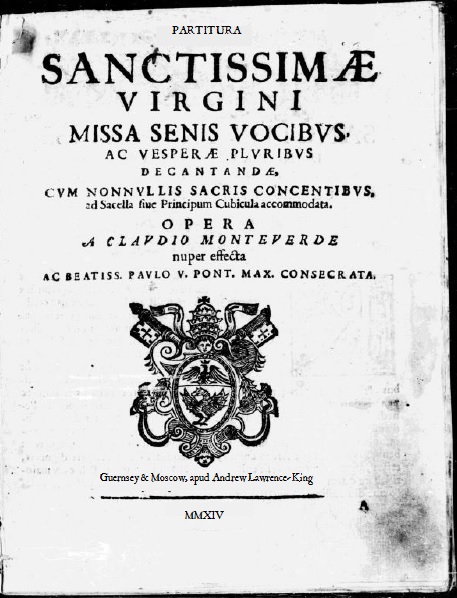
www.historyofemotions.org.au