Form, content & performance practice of Charpentier’s Messe de Minuit pour Noël & In Nativitatem H414
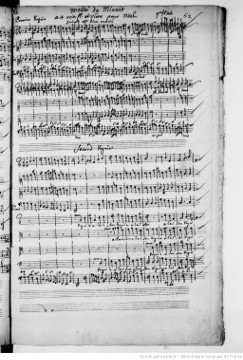
D’ Aquin A la venue de Noël (c1757)
Noëls
To the Christmas story of the Shepherds keeping watch in the fields, of Angels and of God made man, French Baroque composers brought the literary and operatic tradition of pastoral: of poet- ‘shepherds’ singing love-songs in a mythical landscape, of semi-divine Muses and of Apollo, father of Orpheus. And at Christmas-time there came to Parisian churches (and to the royal chapel in Versailles) also the music of real-world country-folk, the catchy ballad-tunes and vigorous dance-rhythms of popular noëls. Liturgical solemnity collided with popular enthusiasm, elite sophistication with rustic energy, royal splendour with heartfelt naivety; just as the Three Kings encountered the ox and ass in that Bethlehem stable.
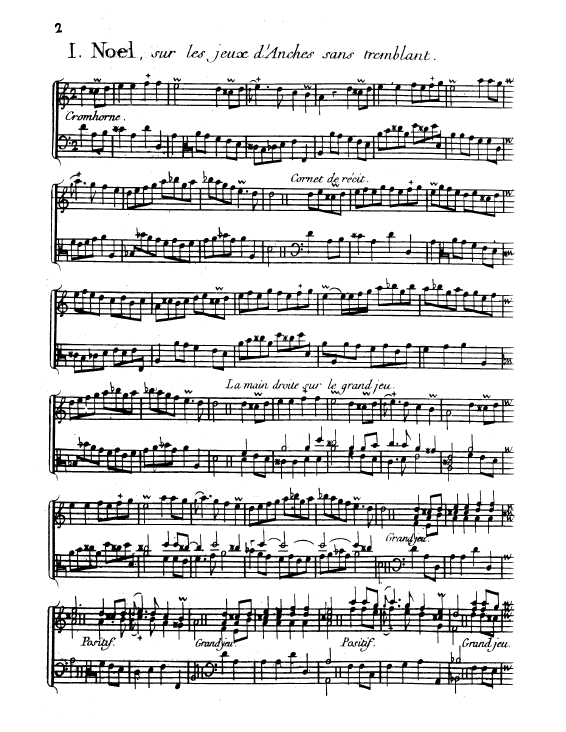
Nicolas Gigault’s (1682) book of noëls for Organ presents typical features found also in later collections. Each piece is a variation-set in which the original melody is heard as a treble and bass duo, in variations with fast notes (doubles), reharmonised, in trios, in dialogue between contrasting timbres or registers, sometimes with an extended glissando-like rush upwards or downwards to the melody note, in the rich sound of the full organ, with echo effects, or with block contrasts imitating polychoral vocal music.
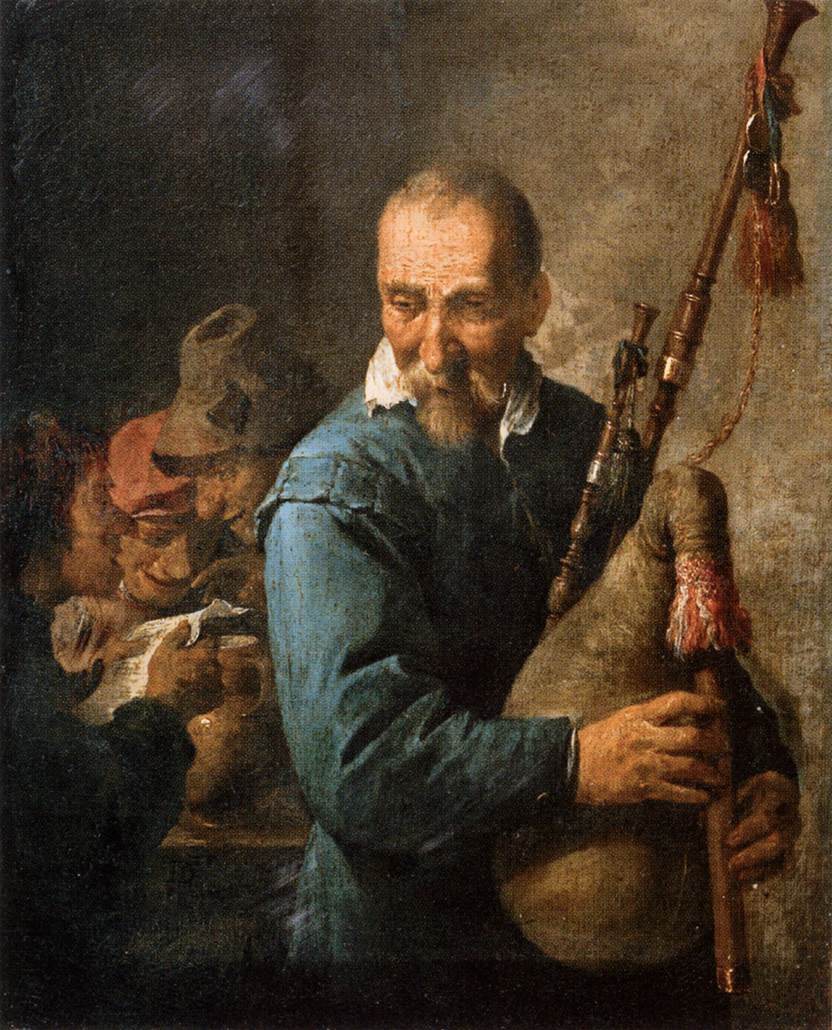
Keyboard noëls also imitated pastoral instruments: the fast beat of a small drum (tambourin) or the drone of a soft bagpipe (musette).
Tradition (and the church authorities) favoured a small selection of noëls, although sometimes a tune is given different words, or the same title is used for two different tunes. Gigault provides details of how to adapt his keyboard compositions for instrumental ensembles. He mentions that noëls were already being sung in church at Christmas time, and no doubt organists had begun to improvise on these melodies, just as they improvised or composed variations on plainchant melodies for Organ Masses. In an Organ Mass. singing and organ-playing alternated verse by verse, except for the Credo which would be entirely sung.
Charpentier
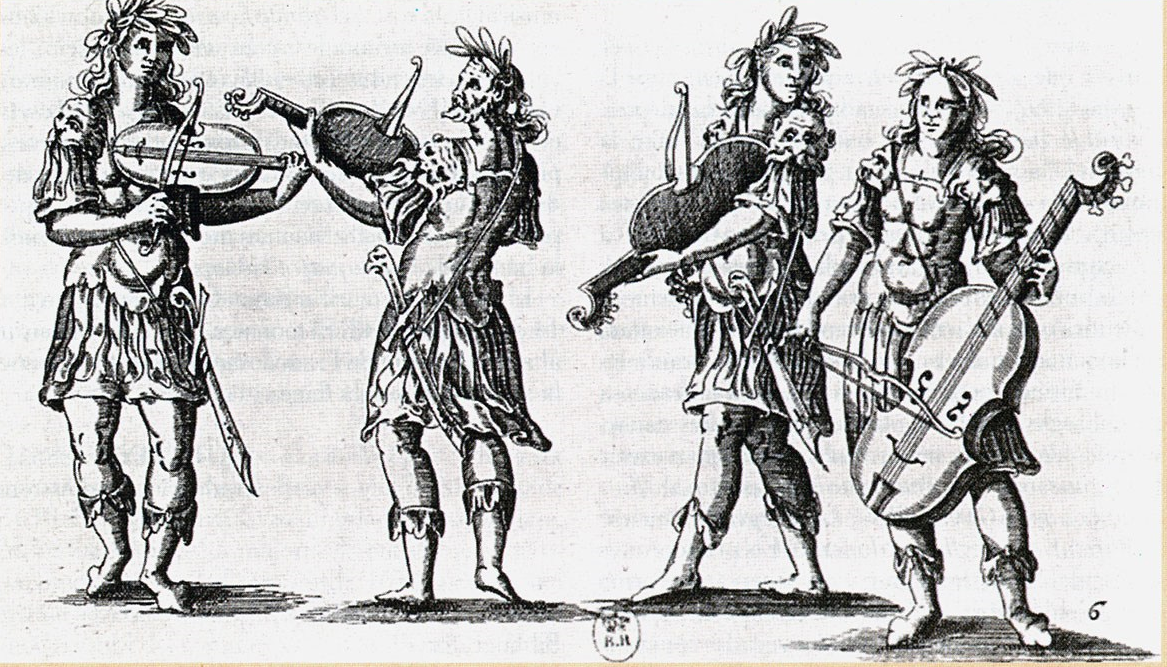
Although the precise dates are uncertain, in the early 1690s Charpentier, a profoundly devout Catholic, set noëls for instruments, and created a Messe de Minuit pour Noël (Midnight Mass for Christmas), setting the Ordinary of the Mass to noël-melodies for consort of voices and an orchestra of strings and flutes. Although this charming work has become famous as a unique combination of baroque folk-tunes and formal liturgy, it was perhaps less surprising to Charpentier’s congregation than to modern listeners.
Instrumental noëls were frequently heard in Parisian churches, and dramatised Christmas pastorales were enacted throughout the country. The titles of Charpentier’s noëls – very well-known to Parisian listeners – would encourage members of the Christmas congregation to identify themselves with the original recipients of the Angels message, to remember the Bible stories and religious doctrine expounded in subsequent verses of the noël text, and (like the antiphon of the day for a set psalm-text) to re-consider the fixed text of the Ordinary in a particular Christmas context.
Formally, Charpentier’s orchestra and vocal consort alternate according to the ecclesiastically approved model for an Organ Mass.
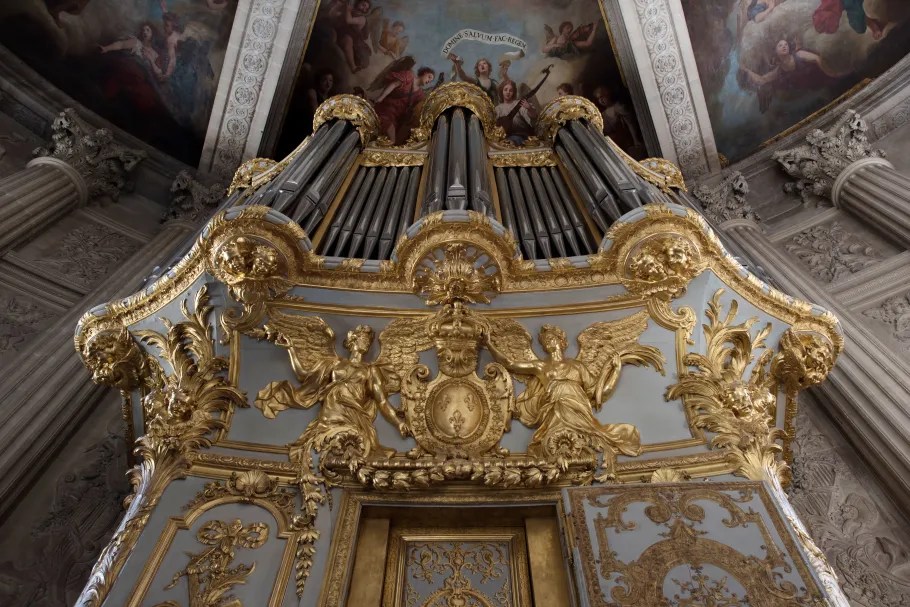
The organ in the Chapel of Versailles
Form: Organ Mass
Ceremonial regulations for the diocese of Paris (1662) prescribed nine alternating versets for the Kyrie, beginning with the organ. Charpentier’s Kyrie sets the noël-melody Joseph est bien marié (Joseph is well married) in turn for instruments, voices, and then organ. Solo voices begin the Christe to the tune of Or nous dites Marie (Now tell us, Mary), instruments follow with the longer tune Une jeune pucelle (A young virgin), which provides the remaining two versets. The second Kyrie suggests grandeur with fugues – imitative polyphony – developing the melody for two more versets, and – as ordained – the organ concludes.
Charpentier’s organ settings do not survive (they may well have been improvised). Jean François Dandrieu’s collection of organ-noëls, expanding his uncle Pierre’s (1714) book and published posthumously (1759) by his sister Jeanne Françoise, provide suitable models for Joseph and Une jeune pucelle, which work at Charpentier’s Kyrie tempo.
The Gloria has muted strings for ‘peace on earth’. After a dramatic pause, Laudamus te (we praise thee) bursts out with the exuberant tune Les bourgeois de Chastre (The townspeople of Châtres), switching at Quoniam tu solus sanctus (For you only are holy) to Ou s’en vont ces gais bergers (Where have the happy shepherds gone?), alternating phrases between singers and instruments as the final Amen approaches.
The entire text of the Credo is sung, beginning with appropriate solemnity: sonorous harmonies, a long bassline descent for ‘maker of heaven and earth’ and a dramatic pause. The doctrine of eternity and of the Christmas moment, ‘God of God, light of light…’ sparkles in the happy (guay) Tripla (fast triple metre) of Vous qui desirez sans fin (You who endlessly desire). The obligatory descending figures for descendit de coelis (he descended from heaven) are particularly beautiful and extended for this Christmas night, with Et incarnatus (And was made man) set in the slow triple-metre of Sesquialtera, a divine dance on the time-scale of all eternity.
After a ‘very long silence’ le jour solonnel de Noël (the solemn day of Christmas) arrives: notated differently from the other tunes and ornate with instrumental and vocal fugues. Tripla metre and rising lines for Et ascendit (And ascended…) contrast with another slow Sesquialtera ‘to judge the living and the dead’. A third folk-tune, that baroque top favourite A la venue de Noël (When Christmas comes) heralds the coming of the Holy Spirit. ‘One holy, catholic and apostolic church’ is a third Sesquialtera, and the finale has the expected fugues in vigorous rhythms.
As in an Organ Mass, the Offertory is not sung. Charpentier gives instruments the tune Laissez paitre vos betes (Leave your animals to graze). Just as the Shepherds must go to Bethlehem, so the congregation must leave behind everyday thoughts as they approach the altar.
Following faithfully the regulations for an Organ Mass, the Sanctus begins instrumentally, with full choir for Pleni (Heaven and Earth are full of your glory), and soloists for the fugues of the Benedictus. The robust rhythms and repeated short phrases of the Hosanna suggest the acclamations of the crowd in biblical Jerusalem, set in the style of noël refrains sung by congregations in Baroque Paris.
The final Agnus, instrumental-vocal-instrumental as in an Organ Mass, calls the faithful to communion at this special moment: A minuit fut fait un reveil (At midnight a cry was made). Christmas was one of the few occasions during the year when those attending Mass would also take Communion.
Charpentier Messe de Minuit
Content: Vernacular commentary on Latin liturgy
During the 16th century, the noël tradition supported one of the aims of Protestantism, making Bible stories and religious doctrine available to ordinary people, in their own language. Cast in metrical verse with the typical low-style features of strong rhythms, short lines and frequent rhymes, and set to catchy tunes and dance-melodies, noëls were easily remembered, enjoyable to sing, and quickly passed on through oral traditions and in such printed collections as La Grande Bible des Noëls (Orleans, 1554). Aboard French explorer of Canada, Jacques Cartier’s ship, Ça, Bergers, assemblons nous (So, Shepherds, let’s gather together) was sung on Christmas Day 1535.
The rhetorical messaging of Charpentier’s masterpiece goes far beyond the popular appeal of a few folk-tunes thrown into a mass setting. He responds to the liturgical text at every level from the doctrine of the Trinity and ceremonial regulations to choices of rhythmic metre and musical depiction of individual words. His selection of particular noëls with their well-known vernacular texts from amongst those traditionally approved, and subtle placement of these French citations in parallel to the Latin of the liturgy, create a personal, Christmastide commentary alongside the universality and constancy of the mass Ordinary.
Kyrie – Christe – Kyrie present Joseph (a human father), une jeune pucelle (a young maid, Mary) and then polyphony, the development of something divine from the virgin’s tune. In the Gloria, as soon as the Angels have announced ‘peace to men of goodwill’, the recipients of that peace are identified as Les bourgeois, ordinary townspeople who then sing praises, just as in real-world Paris. And where have the happy Shepherds (ces guays bergers) gone? To the Bethlehem stable of course, where they recognise (in the words of the liturgy) ‘the only holy one, the only Lord, the only Christ’.
For the Credo, strange harmonies (C natural in the tenor over F# in the bass) depict invisibilium (things invisible): the dissonance is increased by an ‘invisible’ Bb, the upper-note of the violin trill. A dramatic pause creates both clarity and suspense, before revealing unum Dominum, Jesum Christum (one Lord Jesus Christ) in robust rhythms, simple homophony and translucent C major. The noël text Vous qui desirez sans fin evokes real-world anticipation of the coming holiday, the historical time-span between Creation and Nativity, and religious longing for Salvation at the Second Coming. In all three contexts, there is ‘endless desire’ for the appearance of ‘God of God, Light of light, very God of very God’ (the liturgical text).
Charpentier’s most insightful commentary is to link la jour solomnel de Noël (the solemn day of Christmas) to the Crucifixion, a dark reminder (like the Three King’s myrrh) of the sombre destiny of the new-born Babe. Charpentier’s high-style fugues not only signal sacred profondity , but also produce cross-shaped melody-fragments, # marks for certain notes, and piercing dissonances of F# (durum) against Bb (mollis), as if of hard nails through soft skin.
This solemn moment is notated under a different mensuration mark – C rather than the usual ¢ – the only appearance in the whole Mass of this mark, with its associated tempo and rhythmic patterns. (See below for details.)
The second half of the same noël is sung to the text et resurrexit (and He rose again), presented in bold homophony and joyful harmonies, recalling the style of et in unum Dominum, before re-introducing intellectual fugues ‘according to the scriptures’. Indeed, the continuation of this noël weaves in the second, joyful part of the dark Crucifixion story, the story which ecclesiastical doctrine and Charpentier’s folk-music rhetoric link to the seriousness that underlies Christmas merriment.
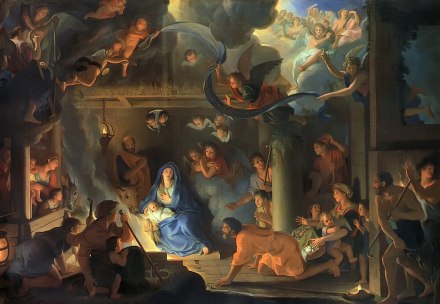
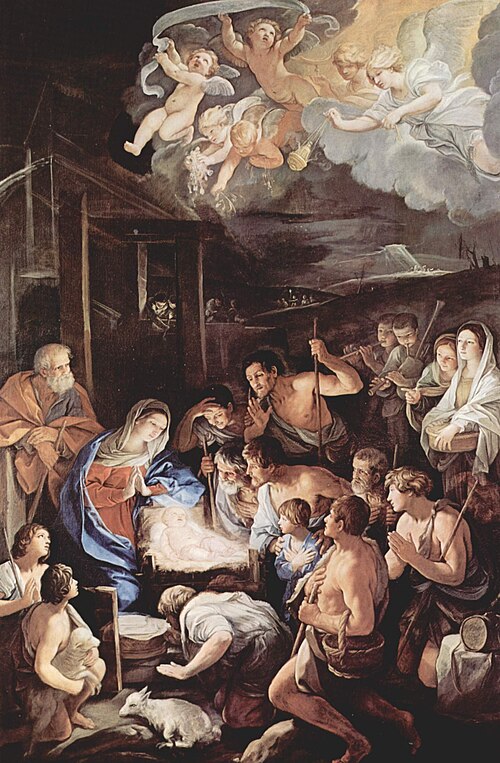
Adoration of the Shepherds Reni (c1642)
Canticum: In Nativitatem H414 (1684)
There are several pieces by Charpentier with this title: this one has the famous song Salve puerule as its finale.
Having studied in Italy with Carissimi, Charpentier introduced sacred oratorios into France under the Latin denomination Canticum. This work’s anonymous libretto, perhaps by the composer himself, begins with a close paraphrase of the account in Luke’s gospel of the Angels and Shepherds. It ends with a beautiful song in sarabande dance-metre, representing the Shepherds’ adoration of the Holy Infant.
The formal structure matches perfectly with the material. After a a short instrumental Prélude, the evangelist-narrator – L’Historien – sets the scene. This soprano récit begins dramatically with an abrupt intake of breath and syncopation for the word frigidae, evoking the cold night, after which the static bass and slow, descending vocal line ‘immerse everyone in deep sleep’. Et ecce ‘And lo’… a second soprano appears heralding ‘the angel of the Lord’. Students of musical gesture will be interested to note that the melodic fragment for Et claritas Dei (and the glory of the Lord shone round about them) is the same as for descendit de caelis in the Messe de Minuet, composed up to a decade later.
The Angel’s words are set as an aria for solo soprano, punctuated by the violin duo. The first part repeats one short text, Nolite timere, pastores (Do not be afraid, Shepherds): the second delivers the remainder of the angelic message, repeating the final line Ite pastores et adorate (Go Shepherds, and adore him) with particularly beautiful writing for the three high parts and continuo bass.
The Shepherds say one to another ‘let us now go even unto Bethlehem’ in the form of an antiphonal chorus, 3 low voices and 3 high, led by a thrilling high, upward leap for the highest male voice, the haute-contre on the word surgamus (Let us arise!). Their questions, quid moramur? quid cunctamur? (Why wait? why delay?) are syncopated and upwardly inflected, as rhetoric requires. The opening bars become a rondeau refrain, a low-style feature appropriate to the lowly Shepherds, with the words usque Bethlehem (towards Bethlehem!) delivered by the full ensemble in the robust homophonic rhythms and simple harmonies that Charpentier uses for emphasis also in the Christmas Mass.
The Shepherds set off on their journey to a lively marche en rondeau. A bass récit continues the gospel narration of their arrival. As the librettist adds the traditional action of their kneeling to adore the Baby, two violins join in the appropriate descending motive, And although the libretto introduces the following song as inculto sed devoto carmine (uneducated, but devout), its text, melody, harmony and rhythm are exquisitely crafted to represent simple piety by means of the art that disguises art. Even the repeat scheme is subtly varied to keep listeners’ ears fresh.
No wonder this beautiful imitation of a folk-noël is frequently performed as an excerpt! But the whole oratorio is of equally high quality, appealing on first encounter, and full of subtle details that further listening.
Performance practice 1: French baroque Latin
It is well worth it for singers to adjust standard modern-day (usually italianate) Latin pronunciation to a period, Parisian delivery. Advice is available from Harold Copeman’s Singing in Latin (1992) ISBN 978-0951579824 and Singing Early Music (Indiana 2004) ISBN 978-0253210265. Although scholars debate some details, the most important differences in vowel and consonant values are generally agreed and not so hard to put into practice.
Some knowledge of the stress-patterns of French, and careful study of Charpentier’s word-setting, will aid a reconsideration of the question of Good and Bad syllables for Francophone Latin. Right from the outset, Charpentier seems to set Kirié and Christé, rather than accenting the first syllable as in italianate pronunciation. Eleison also seems to be accented on the final (nasalised) syllable.
Because this question of word-accentuation has such strong influence on musical phrasing, it is even more important than vowel- and consonant-values, but receives less (if any) attention in the Singing books above.
Duffin on Temperament (2008)
Performance practice 2: Temperament
Sixth-comma meantone.
Muffat (1698) warns followers of French style against too low a mi, too high a fa, suggesting that the shift from the pure major third of quarter-comma meantone to the slightly wider third of sixth-comma has already happened, smoothing melodies and improving the violin-band’s open fifths. For most instruments, meantones work in all tonalities, as long as you observe the difference between G# and Ab, etc.
Mean-tone, and not a circulating temperament.
Modern-day Early Music practice is for the keyboard player to choose, usually a circulating temperament, with various compromises for the black notes, with different widths for different fifths, and to force the orchestra and singers to do their best to match what feels like a random set of adjustments. This is one of the downsides to the immense contribution made to Early Music by keyboard-player/directors.
Ross Duffin’s (2008) argument is that most musicians only need to learn meantone (quarter-comma for early baroque, sixth-comma later), supported by Ibo Ortgies’ research indicating that other instruments should not attempt to match any bad compromises in the keyboard temperament.
Rather than asking violinists and singers to learn a zillion temperaments, the challenge is for keyboard players to find a temperament that works reasonably well for the repertoire at hand. When that temperament creates a problem, it is for the keyboard player to hide the problem somehow (miss out that note, have different enharmonics in different octaves, tweak the temperament, whatever), not for the orchestra to move away from their beautiful meantone!
Keyboard solos are a different question of course, but for most ensemble work, it can often work better to tune meantone with the most frequently encountered enharmonics, and work around the notes you don’t have, than to tune some circulating temperament that doesn’t match the orchestra anywhere. I also find variants of temperament ordinaire to be very effective in practice: tune meantone, and then temper just one or two black notes as needed, using them with discretion.
The Country-Dance Watteau (1706-1710)
Performance practice 3: What’s the Time to Beat?
A la venue de Noël… Christmas is coming, but how fast? Did Charpentier intend his liturgical Mass setting based on popular songs and country-dances to be performed fast and folky? Or slow and sacred? The argument below suggests that the answer might be “Yes”!
Charpentier’s teacher, Carissimi, suggested (see below) that musical tempo was not merely quantitative, some number of time to be counted, but rather a Quality of emotional experience, depending on how we count time. In search of that Quality of Baroque time, the remainder of this article dives deep into questions of historical tempo.
Even in today’s Early Music ensembles, tempo decisions are mostly made by the personal preference of a director and realised with modern-style conducting. Back then, tempo was notated by the composer and realised with Tactus-beating. The Tactus-beater was often a singer, since instrumentalists’ hands were already occupied.
Musicians – like car-drivers – don’t like being told how fast to go! So even amongst Early musicians, there is considerable resistance to the concept that baroque composers indicated the tempo they wanted, that it’s not the performer’s free choice. Of course, there are disagreements amongst scholars about the fine detail of particular notations. and some gaps in our understanding. But the fundamental principle is clear, there is a “correct” tempo, and the Historically Informed Performer’s job is to find it, not to invent their own.
The guiding principle of the research behind this article is that music notated the same way will be realised at the same tempo, throughout any given work, perhaps throughout an individual composer’s oeuvre, even across an entire repertoire. By considering theoretical explanations and very many practical examples of the same notation, the appropriate tempo gradually emerges with ever-increasing precision.
Persistance resistance to this concept, combined with the entrenched position of conducting within the music business, resulted during the 20th century in a roundabout approach to the study of historical notation of tempo, and (still today) in a lack of investigation of the practicalities of Tactus-beating.
During the 1980s and 1990s, great attention was paid by scholars and performers of early 17th-century Italian music (Monteverdi in particular) to questions of Proportions. In theory, Proportional notation establishes simple fixed ratios of speed between different mensural signs. Precisely how this was done changed from early to late 17th century, and again between 17th and 18th centuries; theory lagged behind practice; there were also differences between one country and another. Unsurprisingly, primary sources disagree and there is confusion about nomenclature.
During the 1980s, performers tended to treat all triple-metre proportions as fast Tripla – three triple beats in the time of one duple beat. The leading hypothesis of the 1990s was proposed by Prof Roger Bowers, who advocated interpreting Monteverdi’s mensuration marks highly conservatively, according to medieval rules.
Applying Bowers’ hypothesis, it can be difficult and time-consuming even for an academic expert to calculate the implied Proportion. Sometimes one needs to examine every part in the score, to be sure of the answer. Meanwhile, amongst performers, the trend was towards more frequent application of slow Sesquialtera proportion – three triple beats in the time of two duple beats.
I developed an alternative hypothesis in the mid-1990s, and have tested it against every example I have encountered since, including some famously challenging cases proposed by Bowers. I suggest that by the early 17th century, mensuration marks had lost their medieval meanings, and had become little more than elegant decoration, like the elaborate G that still forms our treble-clef sign 𝄞 today. Indeed, there are several examples of mensuration signs being omitted entirely (e.g. the final Moresca in Monteverdi’s Orfeo), without any loss of performers’ understanding of the notation.
In my hypothesis, Italian seicento Proportions are determined by note-values. For Monteverdi, three semibreves indicate slow Sesquilatera (corresponding to two duple minim beats); three minims indicate medium-fast Tripla (corresponding to one duple minim beat).
There’s also very fast Sesquialtera, six semi-minims (looking like crotchets) to one duple minim beat. And quantitatively, these three Proportions are the same. Once you know you are in triple metre, each particular note-value (semibreve, minim or semi-minim) has its own consistent duration, whether you are beating slow semibreves, medium-fast minims or very fast semi-minims. That quantative equality is accepted by Bowers, and confirmed by Carissimi (see below).
Determining Proportional changes according to note-values is quick and easy for performers. At the crucial moment, everyone instantly gets the same answer, even whilst sight-reading. And it can be done from any single part. This is essential, since we know that Monteverdi’s musicians often performed without rehearsal, and nearly always from individual part-books, not from score.
Tactus (c1600): concept, hand-beat, notation, Time itself
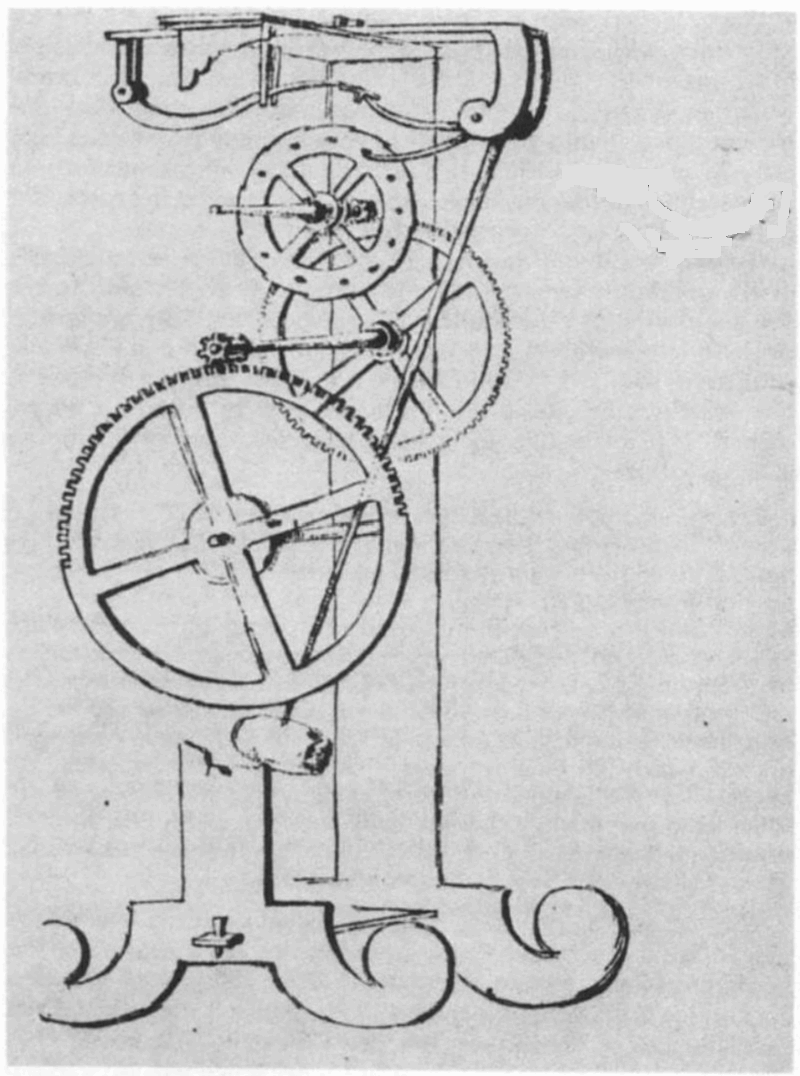
Incredible as it may seem, scholarly debates and rehearsal discussions about Proportions largely ignored the more fundamental question of the underlying duple beat, the Tactus. In Zacconi’s (1592/1596) analogy, Proportions are like the cog-wheels in a mechanical clock, taking the steady tick-tock of the pendulum beat, and converting it into various different speeds at fixed mathematical ratios. No matter how closely we examine the cog-wheels, we can’t understand the resulting movement unless we know how fast the pendulum ticks.
From Zacconi to Mersenne (1636), the Tactus beat (one-way, down or up) corresponds to one second of real-world Time. Not measured by machine – obviously they didn’t have digital metronomes, and when pendulum-based machines were developed (by Loulié, 1694) they mostly chose not to use them – but subtly perceived to the best of human ability, using skills developed over long experience. What is your best estimate of a one-second beat?
Inevitably, this perception of time is subjective, varying with mood, emotion, venue and occasion. As you move from an acoustically (and emotionally) dry rehearsal room to passionate performance in a baroque cathedral, your perception of “the same tempo” is likely to change, if it would be measured by some scientific gauge. But they didn’t measure that way and – in the age before Newton (Principia 1687) – they did not even share our concept of Absolute Time.
For them, there was no fixed time-scale against which movements could be measured. Their concept of Time was Aristotelean: Time does not exist of itself, it is dependent on movement. On the cosmic scale, Time is created by movement of the highest sphere, the Primum Mobile, turned by divine love. Musical time is created by the movement of the Tactus hand.
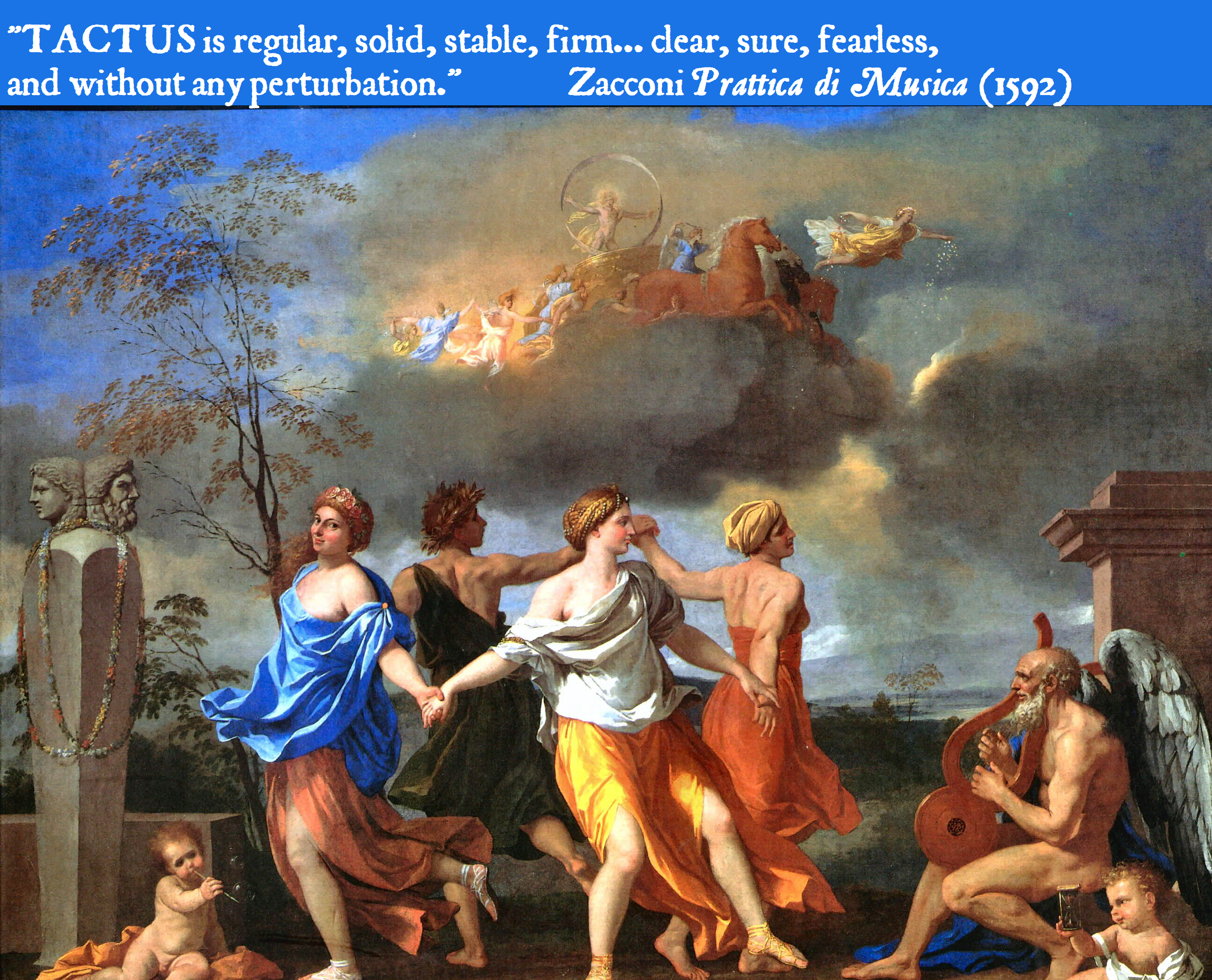
Dance to the Music of Time Poussin (c1635)
Battuta
Tactus is regular, solid, stable, firm… clear, sure, fearless, and without any pertubation. Zacconi (1596)
Meanwhile modern-day Early Music has paid very little attention to how Time-beating was done historically. Whilst our instrumentalists study the use of their historical instruments, most early music conductors do not follow historical practices of time-beating, neither applying the essential principles of Tactus, nor employing historical movements of the hand.
The fundamental duple beat was shown by down-up movement of a musician’s hand (there was no conductor in the modern sense). Instrumentalists could use their foot.
Zacconi equates (1) the concept of Tactus as a constant, slow, steady beat with (2) the physical action of beating time, battuta; with (3) the corresponding amount of musical notation, misura; and with (4) real-world Time itself, tempo. Under Monteverdi’s mensuration mark of C, Tactus (1) corresponds to (2) the complete down-up movement of the hand, to (3) a semibreve’s worth of written note-values, and (4) to 2 seconds of real-world Time.
For most modern-day musicians, a down-up beat of one second each way feels rather slow. For early musicians, there is a fundamental skill to be acquired, of finding and maintaining this slow, steady beat, whilst realising all the various rhythms notated within it. Renaissance and baroque sources make it clear that musicians also had a strong awareness of the steadiness of the complete down-up Tactus (approximately 2 seconds). And as we will soon see, sometimes that beat might be appreciably slower.
Improve your own Tactus skills
Around 1600, musicians acquired deep-rooted and subtle awareness of Tactus through long and constantly repeated practice. In elementary training, they would learn to beat Tactus consistently, and would use their own hand-beat to structure their study of smaller note-values and Proportional changes. Throughout their career, singers would prepare new repertoire by beating Tactus to control rhythm, and occasionally checking pitches with a small flute (compare and contrast a modern-day singer controlling pitches with a keyboard, and occasionally checking speed with a metronome).
In performance, ‘the person administering the Tactus’ (Zacconi’s form of words) would do their very best to give a steady and unperturbed beat, the same beat as in rehearsal, the same beat every day, the same beat for every piece, the same beat as everyone else, to the limits of human ability. This contrasts with modern-day conducting in general, and in particular with conductors’ wish to do something ‘special’ in performance, to do something spontaneously ‘different’ today, to do something different with this piece, to do something different from everyone else, etc.
Constant exposure to the same steady beat (to the limits of human perception) allowed musicians to expand their own perceptual limits, becoming very consistent and highly sensitive to tiny deviations from the ideal steadiness. Modern-day early musicians can imitate that historical experience by devoting hours (days, weeks… if we start as adults, we have a lot of catching-up to do!) to beating Tactus, beating Tactus whilst practising smaller note-values, beating Tactus whilst studying an individual line, beating Tactus whilst listening to or performing ensemble music. Observing a pendulum is also useful training.
Tactus-beating is an embodied skill: it’s ‘in your arm’, not just ‘in your head’. It’s a participatory experience: everyone needs to know how it feels. Tactus-led music-making is not controlled from the top (conductor or soloist) downwards, but is rooted in a lifetime of specific, shared involvement. In mixed ensembles, Tactus comes from the ‘grass-roots’ of the continuo upwards. (Agazzari 1607) Think of a jazz-band, guided by the rhythm-section.
Think of a jazz big band’s backing-singers (literally at the back, as we also see Tactus-beaters in Baroque paintings), waving their arms and clicking their fingers.They are certainly not conducting the band, but the physical action of their hand-beat is inseperable from the steady groove and subtle swing of the music, inseperable from their experience of ‘how the music feels’. For this reason, it’s worth experiencing the particular hand-position (palm outward), detailed movements (see below), and philosophical context (Music of the Spheres, Aristotelean Time) of Tactus, in order to appreciate the Quality of Baroque musical Time.
Zacconi also describes another mensuration mark, which he associated with old-fashioned religious music. Under ¢, each beat (down or up) corresponds to a semibreve. In theory, the various note-values would go by twice as fast, but in practice the beat itself is somewhat slower. Compared to the appoximate one second each way of C (i.e. 60 bpm), the slower beat for ¢ might be about 45 bpm. This practice re-emerges in a new context in Charpentier’s compositions (see below).
Even within one mensuration mark, the Tactus might vary subtly from one section to another, depending on the emotional affetto of the text, or the rhythmic structure of the musical activity. Frescobaldi gives detailed rules for how and when to do this (see below).
And in practice, triple-metre Proportions were not so strictly mathematical. In the early 17th century, there was a tendency to tweak the proportion to exaggerate contrasts. In the 18th century, the tendency was rather to reduce contrast. See Looking for a Good Time?
Gradually, during the mid-17th century – whilst Charpentier was studying in Italy – there was a change in the conventions of notating triple metre. The principles of Tactus and Proportions remained, but Monteverdi’s way of writing slow Sesquialtera with three semibreves fell out of use. Instead, three minims (usually under mensuration mark 32) came to represent Sesquialtera, and the notation for medium-fast Tripla became three crotchets (under mensuration mark 34 or 3). We see this change of notational conventions in process across the various publications of the singer-composer nun Isabella Leonarda:
In late-17th-century France, after Charpentier returned to Paris to work for Mlle de Guise, three duple mensuration marks were used: (from slow to fast) C, ¢ and 2. In theory, ¢ was twice as fast as C, and 2 was twice as fast again. In practice, the differences were less drastic, with ¢ and 2 considered equivalent to each other in some sources. And for some genres (overtures, preludes and symphonies) 2 would be slow, whereas in dances it was fast (Muffat 1695).
Hand-beats in France
The relationship between C and ¢ seems to have grown out of the Zacconian tradition (C minim ~ 60 bpm; ¢ counted in semibreves but with a slower Tactus, say semibreve ~ 45 bpm). The French kept the respective note-value durations but changed to a minim beat for ¢ mensuration: Zacconi’s Tactus of semibreve ~ 45 was realised with a minim-beat at minim ~ 90. Compared to the minim-beat of C (minim ~ 60), the French ¢ minim-beat is indeed faster, but not twice as fast.
And in this same period, the particularly strong connection between French music and dance led to an increased focus on the internal beats within the Tactus, at the level of dance-steps, e.g. crotchets in 3. This encouraged a tendency for metre-changes from duple to triple to preserve the duration of (say) crotchets, rather than to apply Proportion (by which the Tactus remains the same, and the duration of crotchets and other small note-values changes). Beating ¢ as minim ~ 90, they would feel (and make dance-steps on) crotchet ~ 180. Making a change to 3 (theoretically a Tripla proportion of C minim ~ 60), they would still feel and dance crotchet ~ 180.
Beyond the simple down-up Tactus beat, other ways of beating are described, facilitating this tendency to focus on more frequent internal beats rather than the slow count of Tactus. Following this gradual development through period sources is challenging. Aristotelean concepts applied by Zacconi (Tactus = the movement of the hand = musical notation = Time itself) were still embedded within musical terminology, even as actual practice had already begun to change.
French terminology
Zacconi’s constant Tactus and its identity with real-world Time faded into the background. In French musical terminology, temps is a beat, a movement of the hand (variable according to context) corresponding to a particular sub-division (determined by context) of the mesure (a certain duration of written note-values). The mesure is now shown in bars of regular length, that length chosen by the composer and corresponding to the mensuration mark (which looks to us increasingly like a modern time-signature).
The calibration of the hand-beat to written note-values is more complex. Battre (to beat) refers to the action of the hand-beat and also to the conceptual division of the mesure into internal beats (temps). Action and concept do not always match: depending on circumstances, not every temps receives a hand-beat.
At a subordinate rhythmic level within the beat (temps), conjunct notes written equally are performed inégal (unequally), usually long-short. The degree of inequality and the note-value to which it is applied depends on the mensuration mark, dance-genre, level of activity and other context, determined (as ever in French music) by good taste – le bon gout.
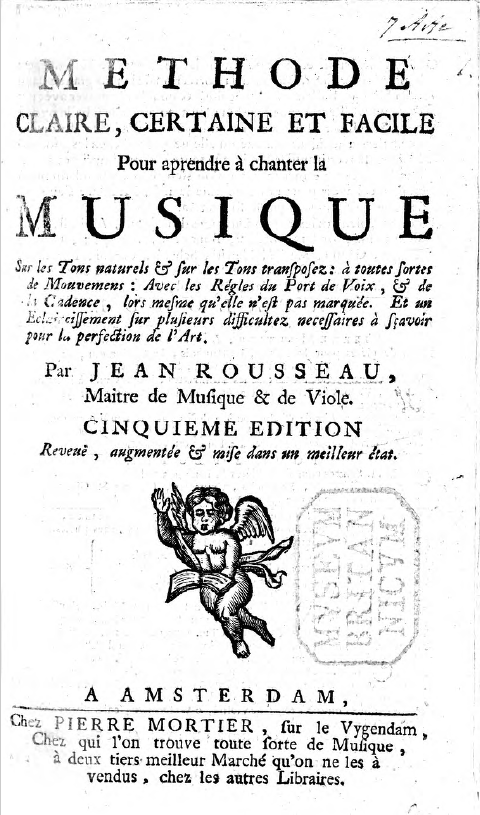
Jean Rousseau (1683) shows how to battre (feel the beat, and show it with the hand) for each mensuration mark, beating down (frappant) and up (levant) for durations specified as temps within the mesure. Depending on the mensuration mark, a mesure could contain one or more units of actual Time, and those Time-units could themselves be long. medium or short. Writing within a pre-Newtonian, Aristotelean concept of Time, musical theorists struggled to find any fixed scale of Absolute Time against which various types of musical beats might be measured.
Rousseau’s calibration of temps to actual Time uses descriptive words grave (very slow, profound), lent (slow), vite (fast) and léger (light). His ‘slow’ temps for the minim-beat in ¢, is probably around 90 bpm. That might indeed feel ‘slow’ for modern-day musicians, but it is significantly faster than Zacconi’s 60 bpm and 45 bpm Tactus movements.
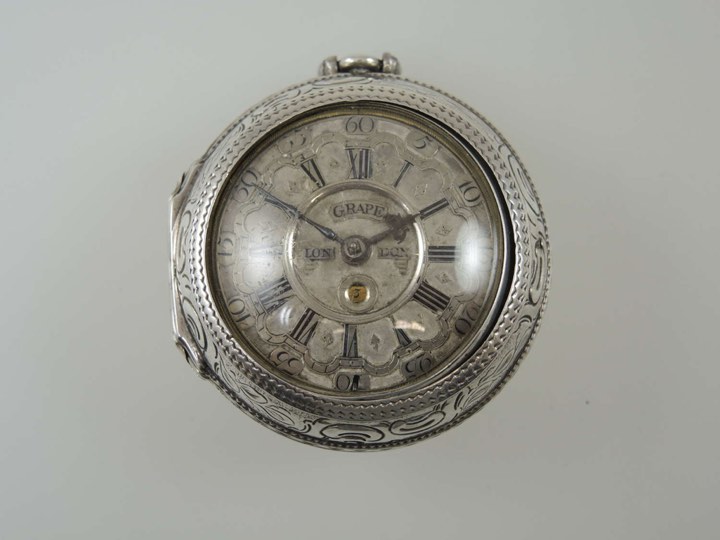
Grassineau’s (1740) translation and expansion of Brossard (1703), approximates quavers in ¢ to the tick of a fine pocket watch. 5 ticks per second was typical, but in this period, better watches ticked faster. The range of 5-6 ticks per second suggests a ¢ minim-beat of 75-90 bpm, which Grassineau would halve for C and double for 2. Many 18th-century sources indicate beats based on a ‘pulse’ around 80 bpm.
Rousseau’s C
Rousseau’s detailed instructions for C reveal a new French practice very different from the old Italian Tactus = Time = minim = 1 second. He specifies that the C temps is grave (i.e. slower than his lent of around 90 bpm), so 1 second for each temps (60 bpm) is still plausible. But the mesure se bat (literally ‘is beaten’, here meaning ‘is understood conceptually’ or ‘is felt’) in four of these temps graves. This is crotchet ~ 60 bpm. Meanwhile Rousseau’s hand is down for 2 crotchet temps, up for the next 2, so that its movement is very slow indeed, minim ~ 30 bpm.
Inégalité is applied to semiquavers.
C for Charpentier – case studies
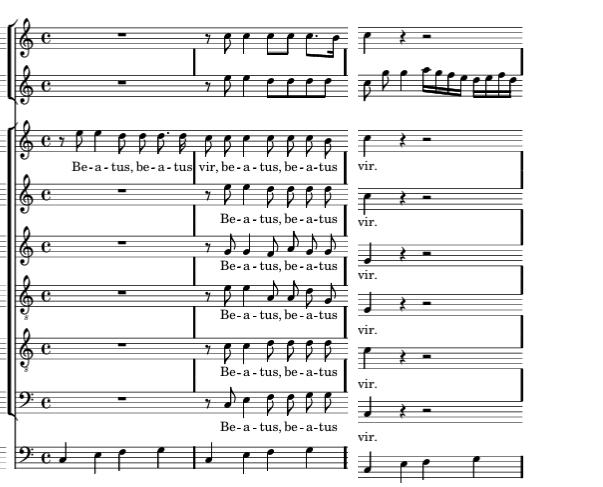
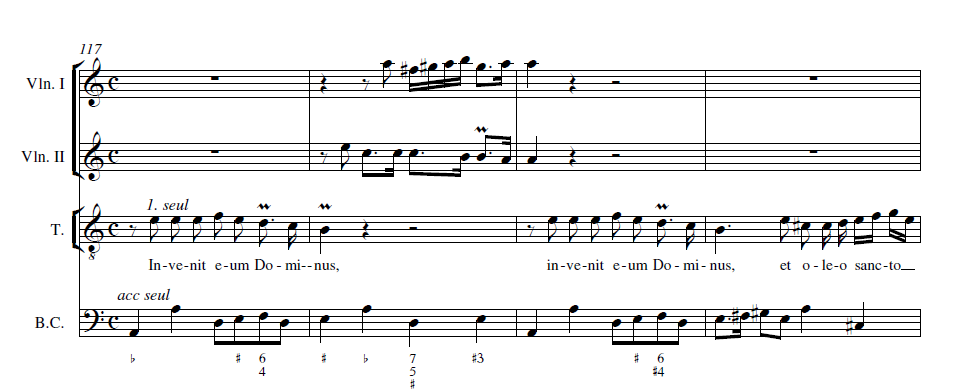
Much of Charpentier’s music in C seems to work very well at the older minim = 60 that he would have learned in Italy. For example, in the magnificent Offertoire for the consecration of a Bishop, Ecce sacerdos magnus H432, the words Invenit eum Dominus are set in C with music reminiscent of Monteverdi’s much-beloved Beatus vir (1641).
Probably composed around 1630, Monteverdi’s piece goes very nicely at the Tactus and Proportions we would expect: C minim ~ 60, later changing to triple-metre Sesquialtera semibreve ~ 90.
It seems plausible to take Charpentier’s C Invenit similarly at minim ~ 60.
Although a Rousseau-style, super-slow minim ~ 30 is not impossible for Invenit , this movement comes after 116 mesures of slow 2 (slow, because it starts as a Prélude, see Muffat’s remarks above), around minim ~ 45. After this, Invenit‘s Monteverdi-like music at a Monteverdian tempo brings an ideal contrast, rather than grinding down into even lower gear Rousseau-style.
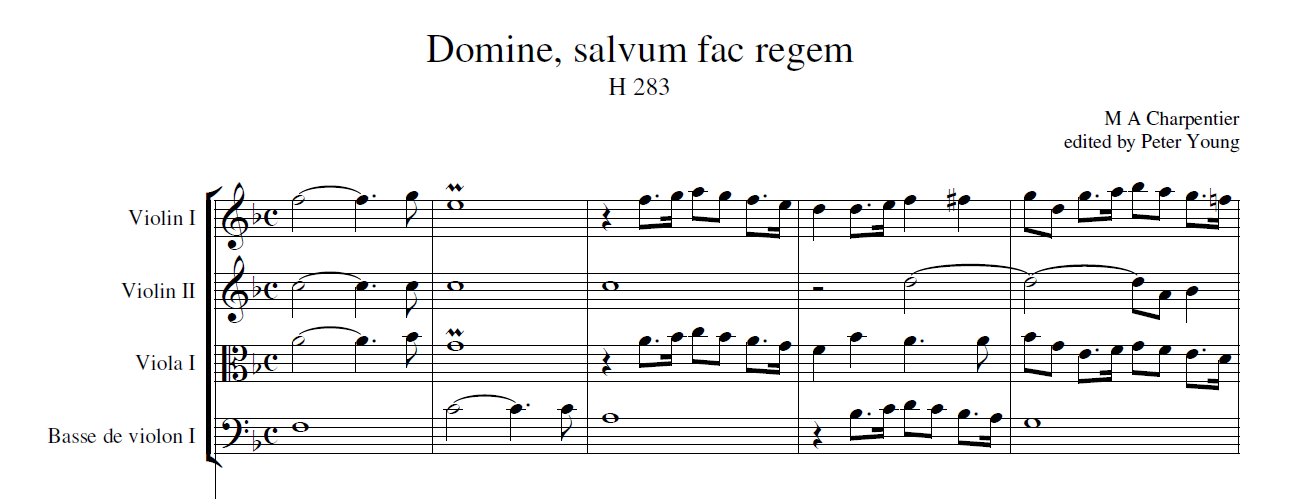
Similarly for another movement notated in C mensuration. One of Charpentier’s many settings of Domine, salvum fac regem (Lord, save the King) H283, has four 4-voice ensembles (2 vocal choirs, 2 instrumental) combined over the Basse continue. It works very well realising its C mensuration at italianate minim = 60, but makes no sense at Rousseau’s minim = 30.
C for Christmas
But my experiments with this same italianate minim = 60 for the C movements of the Messe de Minuit (the Crucifixus) and In Nativitatem (the récits) felt rushed and unsuitable for the words. Singers (rightly) complained. Here Rousseau’s crotchet ~ 60 works much better.
So how should performers recognise which kind of C is required when, in Charpentier’s works?
Two meanings of C
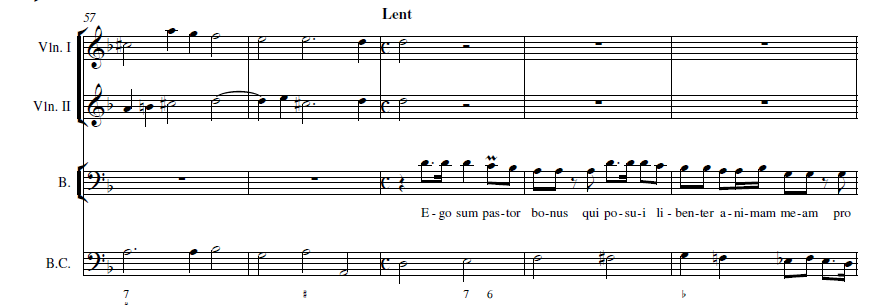
Charpentier’s canticum (Oratorio) for the feast of Corpus Christi, Venite ad me H344 is consistent with the idea of two meanings for C, and indirectly supports the need to recognise genre distinctions. After 58 mesures of slow-dancing Sesquialtera 32 (minim ~ 90), it is not immediately apparent whether the next movement’s bass is active or récit-like, and the vocal line has both récit-style repeated notes and beautiful melodic touches.
The marking Lent (Slow) recognises that there is a a question to be resolved and provides the required information. Rousseau-style slow delivery is highly appropriate as the music proceeds, setting a highly-charged text that paraphrases John 10:11 (I am the good shepherd who gives his life for his sheep) and the most sacred words of the Prayer of Consecration (my Body and Blood).
After the return of the 32 refrain Venite ad me, the choir enters with long notes in 22 mensuration. Slow like a Prélude or fast like a dance? Charpentier avoids any ambiguity with the instruction A deux temps lentement (in two beats, slowly). This is perhaps around minim ~ 45, slow indeed, but not as slow as Rousseau’s grave C, shown by the hand at minim ~ 30 and felt as four crotchets.
C for Crucifixus
In the Messe de Minuet, although the bass-line of the Crucifixus is active, the texture is densely polyphonic, and the text is intensely solemn. In Peri’s (1600) words, this is clearly a ‘sad and serious matter’ in which the singers’ music should not ‘dance’.
And an analysis of contrasts of activity (as for Invenit above) here supports the Rousseau-style very slow beat. The Crucifixus is the only movement in C in the whole Mass: nearly everything else is in¢ or 3 which (see above) both produce the feeling of crotchet activity (and a syllable on each crotchet) around 180 per minute.
According to the old, italianate notation with C minim ~ 60, the quaver activity and quaver-syllables of the Crucifixus would come out around 240 per minute,faster than the surrounding movements and uncomfortably fast for performers. But realised according to Rousseau, quaver activity and syllables are around 120 per minute, slower than surrounding movements and appropriate for the text, though still tripping lightly enough to suit the folk-tune theme of Charpentier’s fugues. Meanwhile the hand-beat is very slow indeed, around 30 bpm, which transforms the noël‘s melody and associated words along with Charpentier’s polyphony into a unique moment of solemnity within the whole work.
Two meanings of Charpentier’s 3?
For both 2 and C, mensurations, it seems that Charpentier has two meanings available, slow or fast. The performer’s decision is not so much a choice, as an arrival at the correct understanding. Usually Charpentier’s meaning is obvious by considering genre distinctions, musical activity and text. Where doubt remains, instructions in French language confirm the composer’s intentions.
We have already noticed that Baroque theorists from Zacconi to Rousseau prefer qualitative words to quantitative numbers when describing musical time. It seems that Charpentier uses descriptive words to clarify symbols that could have different meanings in older Italian or newer French practices.
And perhaps there is a similar principle at work in one of the 3 sections of the Messe de Minuit. In the Credo, Charpentier marks Deum de deo to be performed Guay (literally ‘happy’, but like Italian allegro conventionally meaning ‘fast’). It is the only such marking in the whole Mass.
In Italy, 3 allegro would be understood as a subtle modification of the theoretical dotted minim = 60, implying crotchet > 180). But perhaps (as with 2 and C), Charpentier is using a descriptive word to indicate an entirely different realisation of the mensuration mark, taking the Tripla Proportion on the surrounding pulse of 90 bpm, resulting in crotchet ~ 270. This would be significantly faster.
Rousseau would notate this fast triple metre as 34, with three crotchet beats going faster than in 3. Indeed, he comments that these beats are too fast to be given with the hand, which therefore shows down for two beats and up for one. This is nevertheless a very energetic hand-movement, compared to the basic minim ~ 90 before and after.
Changes of Pace
17th-century music is often structured with several more or less contrasting sections within a larger whole, the end of each intermediate section usually indicated with a double-bar. Standard modern-day procedure, in early music and mainstream alike, is for the conductor to direct a rallentando into the final chord, allow it to be sustained (with or without an underlying beat, sensed or shown) and to show a cut-off. Then there will be one or more preparatory beats to show the new tempo of the next section. The cut-off itself can be one of those preparatory beats, and with a good conductor, the preparatory beats will be precisely equal to the desired new tempo. (The modern phenomenon of conducting ahead of the ensemble is beyond the scope of this article, but seems remote from any Baroque quality of time).
If there is a fermata mark 𝄐, this invites the conductor to sustain for longer and to de-emphasise any underlying beat.
Historical practices differ from this, and they also changed during the 17th century.
Monteverdi
From Zacconi (1596) to the anonymous Il Corago (c1630), musical theory, the science of Time, the philosophy of the Music of the Spheres, and performance practice all favour a steady Tactus beat that continues unchanged throughout the whole piece (for Il Corago an entire ‘opera’). The last note of each phrase, though notated long, would be sung short, creating frequent silences within the steady Tactus.
The mark 𝄐 indicates the end of something, but for Monteverdi it certainly does not imply an automatic sustaining of the note. Whilst the very last note of a piece might well be sustained, the default for intermediate phrase-endings is to shorten the final note, which will nearly always be a Bad syllable. [Doni 1641].
Cavalieri uses another mark 𝄋 at the end of almost every phrase, indicating that the silence resulting from shortening the final note gives an opportunity for rhetorical gesture. A longer note-value for the final note would still be pronounced short, leaving an even longer silence. Varied note-values for final notes in later operas suggest that composers varied the length of this dramatic silence, varying the theatrical ‘pacing’ of the dialogue.
The model for music-drama was the declamation of a fine actor in spoken theatre: the context for theatrical acting was the etiquette of conversation in polite society, famously documented in the Book of the Courtier.
Such operatic debates as the encounter between Nerone and Seneca in Monteverdi’s (1643) Poppea (Act I scene ix) are notated with sufficient time between speech and riposte for the audience to appreciate fully each rhetorical point, drama being heightened by the requirement to maintain the semblance of politeness whilst the emotions cook under the pressure of unrelenting Tactus. Modern directors are often tempted to crowd everything together in the search for raw excitement, losing contact with the fine detail of the text and the inexorable power of steady rhythm.
Il Corago discusses practical solutions for another frequently-encountered situation in music-theatre, when stage action requires more time than is available within the notated music. In this situation, one does not leave a silence. Rather, the Continuo repeats the harmony in Tactus rhythm (minims or semibreves). If it is known in advance that more than a second or two (i.e. one or two chords) will be needed, then a chord sequence can be played (for example a standard ground bass, or a harmonic progression from the work at hand).
For example, the presentation in score of Monteverdi’s Lamento della Ninfa (intended to be performed in theatrical style, with a soprano and three men embodying the character roles of the Nymph and three sympathetic Shepherds) allows the accompanying male trio to follow the soloist’s spontaneous dramatic timing. If she chooses to delay an entry, according the emotional ‘Tactus of the heart’ rather than the unchanging ‘Tactus of the hand’, the Continuo will make an extra reiteration of the ground bass, which the male trio will be able to follow from their score. If they had individual parts only, they would have no way of knowing what was happening: with the whole movement structured on a ground bass, their next entry would fit with the continuo bass, even if the soloist was meanwhile several seconds behind!
Contrariwise, some theatrical ritornelli could be realised as overlapping or ‘telescoped’: the ritornello starts simultaneously with the soloist’s final note (and/or vice versa) rather than a beat or two afterwards. This practice is especially associated with Prologues, and might be intended for the intermediate strophes of the La Musica prologue to Monteverdi’s Orfeo.
In all these situations, steady Tactus continues across the boundaries between musical sections, even across Proportional changes etc. Reading polyphony from individual parts, one does not know whether a change of Proportion will affect all the voices, some voices, or only your own part. So a new mensuration mark cannot be read as an automatic instruction to pause. Between musical sections, there may be silence or overlap, but the Tactus (in this period identified as Time itself) ticks on ‘without any pertubation’ (Zacconi 1596).
Frescobaldi (1615)
In the context of contrasting sections with diverse rhythmic structures (diversità di passi), found in ‘modern madrigals’ and imitated ‘with passionate vocal effects’ in his own Toccatas, Frescobaldi describes in careful detail how to ‘drive the Time’ (guidare il Tempo) ‘by means of the beat’ (per mezzo della battuta). From one section to another, the Tactus may be somewhat faster or slower ‘according to the passions or the sense of the words’. Between one section and the next, the Tactus-hand may hesitate in the air, prolonging the upbeat. The new section starts ‘resolutely’.
Rallentando is indicated where, towards the end of a section, the note-values become smaller and smaller. The modern habit of starting a section with semiquaver action slowly and then accelerating is specifically contradicted. After prolonging the upbeat, the new section starts ‘resolutely’.
Describing Lully’s string-playing style with a wealth of precise details, Muffat too emphasises the need to find the vrai mouvement at the beginning of each section and to maintain it consistently until the very end. This ‘true movement’ means more than just the speed, it implies also the ‘groove’ of each particular dance-type and the ‘swing’ of inégalité. (See below)
In Rousseau’s system, a change of mensuration will often imply change to several aspects of the organisation of musical time, both conceptual and practical. If we modern-day musicians want to understand how these changes felt to Charpentier’s musicians and their listeners, we need to study and experience each of these temporal variables, within the historical context of a fading tradition of unchanging Tactus, and amidst the Aristotelean imperative to create Time through movement.
In late 17th-century France, the central mensuration-mark was ¢, perceived as two slow (lent) beats, shown similarly by two beats down-up, all this at minim ~ 90, with inégalité applied to quavers. We can experience the physical feeling by trying this hand-beat, finding the speed and maintaining it as precisely as humanly possible: palm outwards, elegant hand-shape (fingers gently curved, middle fingers close together, index slightly extended, little finger slightly withdrawn, thumb relaxed), arm hinging at the elbow. The down-stroke hits (frappant) an imaginary stopping point, the up-stroke is free.
There was also awareness of the complete mesure, corresponding to the old slow Tactus ~ 45 bpm. But musical activity and syllables are usually at the level of crotchets (180), resulting in the traditional practice of dividing up a slow beat into smaller note-values. We can experience this by singing a few phrases, noticing how ever-changing patterns of text-led accentuations and articulations (where is the Good – accented or lengthened – syllable? How do consonants or word-breaks affect the smooth flow of sound?) interact with the steady beat.
Changing into 3, the perception is of three fast (léger) beats at 180, shown by two hand-movements that are unequal: down for two crotchets, up for one. Meanwhile the underlying sensation of time has changed to bar = 60 bpm. And the interaction of musical activity and syllables to the fast, unequal hand-beat is very lively and complex. Inégalité is still applied to quavers.
At the instant of change, the hand might hesitate on the up-beat (as Frescobaldi describes). Or perhaps the hand continues steadily, since the first down-beat of 3has the same duration as a down-beat in C, and the same awareness of crotchet activity.
What is sure, is that until we try out these changes of pace not only with historical quantities of beats per minute, but also with period qualities of physical movement and philosophical context, we have not truly experienced a French baroque connection. And if we disconnect from our individual and mutual sense of embodied rhythm (acquired through long participation in Tactus), allowing a conductor to drive his own Time, we become musical passengers when we should be beat-dancers.
Rousseau specifies that 32 is understood as three slow (lent) beats, shown as two hand-movements (down for two minims and up for one), corresponding to minim ~ 90. This produces a very particular effect at the moment of change from C, as the down-beat becomes twice as long, and the underlying sensation of time slows to bar = 30 bpm. Inégalité is now applied (subtly) to slow-moving crotchets.
Charpentier uses this measure for the three most sublime moments of his sacred text: Et incarnatus est; judicare vivos et mortuos; Et Unam Sanctam et Catholicam Ecclesiam. This last 32 continues, linking the Church to Baptism and the promise of the Resurrection of the Dead.
The first message of Charpentier’s Credo (Christmas leads to Crucifixion) is enveloped by his second commentary: the Christmas Babe is also the Judge and the Spirit that enlivens the Church’s faithful. Baptism is an entrée into the holy assemblée of the Church for the three-fold triple-metre sacred dance of Life and Death.
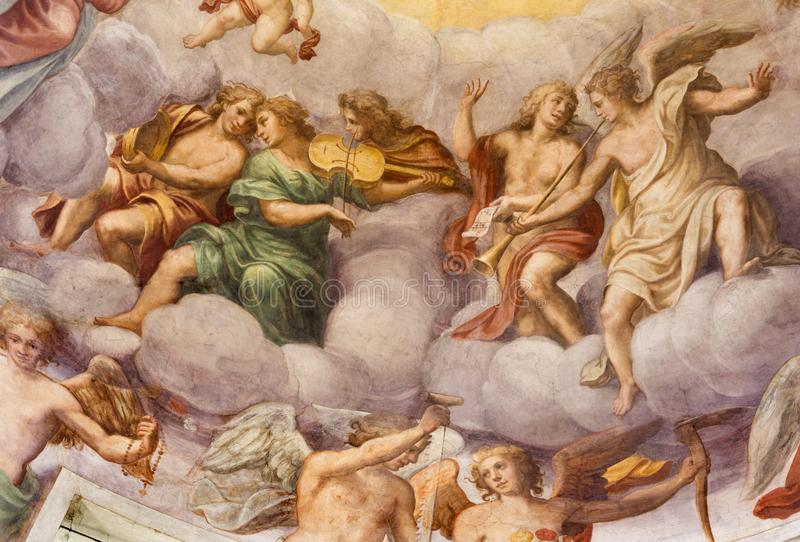
Tactus-beating in Heaven (Giovanni Maria Conti, Santa Croce, Parma, mid-17th century)
Charpentier’s 𝄐
For Rousseau, the sign 𝄐 gives the last note whatever value one wants. Charpentier uses this sign rarely, and seems to give it the older meaning of ‘something ends here’.
In the Messe de Minuit, there are only three occurences. The first, at the end of the Gloria, is helpful to performers, because this is the first time that the music actually stops. At the end of the Kyrie (with its unwritten organ solos) the liturgy continues immediately with the (also unwritten) intonation Gloria in excelsis Deo. The sign therefore seems to indicate that the music has stopped. But it would do no harm also to lengthen the final note, written as a ¢ semibreve.
In the Credo, the crucial words et homo factus est (and was made man) are sung three times, with notated silences before each repetition, and a 𝄐 mark on the very last note, a dotted semibreve in 32. There is also an instruction in French Faites icy un grand silence. The final note is already about two seconds long, and it might be sustained even longer. But Charpentier insists that performers ‘make here a great silence’, and the 𝄐 mark essentially warns everyone to stop.
In the Sanctus, there is a 𝄐 mark at the end of the Hosanna, combined with an apparently contradictory instruction Suivez immediatement (continue immediately). Indeed, the music does continue into the Benedictus (immediately, as liturgically required) without any change of mensuration, but with contrast of texture (soloists, less active figures and fugues). After this, the Hosanna is repeated dal segno, with 𝄐 indicating the fine. Again, it would do no harm to elongate the final note (a ¢ semibreve) but the primary purpose of the sign is to show the ending.
In the historical context where the last notes of each intermediate phrase are likely to be shortened, the effect of finality can usually be acheived by giving the very last note its full written length, without additional sustaining. And very long final notes with heroic cut-off would seem to be inextricably linked to the whims and gesturings of modern conductors!
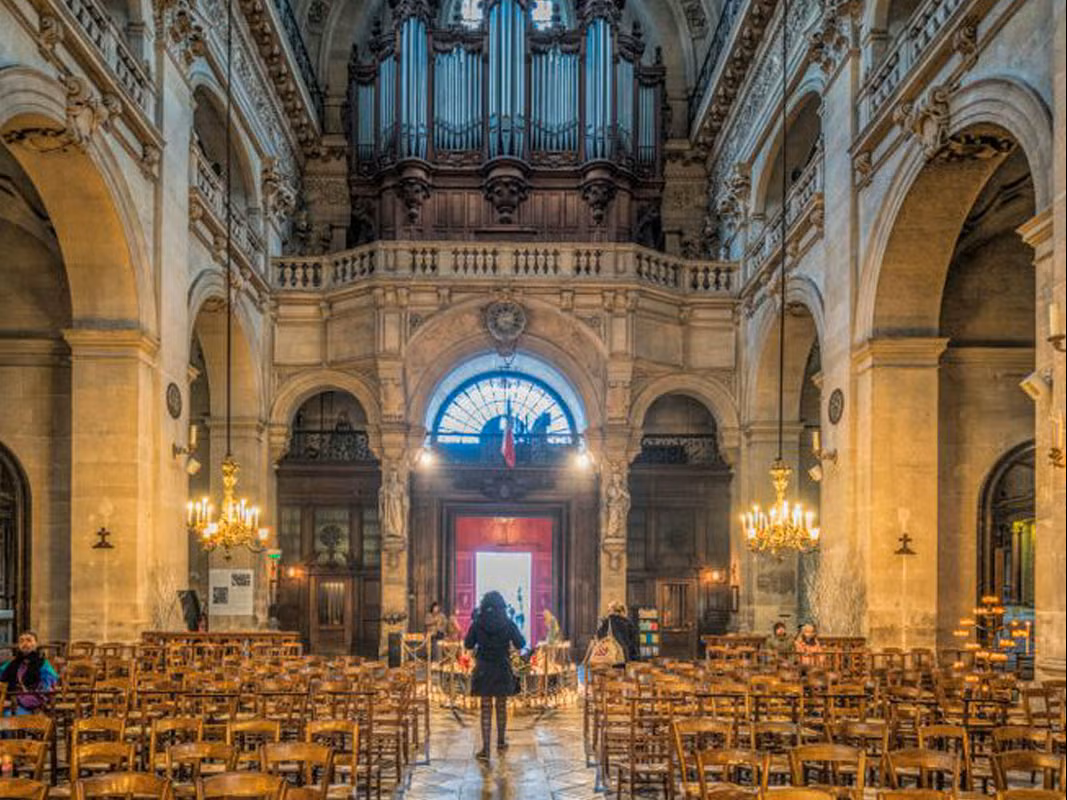
Charpentier’s Jesuit church of St Louis & St Paul, Paris
Charpentier’s connections (1: Messe de Minuit)
Rather than write signs for elongated final notes, Charpentier uses empty bars and clear instructions to control silences and connections: Passez au second Christe (continue to the second Christe) after the first Christe (useful because the previous section was followed by an Organ solo); a bar of silence before Laudamus te, before Et in unum Dominum and after vivos et mortuos. Other changes of pace are overlapped, with the old phrase finishing once the new mensuration has already started: this specifies the connection precisely.
At the end of the Crucifixus, in slow C mensuration, the mensuration changes to ¢ for the final note (a semibreve), and immediately changes again to 3 for Et ascendit. This controls the duration of the change-over and also shows how to beat it. The slow section is felt in four one-second beats, but shown with two very slow beats to the bar. The last bar has two 90 bpm hand-beats and does not last as long as previous bars. Then the hand-beat changes again, and the activity increases sharply from equal quavers at 120 to crotchets at 180 and inégal quavers at 360.
Charpentier’s connections (2: In Nativitatem)
Our second Christmas case-study, In Nativitatem H414, has particularly interesting notations of connections. The opening Prélude in 3 begins conventionally with a sense of paired bars, but an irregular phrase-length results in the first strong cadence ending in bar 9. Conventional paired bars continue so that the ending at bar 29 feels like an “up-beat bar”, encouraging performers to continue directly into the following C récit. This connection is in theory Proportional, a whole bar (dotted minim) = 60bpm equivalent to the new crotchet beat. But the hand-beat would change hugely from unequal (minim+crotchet) at crotchet = 180 to equal minims = 30. However, there might be no beating during the instrumental section (players’ hands are already occupied), nor during the dramatic récit.
As the C récit shifts into the Angel’s 3 aria, the text suggests continuity. Charpentier’s notation is similar to the Crucifixus-Et resurrexit change in the Mass. There is the same mensuration change to ¢ for the final note (again a semibreve), implying a change to faster minim ~ 90 beat and a short-duration bar. But this time there is a 𝄐 mark as well. Most likely, this merely signals the end of the narrative récit, before a (third?) soprano takes on the role of the Angel. It seems unlikely that the carefully notated bar-notation and change of beat would be confounded by an arbitrary lengthening of a weak final syllable (previous bars make it clear that Charpentier accents the word angelus on the first syllable).
Again, in this dramatic genre, there might be no visible hand-beating, leaving the continuo to manage the metrical shift in the final bar of the duo-Evangelists and the following downbeat for the solo Angel.
The next change is unambiguously notated, with the last syllable of the Angel’s aria arriving on the downbeat of the Shepherds’ chorus, measured in ¢. Their music begins with a crotchet up-beat, as does the following March, with notation and dramaturgy alike strongly supporting continuity.
Especially if the March was enacted as a procession to the crib for the following scene, the beginning of the next récit may have been a fresh start after a short pause, rather than any strict observance of musical notation. The final bar of the ¢ March is incomplete (minim + crotchet), which makes sense given its upbeat crotchet start, but doesn’t show how to continue.
The C récit leads into a madrigalistic depiction of the Shepherds kneeling down, under mensuration mark ¢32. An academic medievalist might start frantic calculations of theoretical Proportions, but Charpentier’s marking is much more likely to be pragmatic. 32 identifies the measure-structure of three slow minims, and ¢ instructs the time-beater to revert from the super-slow minim = 30 of the récit to the standard minim ~ 90.
That minim beat continues into the next ¢ section, describing the Shepherds ‘naive but devoted song’, and the final change has the Evangelist’s last note measured in the 3 of the song itself, establishing the unequal minim+crotchet beat that will continue until the end of this beautiful sung-sarabande.
In the other pieces mentioned in this essay, Charpentier avoids 𝄐 marks (except for one very last note) and often notates continuity across mensuration changes, encouraging performers to keep the beat going even as it changes, as demanded by the Aristotelean philosophy of time created by movement.
Summary (Messe de Minuit)
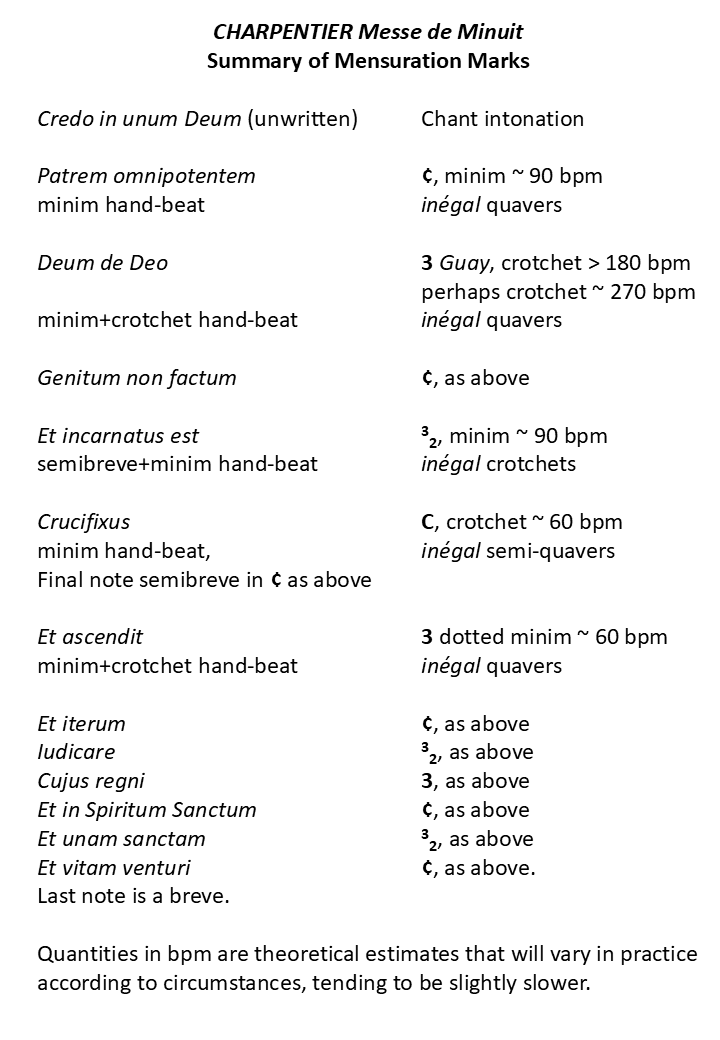
Most of the Mass is notated in ¢. The greatest variety of mensuration marks comes in the Credo, the longest and only fully-sung movement, bringing structure and contrast to the narrative embedded in the text. This movement includes all mensurations found in the Mass, as summarised here:
And similarly wherever these mensurations appear in other movements.
Conclusion
I posed the question, whether Charpentier intended his Mass of noëls to be fast and folky, or slow and sacred. And now I can support my suggested answer, Yes.
Most of the Messe de Minuit is notated in ¢ mensuration, indicating minim ~ 90bpm, producing fast-moving surface activity and plenty of rustic energy. But the underlying quality of that hand-beat is a traditional awareness of the whole bar, the complete down-up movement of the hand, around 45 cycles per minute. For modern musicians, this feels very slow indeed.
Awareness of this slow pulse creates sacred solemnity, a connection with the perfect eternal movement of the stars in heaven, appropriate for one of the holiest Masses of the ecclesiastical year. Yet within that very slow measure, the music itself dances in popular rhythms and sparkles with fast-moving action. Charpentier’s much-loved Mass can feel both fast and slow simultaneously, exquisitely balancing joy and reverence.
And this special quality of time catches the Zeitgeist (literally, the spirit of Time) around the year 1700. As described by Carissimi, the mathematical Quantity of time, how long each note lasts, is one thing. But the spiritual and emotional Quality, how the music feels, can be very different, according to how we experience those note-lengths.
The triple-metres all agree with regard to quantity, division and proportion, as is easily understood, but in the slow or fast quality, known by the Italians as tempo and by the French as mouvement, they are utterly different. Carissimi Ars Cantandi (1696)
For Carissimi and his pupil Charpentier, musical tempo no longer means real-world Time (as it did for Zacconi a century earlier). Neither does it mean ‘speed’, as it does for musicians today. Around 1700, it meant the feeling of how the music goes, the groove, the swing, the entire emotional and embodied experience. This Quality is what Charpentier and his contemporaries meant by mouvement. This vrai mouvement, this true Quality of musical Time, is what this article has searched for.
Nevertheless, I have attempted to indicate some time-quantities, whilst emphasising that these are approximations. Especially in a reverberant acoustic, many of the theoretical 90 bpm realisations suggested above will come out in the mid-80s – this is supported by quantitative evidence from French baroque sources.
But, as I concluded a previous article on Quality Time (2015), the essential Quality of baroque Time emerges from the fact that baroque musicians did not use machines to determine time accurately, even when such machines became available. No matter how closely we investigate period sources, we cannot know the precise Quantity of baroque Time. And actually, we don’t want to, because to ask the question of Quantity doesn’t give us a useful answer. The objectively “right” metronome speed will still “feel wrong” if the subjective situation changes.
What we want is the Quality of time. And the essential point of this post is that the quality of Baroque time can only be experienced by creating time as they did: by beating in steady measure with specific hand-movements, informed by a tradition of constant Tactus, and with an innate sympathy for Aristotelean philosophy and the Music of the Spheres.




 Andrew Lawrence-King