Irish Harp Ornament of the Month #3 – The Triple Shake

Welcome back after the winter break! As storms batter the western isles, what better time to sit indoors and practise Irish Harp ornaments? And what ornament could be more Gaelic-sounding than a Triple Shake, Tribhuilleach or creathadh coimh-mhear? And how could I possibly resist making it ornament #3?

Three-leafed clover

But at this point, I have to issue a warning. In the ornaments we’ve looked at so far, we’ve seen connections to (and differences from) European practice of the same period, and we’ve compared Bunting’s Table of Ornaments with the opportunities to use those ornaments in the pieces he prints later on. But there is no equivalent of this Triple Shake in European music, and (as we will see) our principal source, Bunting (1840) available here  is unsatisfactory.

So this wonderfully Gaelic ornament remains somewhat enigmatic, and the realisation I propose here is necessarily conjectural. I look forward to your comments and alternative suggestions.

Here is the information from Bunting’s Table of Ornaments (page 25).

Triple Shake Bunting

Remember that the period fingering notation uses + for the thumb, 1 for index finger, etc. (see Ornament #1 – The Long Shake). Although for several of the more complex ornaments Bunting gives information about stopping the sound, for this Triple Shake he does not. I believe this omission points us towards the solution I suggest at the end of this posting.

Bunting indicates opportunities for other Shakes frequently in the pieces he publishes, with the conventional Tr marking (from Italian trillo). Many of these opportunities are at Cadences (see Ornament #2 – The Cadential Shake). But there is only one appearance of the Triple Shake, on page 92 in the music section, in a piece Bunting describes as Cooee en Devenish or The Lamentation of Youths, composed by Harry Scott in 1603 for Hussey, Baron of Galtrim. According to the Bunting’s Preface p91, he noted down Cumha an Devenish from the playing of Dominic O’Donnell,  a harper from Foxford in County Mayo. Bunting wrote the music into his notebook BMS12 in 1811, and the transcription published in 1840 abounds with those peculiar graces of performance alluded to in the Table of Ornaments.

This Lamentation is similar to another circa-1600 piece, Cumha Caoine an Albanaigh or Scott’s Lamentation for Purcell, Baron of Loughmoe (the late 17th-century English composer, Henry Purcell was a distant relative) who died about 1599 (page 6 in Bunting’s music section). These Lamentations are highly significant in Bunting’s output for they are linked to traditional rituals of mourning (in particular, the imitation of keening, the crying or wailing for the dead) and seem to preserve many details of ornamentation from two centuries earlier.

In his transcriptions of the Lamentations, Bunting takes special care to notate many ornaments, labelling them with cross-references to his Table of Ornaments. But it is far from certain that the harpers shared his view that these pieces were special. Bunting writes that O’Donnell appeared totally unconscious of the art with which he was playing. My working hypothesis is that Bunting’s 1840 version of the Lamentation of Youths was deliberately created as an exemplar of how to apply ornaments.

Some of those ornaments might well have been played by O’Donell in 1811 (and noted in BMS 12), others might have been played, not noted at the time, but remembered and restored in later versions. But I suspect that Bunting might also have added some ornaments (not played by O’Donell), according to his best knowledge of how ornaments were used, in order to complete his exemplar. A full analysis is beyond the scope of this article, but would be a fascinating topic for discussion at Scoil na gCláirseach 13th-19th August 2014 (details here) We can also look forward to a forthcoming article from Ann Heyman on the two Lamentations.

Meanwhile, there is plenty to think about in relation to the Triple Shake. Here it is, as Bunting applies it to the Lamentation of Youths.

Triple Shake in Lamentation of Youths

Bunting applies the Triple Shake in the position of a Cadential Shake. The underlying simple melody is falling from A to G, and the accompanying harmonies move conventionally from D major to G major. The rhythm of the Triple Shake corresponds to the Table of Ornaments, although the notes are three strings higher, A and B instead of F# and G. The fourth beat of the bar is filled in with an ornamental Turn, with a very Irish-sounding gap (the turn moves from G to E, omitting F#). So far, so good.

But now the problems start. If you play the Triple Shake with the fingering given in the Table of Ornaments, since there is no damping, both notes ring on. If anything, the B rings louder and longer, since it is written as a longer note, and the A will damped as you replace your finger ready to start the next element of the Triple Shake, or ready to start the final Turn. The resulting sound is messy and discordant, since the B does not fit well with the D major harmonies.

Simon Chadwick speculates that the Triple Shake is therefore an ornament on the note B, that begins on the lower auxiliary note of A. But this still leaves the problem that the B does not fit with the accompanying harmonies (proudly labelled as another piece of authentic detail Lancrodh or full hand.) And when we looked at the Cadential Shake, we saw that the Cadence with accented A falling to G is very typical.

And when we compare this one bar from the Lamentation of Youths to the remainder of Bunting’s output, an even more serious problem emerges. Not only is this the only example Bunting gives of a Triple Shake, but

There is no other opportunity to apply the Triple Shake like this, in the whole of Bunting’s output.

There are many opportunities for Cadential Shakes, but they are all much too short for the three-beat Triple Shake.

Meanwhile, there is something rather unsatisfactory about Bunting’s application of the three-beat Triple Shake to the four-beat A of his unique example in Lamentation of Youths. He has to fill up the missing beat with a Turn, but he told us in the Table of Ornaments that the old Irish harpers did not finish the shake with a turn, as in the mode adopted at present. 

My hypothesis is that in the enthusiasm to include lots of ornaments in a piece that seems to exemplify the circa-1600 style, the Triple Shake was applied in the wrong place. There is no place like this in the rest of the repertoire, and the Triple Shake doesn’t really fit, even here. Bunting’s limited understanding of the function of this particular Shake is also shown by the lack of information on damping.

But there is an opportunity for a Triple Shake that occurs many, many times in this repertoire. Many tunes repeat the final note, the tonic, three times.

Bunting’s first music examples are at page 15 of the Preface. The first phrase of the first piece ends with three Cs. The second phrase ends with three Bbs. The third phrase ends with three Gs, and is repeated. The next phrase ends with three Cs, and the final phrase repeats the second phrase, ending with three Bbs.

Triple Shake opportunities

The final phrases of both parts of the next tune end with three Gs. There are hundreds more examples, throughout the book. Indeed, this Triple Tonic is an instantly recognisable feature of Irish melodies.

So I suggest that we can apply the Triple Shake not to the penultimate note on the Dominant harmony (as for the Cadential Shake), but rather to the final note, the Triple Tonic.

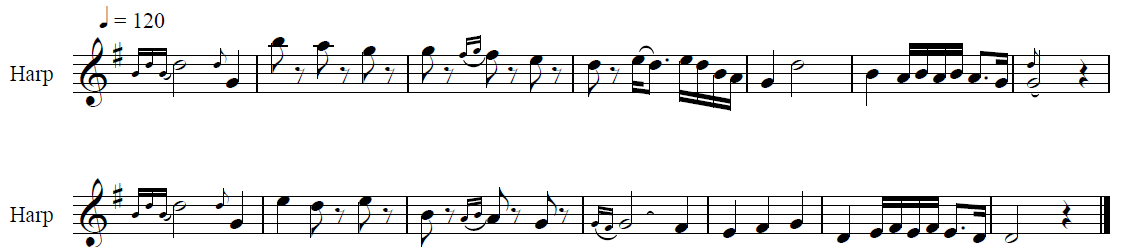
All we need to do now, is to sort out the lack of damping in Bunting’s Table of Ornaments. Here is my solution, with modern notation (1 = thumb, 2 = index finger etc). I’ve chosen to put the Triple Shake on G, since we often play melodies in G major, because they suit the standard tuning of the historical Irish harp.

Triple Shake ALK

The finger-movements are like a small section of the Long Shake. After playing G A G quickly, the index finger drops silently onto the A, damping it so that the main note G rings on. That’s one element – play three elements to make a Triple Shake.

So now when you see a Triple Tonic, you can give it a twist with a Triple Shake …. Cheers!

Triple Tonic

Please join me on Facebook https://www.facebook.com/andrew.lawrenceking.9 and visit our website www.TheHarpConsort.com .

Opera, orchestra, vocal & ensemble director and early harpist, Andrew Lawrence-King is director of The Harp Consort and of Il Corago, and Senior Visiting Research Fellow at the Australian Research Council Centre for the History of Emotions.

Irish Harp Ornament of the Month #2 – The Cadential Shake

So I hope you’ve all been practising the Long Shake [see Irish Harp Ornament #1 here]  and that it’s beginning to feel as if the fingers can do it ‘by themselves’, and starting to sound good. Don’t be discouraged if it takes quite a while to master these ornaments – they are not easy.

The late Mr Seybold, a celebrated performer on the Pedal Harp, being in a gentleman’s house in Belfast, in 1800, when Arthur O’Neill was present, declared his admiration of the old man’s shake on the Irish harp, which was performed apparently with the greatest ease and execution: admitting that he could not do it himself in the same manner on his own instrument, the shake being of the greatest difficulty on every species of harp.

Bunting 1840

Practise little and often. Practise slowly, getting everything absolutely right. And then take a risk, let loose a fast shake, and see if your fingers will fly. Then practise slowly again. Repeat ad shake-it-um.

So now your Shake is all ready to go, but how to use it?

Unfortunately, Bunting’s table of ornaments doesn’t tell us everything we need to know. It’s not complete (there are typical ornaments that he doesn’t list), it doesn’t necessarily cover every technical detail, and – most awkward of all – it doesn’t tell us how to apply the ornaments.

So we have to look at tunes, and see where each ornament might fit. We can look at Bunting’s published versions (to a greater or lesser degree arranged for pianoforte), and see where he writes each ornament. We can look at Bunting’s manuscript note-books for hints of what the old Irish harpers actually played to him, before he adapted their music for publication. We can make comparisons to European music of the same time. And we can make comparisons to traditional Irish playing, today.

When we look for opportunities to use our shiny new Long Shake in Irish music, there seem to be very few, especially in those tunes that have a real Gaelic (rather than European flavour). So although the Long Shake is a very useful exercise, and a typical feature of European 18th-century music, I don’t see many opportunities for it in Gaelic tunes of the period. Actually, I don’t see any opportunities for it in the tunes Bunting prints, following on from the ornament table in his 1840 book.

Challenge: can you find a Long Shake opportunity that I’ve missed? All three Bunting publications (1796, 1809 and 1840) are available free here, and Wikipedia provides a handy introduction to his work here.

Meanwhile, don’t panic, the last month of practice has not been wasted. Not at all! The Long Shake is the ideal starting point from which to study many ornaments, and here comes one of the most frequently encountered: the Cadential Shake.

A Cadence marks the end of a musical phrase, just as punctuation marks the end of a clause, or the end of a sentence. In period literature, we often see long sentences organised with light punctuation, continuing for many clauses, until terminated by a full stop. Similarly in music of this time: each short phrase will end with an intermediate Cadence, and a longer section, or the whole piece, will end with a Full Close.

Although European music has several melodic options for a Cadence, the most common Full Close in Gaelic tunes is the so-called Tenor Cadence. The melody descends to the final note, with a strong accent on the second degree of the scale just before end of the phrase. So in the Irish harpist’s favourite mode of G, many tunes end with a strong A before the final G.

EXAMPLE 1  Ta me mo chodlach I

Ta me mo chodlach

(I am asleep and don’t waken me) after the William Forde MS (collected during the 1840s).

That strong A corresponds to the Principal Accent in poetry, typically on the penultimate syllable of a line of verse:

To be or not to be, that’s the QUEST-ion

For more on historical phrasing, see ‘The Good, The Bad and the Early Music Phrase’ here.

Often, this strong note will be longer than neighbouring notes – and when it is long enough, this is our opportunity for a Cadential Shake. Often, Bunting gives us the hint for a Cadential Shake with a Tr marking.

The first example of a Shake in the music of the 1840 collection comes on Page 2: Irish Cry. Bunting publishes this in Eb, so the Cadential Shake is on the strong F just before the end of each of the first three phrases, marked Tr by Bunting.

EXAMPLE 2 Irish Cry

Irish Cry Bunting 1840

Bunting 1840

In the usual G-tuning for Irish harp, we would play this piece a third higher, of course, and the Cadential Shake would be on A.

EXAMPLE 2A Irish Cry in G

Irish Cry transposed

The next example is on Page 4: Scott’s Lamentation. Bunting notates this in F, with a Cadential Shake marked Tr on the strong G just before the end of the first line. And another Cadential Shake Tr, on the strong D of the phrase ending on C in the next line.

EXAMPLE 3 Scott’s Lamentation

Scotts Lament Bunting

Bunting 1840

In the usual G-tuning for Irish harp, we would play this piece a tone higher, with Cadential Shakes on A and later on E.

EXAMPLE 3A Scott’s Lamentation in G

Scotts Lament transposed

These first few pieces are those that Bunting regards as especially typical of the ancient Gaelic style.  Not all of them have suitable cadences for a Cadential Shake (notice there was nothing on pages 1 and 3). But many of them do.

So, since this Cadential Shake is going to be useful, let’s see how to modify Bunting’s Long Shake, to work in the Cadential context.

As could be expected, the first modification is to shorten the Long Shake. Don’t try to make too many iterations of the Shake. Rather, shorten it to the available length of the Cadential note. [See how to shorten the Long Shake, here.]

Bunting gives another ornament, the half-Shake, which is very short, and we’ll examine that another time. For our Cadential Shake, we need bit more than this, but not very much more. Very often, the following (minimal) Shake is sufficient (and anything more would be too difficult).

EXAMPLE 4 Cadential Shake

Cadential Shake

Notice that the Cadential Shake starts on the main note (the Gaelic way, Bunting tells us) and not on the upper auxiliary (the European way, according to many period sources, for example C.P.E. Bach).

Bunting doesn’t tell us any more, but I recommend that after reaching the last note of the Shake (the main note), you should damp the upper auxiliary note. This cleans up the sound, and steadies your hand ready to continue into the last note of the phrase.

So here is the Cadential Shake to practise:

EXAMPLE 4A Cadential Shake with damping

Cadential Shake with damping

Damp the crossed-out note, with the finger [2], let the red note ring on.

And here are the first Tr markings in Bunting’s 1840 collection, as above, but now realised with this Cadential Shake:

EXAMPLE 5 Irish Cry with Cadential Shake realised

Irish Cry realised

EXAMPLE 6 Scott’s Lamentation with Cadential Shakes realised

Scotts Lament realised

Bunting’s metronome marks support his statement that the character of the Irish harpers’ playing was

spirited, lively and energetic

in contrast to the

languid and tedious manner in which they were, and too often still are, played among fashionable public performers, in whose efforts at realizing a false conception of sentiment, the melody is …. lost.

One last, but very important point. 18th-century sources emphasise that the Shake should begin louder and end softer. We can be sure that Seybold would not have admired O’Neill’s Shake, if this essential ‘dying fall’ was absent. So practise your Cadential Shake from loud to soft.

And that concludes this month’s posting. Have fun finding Full Closes in your Gaelic melodies, and adding Cadential Shakes to them. Compare the places you want to add a Cadential Shake to Bunting’s Tr markings. Do they mostly correspond?

As you will discover, not all of Bunting’s Tr markings are Cadential. There are some other opportunities for Shakes, and we’ll come to those in a later post.

Good luck, and Good Shaking!

Please join me on Facebook https://www.facebook.com/andrew.lawrenceking.9 and visit our website www.TheHarpConsort.com .

Opera, orchestra, vocal & ensemble director and early harpist, Andrew Lawrence-King is director of The Harp Consort and of Il Corago, and Senior Visiting Research Fellow at the Australian Research Council Centre for the History of Emotions.

www.historyofemotions.org.au