Rhythm – what really counts?

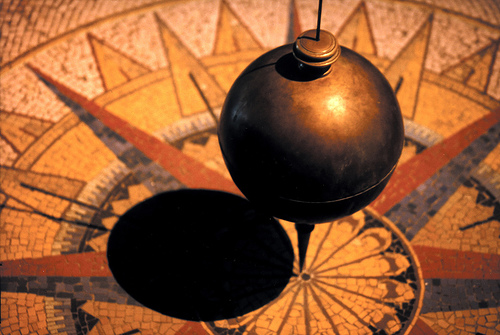
Galileo Pendulum

Rhythm is the beating heart of music, from the powerful throb of heavy rock to the sensual swing of jazz and the ‘vacillating rhythm’ of romantic rubato. For many musicians and listeners today, the very word ‘expressive’ suggests rhythmic fluidity. Around the year 1600, John Dowland, William Shakespeare, and Giulio Caccini agree that rhythm is a high priority:

Music is nothing else than Text, and Rhythm, and Sound last of all. And not the other way around!

Caccini Le nuove musiche 1601/2

But what did 17th-century musicians mean by Rhythm? A rock drummer’s groove? A jazz singer’s swing? 20th-century rubato? Just as instruments, pitch and temperament, bowing styles and ornamentation all vary between different periods and repertoires, so the aesthetics of rhythm also show historical change.

This is a huge subject. Detailed investigation of attitudes to rhythm around 1600 are a major strand of our six-year Performance research program at the Australian Centre for the History of Emotions. Dance and Swordsmanship sources set the context for musical tempo. Frescobaldi, Caccini and Peri give us insights into Italian subtleties of rhythm. The very concept of Time itself must be studied, in order to understand how musicians were thinking in that pre-Newtonian age.
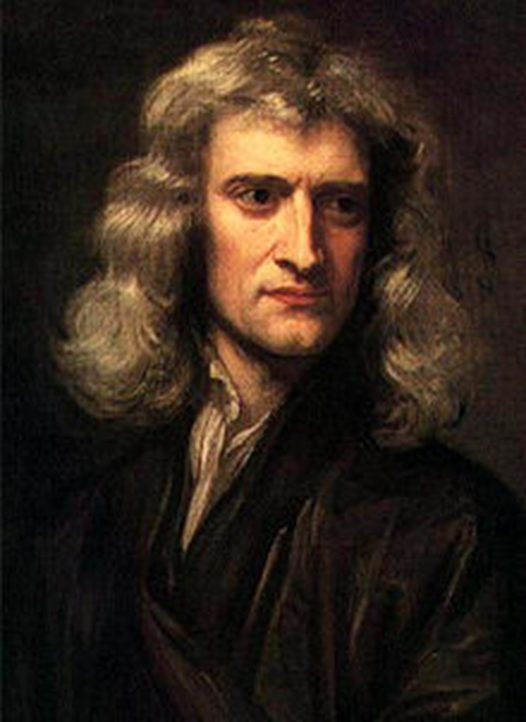
Isaac Newton

(Isaac Newton Philosophiae Naturalis Principia Mathematica 1687 sets out the concept of Absolute Time)

Nevertheless, the essential practicalities of period Rhythm are already well understood, although only partially applied in today’s Early Music performances. George Houle’s 1987 Meter in Music, 1600-1800 provides a summary of historical sources, setting the context for this period of fundamental change. 17th-century theorists and performers tried to reconcile incompatible elements: the old system of triple-time proportions and the newly fashionable French dances; the gradual shift from proportional signs to modern time-signatures; the persistent concept of a (more-or-less) fixed tempo ordinario and the proliferation of speed-modifying words, allegro, andante etc; the distinction between measured meter and modern accentual rhythm.

But what simple, practical guide-lines can we draw from all this?

As elementary music students, many of us were taught to manage difficult rhythms by counting the smallest note-values, adding these up to measure longer notes. Before 1800, the contrary held: musicians counted a long note-value, and divided this up to measure shorter notes. Purely mathematically, there should be no difference between the two approaches, but (since musicians are human), the practical results are measurably different. Even more importantly, the slow count feels different.

Around 1600, this slow count is called Tactus. Its slow constancy is an imitation of the perfect motion of the stars, whose circular orbits create the heavenly sounds of the Music of the Spheres. It is felt in the human body as the heart-beat and pulse, or measured as a walking step. In practical music-making, it can be shown by an up-and-down movement of the hand, or by a swinging pendulum.

(Of course, 17th-century musicians did not have digital watches or metronomes, but Galileo had noted the pendulum effect around 1588, observing a swinging chandelier in Pisa cathedral – see illustration above. In another posting, I’ll report on some recent experiments with pendulum tactus.)

Around 1600, typically the Tactus will be on minims (half-notes), somewhere around MM60. Down for one second, Up for the next second. You create crotchets (quarter notes) by dividing each Down and each Up in two. “Down-and-Up-and.”

The simple, steady movement of the hand, Down-Up, makes it easy to manage changes of Proportion. Keep the hand movement the same, but now divide it into three beats on the Down, and another three on the Up: this gives Tripla. Making the Down long, and the Up short (whilst keeping the duration of the whole Down-Up cycle the same) gives Sesquialtera: two beats on Down, one on Up.

Grouping notes into phrases, and choosing where to place the accents is independent of Tactus. Tactus simply measures time. This is the crucial difference between early and modern attitudes to rhythm: Tactus and Accent are independent, whereas our modern Downbeat implies accentuation.

The independence of Tactus and Accent allowed 17th-century musicians to notate triple rhythm under what looks to us like a “common time time-signature” of C. Time is being measured by dividing the minim tactus into two crotchets, but the music is phrased in groups of three crotchets. Professional dancers do something similar today, counting everything in blocks of 8, so that a waltz is counted:

123/456/781/234/567/812/345/678

Before 1800, counting (i.e. measuring time) and accent are independent. They can coincide, but they don’t have to.

Tactus and Proportion were central concepts in period music-making.

Tactus directs a Song according to Measure.

John Dowland Micrologus (1609) translated from Ornithoparcus (1517).

Ha, ha, keep time! How sour sweet music is / When Time is broke, and no Proportion kept!

William Shakespeare Richard II Act V Scene v (c 1595)

In today’s Early Music, the acceptance of Tactus principles varies. Stronger principles are supported by academics more than they are applied by performers.

  • Slow count

This is widely accepted, and many performers work with and teach a slow count.

  • Proportions

Amongst academics, there is debate about precisely how to interpret Proportional changes, but the central concept of an underlying constant slow count is not contested. Amongst performers, adherence to Proportions is regarded as ‘hard-core’ HIP, and ‘too academic’ for some.

  • Consistent Tactus: a whole “Song according to Measure”

Though the period evidence supports this, very few performers are prepared to relinquish their romantic rubato.

  • “Tactus directs a Song”

In most modern performances, a conductor directs.

  • Soloists follow the accompaniment

Explicitly stated by Leopold Mozart (1756), clearly implied by Jacopo Peri (1600), and the basis of the entire period practice of Divisions, this is almost universally ignored today.

  • Rhythm in Recitative

Most singers today are astonished at the mere suggestion that Monteverdi might actually have meant something by all those complex rhythms that he forced his printers to set in type.

  • Tactus in Recitative

Very few performers have tried this. However, conductors in recitative are commonplace…

  • Consistent Tactus for a large-scale work

I was first introduced to this concept by Holger Eichhorn, director of the Berlin ensemble, Musicalische Compagney. Paradoxically, consistent Tactus often results in more contrast in what the listeners hear, since (without the discipline of Tactus) musicians tend to pick a slower tempo when the notes go fast, ironing out the composed contrasts. It is very rarely tried today.

  • Consistent Tactus for an entire repertoire, say all Caccini songs, or everything by Monteverdi.   

There is considerable evidence for this, and some academics argue for it. I know of only one other musician today who supports it in practice: continuo-guru Jesper Christensen.

At CHE, we are investigating Baroque Time, researching period Philosophy and the aesthetics of Rhythm, testing all our findings and hypotheses in experimental productions. Our six-year mission is to boldly go where 17th-century musicians have gone before, but few performers today have followed: we are applying all these Tactus principles in teaching, rehearsals and performance. So far, the results are academically and artistically convincing, with performers and (most importantly) audiences responding very positively.

You can see a video report of our Tactus-based production of Monteverdi’s Orfeo here.

But I’ll give the last word to John Dowland:

Above all things keep the equality of measure. For to sing without law and measure is an offence to God himself…

pendulum

Please join me on Facebook https://www.facebook.com/andrew.lawrenceking.9 and visit our website www.TheHarpConsort.com . Further details of original sources are on the website, click on “New Priorities in Historically Informed Performance”

Opera, orchestra, vocal & ensemble director and early harpist, Andrew Lawrence-King is director of The Harp Consort and of Il Corago, and Senior Visiting Research Fellow at the Australian Research Council Centre for the History of Emotions.
www.historyofemotions.org.au

What is Music?

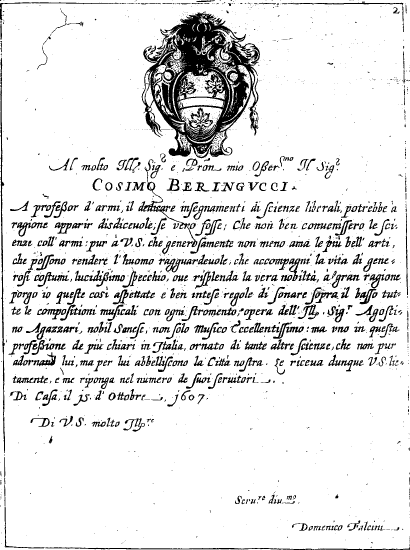
A Master of Arms, as the opening words of a discussion on early music, might seem inappropriate…

Agazzari dedication

What is Music? Is it an Art, a Science, a Practice, or just something that comes naturally? How would musicians have thought about this question in earlier periods? And how have the meanings of all these words changed over the years?

Nowadays, we admire a performance that strikes us as ‘natural’, and we shun ‘artificiality’. It’s assumed that a great Artist should not be subject to petty rules. And that the subtleties of Art transcend the limits of Science. In academic circles, Musicology (in German, Musikwissenschaft, music-science) outranks Performance Studies. And those who might wish to call themselves Artists are often looked down upon as mere Practitioners. So how did all this play out around the year 1600?

Agazzari’s treatise Del sonare sopra’l basso is one of the most-studied sources for early seicento performance practice. Many of us got to know it through Gloria Rose’s pioneering 1965 article, Agazarri and the Improvising Orchestra, but now both the original (Siena, 1607) and Bernhard Lang’s most helpful 2003 transcription (with parallel translations into English and German) are now available free online.

Original

Lang’s transcriptions

Rose’s commentary (fee or subscription to access)

Del sonare sopra’l basso is a key text that I shall certainly return to in future postings on the practical details of ensemble direction and continuo-playing. But first let’s look more closely at the preliminary dedication. It’s all too tempting to skip over this, in the rush to get to Agazzari’s main text, but it hints at answers to my question: What is Music? – answers that are significantly different from those most musicians would give today.

Agazzari’s treatise is dedicated to Cosimo Berlingucci, and the printer, Domenico Falcini, begins with the words A Professor d’armi

“A Master of Arms, as the dedicatee for teachings on liberal sciences, might well appear inappropriate – if it were true, that Sciences and Arms do not belong together.”

The myriad connections between early music and historical swordsmanship are a fascinating topic in themselves, but Falcini’s words strike to the heart of my question. He takes it for granted that music is one of the ‘liberal sciences’. His more subtle point is that Arms are also Science. Music and Arms are both scienze liberali, worthy to be studied by every free citizen.

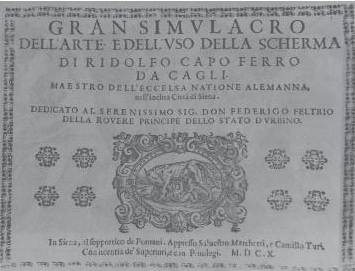
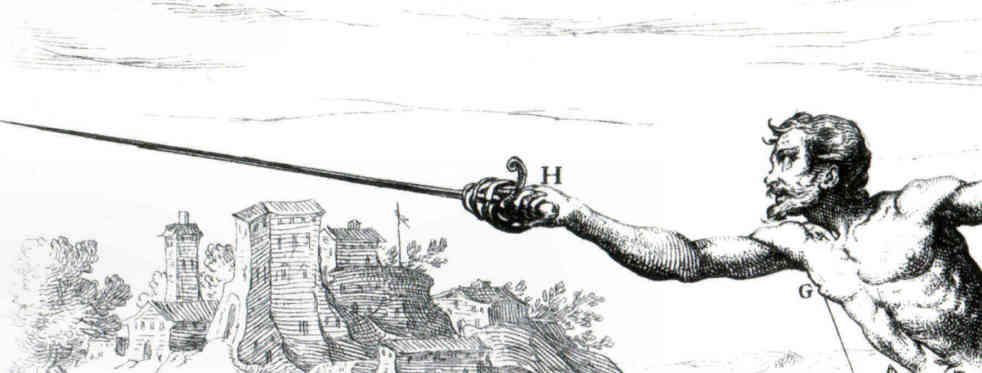
Just a few years later, in the same city of Siena, Ridolfo Capo Ferro published his Gran Simulacro dell’ Arte e dell Uso della Scherma (1610), one of the most famous  texts on period swordsmanship. Tom Leoni’s excellent 2011 English translation and commentary is currently out of print, but the original and Swanger & Wilson’s 1999 English translation are free to download:

Original

English

This ‘Great Representation… of Swordfighting’ refers to ‘the Art and Practice’, and although Capo Ferro does refer to the discipline as a Science, he formally defines it as “Art, and not Science”.  “The term Science, in its strict definition”, he explains, “treats of eternal and divine things that surpass human judgement.” Capo Ferro’s main purpose is to teach the Art and the Practice, not the Philosophy, of swordsmanship.

In modern terms, renaissance ‘Science’ includes Philosophy, Astro-Physics, Mathematics and Theology: Astrology and Alchemy also are not excluded. Returning to 17th-century ways of thinking, the Science of Geometry studies Number and Space. The higher Science of Astronomy unites the studies of Number, Space and Movement. Swordsmanship  and historical Dance are thus related to Astronomy, the study of the perfect movement of the heavenly spheres. As a Science, Music is only a little lower, combining the two disciplines of Number (pitch ratios and rhythmic subdivisions) and Movement (ie, Time).

capoferro title page

Capo Ferro also neatly summarises the period view of Nature, Art and Practice. “Art regulates Nature, and with the more secure guidance directs us by the infallible truth and by the organisation of its precepts to the true Science of our [discipline].” This places Nature, Art and Science in a hierarchy: Art is a means of organising Nature according to rational precepts, in order to approach the ‘eternal and divine’.

Capo Ferro is very clear about the relation between Art and Nature. Nature’s material receives the “ultimate form and perfection of Art”. “Art… in the guise of Architect, takes it [Nature] and makes some beautiful construction, and thus refines and sculpts… bringing it little by little to the summit of perfection.”

And what then is Art? “Art… is a system of perpetually true and well-organised precepts”. A renaissance ‘Art’ is thus a set of rules that bring disorderly nature towards heavenly perfection. But are such rule-sets really ‘perpetually true’?

I suggest that we can accept that they are perpetual, if we understand them not as abstract rules, “you must always do this”, but as precepts that guide Nature and your Practice towards the high perfection of a desired result. Different Arts will desire different results, and have different rules. Thus Capo Ferro’s set of rules still work very well indeed, providing that your intention is to defend yourself in a duel to the death with long, sharp rapiers. If you are trying to score points in a modern fencing competition using lightweight foils, without needing to kill your opponent, you need another set of rules.

Similarly, we can trust Agazzari’s rules if we are playing seicento music on early instruments, with the period intention of ‘moving the passions’ of our audience. But if we are playing say Romantic repertoire, with the 19th-century intention of expressing the performer’s genius and sublime depth of feeling, we probably need another set of rules.

Historical treatises on Swordsmanship also deal with down and dirty questions of uso, Practice, as opposed to Art. However well you understand the precepts of the Art as an intellectual construct, you still need to practice assiduously to acquire physical skills. Musicians can certainly relate to that.

And some of what one does in Practice falls a little short of the divine perfection that Art would have us aspire to. A swordsman might stab you with his dagger, rather than with his sword, the Queen of Weapons, if it would save his life. Continuo-players might accept less-than-perfect contrapuntal move, if it preserved their concentration on the vital priorities of text and rhythm. Many historical treatises leave space for practical subtleties which cannot be written down, within the limitations (and rules) of period notation.

Now we can understand how the word ‘artificial’, in its 17th-century sense of ‘full of Art’, is one of the highest compliments awarded to fine music, both in composition and performance. In the original sense, ‘artificial’ music takes something Natural, subjects it to the Precepts of that particular Art (since of course, Monteverdi’s Art is not quite the same as Purcell’s), in order to bring it as close as possible to the summit of heavenly perfection.

In this period view, Nature, Art, Practice and Science all have their place. But those philosophical terms, and their respective places in a hierarchical value-system, differ from our modern understanding. Is this just a quirky detail of historical philosophy, or might it change how we approach the Practice of playing old music today?

capo ferro lunge detail

Study the Art of Historical Swordsmanship here

Please join me on Facebook https://www.facebook.com/andrew.lawrenceking.9 and visit our website www.TheHarpConsort.com . Further details of original sources are on the website, click on “New Priorities in Historically Informed Performance”

Opera, orchestra, vocal & ensemble director and early harpist, Andrew Lawrence-King is director of The Harp Consort and of Il Corago, and Senior Visiting Research Fellow at the Australian Research Council Centre for the History of Emotions.
www.historyofemotions.org.au

Music expresses emotions?

Il corago

Probably most musicians and music-lovers would agree that ‘music expresses emotions’, although each of these three words can be problematised: what kind of music? What do you mean by ‘express’? Whose emotions? What is emotion, anyway? And all of these three concepts – music, expression, emotion – change as we trace them back through history.

Early Music tends to concentrate on precise detail: should we play up or down a semitone from modern pitch, or in-between? Precisely how should we tune a harpsichord for Bach? Which violin-bow or oboe-reed should we use for Handel? These small details are significant – each one is a piece of jigsaw-puzzle which constructs your over-view of a particular repertoire and where it fits in history. But here, I want to ask the big questions, questions about ‘music’, ‘expression’ and ’emotions’, questions that are sometimes missed as we grapple with the minutiae of Historically Informed Performance.

For many musicians today, the first and most important means of ‘expression’ is rubato: vacillating rhythm, playing around with musical time.  Exchanges of views between ‘modern’ and ‘early’ performers tend to focus on vibrato. A blog-posting on early opera begins bravely by noting that audiences value “imagination, innovation, and musical, sensitive interpretations; not what kind of bow is in use”, but fades out with “everyone’s happy to get back to using vibrato now”. So are these today’s priorities for early music: rubato, vibrato and the performer’s happiness?

We know what the priorities were for music and performance at the beginning of the baroque, around the year 1600. According to Caccini’s Le Nuove Musiche (1601/2)

Music is nothing else than Text, and Rhythm, and Sound last of all. And not the other way around!

On performance, many writers, notably John Bulwer Chironomia (1644), cite Quintilian, Cicero and Demosthenes:

What are the three secrets of great performance: Action! Action! Action! 

And summarising the first two strophes of the Prologue to Monteverdi’s Orfeo (1607), one of the first ‘operas’:

Music comes to you, noble audience, whose importance is too high to be told, to move your hearts.

The historical priorities are Text, Rhythm, Action – and the audience’s emotions. Text (not vibrato), Rhythm (not rubato), Action for the Audience (not how the performers themselves feel).

I’ll try to keep these historical and inspiring priorities in mind as I continue to write, as well as in my research, performance and teaching.

Meanwhile, please join me on Facebook https://www.facebook.com/andrew.lawrenceking.9 and visit our website www.TheHarpConsort.com . Further details of original sources are on the website, click on “New Priorities in Historically Informed Performance”

Opera, orchestra, vocal & ensemble director and early harpist, Andrew Lawrence-King is director of The Harp Consort and of Il Corago, and Senior Visiting Research Fellow at the Australian Research Council Centre for the History of Emotions.
www.historyofemotions.org.au